
уроборос
-
1
Уроборос
General subject: ( the) Ouroboros
Универсальный русско-английский словарь > Уроборос
-
2
уроборос
General subject: ( the) Ouroboros
Универсальный русско-английский словарь > уроборос
См. также в других словарях:
-
Уроборос — архаический образ, часто встречающийся в алхимических трактатах и представляющий собой змею, заглатывающую свой хвост. В рамках глубинной психологии, например у Э. Нойманна (Neumann E. Die Grosse Mutter , Zurich, 1956) трактуется как базовый… … Психологический словарь
-
уроборос — сущ., кол во синонимов: 2 • вымышленное существо (334) • символ (25) Словарь синонимов ASIS. В.Н. Тришин. 2013 … Словарь синонимов
-
уроборос — Этимология. Мифологический персонаж, встречающийся в алхимических трактатах, в виде змеи, заглатывающей свой хвост. Исследования. В рамках глубинной психологии, например у Э.Нойманна трактуется как базовый архетип, символизирующий доисторическое… … Большая психологическая энциклопедия
-
Уроборос — Изображение уробороса в алхимическом трактате 1478 г. Автор Теодор Пелеканос Уроборос (др. греч … Википедия
-
УРОБОРОС — архаический образ, часто встречающийся в алхимических трактатах и представляющий собой змею, заглатывающую свой хвост. В рамках «глубинной» психологии, например у крупнейшего специалиста в этой области Э. Нойманна, трактуется как базовый архетип… … Символы, знаки, эмблемы. Энциклопедия
-
Уроборос — Изображается в виде змеи или дракона, пожирающего собственный хвост. Мой конец это мое начало. Символизирует отсутствие дифференциации, совокупность всего, изначальное единство, самодостаточность. Порождает сам. себя, сам с собой соединяется в… … Словарь символов
-
УРОБОРОС — (Uroboros) универсальный мотив змеи, свернувшейся в кольцо и кусающей свой собственный хвост.Как символ уроборос предполагает первичное состояние, подразумевающее темноту и саморазрушение, равно как и плодородность, и творческую потенцию. Он… … Словарь по аналитической психологии
-
уроборос — (грч. ura опашка, boros јадач) позната фигура од старогрчката митологија што прикажува змија што сама си ја јаде опашката и така се врти како круг симбол на вечноста … Macedonian dictionary
-
Ороборос — Уроборос. Изображение из алхимического трактата XV века Aurora Consurgens Уроборос, ороборос (от греч. ουρά, «хвост» и греч. βορά, «еда, пища»; букв. «пожирающий [свой] хвост») мифологический мировой змей, обвивающий кольцом Землю, ухватив себя… … Википедия
-
Уроборус — Уроборос. Изображение из алхимического трактата XV века Aurora Consurgens Уроборос, ороборос (от греч. ουρά, «хвост» и греч. βορά, «еда, пища»; букв. «пожирающий [свой] хвост») мифологический мировой змей, обвивающий кольцом Землю, ухватив себя… … Википедия
-
Цикличность в религии — Уроборос … Википедия
уроборос — перевод на английский
Уроборос напоминает, что нужно выйти из бесконечного круга и идти по пути просветления.
Ouroboros reminds us to transcend the cycle And walk the path to enlightenment.
в итоге выйдет Уроборос
«the result is… the Ouroboros!»
Это Уроборос?
Is this the Ouroboros?
Вы не могли бы рассказать мне про Уробороса что-нибудь еще, что могло бы помочь?
Can you tell me anything more about Ouroboros, anything that may help us?
Уроборос, этот рассказ о драконе.
You know, Ouroboros, this talk of the dragon.
Показать ещё примеры для «ouroboros»…
Отправить комментарий
На основании Вашего запроса эти примеры могут содержать грубую лексику.
На основании Вашего запроса эти примеры могут содержать разговорную лексику.
Перевод «Уроборос» на английский
Отсылка к главной теме люминизма:циклы, Уроборос, природа в поисках завершения.
Goes to the central theme of Luminism, cycles, ouroboros, nature seeking completion.
Термин уроборос происходит от двух слов на древнегреческом языке.
The term ouroboros is derived from two words in ancient Greek language.
Сегодня я и Уроборос разбудим лучшее, что есть в этом мире.
Tonight Uroboros and I shall awaken the best of this world.
Похоже, эти эксперименты по выращиванию вируса «Уроборос» довольно опасны.
These cultivation experiments with the Uroboros virus seem pretty dangerous.
Уроборос, этот рассказ о драконе.
You know, Ouroboros, this talk of the dragon.
Символ бесконечности Уроборос восходит к древнеегипетским временам.
The Ouroboros infinity symbol dates back to the ancient Egyptian times.
В случае с Уроборос, гремучих змей.
In the case of Ouroboros, pit vipers.
Уроборос это древний символ бесконечности, который широко использовался во многих различных культурах по всему миру в течение истории.
Ouroboros is an ancient infinity symbol which has been used widely in many different cultures throughout the world during the course of history.
Уроборос — змей, пожирающий самого себя
Ouroboros, the snake that eats itself.
Название Уроборос относится к древнему символу, изображающему змея или дракона, который ел собственный хвост, представляющий цикличность.
The name Ouroboros refers to an ancient symbol depicting a serpent or dragon eating its own tail, which represents cyclicality.
Уроборос напоминает, что нужно выйти из бесконечного круга и идти по пути просветления.
Ouroboros reminds us to transcend the cycle And walk the path to enlightenment.
Уроборос. Платон описывал их как первых живущих существ во Вселенной.
The ‘Ouroboros‘ is what Plato described… as the first living creature in the universe.
На этой премиальной футболке изображен символ Уроборос, древний символ, изображающий трех драконов, поедающих свои хвосты…
This premium T-Shirt shows the Ouroboros Symbol, an ancient symbol depicting three dragons eating their own tails.
Ты всю жизнь преследовал эту идею… Уничтожая и пожирая себя как Уроборос.
You spent your entire life chasing this idea… consuming and devouring yourself like Ouroboros.
Ты что-нибудь знаешь о проекте Уроборос?
Do you know anything about Project Ouroboros?
Знаешь, это Роману нужно беспокоиться о своём долголетии… Если он нарушит моё исследование Уроборос.
You know, it’s Roman who should be concerned about his longevity if he disrupts my Ouroboros research.
Вирус Уроборос будет напрямую и существенно будет воздействовать на ДНК человека.
The Uroboros Virus will have a direct and substantial impact on the Human DNA.
Первоначально проект Уроборос был направлен на создание самостоятельного организма, но после возвращения Шелли я решил, что он может стать домом для новой нее.
Project Ouroboros was the creation originally of a host body, which I realized, upon her return, could serve as a home for the new Shelley.
Например, он может напрямую вступать в контакт с управляющей компанией, ответственной за разработку Иггдрасиля, и запросить одно желание, которое владелец Уроборос хочет получить от них.
For instance, it can directly make contact with the operating company who was responsible for the development of YGGDRASIL and request one wish the holder of Ouroboros wants to be granted from them.
Результатов: 64. Точных совпадений: 64. Затраченное время: 99 мс
Documents
Корпоративные решения
Спряжение
Синонимы
Корректор
Справка и о нас
Индекс слова: 1-300, 301-600, 601-900
Индекс выражения: 1-400, 401-800, 801-1200
Индекс фразы: 1-400, 401-800, 801-1200
From Wikipedia, the free encyclopedia

An ouroboros in a 1478 drawing in an alchemical tract[1]
The ouroboros or uroboros ([2]) is an ancient symbol depicting a serpent or dragon[3] eating its own tail. The ouroboros entered Western tradition via ancient Egyptian iconography and the Greek magical tradition. It was adopted as a symbol in Gnosticism and Hermeticism and most notably in alchemy. The term derives from Ancient Greek οὐροβόρος,[4] from οὐρo oura ‘tail’ plus -βορός -boros ‘-eating’.[5][6] The ouroboros is often interpreted as a symbol for eternal cyclic renewal or a cycle of life, death, and rebirth; the snake’s skin-sloughing symbolises the transmigration of souls. The snake biting its own tail is a fertility symbol in some religions: the tail is a phallic symbol and the mouth is a yonic or womb-like symbol.[7]
Some snakes, such as rat snakes, have been known to consume themselves. One captive snake attempted to consume itself twice, dying in the second attempt. Another wild rat snake was found having swallowed about two-thirds of its body.[8]
Historical representations[edit]

First known representation of the ouroboros, on one of the shrines enclosing the sarcophagus of Tutankhamun
Ancient Egypt[edit]
One of the earliest known ouroboros motifs is found in the Enigmatic Book of the Netherworld, an ancient Egyptian funerary text in KV62, the tomb of Tutankhamun, in the 14th century BCE. The text concerns the actions of the Ra and his union with Osiris in the underworld. The ouroboros is depicted twice on the figure: holding their tails in their mouths, one encircling the head and upper chest, the other surrounding the feet of a large figure, which may represent the unified Ra-Osiris (Osiris born again as Ra). Both serpents are manifestations of the deity Mehen, who in other funerary texts protects Ra in his underworld journey. The whole divine figure represents the beginning and the end of time.[9]
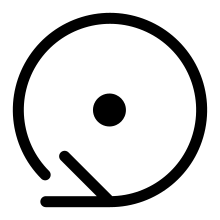
Ouroboros swallowing its tail; based on Moskowitz’s symbol for the constellation Draco
The ouroboros appears elsewhere in Egyptian sources, where, like many Egyptian serpent deities, it represents the formless disorder that surrounds the orderly world and is involved in that world’s periodic renewal.[10] The symbol persisted from Egyptian into Roman times, when it frequently appeared on magical talismans, sometimes in combination with other magical emblems.[11] The 4th-century CE Latin commentator Servius was aware of the Egyptian use of the symbol, noting that the image of a snake biting its tail represents the cyclical nature of the year.[12]
China[edit]
An early example of an ouroboros (as a purely artistic representation) was discovered in China, on a piece of pottery in the Yellow River basin. The jar belonged to the neolithic Yangshao culture which occupied the area along the basin from 5000 to 3000 BCE.[13]
Gnosticism and alchemy[edit]

In Gnosticism, a serpent biting its tail symbolised eternity and the soul of the world.[14] The Gnostic Pistis Sophia (c. 400 CE) describes the ouroboros as a twelve-part dragon surrounding the world with its tail in its mouth.[15]
The famous ouroboros drawing from the early alchemical text, The Chrysopoeia of Cleopatra (Κλεοπάτρας χρυσοποιία), probably originally dating to the 3rd century Alexandria, but first known in a 10th-century copy, encloses the words hen to pan (ἓν τὸ πᾶν), «the all is one». Its black and white halves may perhaps represent a Gnostic duality of existence, analogous to the Taoist yin and yang symbol.[16] The chrysopoeia ouroboros of Cleopatra the Alchemist is one of the oldest images of the ouroboros to be linked with the legendary opus of the alchemists, the philosopher’s stone.[citation needed]
A 15th-century alchemical manuscript, The Aurora Consurgens, features the ouroboros, where it is used among symbols of the sun, moon, and mercury.[17]
-

A highly stylised ouroboros from The Book of Kells, an illuminated Gospel Book (c. 800 CE)
-

An engraving of a woman holding an ouroboros in Michael Ranft’s 1734 treatise on vampires


World serpent in mythology[edit]
In Norse mythology, the ouroboros appears as the serpent Jörmungandr, one of the three children of Loki and Angrboda, which grew so large that it could encircle the world and grasp its tail in its teeth. In the legends of Ragnar Lodbrok, such as Ragnarssona þáttr, the Geatish king Herraud gives a small lindworm as a gift to his daughter Þóra Town-Hart after which it grows into a large serpent which encircles the girl’s bower and bites itself in the tail. The serpent is slain by Ragnar Lodbrok who marries Þóra. Ragnar later has a son with another woman named Kráka and this son is born with the image of a white snake in one eye. This snake encircled the iris and bit itself in the tail, and the son was named Sigurd Snake-in-the-Eye.[19]
It is a common belief among indigenous people of the tropical lowlands of South America that waters at the edge of the world-disc are encircled by a snake, often an anaconda, biting its own tail.[20]
The ouroboros has certain features in common with the Biblical Leviathan. According to the Zohar, the Leviathan is a singular creature with no mate, «its tail is placed in its mouth», while Rashi on Baba Batra 74b describes it as «twisting around and encompassing the entire world». The identification appears to go back as far as the poems of Kalir in the 6th–7th centuries.[citation needed]
The Ouroboros as an auroral Phenomenon[edit]
Following an exhaustive survey, historical linguist Marinus van der Sluijs and plasma physicist Anthony Peratt suggested that the ouroboros has a specific origin in time, in the 5th or 4th millennium BCE,[21][22] and was ultimately based on globally independent observations of an intense aurora, with somewhat different characteristics than the familiar aurora.[23] Specifically, the ouroboros could have represented an auroral oval seen as a whole, at a time when it was smaller and located closer to the equator than now. That could have been the case during geomagnetic excursions, when the geomagnetic field weakens and the earth’s magnetic poles shift places.[24] Tok Thompson and Gregory Allen Schrempp cautiously allow that this new idea might «mark a bold new interdisciplinary venture made possible by modern science«.[25]
Connection to Indian thought[edit]
In the Aitareya Brahmana, a Vedic text of the early 1st millennium BCE, the nature of the Vedic rituals is compared to «a snake biting its own tail.»[26]
Ouroboros symbolism has been used to describe the Kundalini.[27] According to the medieval Yoga-kundalini Upanishad: «The divine power, Kundalini, shines like the stem of a young lotus; like a snake, coiled round upon herself she holds her tail in her mouth and lies resting half asleep as the base of the body» (1.82).[28]
Storl (2004) also refers to the ouroboros image in reference to the «cycle of samsara».[29]
Modern references[edit]
Jungian psychology[edit]
Swiss psychiatrist Carl Jung saw the ouroboros as an archetype and the basic mandala of alchemy. Jung also defined the relationship of the ouroboros to alchemy: Carl Jung, Collected Works, Vol. 14 para. 513.
The alchemists, who in their own way knew more about the nature of the individuation process than we moderns do, expressed this paradox through the symbol of the Ouroboros, the snake that eats its own tail. The Ouroboros has been said to have a meaning of infinity or wholeness. In the age-old image of the Ouroboros lies the thought of devouring oneself and turning oneself into a circulatory process, for it was clear to the more astute alchemists that the prima materia of the art was man himself. The Ouroboros is a dramatic symbol for the integration and assimilation of the opposite, i.e. of the shadow. This ‘feedback’ process is at the same time a symbol of immortality since it is said of the Ouroboros that he slays himself and brings himself to life, fertilizes himself, and gives birth to himself. He symbolizes the One, who proceeds from the clash of opposites, and he, therefore, constitutes the secret of the prima materia which … unquestionably stems from man’s unconscious.
The Jungian psychologist Erich Neumann writes of it as a representation of the pre-ego «dawn state», depicting the undifferentiated infancy experience of both humankind and the individual child.[30]
Kekulé’s dream[edit]
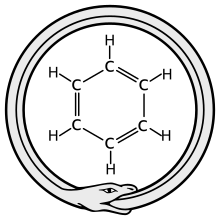
The ouroboros, Kekulé’s inspiration for the structure of benzene
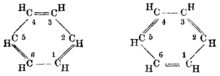
Kekulé’s proposal for the structure of benzene (1872)
The German organic chemist August Kekulé described the eureka moment when he realised the structure of benzene, after he saw a vision of Ouroboros:[31]
I was sitting, writing at my text-book; but the work did not progress; my thoughts were elsewhere. I turned my chair to the fire and dozed. Again the atoms were gamboling before my eyes. This time the smaller groups kept modestly in the background. My mental eye, rendered more acute by the repeated visions of the kind, could now distinguish larger structures of manifold conformation: long rows, sometimes more closely fitted together; all twining and twisting in snake-like motion. But look! What was that? One of the snakes had seized hold of its own tail, and the form whirled mockingly before my eyes. As if by a flash of lightning I awoke; and this time also I spent the rest of the night in working out the consequences of the hypothesis.
Cosmos[edit]
Martin Rees used the ouroboros to illustrate the various scales of the universe, ranging from 10−20 cm (subatomic) at the tail, up to 1025 cm (supragalactic) at the head.[32] Rees stressed «the intimate links between the microworld and the cosmos, symbolised by the ouraborus«,[33] as tail and head meet to complete the circle.
Cybernetics[edit]
Cybernetics deployed circular logics of causal action in the core concept of feedback in the directive and purposeful behaviour in human and living organisms, groups, and self-regulating machines. The general principle of feedback describes a circuit (electronic, social, biological, or otherwise) in which the output or result is a signal that influences the input or causal agent through its response to the new situation. W. Ross Ashby applied ideas from biology to his own work as a psychiatrist in «Design for a Brain» (1952): that living things maintain essential variables of the body within critical limits with the brain as a regulator of the necessary feedback loops. Parmar contextualises his practices as an artist in applying the cybernetic Ouroboros principle to musical improvisation.[34]
Hence the snake eating its tail is an accepted image or metaphor in the autopoietic calculus for self-reference,[35] or self-indication, the logical processual notation for analysing and explaining self-producing autonomous systems and «the riddle of the living», developed by Francisco Varela. Reichel describes this as:
…an abstract concept of a system whose structure is maintained through the self-production of and through that structure. In the words of
Kauffman, is ‘the ancient mythological symbol of the worm ouroboros embedded in a mathematical, non-numerical calculus.[36][37]
The calculus derives from the confluence of the cybernetic logic of feedback, the sub-disciplines of autopoiesis developed by Varela and Humberto Maturana, and calculus of indications of George Spencer Brown. In another related biological application:
It is remarkable, that Rosen’s insight, that metabolism is just a mapping…, which may be too cursory for a biologist, turns out to show us the way to construct recursively, by a limiting process, solutions of the self-referential Ouroborus equation f(f) = f, for an unknown function f, a way that mathematicians had not imagined before Rosen.[38][39]
Second-order cybernetics, or the cybernetics of cybernetics, applies the principle of self-referentiality, or the participation of the observer in the observed, to explore observer involvement in all behaviour and the praxis of science[40] including D.J. Stewart’s domain of «observer valued imparities».[41]
Armadillo girdled lizard[edit]
The genus of the armadillo girdled lizard, Ouroborus cataphractus, takes its name from the animal’s defensive posture: curling into a ball and holding its own tail in its mouth.[42]
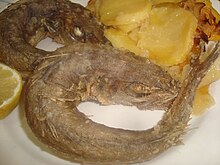
Pescadillas are often presented biting their tails.
In Iberian culture[edit]
A medium-sized European hake, known in Spanish as pescadilla and in Portuguese as pescada, is often presented with its mouth biting its tail. In Spanish it receives the name of pescadilla de rosca («torus hake»).[43]. Both expressions Uma pescadinha de rabo na boca «tail-in mouth little hake» and La pescadilla que se muerde la cola, «the hake that bites its tail», are proverbial Portuguese and Spanish expressions for circular reasoning and vicious circles.[44]
Dragon Gate Pro-Wrestling[edit]
The Kobe, Japan-based Dragon Gate Pro-Wrestling promotion used a stylised ouroboros as their logo for the first 20 years of the company’s existence. The logo is a silhouetted dragon twisted into the shape of an infinity symbol, devouring its own tail. In 2019, the promotion dropped the infinity dragon logo in favour of a shield logo.
In fiction[edit]
«Ouroboros» is an episode of the British science-fiction sitcom Red Dwarf,[45] in which one character is revealed to be his own father due to time travel. The concept also features in Claire North’s ‘the fifteen lives of Harry August.
The Worm Ouroboros is a high-fantasy novel written by E. R. Eddison. Much like the cyclical symbol of the ouroboros eating its own tail, the novel ends the way it begins.
The Ouroboros is used as a main plot device in Lisa Maxwell’s The Last Magician series.
The main six playable characters of the video game Xenoblade Chronicles 3 are able to transform into fiercely powerful forms called Ouroboros, which are ultimately tied to the fate of their world.[46]
The Ouroboros is the adopted symbol of the End Times-obsessed Millennium Group in the TV series Millennium. It also briefly appears when Dana Scully gets a tattoo of it in The X-Files episode «Never Again».
The Ouroboros is referenced in the science fiction short story All You Zombies by American writer Robert A. Heinlein as ‘the worm Ouroboros, the world snake’. The short story later serves as inspiration for the movie Predestination (2014).
In the A Discovery of Witches novels and television adaptation, the crest of the de Clermont family is an ouroboros. The symbol plays a significant role in the alchemical plot of the story.
In The Wheel of Time, the Aes Sedai wear a «Great Serpent» ring, described as a snake consuming its own tale. This image evokes the idea of eternity, and the cyclical nature of time and creation (major themes of the series, throughout).
Splatoon 3 has a similar creature called the Horrorboros which is based off the ouroboros.
See also[edit]
- Amphisbaena
- Cyclic model
- Dragon (M. C. Escher)
- Endless knot
- Ensō
- Eternal return (Eliade)
- Eternalism (philosophy of time)
- Historic recurrence
- Hoop snake
- Infinite loop
- Möbius strip
- Quine (computing)
- Self-reference
- Social cycle theory
- Strange loop
- Three hares
- Valknut
- The Worm Ouroboros
References[edit]
Notes[edit]
- ^ Theodoros Pelecanos’s manuscript of an alchemical tract attributed to Synesius, in Codex Parisinus graecus 2327 in the Bibliothèque Nationale, France, mentioned s.v. ‘alchemy’, The Oxford Classical Dictionary, Oxford University Press, 2012, ISBN 0199545561
- ^ «uroboros». Lexico UK English Dictionary. Oxford University Press. Archived from the original on 19 December 2019.
- ^ «Salvador Dalí: Alchimie des Philosophes | The Ouroboros». Academic Commons. Willamette University.
- ^ Liddell & Scott (1940), οὐροβόρος
- ^ Liddell & Scott (1940), οὐρά
- ^ Liddell & Scott (1940), βορά
- ^ Arien Mack (1999). Humans and Other Animals. Ohio State University Press. p. 359.
- ^ Mattison, Chris (2007). The New Encyclopedia of Snakes. Princeton, N.J.: Princeton University Press. p. 105. ISBN 978-0-691-13295-2.
- ^ Hornung, Erik. The Ancient Egyptian Books of the Afterlife. Cornell University Press, 1999. pp. 38, 77–78
- ^ Hornung, Erik (1982). Conceptions of God in Egypt: The One and the Many. Cornell University Press. pp. 163–64.
- ^ Hornung 2002, p. 58.
- ^ Servius, note to Aeneid 5.85: «according to the Egyptians, before the invention of the alphabet the year was symbolized by a picture, a serpent biting its own tail because it recurs on itself» (annus secundum Aegyptios indicabatur ante inventas litteras picto dracone caudam suam mordente, quia in se recurrit), as cited by Danuta Shanzer, A Philosophical and Literary Commentary on Martianus Capella’s De Nuptiis Philologiae et Mercurii Book 1 (University of California Press, 1986), p. 159.
- ^ van der Sluijs, Marinus Anthony; Peratt, Anthony L. (2009). «The Ourobóros as an Auroral Phenomenon». Journal of Folklore Research. 46 (1): 3–41. doi:10.2979/JFR.2009.46.1.3. ISSN 0737-7037. JSTOR 40206938. S2CID 162226473.
- ^ Origen, Contra Celsum 6.25.
- ^ Hornung 2002, p. 76.
- ^ Eliade, Mircea (1976). Occultism, Witchcraft, and Cultural Fashions. Chicago and London: U of Chicago Press. pp. 55, 93–113.
- ^ Bekhrad, Joobin. «The ancient symbol that spanned millennia». BBC. Retrieved 24 July 2021.
- ^ Lambsprinck: De Lapide Philosophico. E Germanico versu Latine redditus, per Nicolaum Barnaudum Delphinatem …. Sumptibus LUCAE JENNISSI, Frankfurt 1625, p. 17.
- ^ Jurich, Marilyn (1998). Scheherazade’s Sisters: Trickster Heroines and Their Stories in World Literature. Greenwood Publishing Group. ISBN 978-0-313-29724-3.
- ^ Roe, Peter (1986), The Cosmic Zygote, Rutgers University Press
- ^ Daily, Charles (2022). The Serpent Symbol in Tradition. Google Books. pp. 218–219.
- ^ Daily, Charles (24 January 2022). The Serpent Symbol in Tradition. Books Google. ISBN 9781914208690.
{{cite book}}: CS1 maint: url-status (link) - ^ Marinus Anthony van der Sluijs and Anthony L. Peratt (2009). «The Ouroboros as an Auroral Phenomenon». Folklore Research 46, No. 1: 17.
- ^ van der Sluijs, Marinus Anthony (2021). The Earth’s Aurora. Vancouver: All-Round Publications. pp. 99, 102, 216.
- ^ Tok Thompson, Gregory Allen Schrempp (2020). The Truth of Myth: World Mythologies in Theory and Everyday Life. UK: Oxford University Press. pp. 157–159. ISBN 9780190222789.
- ^ Witzel, M., «The Development of the Vedic Canon and its Schools: The Social and Political Milieu» in Witzel, Michael (ed.) (1997), Inside the Texts, Beyond the Texts. New Approaches to the Study of the Vedas, Harvard Oriental Series, Opera Minora vol. 2, Cambridge: Harvard University Press. p. 325 footnote 346
- ^ Henneberg, Maciej; Saniotis, Arthur (24 March 2016). The Dynamic Human. Bentham Science Publishers. p. 137. ISBN 978-1-68108-235-6.
- ^ Mahony, William K. (1 January 1998). The Artful Universe: An Introduction to the Vedic Religious Imagination. SUNY Press. p. 191. ISBN 978-0-7914-3579-3.
- ^ «When Shakti is united with Shiva, she is a radiant, gentle goddess; but when she is separated from him, she turns into a terrible, destructive fury. She is the endless Ouroboros, the dragon biting its own tail, symbolizing the cycle of samsara.» Storl, Wolf-Dieter (2004). Shiva: The Wild God of Power and Ecstasy. Inner Traditions / Bear & Co. p. 219. ISBN 978-1-59477-780-6.
- ^ Neumann, Erich. (1995). The Origins and History of Consciousness. Bollington series XLII: Princeton University Press. Originally published in German in 1949.
- ^ Read, John (1957). From Alchemy to Chemistry. pp. 179–180. ISBN 978-0-486-28690-7.
- ^ M Rees Just Six Numbers (London 1999) p. 7-8
- ^ M Rees Just Six Numbers (London 1999) p. 161
- ^ Parmar, Robin. «No Input Software: Cybernetics, Improvisation, and the Machinic Phylum.» ISSTA 2011 (2014). He further discusses the cybernetics in elementary actions (like picking up a drum stick), the evolution of cybernetic science from Norbert Wiener to Gordon Pask, Heinz von Foerster, and Autopoiesis, and in related fields such as Autocatalysis, the philosophical system of Gilles Deleuze and Félix Guattari, and Manuel DeLanda.
- ^ Varela, Francisco J. «A Calculus for Self-reference.» International Journal of General Systems 2 (1975): 5–24.
- ^ Kauffman sub-reference: Kauffman LH. 2002. Laws of form and form dynamics. Cybernetics & Human Knowing 9(2): 49–63, pp57–58.
- ^ Reichel, André (2011). «Snakes all the Way Down: Varela’s Calculus for Self-Reference and the Praxis of Paradis» (PDF). Systems Research and Behavioral Science. 28 (6): 646–662. doi:10.1002/sres.1105. S2CID 16051196.
- ^ Gutiérrez, Claudio, Sebastián Jaramillo, and Jorge Soto-Andrade. «Some Thoughts on A.H. Louie’s More Than Life Itself: A Reflection on Formal Systems and Biology.» Axiomathes 21, no. 3 (2011): 439–454, p448.
- ^ Soto-Andrade, Jorge, Sebastia Jaramillo, Claudio Gutierrez, and Juan-Carlos Letelier. «Ouroboros Avatars: A Mathematical Exploration of Self-reference and Metabolic Closure.» «One of the most important characteristics observed in metabolic networks is that they produce themselves. This intuition, already advanced by the theories of Autopoiesis and (M,R)-systems, can be mathematically framed in a weird-looking equation, full of implications and potentialities: f(f) = f. This equation (here referred to as Ouroboros equation), arises in apparently dissimilar contexts, like Robert Rosen’s synthetic view of metabolism, hyper set theory and, importantly, untyped lambda calculus. …We envision that the ideas behind this equation, a unique kind of mathematical concept, initially found in biology, would play an important role in the development of a true systemic theoretical biology. MIT Press online.
- ^ Müller, K H. Second-order Science: The Revolution of Scientific Structures. Complexity, design, society. Edition Echoraum, 2016.
- ^ Scott, Bernard. «The Cybernetics of Systems of Belief.» Kybernetes: The International Journal of Systems & Cybernetics 29, no. 7-8 (2000): 995–998.
- ^ Stanley, Edward L.; Bauer, Aaron M.; Jackman, Todd R.; Branch, William R.; Mouton, P. Le Fras N. (2011). «Between a rock and a hard polytomy: Rapid radiation in the rupicolous girdled lizards (Squamata: Cordylidae)». Molecular Phylogenetics and Evolution 58 (1): 53–70. (Ouroborus cataphractus, new combination).
- ^ Spínola Bruzón, Carlos. «Pescadilla; entre pijota y pescada.- Grupo Gastronómico Gaditano». grupogastronomicogaditano.com (in European Spanish). Grupo Gastronómico Gaditano. Retrieved 28 October 2021.
La pescadilla se fríe en forma de rosca, de modo que la cola esté cogida por los dientes del pez.
- ^ «pescadilla». Diccionario de la lengua española (in Spanish) (24th ed.). RAE-ASALE. 2014. Retrieved 28 October 2021.
- ^ «Ouroboros». Red Dwarf: The Official Site. Grant Naylor Productions. Retrieved 10 October 2022.
- ^ «Xenoblade Chronicles 3 Direct – Nintendo Switch». Nintendo of America. 22 June 2022 – via YouTube.
Bibliography[edit]
- Bayley, Harold S (1909). New Light on the Renaissance. Kessinger. Reference pages hosted by the University of Pennsylvania
{{cite book}}: CS1 maint: postscript (link) - Hornung, Erik (2002). The Secret Lore of Egypt: Its Impact on the West. Cornell University Press.
- Liddell, Henry George; Scott, Robert (1940). A Greek-English Lexicon. Oxford: Clarendon Press – via perseus.tufts.edu.
External links[edit]

Wikimedia Commons has media related to Ouroboros.
- BBC Culture – The ancient symbol that spanned millennia
Примеры перевода
-
ouroboros
Белая Башня, Уроборос.
The White Tower, Ouroboros.
Это проект Уроборос,
That is Project Ouroboros.
Это Проект Уроборос, Роман.
This is Project Ouroboros, Roman.
в итоге выйдет Уроборос
the result is… the Ouroboros!
Расскажи мне про Уроборос, Йоханн.
Tell me about Ouroboros, Johann.
Древние культуры поклонялись символу Уроборос.
Ancient cultures worshiped the symbol Ouroboros.
Мы назвали это делом Уробороса.
We called it the Ouroboros case.
Уроборос, этот рассказ о драконе.
You know, Ouroboros, this talk of the dragon.
В случае с Уроборос, гремучих змей.
In the case of Ouroboros, pit vipers.
Расскажите мне про Уробороса, змею поедающую саму себя.
Can you tell me about ouroboros?
Уроборос – великий червь мира.
Ouroboros is the great worm of the world;
Уроборос – символ целостности и единения.
The Ouroboros: the symbol of wholeness and at-one-ment.
Вот как уроборос перемещается в этом ограниченном объеме.
That’s how the ouroboros moves, in this restricted locale.
Он создал игру «Уроборос». Я помогал ему.
He wrote a game called Ouroboros. I helped with the research.
– Уроборос. – Деландро ждал моей реакции.
«Ouroboros.» He waited to see if I would react.
Уильямс и Эдисон{85} (автор «Уробороса»)[164].
Williams, and Edison (author of Ouroboros) were assembled.
Отображенный диск был не что иное, как «Уроборос», стремящийся к Земле.
The disk was Ouroboros, of course, viewed head-on as it came streaming in toward Earth.
Эддисон [sic], автор книги «Червь Уроборос» и других романов.
Eddison [sic], author of The Worm Ouroboros and other romances.
Затем показалась голова уробороса, крепко сжимающая зубами хвост.
Then the head of the ouroboros came in sight, its teeth firmly clamped to the tail.
Бинк догадался, что и этот монстр, подобно уроборосу, не должен быть опасным, если только правильно вести себя.
Then he realized that this monster, like the ouroboros, should not be dangerous if he handled it properly.
How about we make sure that doesn’t happen?
Ouroboros.
It has something to do with whatever Spivak is.
Может, просто не разделяться?
Уроборос.
Это как-то связано с тем, что из себя представляет Спивак.
And it foretold the end of days.
When the Jörmungandr would constrict… choking all other life on the planet… the ouroboros.
The apocalypse.
И это предсказание конца света.
Когда Ёрмунганд схватит себя за хвост, он задушит всех на планете. Уроборос.
Апокалипсис.
The name of the program he wrote:
Ouroboros.
A snake eating his own tail.
Название программы, что он написал:
Уроборос.
Змея поедающая свой хвост.
That’s how it got its name.
It seems this Ouroboros killer was also obsessed with eyes.
Nice work.
Вот как возникло название.
Кажется, этот убийца Уроборос тоже был одержим глазами.
Отличная работа.
The victims were mostly child molesters.
We called it the Ouroboros case.
No beginning, no end.
Жертвы были в основном педофилами.
Мы назвали это делом Уробороса.
Нет ни начала, ни конца.
— Let it go, Norman.
Do you know anything about Project Ouroboros?
I told you, I haven’t got any better idea what goes on there than you do.
— Хватит, Норман.
Ты что-нибудь знаешь о проекте Уроборос?
Я ведь уже говорила, я знаю не больше тебя о том, что здесь происходит.
Exactly what it looks like.
This is Project Ouroboros, Roman.
Oh, my god. You—
Именно то, чем кажется.
Это Проект Уроборос, Роман.
Боже правый, ты…
Looks like your freak’s back, Carlos.
Ouroboros.
This is your case.
Похоже, твой маньяк вернулся, Карлос.
Уроборос.
Это твое дело.
— if you extinguished it.
— Ouroboros.
I’m sorry?
— если ты просто ее погасишь.
— Уроборос.
Что, прости?
In this instance, the Dragon is clearly the subject’s own shadow, the most repressed of his inner thoughts.
As for the oft-mentioned representation, Ouroboros, the snake consuming its own tail, I could go on and
What are the stakes of this narrative?
В данном случае, Дракон — явно тень самого объекта, самые тщательно подавляемые мысли.
Наиболее часто упоминаемое воплощение, Уроборос, змей, пожирающий собственный хвост, я могу продолжать до бесконечности, но, как это ни смешно, суть все равно ускользнет от молодого человека, так привыкшего к двусмысленности.
Где же риск в этом рассказе?
Full stop.
Should he wake, a report of Ouroboros will never be believed.
Semicolon.
Точка.
Если он очнется, его рассказу об Уроборосе никто не поверит.
Точка с запятой.
Right.
Can you tell me anything more about Ouroboros, anything that may help us?
That’s why they killed us.
Ясно.
Вы не могли бы рассказать мне про Уробороса что-нибудь еще, что могло бы помочь?
Вот почему они убили нас.
I tell you.
Ouroboros is that important and that vulnerable.
I am, as always, in my best girl’s debt, and even more deeply if you would favor me with a smile.
Я тебе говорю.
Уроборос настолько же важен, насколько и уязвим.
И я, как всегда, буду в долгу у моей любимой девочки, если она подарит мне улыбку.
Yeah.
Ouroboros.
I seen that cheerleader.
Да.
Уроборос.
Я видел ту болельщицу.
Peter.
tell me about an experiment being conducted at the Godfrey Institute of Biomedical Technologies called Ouroboros
I know that symbol means something. I don’t know, something… happening.
От Питера.
Что ты мне можешь рассказать о экспериметах биомедицинских технологий института Годфри, под название Уроборос?
не знаю… какое-то… событие.
I can do more.
The White Tower, Ouroboros.
I can find out what it is!
Я и больше могу!
Белая Башня, Уроборос.
Я могу выяснить, что это такое!
Francis, I need you to focus.
You know, Ouroboros, this talk of the dragon.
I can’t help you unless I know what you mean.
Фрэнсис, мне нужно, чтобы вы сосредоточились.
Уроборос, этот рассказ о драконе.
Я не смогу вам помочь, если не пойму, о чём вы.
— Don’t.
Yes, Ouroboros.
Of course.
— Не надо.
Да, Уроборос.
Конечно.
— Shut up.
Tell me about Ouroboros, Johann.
I see.
— Заткнись.
Расскажи мне про Уроборос, Йоханн.
Понятно.
— Oh, it’s a term one of the wags in the laboratory devised to define our more conceptual efforts, as in we throw something against the wall and see if it sticks.
In the case of Ouroboros, pit vipers.
They possess heat-sensitive organs called thermoreceptors.
— Да просто термин, один из наших остряков придумал называть так наши наиболее концептуальные проекты, когда мы швыряем что-нибудь в стену, и смотрим, прилипнет ли.
В случае с Уроборос, гремучих змей.
Они обладают термочувствительными органами, называемыми терморецепторами.
376 about two-two miles south of the White Tower.
— Ouroboros.
— Is that your name?
Трасса 376, около двух миль южнее Белой Башни.
— Самоед.
— Это ваше имя?
Cardio-cerebral resuscitation.
Can you tell me about ouroboros?
Where’d you hear that?
Кардиоцеребральная реанимация.
Расскажите мне про Уробороса, змею поедающую саму себя.
Откуда вам это известно?
— Creeping mother of Christ.
— You know, it’s Roman who should be concerned about his longevity if he disrupts my Ouroboros research
I need to help him get his footing in this new chapter of his life.
— Матерь божья.
— Знаешь, это Роману нужно беспокоиться о своём долголетии… Если он нарушит моё исследование Уроборос.
Мне нужно помочь ему встать на ноги в этой новой главе его жизни.
What about this one?
Ouroboros.
2009 to 2018.
Как насчет этого?
Уроборос.
С 2009 по 2018.
— What’s back there?
Is it Ouroboros?
Frankly, you don’t even have to give it to me.
— Что там?
Уроборос?
На самом деле, можешь оставить эту штуку себе.
Let me out of here! Let me out of here, you fucking maniac!
That is Project Ouroboros.
My beautiful boy.
Выпусти меня, гребаный маньяк!
Это проект Уроборос,
мой красавец.
That’s the calvary cross, the tree of life.
And the ouroboros.
Life out of death.
Это Голгофский крест, древо жизни.
И Уроборос.
Бессмертная жизнь.
It symbolized eternity and the soul of the world.
And of course, in modern mysticism, it represents Ouroboros.
The snake which devours its own tail.
Он — символ вечности и души мира.
И, конечно, в современной мистике, он представляет Уробороса.
Змея, пожирающего свой собственный хвост.
— Hmm.
The ‘Ouroboros‘ is what Plato described… as the first living creature in the universe.
An immortal, perfect creature.
Я думаю.
Уроборос. Платон описывал их как первых живущих существ во Вселенной.
Бессмертные и совершенные существа.
Love that.
— Ouroboros.
— Huh?
Здорово.
— Уроборос.
— Что?
Показать еще
To broaden the discussion of pronunciation possibilities a bit, I ran a Google Books Ngram search for «an ouroboros» (the blue line), «a ouroboros» (no line), «an uroboros» the green line), and «a uroboros» (the red line), with the following results:

The red line (which reflects some two dozen matches for «a uroboros» between 1951 and 2008) suggests that at least some English speakers pronounce the first syllable of uroboros as yo- or yoo- or yoor-, or yor-. A separate Google Books search for «a ouroboros» turns up seven matches for that spelling, as well (although the number was evidently too small to support a plotted line in the Ngram graph). For example, from The British Museum Quarterly, volume 31 (1966):
The Cairo example stands within an oval formed by a ouroboros snake, a motif which, rare in the art of dynastic Egypt, becomes a common design on the magical amulets from Roman Egypt.
And from Pierre François, Inlets of the Soul: Contemporary Fiction in English and the Myth of the Fall (1999):
The alchemy-related metaphor in the excerpt above affords one of the most far-reaching glimpses of the «premises» normally hidden from human senses. The «serpent-craft around Jupiter, Venus» is a hierogamy—a divine wedding of the cthonic (serpent) and heavenly (Jupiter, Venus) deities—a ouroboros image identifying the circular periphery and the centre of the cosmic fabric.
And from Michael Speyer, The Kitish (2009):
Judas had had no wife or children, and had cut all ties with his previous life so that his family would not suffer Roman retribution for his ations; he had exchanged family life for a cause in which he had believed without reservation, that i, until he had encountered the Master, who had made him see that strife and conflict were of the nature of this world, and that to blindly follow any cause no matter how noble was to throw away one’s life for something that had no resolution, and which would keep repeating itself throughout the ages like a Ouroboros.
My assumption here is that use of an as the indefinite article before ouroboros or uroboros implies pronunciation of the noun with a y sound at the beginning of the word, whereas use of a as the indefinite article implies pronunciation of the word without a y sound at the beginning of the word.
The Ngram chart strongly suggests that pronunciations that include a y sound at the beginning of the noun ouroboros or uroboros are less common than pronunciations that begin with an o-, oo-, ou-, or-, oor-, and our- sound (treated collectively). Nevertheless, the chart results indicate that pronunciations of the noun that begin with a y sound do (probably) exist among English speakers.