
Всего найдено: 6
Добрый день. Воспользовавшись строкой «Поиск вопроса» я нашла такой противоречивый ответ на мой вопрос: Вопрос № 211146
….
Ответ справочной службы русского языка
Правильно с маленькой буквы: _европейский континент, африканский континент, американский континент, европейские страны, азиатские страны, африканские страны, Скандинавские страны_.
Так с какой же все-таки буквы писать «Скандинавские страны» — отвечаете «с маленькой», а пишете с прописной….
Ответ справочной службы русского языка
Действительно, словарная фиксация такова: европейские страны (по общему правилу), но Скандинавские страны.
Здравствуйте, уважаемая служба русского языка!
У меня тоже возник вопрос по поводу американского континента, и я нашла, что ваши ответы противоречат друг-другу. Как все-таки правильно? А строчная или прописная? Спасибо.С прописной или строчной: североамериканский континент, африканский континент и т.д.?
Нина
Ответ справочной службы русского языкаСогласно словарю «Прописная или строчная?» (В. В. Лопатин, И. В. Нечаева, Л. К. Чельцова) название континентов пишутся с прописной: Северо-Американский континент, Африканский континент.
Вопрос № 211146
С какой буквы (прописной, строчной) следует писать словосочетания «европейский (африканский, американский) континент», «европейские (азиатские, африканские)страны», «скандинавские страны»?
Иванов Юрий Александрович
Ответ справочной службы русского языкаПравильно с маленькой буквы: _европейский континент, африканский континент, американский континент, европейские страны, азиатские страны, африканские страны, Скандинавские страны_.
Вопрос № 191769
Здравствуйте! Прописная или строчная: А(а)фриканский континент, А(а)мериканский континент? Большое спасибо!
Игорь А.
Ответ справочной службы русского языкаПравильно: _африканский континент, американский континент_.
Ответ справочной службы русского языка
Разнобой в наших ответах вызван тем, что изменилась словарная фиксация подобных сочетаний.
Прежде словарь В. В. Лопатина, И. В. Нечаевой, Л. К. Чельцовой «Как правильно? С большой буквы или с маленькой» (М., 2002) рекомендовал писать с прописной буквы только образные названия континентов: Зеленый континент (об Австралии), Черный континент (об Африке). Такие названия, как африканский континент, американский континент, рекомендовалось писать со строчной буквы.
Однако впоследствии данная рекомендация авторами была пересмотрена. В вышедшем в 2007 году новом издании словаря (теперь он называется «Прописная или строчная?», авторы те же) зафиксированы сочетания Американский континент, Африканский континент, Азиатский континент и т. п. Другими словами, орфографическая норма изменилась (это нормально, литературной норме, в том числе орфографической, свойственна динамика, это признак жизнеспособности языка), сейчас правильно писать с прописной.
Здравствуйте! Я изучал шведский язык и недавно поймал себя на мысли, что слова «совет», «завет» и прочие имеют общий корень, очень схожий со шведским глаголом «att veta» = знать (Jag vet = я знаю) + смысловая нагрузка этих слов тоже подразумевает какое-то знание. Действительно ли эти слова имеют скандинавские корни или это просто совпадение??
Заранее благодарен за ответ.
Ответ справочной службы русского языка
Слова _совет, завет_ восходят в индоевропейскому корню uoik- ‘дело, действие’. То есть эти слова имеют не скандинавское, а индоевропейское происхождение. Восходит ли шведский глогол к этому же корню, мы не знаем.
«белокурые скандинавские бестии, «прекрасные викингши»(,) прибирали к рукам лучших холостяков…» нужна ли запятая в скобках? спасибо
Ответ справочной службы русского языка
Указанная запятая нужна.
С какой буквы (прописной, строчной) следует писать словосочетания «европейский (африканский, американский) континент», «европейские (азиатские, африканские)страны», «скандинавские страны»?
Ответ справочной службы русского языка
Правильно с маленькой буквы: _европейский континент, африканский континент, американский континент, европейские страны, азиатские страны, африканские страны, Скандинавские страны_.
Напишите, пожалуйста, правильно ли расставлены знаки препинания в следующем предложении: До этого скандинавские инженеры работали только на основное направление своего концерна – безопасность, и совершенно не брали во внимание мнения дизайнеров. Наталья.
Ответ справочной службы русского языка
Корректные варианты: _До этого скандинавские инженеры работали только на основное направление своего концерна –- безопасность — и совершенно не брали во внимание мнения дизайнеров_ и _До этого скандинавские инженеры работали только на основное направление своего концерна, безопасность, и совершенно не брали во внимание мнения дизайнеров._
Как правильно пишется словосочетание «Скандинавские страны»
Скандина́вские стра́ны
Скандина́вские стра́ны
Источник: Орфографический
академический ресурс «Академос» Института русского языка им. В.В. Виноградова РАН (словарная база
2020)
Делаем Карту слов лучше вместе

Привет! Меня зовут Лампобот, я компьютерная программа, которая помогает делать
Карту слов. Я отлично
умею считать, но пока плохо понимаю, как устроен ваш мир. Помоги мне разобраться!
Спасибо! Я стал чуточку лучше понимать мир эмоций.
Вопрос: ходульность — это что-то нейтральное, положительное или отрицательное?
Ассоциации к слову «страна»
Синонимы к словосочетанию «скандинавские страны»
Предложения со словосочетанием «Скандинавские страны»
- Тем не менее перспективы, по крайней мере в скандинавских странах, выглядят радужными.
- И тогда лютеранство с энтузиазмом приняли короли скандинавских стран, ряд германских князей – это позволило им захватить церковные земли и богатства.
- Скандинавским странам удаётся объединять всё то, что острейшие умы считали несовместимым.
- (все предложения)
Цитаты из русской классики со словосочетанием «Скандинавские страны»
- Ну, ничего: он жил от нас за морем, в странах скандинавских…
- (все
цитаты из русской классики)
Сочетаемость слова «страна»
- разные страны
европейские страны
западные страны - страны мира
страна советов
страны запада - население страны
история страны
экономика страны - страна развалилась
страна процветала
страна жила - жить в стране
покинуть страну
происходить в стране - (полная таблица сочетаемости)
Значение слова «страна»
-
СТРАНА́, -ы́, мн. стра́ны, ж. 1. Местность, территория, выделяемая по географическому положению и природным условиям. Горная страна. Жаркие страны. (Малый академический словарь, МАС)
Все значения слова СТРАНА
Отправить комментарий
Дополнительно
Смотрите также
СКАНДИНА́ВСКИЙ, —ая, —ое. Прил. к скандинавы, к Скандинавия. Скандинавские языки. Скандинавские страны.
Все значения слова «скандинавский»
СТРАНА́, -ы́, мн. стра́ны, ж. 1. Местность, территория, выделяемая по географическому положению и природным условиям. Горная страна. Жаркие страны.
Все значения слова «страна»
-
Тем не менее перспективы, по крайней мере в скандинавских странах, выглядят радужными.
-
И тогда лютеранство с энтузиазмом приняли короли скандинавских стран, ряд германских князей – это позволило им захватить церковные земли и богатства.
-
Скандинавским странам удаётся объединять всё то, что острейшие умы считали несовместимым.
- (все предложения)
- западноевропейские страны
- северная страна
- ряд стран
- западная страна
- прибалтийские страны
- (ещё синонимы…)
- Иран
- посол
- Россия
- Шотландия
- Югославия
- (ещё ассоциации…)
- скандинавские страны
- скандинавская мифология
- о скандинавском происхождении варягов
- со скандинавскими чертами лица
- (полная таблица сочетаемости…)
- разные страны
- страны мира
- население страны
- страна развалилась
- жить в стране
- (полная таблица сочетаемости…)
- Разбор по составу слова «скандинавский»
- Разбор по составу слова «страна»
с § 137 п. 3
-с (частица) § 143 п. 1
Сабах ас-Салем ас-Сабах § 161
Сабит ибн Курра § 161
Саваоф § 180
Саввична § 91
Савка § 109
савраска § 164 прим. 1
садануть § 43
Садовая-Спасская улица § 126 п. 1
Садовая-Сухаревская улица § 169
садовод-любитель § 120 п. 1 б)
Садовое кольцо § 169
садово-огородный § 130 п. 2
сажёнки § 19 п. 7
Сайыр § 26 п. 3 прим.
Салах зуль-Фикар § 161
Салах-ад-Дин § 161
Салтыков-Щедрин § 159
сальтоморталист § 120 п. 10
сам-друг § 129 п. 6
само- § 119 п. 1, § 128 п. 1
самодостаточный § 117 п. 1
самозваный § 99 п. 2
Самойла § 70 прим.
самолёт «Боинг-707» § 200
самолёт «Руслан» § 200
самолёто-вылет § 120 п. 6 а)
самолечение § 117 п. 1
самоуверенна § 103
сам-пят § 129 п. 6
сам-третей § 129 п. 6
Сан- (в геогр. названиях) § 126 п. 6, § 169 прим. 2
Сан- (в иностранных фамилиях) § 124 п. 2, § 160 прим. 2
-сан § 124 п. 5, § 161
Сан-Диего § 169 прим. 2
Санкт- (в геогр. названиях) § 126 п. 6, § 169 прим. 2
Санкт-Мориц § 169 прим. 2
Санкт-Петербург § 126 п. 6
санкт-петербургский § 129 п. 1
Санкт- Петербургский государственный университет § 189 прим. 1
Санкт- Петербургский монетный двор § 177
Сан-Мартин § 124 п. 2
саночки § 48
Санта- (в геогр. названиях) § 126 п. 6, § 169 прим. 2
Санта-Барбара § 169 прим. 2
Санта-Крус § 126 п. 6
санти- § 66, § 117 п. 3
сантиграмм § 117 п. 3
сантиметр § 66
Санто-Домингский собор § 194 прим. 3
Сантьяго § 126 п. 6
Сантьяго-дель-Эстеро § 126 п. 6
Сан-Франциско § 126 п. 6
Сан-Францисская бухта § 126 п. 6 прим.
Сан-Францисская конференция § 179 прим. 4
сан-францисский § 84, § 129 п. 1
санэпидстанция § 6 п. 4 б)
Сапун-гора § 126 п. 3
Саратов (Саратовом) § 73
сарказм § 81 п. 2 прим. 1
саркастический § 81 п. 2 прим. 1
сатир § 162 прим. 2
Сатурн § 178
Сацуо Ямамото § 123 п. 4
сб (стильб) § 209
сбоку § 136 п. 6, § 137 п. 2 прим.
с боку на бок § 137 п. 4
сборник «Синтаксис и стилистика» § 195 а)
сбруя § 80
с бухты-барахты § 139
сбыточный § 43
свадьба § 79 п. 2 б),
свадеб § 64 п. 2
с ведома § 137 п. 5
свеж § 32
свежеокрашенный § 99 п. 2, § 130 п. 1
свежо § 18 п. 1
свежохонький § 18 п. 4
свёртывать § 61
сверх § 140 п. 1
сверхдальний § 117 п. 1
сверхизысканный § 11 п. 4 б)
сверхинтересный § 11 п. 4 б)
сверх-Мефистофель § 151
сверху § 136 п. 6, § 137 п. 2 прим.
сверхчеловек § 117 п. 1
сверхъёмкий § 27 п. 1 а)
сверхъестественный § 27 п. 1 а)
сверхъяркий § 27 п. 1 а)
сверхэкономный § 6 п. 4 б)
свесить § 35 п. 2
Светлая седмица § 183
светло-голубой § 129 п. 2
светозарный § 35 п. 1
свечой § 18 п. 1
с виду § 137 п. 2
свиной § 95 прим. 2
свинья свиньёй § 122 п. 4 а)
свинячий § 49
свисать § 35 п. 2
Свобода § 203
свободненский § 55
свободно конвертируемый § 131
сводчатый § 86
свойственник § 97
свойственный § 97
СВЧ-лучи § 206
Связьинвест § 29 прим.
Святая Троица § 181
Святки § 183
святой § 181
святой Василий Великий § 181
Святой Дух § 182
Святые Дары § 182
Святые Тайны § 182
святым духом § 182
Священное Писание § 187
Священный синод § 185
с гаком § 139
с глазу на глаз § 137 п. 4
с голоду § 137 п. 2
с горя § 139
сгоряча § 136 п. 2 б)
сгущёнка § 19 п. 5, § 105
с.-д. (социал-демократ) § 111 п. 2, § 210
сдать § 81 п. 1 прим.
сделанный § 98 п. 2 а)
сделать § 81 п. 1 прим.
сдоба § 81 п. 1
сдобный § 81 п. 1
с душком § 139
себедовлеющий § 66
себестоимость § 66
себялюбивый § 66, § 117 п. 4, § 128 п. 1
себялюбие § 66, § 117 п. 4
север § 172
Север § 172
Северная Америка § 169
Северная Италия § 171
Северная Пальмира § 174
Северно- § 169
Северное полушарие § 169
Северный Ледовитый океан § 169
Северо- § 126 п. 1 прим. 2, § 169, § 189 прим. 1
Северобайкальск § 126 п. 1 прим. 2
Северо-Байкальское нагорье § 169
северо-восток § 120 п. 6 б)
северо-восточный § 129 п. 1
Северодвинск § 126 п. 1 прим. 2
Северодонецк § 126 п. 1 прим. 2
Северо-Задонск § 126 п. 1 прим. 2
северо-запад § 120 п. 6 б), § 172
Северо-Запад (Северо-Западный регион России) § 172
северо-западный § 129 п. 1
Северо-Кавказская научная географическая станция § 189 прим. 1
северокавказская природа § 177
Северо-Кавказский военный округ § 126 п. 6 прим., § 177
Северо-Кавказский регион § 177
Северо-Китайская равнина § 126 п. 6 прим.
Северо-Курильск § 126 п. 1 прим. 2
Североморск § 126 п. 1 прим. 2
северо-северо-восток § 120 п. 6 б)
северо-северо-запад § 120 п. 6 б)
сего § 92
сегодня § 92
сегодняшний § 56 прим., § 91 прим. 1, § 92
сеголетки § 92 прим.
седалище § 35 п. 2
седалищный § 35 п. 2
седельник § 35 п. 2
седельный § 35 п. 2
седельце § 35 п. 2
седлать § 35 п. 2
седло (сёдла) § 35 п. 2
седобородый § 128 п. 3 а,
седок § 35 п. 2
сейм § 191
сейсмо- § 117 п. 3
сейсмометрия § 66, § 117 п. 3
сейсмостойкий § 117 п. 3
Сейф уль-Ислам § 161
секвойя (секвойи, секвойе, секвойю) § 26 п. 3
секретариат § 43
секс-бомба § 120 п. 4
секстаккорд § 121 п. 1
секстиллион и секстильон § 3 п. 3 б)
сектор § 9
сектор учета § 193
секция § 44
села (прош. вр.) § 35 п. 2
селитряный § 45
сельисполком § 29 прим.
сельский § 30 п. 1 прим. 2
сельскохозяйственный § 130 п. 1
сельсовет § 29 прим.
семена § 53
семенной § 53
семеноводство § 66
Семёнов-Тян-Шанский § 124 п. 1
семенохранилище § 66
семечко § 48
Семик § 183
Семилетняя война § 179
семимесячный § 66
семимильный § 117 п. 2
семинария § 186
семнадцать § 31 а) прим.
семьдесят § 31 а)
семьсот § 31 а),
семьюстами § 132 а)
семьюстами сорока девятью § 133 а)
семя, семени § 53
семядоля § 66, § 117 п. 4, § 119 п. 1
семязачаток § 66
семяизвержение § 66
семяочистительный § 66, § 117 п. 4
семяпочка § 66
семяприемник § 66
Сен- (в геогр. названиях) § 126 п. 6, § 169 прим. 2
Сен- (в иностранных фамилиях) § 124 п. 2, § 160 прим. 2
сенбернар § 164 прим. 2
Сен-Готард § 9, § 126 п. 6
Сен-Готардский перевал (и туннель) § 169
Сен-Дени § 169 прим. 2
Сен-Женевьев-де-Буа § 126 п. 6
Сен-Жюст § 13 прим. 2, § 124 п. 2, § 160 прим. 2
Сен-Санс § 160 прим. 2
сенсибельный § 37
сенсибилизация § 37
Сен-Симон. § 124 п. 2, § 160 прим. 2
сенсимонизм § 119 п. 5
сенсимонист § 119 п. 5
сен-симоновский § 129 п. 1
Сент- (в геогр. названиях) § 126 п. 6, § 169 прим. 2
Сент- (в иностранных фамилиях) § 124 п. 2, § 160 прим. 2
Сент-Бёв § 124 п. 2, § 160 прим. 2
Сент-Луис § 169 прим. 2
Сент-Этьенн § 126 п. 6
сентябрьский § 30 п. 2 а) прим.
сеньор § 3 п. 3 б)
сеньора § 3 п. 3 б)
сеньорат § 3 п. 3 б)
сеньорита § 3 п. 3 б)
сеньория § 3 п. 3 б)
септаккорд § 121 п. 1
Серафим Саровский § 159
Сергеев-Ценский § 124 п. 1
Сергиев Посад § 127
Сергиево-Посадский район § 126 п. 6 прим.
сердечный (друг сердечный) § 91
сердце § 83
сердцевина § 83
сердчишко § 83
серебристо-серый § 129 п. 2
серебряник (мастер) § 105
серебряный § 45, § 97
Серёженька § 47
серийный § 44 прим. 1
серия § 44 прим. 1
сёрфинг § 5 п. 2
серчать § 83
Серый Волк § 165
сестринский § 55
сестрицын § 15 п. 3
сесть § 35 п. 2
сеттер § 9
сетчатый § 86
сеющий § 58
сеять § 76 п. 3
сжать § 89
сжёг (прош. вр.) § 19 п. 6
сзади § 136 п. 6
си-бемоль-мажорный § 129 п. 5
Си-би-эс § 207
сивка § 164 прим. 1
сигарета § 108
сигареты «Мальборо» § 199
сигма-функция § 120 п. 3
с иголочки § 137 п. 3
сиделка § 35 п. 2
сидеть (сидят, сиди) § 35 п. 2
сидя § 35 п. 2
сидят-сидят § 155 а)
сиеста § 7 п. 1
сизифов труд § 166
с изнанки § 137 п. 3, § 137 п. 5
СИЗО § 208 прим. 1
сикось-накось § 118 п. 2, § 138 п. 2 прим. 4
Сикстинская капелла § 194
силлаботоника § 119 п. 3
силуэт § 7 п. 2
сильнодействующий § 130 п. 1, § 130 п. 1 прим.
симфониетта § 108
симфония «Юпитер» § 195 а)
синева § 43
синеватый § 43
синий (синего) § 92,
синее, синяя, синие § 69
синий-пресиний § 118 п. 2
синий-синий § 118 п. 1
Синицын § 15 п. 3 прим.
Синод § 185
синьор § 3 п. 3 б)
синьора § 3 п. 3 б)
синьорина § 3 п. 3 б)
синьория § 3 п. 3 б)
Синяя Борода § 165
сирена § 162 прим. 2
сироп § 34
с испугу § 137 п. 2
Си-эн-эн § 207 -ск- § 81 п. 2, § 167
скакалка § 35 п. 1
скакать (скачу, скачи) § 35 п. 1
скакать § 35 п. 1
скакнуть § 35 п. 1
скаковой § 35 п. 1
скак — скок — скач — скоч § 35 п. 1
скакун § 35 п. 1
с кандибобером § 139
Скандинавия § 173
Скандинавские страны § 171
скатёрка § 83
скатерть-самобранка § 120 п. 1 б)
скачок (скачка) § 35 п. 1
скворечник § 91
скворечня § 91
с кем с кем § 155 б)
скептицизм § 16
скерцо § 24 -ски § 138 п. 2
складчина § 86
Склодовская-Кюри § 124 п. 1
склонение § 35 п. 1
склониться § 35 п. 1
склонный § 35 п. 1
склянка § 83
Скобельцын § 15 п. 3 прим.
скок § 35 п. 1
скок-поскок § 118 п. 2
сколько угодно § 135 б) прим.
сколько-нибудь § 135 б)
сколько-то § 135 б)
с кондачка § 139
скопидом § 119 п. 4
скорострельный § 128 п. 3 а)
с корточек § 137 п. 5
скрипка соло § 122 п. 2
скульптура «Мыслитель» § 195 а)
скучно § 91
скучный § 91
слава Богу и слава богу § 181 прим. 3
слагаемое § 35 п. 1
сладковато-горький § 129 п. 2
сладко-пахучий § 129 п. 2
слать § 83
слева § 42, § 136 п. 2 б)
след в след § 137 п. 4
сленг § 9
слепорождённый § 99 п. 2
с лёту § 137 п. 2
слива «Никольская» § 198
с листа § 139
слитный/раздельный § 114
с лихвой § 139
слишком § 139
словно бы § 142 п. 2
Слово (В начале было Слово) § 182
слово в слово § 137 п. 4
слон Самбо § 164
службишка § 70
слыханный (слыханное ли дело?) § 99 п. 3 а)
слыхивать § 61
слышать § 74, § 76 п. 2
слышимый § 59
смазка § 81 п. 2 прим. 2
с маху § 137 п. 2
смеёшься § 32 б)
смешанный § 60
смешон § 18 п. 5
сминать § 36
смотреть § 74
Смутное время (в России в XVII в.) § 179
смышлёный § 97 прим.
снабжённый § 98 п. 2 б)
с налёту § 137 п. 2
с напрягом § 139
снаружи § 139
с наскоку § 137 п. 2
сначала § 136 п. 6, § 137 п. 2 прим.
СНГ § 204
снизу § 136 п. 6, § 137 п. 2 прим.
снимать § 35 п. 2 прим. 2
снимок § 35 п. 2 прим. 2
снобизм § 81 п. 2 прим. 1
снобистский § 81 п. 2 прим. 1
снова § 42, § 136 п. 2 б)
собака § 34
собака-ищейка § 120 п. 16)
собака Каштанка § 164
собкор § 110 прим. 3
соб. корр. § 209
собор § 186
Собор § 185
собор Парижской Богоматери § 186
собор Святого Петра § 186
совершённый § 5 п. 1
совершенство § 105
Совет Безопасности ООН § 189 прим. 2
совместный § 83
совсем § 136 п. 3
совсем-совсем § 118 п. 1
сов-Чичиков § 151
с оглядкой § 137 п. 3
Согне-фьорд § 169 прим. 3
согнутый § 41
согнуть § 41
содействие (при содействии) § 71 п. 1
содом § 158
Содружество Независимых Государств § 170
соевый § 46
Соединённое Королевство Великобритании и Северной Ирландии § 170
Соединённые Штаты Америки § 170
созвездие § 178
созвездие Большого Пса § 178
Создатель § 181
созерцать § 36
созидание § 36 прим. 2
созидать § 36
со зла § 137 п. 5
солдат-новобранец § 120 п. 1 б)
Солженицын § 15 п. 3 прим.
солнечный § 64 п. 3 б)
Солнце § 178
солнце § 83
соло § 120 п. 2
соло-вексель § 120 п. 2
соловушка § 54, § 70
соловьиный § 97
соломенный § 45, § 97
соломина § 51
соломинка § 51
Солт-Лейк-Сити § 126 п. 5
Соль- § 126 п. 4
Сольвычегодск § 126 п. 4
соль-диез § 120 п. 2
Соль-Илецк § 126 п. 4, § 169
соль-илецкий § 129 п. 1
сомневаться § 62
соотечественник § 43, § 97
с опаской § 137 п. 3
соприкосновение § 35 п. 1
сопротивляемость § 59
сорвиголова § 66, § 119 п. 4
соредактор § 117 п. 1
сорок семь § 133 а)
сорокаведерный § 117 п. 2
сорокалетие § 66
сорокасвечовый § 66
сорокачасовой § 66
сороконожка § 66
сорокоуст § 66
сортимент § 43
со своими § 41
сосед-писатель § 154 п. 2
сосед — писатель-фантаст § 154 п. 2
соседушка § 70
сосенка § 51
соскок § 35 п. 1
соскочить § 35 п. 1
сослепу § 41, § 136 п. 2 б)
Сосновый Бор (город) § 169 прим. 1
сосочка § 48 -сот § 132 а)
сотворенный § 35 п. 1
с отвычки § 137 п. 3
сотру § 41
-сотый § 132 б)
соумышленник § 97
софит § 107
с охотой § 137 п. 3
социал-демократ § 121 п. 1
социал-демократический § 129 п. 1
социал-демократия § 121 п. 1
социально защищенный § 131
социально ориентированный § 131
социо- § 117 п. 3
социокультурный § 117 п. 3
соцобязательство § 24 прим. 1
соцреализм § 119 п. 2
сочетание § 36 прим. 1
сочетать § 36 прим. 1
сочинец § 55
сочинский § 55
Союз журналистов России § 189
спазм § 81 п. 2 прим. 1
спайка § 35 п. 1
спайный § 35 п. 1
спаниель § 7 п. 1
с панталыку § 139
Спаситель § 181
Спасское-Лутовиново § 126 п. 1
спастика § 81 п. 2 прим. 1
спастический § 81 п. 2 прим. 1
спектро- § 117 п. 3
спектрогелиограмма § 117 п. 3
спектрометрия § 66
спектропроектор § 117 п. 3
спереди § 136 п. 6
с перепугу § 137 п. 2
спецвыпуск § 119 п. 2
специнтернат § 16
специфика § 16
спецкор § ПО, § ПО прим. 3
спец. корр. § 209
спецодежда § 24 прим. 1
спецотдел § 24 прим. 1
спецПТУ § 119 п. 2, § 151 прим. 2
спецэкспортер § 25 п. 2
спецэлектрод § 25 п. 2
спецэффект § 25 п. 2
СПИД § 205
спиннинг § 107
спин-спиновый § 129 п. 4
сплавлять § 35 п. 1
сплавной § 35 п. 1
сплеча § 137 п. 2 прим., § 139
сплошь § 32
спозаранку § 139
спокоен § 64 п. 2
спокойствие § 44
с поличным § 139
сполна § 136 п. 2 б)
с помощью § 142 п. 1
спорненский § 55
спортинвентарь § 11 п. 4 в)
спортклуб «Стрела» § 192
спортобщество «Динамо» § 192
спорт-Одесса § 151
справа § 42, § 136 п. 2 б)
спросонок § 139 «Спрут-4» § 120 п. 1 б) прим. 1
спрячь, спрячьтесь § 32 в)
спуско-подъёмный § 130 п. 2
спьяну § 136 п. 2 б)
сравнение § 35 п. 1
сравнительно быстрый § 131
сравнить(ся) § 35 п. 1
сравнять § 35 п. 1
сравняться § 35 п. 1
с разбегу § 137 п. 2
с разгону § 137 п. 2
с размаху § 137 п. 2
сразу § 137 п. 2 прим.
сращение § 35 п. 1
сребреник § 97
средиземный § 117 п. 1
Средне- § 125 п. 2
Среднеазиатские республики § 171
Средневолжский завод § 189
Среднедунайская равнина § 126 п. 6 прим.
Среднесибирское плоскогорье § 169
Средние века § 179
Средняя Азия § 171
Сретение § 183
сроду § 137 п. 2 прим.
срочнослужащий § 130 п. 3 прим.
срывка § 137 п. 2 прим.
срыву § 137 п. 2 прим.
сряду § 137 п. 2 прим.
сс. (страницы) § 209
с сердцем § 139
ссора § 106
ссыльнокаторжный § 130 п. 3 прим.
ссыльнополитический § 130 п. 3 прим.
ссыпать § 93
-ст § 81 п. 2
-ста § 132 а)
стабилизировать § 43
ставленник § 97
Ставрополье § 173
стажёр § 19 п. 4
стайер § 26 п. 3
стаканчик § 30 п. 3, § 50
стало быть § 142 п. 2
станкостроительный § 130 п. 1
станко-час § 120 п. 6 а)
станция § 44, (к
станции, на станции) § 71 п. 1
станция метро «Александровский сад» § 175
станция метро «Октябрьское Поле» § 175
станция метро «Проспект Мира» § 175
станция Москва-Пассажирская § 175
Стара-Загора § 126 п. 5
старик Державин § 120 п. 1 в)
старик-отец § 120 п. 1 в)
старинный § 95
Старо- § 125 п. 2
Старобельск § 125 п. 2
Старооскольский район § 126 п. 6 прим.
старушечий § 49
старший лейтенант — артиллерист § 154 п. 1
старшинство § 55
статс- § 120 п. 7
статс-дама § 120 п. 7
статс-секретарь § 120 п. 7
статуэтка § 7 п. 2
статьи § 11 п. 3
-ств(о) § 81 п. 2
-ственн(ый) § 81 п. 2
-ствова(ть) § 81 п. 2
стекложелезобетон § 119 п. 3
стёклышко § 54
стеклянистый § 105
стеклянный § 97
стелить § 36, § 74 прим. 1
Стелка § 109
стеллаж § 107
стен. (стенной) § 209
Стена Плача § 194 прим. 2
стенгазета § 119 п. 2
стенд § 9
стенной § 95
Степаныч § 43 прим.
Степонавичюс § 13 прим. 2
стерео- § 117 п. 3
стереоэффект § 117 п. 3 -сти § 132 а)
стиральная машина «Эврика» § 200
стираный-перестираный § 99 п. 3 а), § 118 п. 2
стихослагатель § 35 п. 1
стихосложение § 35 п. 1
сгишонки § 18 п. 2
стлать § 83
сто § 132 а)
сто восемьдесят девять § 133 а)
стоимость § 59
стоить § 76 п. 3
столетний § 117 п. 2
столик § 50
столицы § 15 п. 2
столько-то § 135 б)
150-летие § 111 п. 3
сторонний § 95
стортинг § 191 •35-м § 111 п. 4
стоящий § 58
Страна восходящего солнца § 174
Страна кленового листа § 174
Страна тюльпанов § 174
Страна утренней свежести § 174
страны Балтии § 171
страны Запада § 172
страны — участники переговоров § 154 п. 1
страсти-мордасти § 118 п. 2
Страстная неделя § 183
Страстная пятница § 183
страстный § 83
Стратфорд-он-Эйвон § 126 п. 6, § 169 прим. 2
страшно не страшно, а… § 155 а)
Страшный суд § 182
страшон § 18 п. 5 прим.
стрекозка § 81 п. 2 прим. 2
Стрелец § 178
стрелково-спортивный § 130 п. 3
стреловидный § 128 п. 3 б)
стрельцы § 15 п. 2
стременной § 53
стриженный и стриженый § 98 п. 3
стрижёт § 19 п. 1
стричь § 32 г)
Строгановское училище § 167
строить § 76 п. 3
стройиндустрия § 26 п. 1
стройотряд § 26 п. 1
строчечный § 64 п. 2
строящий § 58
Струги-Красные § 126 п. 2
студент-альпинист § 154 п. 2
студент-медик § 120 п. 1 б)
студент-медик — альпинист § 154 п. 2
студент-первокурсник § 120 п. 1 б)
студиец § 44 прим. 1
студийный § 44 прим. 1
студия § 44 прим. 1
стюардесса § 9, § 108
субалтерн-офицер § 121 п. 2
суббота § 107
субботник § 179
субинспектор § И п. 4 а)
субпродукты § 117 п. 1
субъединица § 27 п. 1 б)
субъект § 27 п. 1 б)
субъективный § 27 п. 1 б)
субъядро § 27 п. 1 б)
субэкваториальный § 6 п. 4 б)
суверенитет § 43
суворовские традиции § 167
суглинок § 117 п. 1
судия (к судии, о судии) § 71 прим. к п. 1 и 2
судей § 64 п. 3
судоходный § 128 п. 3 а)
сумасшедший § 66
суматошный § 91 прим. 1
с умом § 137 п. 3
с умыслом § 137 п. 3
Сунь Ятсен § 123 п. 4, § 159
суперинфекция § 11 п. 4 а)
суперлайнер § 117 п. 1
суперъяхта § 27 п. 1 б)
суперЭВМ § 206
суперэлита § 6 п. 4 б)
супружеский § 43, § 90
сурово-непроницаемый § 129 п. 2
суток (род. п. мн. ч.) § 64 п. 1
суточный § 64 п. 1
сухово-кобылинский § 129 п. 1
сухощавый § 43
сушёный § 104 прим.
суэцкий § 85
с.-х. (сельскохозяйственный) § 111 п. 2, § 210
сходненский § 55
с ходу § 137 п. 2
сценарий § 44
сценарий фильма «Место встречи изменить нельзя — 2» § 154 п. 5
счастливый § 83, § 88
счастье § 88
с часу на час § 137 п. 4
счесть § 88
счёт § 18 п. 5, § 19 п. 7, § 88
с четверенек § 137 п. 5
счётный § 19 п. 7
счётчик § 19 п. 7
счёты § 88
считанный и считаный § 98 п. 3
считать § 36, § 88
считка § 88
сшить § 89
съёжиться § 27 п. 1 а)
съесть § 27 п. 1 а)
съязвить § 27 п. 1 а)
сызнова § 136 п. 2 б)
сымпровизировать § 12 п. 2
сыпать § 74 прим. 3
Сырная седмица § 183
сыр «Российский» § 199
сыскать § 12 п. 2
сычуаньский § 30 п. 2 а) прим.
Сьерра-Невада § 126 п. 5
сэкономить § 6 п. 4 б)
Сэлинджер § 8 п. 2
Сэм § 8 п. 2
сэр § 8 п. 1
Сэссон § 8 п. 2
сэссон § 8 п. 2
сяду (сядь) § 35 п. 2  Т У Ф Х Ц Ч Ш Щ Ы Э Ю Я

§ 14. Названия государств, административно-территориальных единиц, станций и т. д.
1. В официальных названиях государств все слова, кроме служебных, пишутся с прописной буквы: Российская Федерация, Республика Башкортостан, Корейская Народно-Демократическая Республика, Соединённые Штаты Америки, Мексиканские Соединённые Штаты, Соединённое Королевство Великобритании и Северной Ирландии, Французская Республика, Южно-Африканская Республика.
2. В названиях групп (объединений, союзов) государств с прописной буквы пишется первое слово (и все имена собственные): Закавказские республики, Скандинавские страны, Ассоциация государств Юго-Восточной Азии, Европейское экономическое сообщество, Организация американских государств, Организация Североатлантического договора, Союз Государств Центральной Африки, Тройственный союз.
3. В неофициальных названиях государств все слова, как правило, пишутся с прописной буквы: Советский Союз, Страна Советов, Советская Республика (в период Гражданской войны), Штаты (о США).
4. В образных названиях государств первое слово или слово, подчеркивающее характерный признак называемого объекта, пишется с прописной буквы: Страна восходящего солнца (Япония), Страна утренней свежести (Корея), остров Свободы (Куба).
5. В наименованиях административно-территориальных единиц слова, обозначающие индивидуальные названия, пишутся с прописной буквы, а слова, обозначающие родовое или видовое понятие, пишутся со строчной буквы: Горно-Алтайская автономная область, Орловская область, Краснодарский край, Ханты-Мансийский автономный округ, Мытищинский район.
В названиях административно-территориальных единиц зарубежных государств с прописной буквы пишутся все слова, кроме слов, обозначающих родовые понятия: графство Суссекс (Англия), департамент Верхние Пиренеи (Франция), штат Южная Каролина (США), область Тоскана (Италия), префектура Хоккайдо (Япония), провинция Сычуань (Китай), земля Баден-Вюртемберг (Германия).
6. Официальные названия частей государств пишутся с прописной буквы: Европейская Россия, Западная Белоруссия, Правобережная Украина, Внутренняя Монголия, Азиатская Турция, Северная Италия.
7. В названиях улиц, переулков, площадей и т. д. все слова, кроме родовых обозначений, пишутся с прописной буквы: Ленинский проспект, проспект Мира; площадь Революции, площадь Тверской Заставы, площадь Никитские Ворота; Ростовская набережная, набережная Академика Туполева; Киевское шоссе, шоссе Энтузиастов; Сретенский бульвар, бульвар Генерала Карбышева; 1-й Пехотный переулок, Малый Афанасьевский переулок; Большой Каменный мост, мост Лейтенанта Шмидта; Продольная аллея, аллея Большого Круга; Сытинский тупик; улицы: Адмирала Макарова, Большие Каменщики, Борисовские Пруды, Братьев Фонченко, 1-я Карпатская, Девятая Рота, Кирпичные Выемки, Кузнецкий Мост, Каретный Ряд, Земляной Вал, Коровий Брод, Большая Косинская; проезд Соломенной Сторожки, но: проезд Художественного театра.
8. В названиях достопримечательных мест все слова, кроме родовых обозначений, пишутся с прописной буквы: Большой Кремлёвский дворец, Зимний дворец, Инженерный замок, Шлиссельбургская крепость, Донской монастырь, Новодевичье кладбище.
9. В названиях железнодорожных станций, вокзалов, аэропортов все слова, кроме родовых обозначений, пишутся с прописной буквы: станции Ерофей Павлович, Москва-Товарная, Ленинград-Пассажирский; Казанский вокзал, Северный речной вокзал; Шереметьевский аэропорт, но: московский аэропорт Внуково, парижский вокзал Монпарнас.
10. В названиях станций метро, заключенных в кавычки, все слова пишутся с прописной буквы: станции «Китай-город», «Проспект Мира», «Пионерская», «Александровский Сад».
СКАНДИНАВСКИЕ СТРАНЫ
1) Орфографическая запись слова: скандинавские страны2) Ударение в слове: Скандин`авские стр`аны3) Деление слова на слоги (перенос слова): скандинавски… смотреть
СКАНДИНАВСКИЕ СТРАНЫ
Ударение в слове: Скандин`авские стр`аныУдарение падает на буквы: а,аБезударные гласные в слове: Скандин`авские стр`аны
СКАНДИНАВСКИЕ СТРАНЫ В XII — XV ВВ
К XII в. крестьянство Скандинавских стран в массе своей все еще не являлось феодально зависимым. Важнейшей особенностью скандинавского феодализма, отличавшей его от феодализма других западноевропейских стран, было более замедленное его развитие. Когда в Италии, Франции и Англии крепостное право уже исчезло, в Дании оно еще только оформлялось. Цеховая организация ремесла в Швеции появилась тогда, когда в Италии и Германии она становилась уже помехой нарождавшемуся капитализму. Церковь на скандинавском севере боролась с дохристианскими культами в то время, когда в других странах Западной Европы ей уже приходилось вести борьбу с бюргерской ересью. Расцвет рыцарской культуры в Скандинавских странах относился к более позднему времени, чем раннее Возрождение в Италии.
Социально-экономическое развитие
Рост производительных сил в Скандинавских странах отличался также известной замедленностью. Даже в самой развитой и густонаселенной Дании трехполье еще в XIII в. сочеталось с двухпольем, а из высеваемых злаков преобладали рожь и ячмень. Обычным явлением на Скандинавском полуострове было подсечное, а в горах и мотыжное земледелие. Огромную роль в хозяйственной жизни Дании, Швеции, а особенно Норвегии и Исландии продолжало играть экстенсивное пастбищное скотоводство, горное и лесное. В то же время широкое распространение получил рыболовный, а на океанском побережье и китобойный промыслы; высокоразвитое мореходное искусство обеспечивало, прежде всего Норвегии и Дании, непрекращавшуюся связь с континентом. Доступность и обилие озерно-болотной железной руды, а с XIII в. богатые горные разработки железа и меди (главным образом в Швеции) давали Скандинавским странам металл для выделки орудий производства, а впоследствии и для экспорта.
Кроме отдельных районов Дании, средневековая Скандинавия почти не знала крупных феодальных поместий. Слабая потребность скандинавской знати в барщине в результате крайней земельной тесноты (удобных для хлебопашества земель на севере было очень мало) долгое время делала излишней крепостную зависимость крестьянства. Однако замедленность процесса феодализации не исключала имущественного и социального расслоения среди крестьян-общинников. Скандинавии стала присуща своеобразная форма внеэкономического принуждения — принуждение малоземельных и неимущих сельских жителей к труду по найму у крепких хозяев. Специфически скандинавским явлением был работник, наделенный клочком земли или усадьбой (хусмен). Крупнейшими землевладельцами являлись короли и церковь.
Наиболее быстро процесс феодализации шел в Дании, где к XIV в. основную массу крестьян составляли уже лично зависимые держатели, а в XV в. аграрный строй местами мало чем отличался от северогерманского. Сравнительно большое развитие получили в Дании и крупные поместья, в которых земля обрабатывалась при помощи барщинного труда беднейших держателей. Значительно медленнее шел процесс феодализации в Швеции. В старейшем областном законе этой страны — «Вестъетской правде» начала XIII в. нет даже специальных шведских терминов для обозначения феодалов, которые оказывались таким образом как бы скрыты в формально равноправной массе свободных собственников — бондов. Особенно долго в Швеции сохранялось рабство, а держатели чужой земли даже в XV в. составляли меньшинство крестьян. Причина этого отставания Швеции от своих скандинавских соседей заключалась, по-видимому, в том, что она находилась в сравнительной изоляции как от Западной Европы, поскольку южная часть Скандинавского полуострова в средние века была датской, так и от Восточной, поскольку торговые пути «из варяг в греки» и в Среднюю Азию пришли в упадок. Разорение русских княжеств вследствие татаро-монгольского нашествия косвенно сказалось и на Швеции.
Несколько по-другому шло развитие Норвегии. Ряды крестьян-собственников таяли здесь быстрее, и уже к концу XIV в. 3/5 обрабатываемой земли в стране сосредоточивались в руках короля, светской и особенно духовной знати. В то же время Норвегия (как и Исландия) с ее системой хуторов, удаленных и изолированных друг от друга, и той важной ролью, которую в экономической жизни этой страны играли морской промысел и горное скотоводство, наиболее полно отразила черты, определявшие отсутствие в Скандинавии тех основных признаков феодализма, которые были свойственны таким странам Западной Европы, как Франция, Англия и др. Процесс феодализации, начавшийся в Норвегии раньше, чем в Швеции, как бы остановился на своей первичной стадии. Поэтому, хотя в XV в. в Норвегии крестьян — владельцев земли было меньше, чем в Швеции, их права на землю были еще ближе к полной собственности, чем права шведских крестьян. Точно так же класс крупных землевладельцев-феодалов сложился в Норвегии раньше, чем в Швеции, но уже в XIV в. оказался и малочисленнее и слабее шведского.
Феодальный нажим на скандинавских крестьян, выражавшийся в первую очередь во введении все новых налогов, вызывал отпор с их стороны. Обычно крестьянские восстания возглавляли мелкие собственники, платившие подать королю и дорожившие своей древней свободой. Нередко восстания были направлены против крупнейшего феодального землевладельца — католической церкви. В конце XI в. восставшие датские крестьяне убили короля Кнуда (Канута), который обложил их десятиной. В 1249 г. введение тяжелой поплужной подати вызвало крупное восстание датских крестьян против короля Эрика, получившего прозвище «Плужный грош». В Норвегии во второй половине XII в. (1174—1184 гг.) произошло крупное восстание так называемых биркебейнеров ( Биркебейнерами, что значит «березоногие», восставшие назывались, по-видимому, потому, что, скрываясь в лесах, изготовляли свою обувь из бересты.), в котором объединились мелкие феодалы и крестьяне. Успех этого движения и воцарение на норвежском престоле вождя биркебейнеров Сверри привели к временному ослаблению могущества норвежской знати и прежде всего представителей церкви — епископов, а также к некоторому укреплению политических прав богатого крестьянства. Такой исход движения биркебейнеров наложил свой отпечаток на дальнейшее историческое развитие страны: феодальное дворянство в Норвегии XIII в. — нового происхождения; это — служилые люди, держатели ленов от короля. Позднее всего начались крестьянские выступления в отстававшей по своему экономическому развитию Швеции.
Образование централизованных монархий в Скандинавии и их завоевательная политика
Скандинавские страны не знали или почти не знали феодальной раздробленности. Держатели королевских бенефициев (в Скандинавии их называли ленами), как правило, не стали здесь наследственными владельцами пожалованных земель и не получили над населением этих земель столь широких прав (например, судебных), как немецкие или французские феодалы. «Варварские» королевства эпохи викингов непосредственно развились здесь в централизованные раннефеодальные монархии, окончательно сложившиеся в Дании к середине XII в. при королях Вальдемаре I и Вальдемаре II, в Норвегии — в середине XIII в. при потомках Сверри, а в Швеции — в конце XIII в. при сыновьях ярла Биргера — Фолькунгах.
После упорной борьбы между королями и знатью на рубеже XIII—XIV вв. феодалы Скандинавских стран удовольствовались ограничением королевской власти при помощи съездов знати и постоянного государственного совета. Хартия датского короля Эрика Клиппинга в 1282 г. и условия избрания шведско-норвежского короля Магнуса в 1319 г.— яркие памятники торжества аристократической монархии в Скандинавских странах. Датский король был обязан давать при вступлении на престол особое обязательство соблюдать все вольности дворянства. Обязательство это фиксировалось в так называемой капитуляции. Государственный совет — риксрод стал важнейшим правительственным учреждением в Скандинавских странах, нередко, особенно в XV в., решавшим вопрос об избрании короля, распределении ленных пожалований и направлении внешней политики.
Упрочение центральной власти позволило Скандинавским государствам возобновить свою внешнеполитическую экспансию. Во второй половине XII в. датские короли огнем и мечом покорили поморских славян, а в начале XIII в.— часть Эстонии и немецкие города в районе Нижней Эльбы (Гамбург и Любек) (Почти все эти завоевания были, впрочем, вскоре утрачены датчанами.). Шведские короли уже с середины XII в. стремились захватить Финляндию, но первый решающий шаг к ее завоеванию был сделан лишь сто лет спустя ярлом Биргером. Попытка вторгнуться в пределы Руси окончилась поражением шведского войска на Неве в 1240 г. Покорение Финляндии шведским королям удалось завершить лишь в XIV в. Норвежские короли в XIII в. распространили свою власть на Исландию (1262—1264 гг.— конец исландской независимости), а затем на Гренландию. Экспансия норвежских королей в северном направлении — к Кольскому полуострову — была остановлена новгородцами в середине XIII в.
Кальмарская уния
В XIV в. аристократия отдельных стран предпочитала ради сохранения своих политических вольностей и могущества иметь королей-чужеземцев и шла на заключение личных уний. То, что эти унии заключались между Скандинавскими странами, объяснялось их этнической, языковой и культурной близостью, а также тесными имущественными и родственными связями представителей их господствующих классов.
В 1319 г. по соглашению между феодалами обеих стран в личную унию вступили Швеция и Норвегия. Но в 1363 г. на шведский престол был приглашен северогерманский герцог Альбрехт Мекленбургский, которого норвежцы не признали. Появление короля-немца на скандинавском престоле было признаком широкого проникновения в Скандинавию германских элементов. Ганзейские купцы и саксонские ремесленники, прибывшие в массе своей на Север именно в XIII—XIV вв., способствовали росту производства и торговли в Скандинавских странах. Но в то же время германская колонизация грозила их территориальной целостности и даже независимости Хозяйничанье немецких феодалов в Дании в 20—30-х годах XIV в привело к признанию датской знатью так называемой «Вальдемаровой конституции», согласно которой датский король впредь сохранял лишь номинальную власть над Шлезвигом, этой важной составной частью средневековой Дании. Штральзундский мир, закрепивший победу 60 ганзейских городов над датским королем Вальдемаром Аттердагом (1370 г. ), надолго утвердил их господство на Балтийском море и право вмешательства в самое избрание датского короля. Наметившемуся в XIV в. упадку Норвегии несомненно способствовала кабальная зависимость от Ганзы, сосредоточившей в своих руках всю торговлю страны, в частности жизненно важный подвоз хлеба.
Перед лицом этой общей опасности, грозившей Скандинавским странам, они были вынуждены объединиться. Дело объединения Скандинавии возглавила самая сильная из них — Дания. В 1389 г. в личной унии во главе с королевой Маргаритой Датской оказались уже все Скандинавские королевства. В 1397 г. на съезде знати в Кальмаре уния была утверждена в качестве вечного политического союза, при сохранении внутренней самостоятельности каждой из примкнувших к упии стран. Королем всех трех королевств был торжественно провозглашен Эрик Померанский, внучатый племянник королевы Маргариты. Кальмарская уния была сговором в первую очередь между датскими и шведскими феодалами. Что касается Норвегии, то к исходу XIV в. сказался явный ее упадок (причины которого до сих пор еще не вполне выяснены), и поэтому в момент заключения Кальмарской унии она не играла значительной политической роли.
В первые годы унии датские короли выступали как носители прогрессивных исторических тенденций в противовес местным феодалам, особенно шведским. Но не прошло и четверти века, как стали сказываться отрицательные последствия унии. Она оказалась выгодной главным образом для Дании. Норвегия и особенно Швеция, втянутые в тяжелую войну короля Эрика с Ганзой, страдали как от небывалого податного гнета, так и от блокады их побережий. Королевские наместники, являвшиеся, как правило, датчанами или немцами, вели себя в Швеции и Норвегии подобно завоевателям и жестоко притесняли крестьянство.
В 1434 г. в Швеции вспыхнуло восстание крестьян и рудокопов, возглавленное богатым горным мастером из мелких дворян Энгельбректом Энгельбректсоном. Успеху восстания помогло, в частности, применение восставшими боевых приемов чешских таборитов (создание укреплений из сцепленных повозок). Энгельбрект стал фактически главой Шведского государства. В бурях народно-освободительной войны окрепло сословно-представительное собрание — риксдаг Швеции — с участием не только городских, но и крестьянских выборных. В 1436 г. разразилось восстание в Норвегии, а в 1441 г.— антифеодальное восстание датских крестьян. Эрик Померанский был низложен во всех Скандинавских государствах, не исключая самой Дании, где его политика вызывала растущую оппозицию знати.
Шведская знать, примкнувшая вначале к восстанию 1434 г., вскоре организовала предательское убийство народного героя Энгельбректа. Крестьянское движение, обратившееся теперь и против шведских феодалов,— «шведская Жакерия» — было жестоко подавлено, а уния восстановлена, но уже при условии полновластия шведской аристократии во внутренних делах страны. В течение последующих десятилетий Кальмарская уния, поскольку она касалась Швеции, становилась все более призрачной. Напротив, датско-норвежская уния в 1450 г. была скреплена «навечно», зависимость Норвегии от Дании неуклонно росла (Датско-норвежская уния просуществовала до 1814 г.).
В социально-экономическом отношении XIV—XV века в истории Скандинавских стран ознаменовались дальнейшим постепенным ухудшением общего положения крестьянских масс. Особенно это было заметно в Дании, где соседство немецких городских рынков вызвало стремление феодалов к увеличению барщины и привело к закрепощению части крестьян. В XV в. свобода крестьянского перехода была стеснена и в Швеции. С другой стороны, растущий податной гнет экономически все более сближал свободных скандинавских крестьян-собственников с феодально зависимыми держателями. В Дании продолжался процесс закрепощения крестьян, в Швеции делались попытки закрепощения и развивалась ленная система, сокращались ряды свободных крестьян-собственников и в Норвегии.
В то же время XV век был веком дальнейшего подъема скандинавских городов, причем впереди здесь шла Дания. Начавшееся в конце XV в. ослабление Ганзы создало благоприятные условия для развития приморских городов Дании — Копенгагена, Роскильде и Лунда. В Дании имелся и самый сильный городской патрициат — местное купечество. Вообще же городские вольности в Скандинавских странах были крайне незначительными. Исключение составлял лишь норвежский Берген, где всеми городскими делами управляли ганзейские купцы. Более слабыми были города у шведов (Стокгольм, Упсала). Вместе с тем именно в Швеции в XV в. разросся и приобрел международное значение горнорудный промысел (медные и железные рудники). В металлургии также получило распространение производство чугунного литья, предшествовавшее позднейшим централизованным мануфактурам.
Культура
В XIIIв. достигла наивысшего уровня древнеисландская светская литература на местном языке. Самым выдающимся ее представителем был Снорри Стурлусон, поэт и один из лучших историков средневековой Европы. В результате усиления христианской церкви, относившейся враждебно к светской литературе, исландское творчество пришло в упадок. Известен ряд норвежских авторов XII—XIII вв., писавших на очень близком к древнеисландскому языке. Что касается Дании и Швеции, то здесь вплоть до начала XIV в. в литературе царила латынь. На латинском языке была написана и «История датчан» Саксона Грамматика — вершина датской средневековой словесности (вторая половина XII в.). Наиболее ярким памятником церковной литературы этого времени являются «откровения» св. Бригитты, знатной шведской монахини XIV в. Светская литература XIV—XV вв. была представлена народными балладами, главным образом в Дании, и рифмованными хрониками в Швеции. Норвежская культура в это время все более подчинялась датскому влиянию. Огромное значение для духовной культуры Скандинавских стран имело книгопечатание, которое проникло туда из Германии в конце XV в.
От XII—XV вв. до нас дошли замечательные образцы деревянного зодчества (главным образом в Норвегии). Наиболее выдающимися памятниками архитектуры из камня являются соборы в Лунде (романский стиль), соборы в Упсале и Тронсхейме (готический стиль)…. смотреть
Coordinates: 64°00′N 10°00′E / 64.000°N 10.000°E
|
Nordic countries
|
|
|---|---|

Land controlled by the Nordic countries shown in dark green. Bouvet Island and Antarctic claims not shown. |
|
| Capitals |
|
| Official languages |
|
| Recognised regional languages |
|
| Composition | 5 sovereign states
2 autonomous territories
1 autonomous region
2 unincorporated areas
1 dependency
2 Antarctic claims
|
| Establishment | |
|
• Inauguration of the Nordic Council |
12 February 1953 |
|
• Helsinki Treaty |
23 March 1962 |
|
• Inauguration of the Nordic Council of Ministers |
July 1971 |
| Area | |
|
• Total |
6,125,804 km2 (2,365,186 sq mi)[a] (7th) |
| Population | |
|
• 2021 estimate |
27,562,156 (52nd) |
|
• 2000 census |
24,221,754 |
|
• Density |
7.62/km2 (19.7/sq mi) (225th) |
| GDP (PPP) | 2019 estimate |
|
• Total |
$1.6 trillion[1] (19th) |
|
• Per capita |
$58,000 (13th) |
| GDP (nominal) | 2021 estimate |
|
• Total |
$1.8 trillion (10th) |
|
• Per capita |
$66,900 (15th) |
| Currency |
|
| Driving side | right |
| Calling code |
|


The Nordic countries (also known as the Nordics or Norden; lit. ‘the North’)[2] are a geographical and cultural region in Northern Europe and the North Atlantic. It includes the sovereign states of Denmark, Finland, Iceland, Norway[b] and Sweden; the autonomous territories of the Faroe Islands and Greenland; and the autonomous region of Åland.[4]
The Nordic countries have much in common in their way of life, history, religion and social structure. They have a long history of political unions and other close relations but do not form a singular entity today. The Scandinavist movement sought to unite Denmark, Norway and Sweden into one country in the 19th century. With the dissolution of the union between Norway and Sweden (Norwegian independence), the independence of Finland in the early 20th century and the 1944 Icelandic constitutional referendum, this movement expanded into the modern organised Nordic cooperation. Since 1962, this cooperation has been based on the Helsinki Treaty that sets the framework for the Nordic Council and the Nordic Council of Ministers.
The Nordic countries cluster near the top in numerous metrics of national performance, including education, economic competitiveness, civil liberties, quality of life and human development.[5] Each country has its own economic and social model, sometimes with large differences from its neighbours. Still, they share aspects of the Nordic model of economy and social structure to varying degrees.[6] This includes a mixed market economy combined with strong labour unions and a universalist welfare sector financed by high taxes, enhancing individual autonomy and promoting social mobility. There is a high degree of income redistribution, commitment to private ownership and little social unrest.[7][8]
North Germanic peoples, who comprise over three-quarters of the region’s population, are the largest ethnic group, followed by the Baltic Finnic Peoples, who comprise the majority in Finland; other ethnic groups are the Greenlandic Inuit, the Sami people and recent immigrants and their descendants. Historically, the main religion in the region was Norse paganism. This gave way first to Roman Catholicism after the Christianisation of Scandinavia. Then, following the Protestant Reformation, the main religion became Lutheran Christianity, the state religion of several Nordic countries.[9][10]
Although the area is linguistically heterogeneous, with three unrelated language groups, the common linguistic heritage is one factor that makes up the Nordic identity. Most Nordic languages belong to North Germanic languages, Finno-Ugric languages and Eskimo–Aleut languages. Danish, Norwegian and Swedish are considered mutually intelligible, and they are the working languages of the region’s two political bodies. Swedish is a mandatory subject in Finnish schools and Danish in Faroese and Greenlandic schools. Danish is also taught in schools in Iceland.
The combined area of the Nordic countries is 3,425,804 square kilometres (1,322,710 sq mi). Uninhabitable icecaps and glaciers comprise about half of this area, mainly Greenland. In September 2021, the region had over 27 million people. Especially in English, Scandinavia is sometimes used as a synonym for the Nordic countries. Still, that term more properly refers to the three monarchies of Denmark, Norway and Sweden. Geologically, the Scandinavian Peninsula comprises the mainland of Norway and Sweden and the northernmost part of Finland.[11][12][13][14][15]
Etymology and concept of the Nordic countries[edit]
The term Nordic countries found mainstream use after the advent of Foreningen Norden. The term is derived indirectly from the local term Norden, used in the Scandinavian languages, which means ‘The North(ern lands)’.[16] Unlike the Nordic countries, the term Norden is in the singular. The demonym is nordbo, literally meaning ‘northern dweller’.
Similar or related regional terms include:
- Scandinavia refers typically to the cultural and linguistic group formed by Denmark, Norway and Sweden, or the Scandinavian Peninsula, which is formed by mainland Norway and Sweden as well as the northwesternmost part of Finland. Outside of the Nordic region the term Scandinavia is sometimes used as a synonym for the Nordic countries. First recorded use of the name by Pliny the Elder about a «large, fertile island in the North» (possibly referring to Scania).[17]
- Fennoscandia refers to the area that includes the Scandinavian Peninsula, Finland, Kola Peninsula and Karelia. This term is mostly restricted to geology, when speaking of the Fennoscandian Shield.
- Cap of the North consists of the provinces and counties of Lapland in Finland; Finnmark, Nordland and Troms in Norway; and Lapland and Norrbotten in Sweden. This Arctic area is located around and north of the Arctic Circle in the three Nordic European countries Norway, Sweden and Finland and the Kola Peninsula in Russia.
- Barents Region is formed by the Cap of the North as well as the Northern Ostrobothnia and Kainuu regions of Finland, Swedish provinces of Lapland, Västerbotten and Norrbotten, Russian Oblasts of Arkhangelsk and Murmansk, Nenets Autonomous Okrug, as well as the Republics of Karelia and Komi. This area cooperates through the Barents Euro-Arctic Council and Barents Regional Council.[citation needed]
-

Nordic countries (orange and red) and Scandinavian countries (red)
-

-

A satellite photograph of Northern Europe
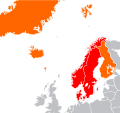


List[edit]
Sovereign states[edit]
| Sovereign state | Kingdom of Denmark[18] | Republic of Finland[19] | Iceland[20] | Kingdom of Norway[21] | Kingdom of Sweden[22] |
|---|---|---|---|---|---|
| Flag | 
|

|

|

|

|
| Coat of arms | 
|

|

|

|

|
| Official local name | Kongeriget Danmark[18] | Suomen tasavalta[19] Republiken Finland[19] |
Ísland[20][23] | Kongeriket Norge[21] Kongeriket Noreg[21] Norgga gonagasriika[24] |
Konungariket Sverige[22] |
| Local common name | Danmark | Suomi Finland |
Ísland | Norge Noreg |
Sverige |
| English common name | Denmark[18] | Finland[19] | Iceland[20] | Norway[21] | Sweden[22] |
| Population (2021 estimate) | 5,894,687[18] | 5,587,442[19] | 354,234[20] | 5,509,591[21] | 10,261,767[22] |
| Area | 43,094 km2[18] | 338,145 km2[19] | 103,000 km2[20] | 385,207 km2[21] | 450,295 km2[25] |
| Population density (2015 estimate) | 129.5/km2[18] | 16.2/km2[19] | 3.2/km2[20] | 13.5/km2[21] | 22.9/km2[22] |
| Capital city | Copenhagen[18] | Helsinki[19] | Reykjavík[20] | Oslo[21] | Stockholm[22] |
| Largest urban areas [citation needed] |
Copenhagen – 2,057,142 Aarhus – 330,639 Odense – 213,558 Aalborg – 205,809 Esbjerg – 116,032 |
Helsinki – 1,488,236 Tampere – 370,084 Turku – 315,751 Oulu – 200,400 Jyväskylä – 140,812 |
Reykjavík – 201,049 Akureyri – 18,103 Reykjanesbær – 14,000 Akranes – 6,699 Selfoss – 6,512 |
Oslo – 1,043,168 Bergen – 265,470 Stavanger/Sandnes – 229,911 Trondheim – 191,771 Fredrikstad/Sarpsborg – 117,510 |
Stockholm – 2,371,774 Gothenburg – 1,015,974 Malmö – 707,120 Helsingborg – 272,873 Uppsala – 253,704 |
| Form of government | Unitary parliamentary constitutional monarchy[18] | Unitary parliamentary republic[19] | Unitary parliamentary republic[20] | Unitary parliamentary constitutional monarchy[21] | Unitary parliamentary constitutional monarchy[22] |
| Current head of state and government | Margrethe II[18] (Queen) Mette Frederiksen[18] (Prime Minister) |
Sauli Niinistö[19] (President) Sanna Marin[26] (Prime Minister) |
Guðni Th. Jóhannesson[20] (President) Katrín Jakobsdóttir[20] (Prime Minister) |
Harald V[21] (King) Jonas Gahr Støre[21] (Prime Minister) |
Carl XVI Gustaf[22] (King) Ulf Kristersson[27] (Prime Minister) |
| European Free Trade Association | No | No | Yes | Yes | No |
| European Union | Yes | Yes | No | No | Yes |
| European Economic Area | Yes | Yes | Yes | Yes | Yes |
| Official languages | Danish[18] | Finnish[19] and Swedish[19] | Icelandic[20] | Norwegian[21] and Sami | Swedish[22] |
| Official or recognized minority languages | German (in South Jutland)[18] | Sami, Romani, Sign Language, Karelian | Sign Language | Kven, Tavringer, Romani | Finnish, Sami, Romani, Yiddish and Meänkieli[22] |
| Main religions | 74.8% Lutheran[18] 5.3% Islam[18] 19.9% other, unspecified or no religion[18] |
67.8% Lutheran[28] 1.1% Orthodox[28] 1.7% other religion[28] 29.4% unspecified or no religion[28] |
63.5% Lutheran[29] 11.7% other Christian[29] 3.3% other religion[29] 21.5% unspecified or no religion[29] |
68.7% Lutheran 7.0% other Christian 3.4% Islam 0.8% other religion 20.2% no religion[30][31][32] |
60.2% Lutheran[22] 8.5% other[22] 31.3% no religion[22] |
| GDP (nominal) (2016) | $306.7 billion[33][34][35][36] | $236.8 billion[33][34][35][36] | $20.0 billion[33][34][35][36] | $370.4 billion[33][34][35][36] | $511.3 billion[33][34][35][36] |
| GDP (nominal) per capita (2016)[37][38][39] | $53,744[37][38][39] | $43,169[37][38][39] | $59,629[37][38][39] | $70,392[37][38][39] | $51,165[37][38][39] |
| GDP (PPP) (2016)[40][41][42] | $273.8 billion[40][41][42] | $231.3 billion[40][41][42] | $16.5 billion[40][41][42] | $364.4 billion[40][41][42] | $498.1 billion[40][41][42] |
| GDP (PPP) per capita (2016) | $47,985[43][44][45] | $42,165[43][44][45] | $49,136[43][44][45] | $69,249[43][44][45] | $49,836[43][44][45] |
| Real GDP growth rate (2019 est.) | 2.85%[46] | 1.15%[46] | 1.94%[46] | 0.86%[46] | 1.29%[46] |
| Currency | Danish krone[18] | Euro[19] | Icelandic króna[20] | Norwegian krone[21] | Swedish krona[22] |
| Military expenditure | 1.41% of GDP | 1.99% of GDP[47] | 0.13% of GDP | 1.4% of GDP | 1.18% of GDP |
| Military personnel | 72,135[48] | 900,000[49] | 130[50] | 69,700[51] | 57,000[52] |
| Labour force[53] | 2,962,340 | 2,677,260 | 197,200 | 2,781,420 | 5,268,520 |
| Human Development Index rank (2019 data, 2020 report) | 10 | 11 | 4 | 1 | 7 |
| Corruption Perceptions Index rank (2020) | 1 | 3 | 17 | 7 | 3 |
| Press Freedom Index rank (2021)[54] | 4 | 2 | 16 | 1 | 3 |
| Fragile States Index rank (2021) | 175 | 179 | 177 | 178 | 172 |
| Economic Freedom rank (2021) | 10 | 17 | 11 | 28 | 21 |
| Global Competitiveness rank (2019) | 10 | 11 | 26 | 17 | 8 |
| Environmental Performance rank (2020) | 1 | 7 | 17 | 9 | 8 |
| Good Country rank (2022) | 2 | 5 | 20 | 11 | 1 |
| Global Gender Gap Report rank (2021) | 28 | 2 | 1 | 3 | 5 |
| World’s Mothers report rank (2014) | 6 | 1 | 4 | 2 | 3 |
| World Happiness Report rank (2021)[55] | 2 | 1 | 4 | 6 | 7 |
| The figures in this table do not include the Faroe Islands, Greenland, Åland, Jan Mayen, Svalbard, Bouvet Island, Peter I Island, and Queen Maud Land. |
Associated territories and other areas[edit]
| Territory / Area | Faroe Islands[56] | Greenland[57] | Åland | Svalbard |
|---|---|---|---|---|
| Flag | 
|

|

|
|
| Coat of arms | 
|

|

|
|
| Official local name | Føroyar Færøerne[56] |
Kalaallit Nunaat[57] Grønland |
Landskapet Åland | Svalbard |
| Population (2016 estimate) |
49,188[56] | 56,483[57] | 29,013 | 2,667 |
| Area | 1,393 km2[56] | 2,166,086 km2[57] | 1,580 km2 | 61,022 km2 |
| Population density | 35.5/km2 | 0.028/km2 | 18.36/km2 | 0.044/km2 |
| Capital city | Tórshavn[56] | Nuuk[57] | Mariehamn | Longyearbyen |
| Largest urban areas | Tórshavn – 12,648 Klaksvík – 4,681 Hoyvík – 2,951 Argir – 1,907 Fuglafjørður – 1,542 |
Nuuk – 16,464 Sisimiut – 5,598 Ilulissat – 4,541 Qaqortoq – 3,229 Aasiaat – 3,142 |
Mariehamn – 11,521 Jomala – 4,646 Finström – 2,529 Lemland – 1,991 Saltvik – 1,827 |
Longyearbyen – 2,144 Barentsburg – 471 Ny-Ålesund – ~30–130 Isbjørnhamna – ~10–12 |
| Sovereign state |  Kingdom of Denmark[56][57] Kingdom of Denmark[56][57]
|
 Republic of Finland Republic of Finland
|
 Kingdom of Norway Kingdom of Norway
|
|
| Status | Autonomous territory | Autonomous region | Unincorporated area | |
| Form of government | Devolved parliamentary within a constitutional monarchy[56] | Devolved parliamentary within a constitutional monarchy[57] | Unitary parliamentary republic | Unitary parliamentary constitutional monarchy[21] |
| Current head of state and government | Margrethe II (Queen) Aksel V. Johannesen (Premier) |
Margrethe II[57] (Queen) Múte Bourup Egede[57] (Premier) |
Sauli Niinistö (President) Veronica Thörnroos (Prime Minister) |
Harald V[21] (King) Jonas Gahr Støre[21] (Prime Minister) |
| European Union | No | No, OCT | Yes | No |
| European Economic Area | No | No | Yes | No |
| Nordic Council | Associate member | Associate member | Associate member | No individual representation |
| Main languages | Faroese,[56] Danish[56] | Greenlandic,[57] Danish[57] | Swedish | Norwegian[21] |
| Main religions | 89.3% Lutheran 6% unspecified 3.8% none[56] |
96.08% Lutheran 0.79% Inuit spiritual beliefs 2.48% atheist+agnostic |
72.0% Lutheran 1.3% Other religion 26.7% No religion[58] |
|
| GDP (nominal) | $2.77 billion[33][34][35][36] | $2.22 billion[33][34][35][36] | ||
| GDP (nominal) per capita | $50,300[37][38][39] | $43,365[37][38][39] | ||
| GDP (PPP) | $1.471 billion[40][41][42] | $2.173 billion[40][41][42] | $1.563 billion | |
| GDP (PPP) per capita | $36,600[43][44][45] | $37,900[43][44][45] | $55,829 | |
| Real GDP growth rate | 5.90% (2017 est.)[46][59] | 7.70% (2016 est.)[46][59] | ||
| Currency | Faroese króna[56] Danish krone |
Danish krone[57] | Euro | Norwegian krone[21] |
History[edit]
Timeline[edit]
| Century | Nordic political entities | ||||||
|---|---|---|---|---|---|---|---|
| Danes | Greenlanders | Faroese | Icelanders | Norwegians | Swedes | Finns | |
| 8th | Prehistoric Danish (East-Norse) |
Prehistoric Greenlandic (Paleo-Eskimo and West-Norse) |
Prehistoric Faroese (West-Norse) |
Prehistoric Icelandic (West-Norse) |
Prehistoric Norwegian (West-Norse) |
Prehistoric Swedish (East-Norse) |
Prehistoric Finnish (Finnic) |
| 9th | Hereditary Kingdom of Norway | ||||||
| 10th | Denmark | Icelandic Commonwealth | |||||
| 11th | |||||||
| 12th | Sweden | ||||||
| 13th | |||||||
| 14th | |||||||
| 15th | Kalmar Union | ||||||
| 16th | Denmark-Norway | Sweden | |||||
| 17th | |||||||
| 18th | |||||||
| 19th | Denmark | United Kingdoms of Sweden and Norway | Grand Duchy of Finland | ||||
| 20th | Denmark | Greenland | Faroe Islands | Iceland | Norway | Sweden | Finland |
| 21st |
Italics indicates a dependent territory.
Early history and Middle Ages[edit]


Little evidence remains in the Nordic countries of the Stone Age, the Bronze Age, or the Iron Age with the exception of a limited numbers of tools created from stone, bronze and iron, some jewelry and ornaments and stone burial cairns. However, one important collection that exists is a widespread and rich collection of stone drawings known as petroglyphs. The Goths, who originated in southern Scandinavia and would later divide into Visigoths and Ostrogoths, are known to have been one of the Germanic people that would later relate to the fall of the Western Roman Empire and the emergence of Medieval Europe. However, these acquired the Latin culture of Rome.[60]
The Nordic countries first came into more permanent contact with the rest of Europe during the Viking Age. Southern Finland and northern parts of Sweden and Norway were areas where the Vikings mostly only traded and had raids, whilst the permanent settlements of Vikings in the Nordic region were in southern Norway and Sweden, Denmark and Faroes as well as parts of Iceland, Greenland and Estonia. Christian Europe responded to the raids and conquest of Vikings with intensive missionary work. The missionaries wanted the new territories to be ruled by Christian kings who would help to strengthen the church. After conversion to Christianity in the 11th century, three northern kingdoms emerged in the region: Denmark, Norway and Sweden. Iceland first became a commonwealth before it came under Norwegian rule in the early 13th century. There were several secular powers who aimed to bring Finland under their rule, but through the Second and Third Swedish Crusade in the latter part of 13th and through the colonisation of some coastal areas of Finland with Christian Swedes, the Swedish rule was gradually established in the region.[61][62]
During the Middle Ages, increased trade meant that the Nordic countries became increasingly integrated into Europe and Nordic society became more Continental. The monarchies strengthened their positions in the 12th and 13th centuries through imposing taxes on peasants and a class of nobles also emerged. By the Late Middle Ages, the whole of the Nordic region was politically united in the loose Kalmar Union. Diverging interests and especially Sweden’s dissatisfaction over the Danish dominance gave rise to a conflict that hampered the union from the 1430s onward until its final dissolution in 1523. After the dissolution Denmark and Norway, including Iceland, formed a personal union of the two kingdoms called Denmark–Norway whilst the successful period of Vasa Kings began in Sweden and Finland. The Lutheran Reformation played a major role in the establishment of the early-modern states in Denmark–Norway and Sweden.
Early modern period and industrialization[edit]
Sweden was very successful during the Thirty Years’ War, while Denmark was a failure. Sweden saw an opportunity of a change of power in the region. Denmark–Norway had a threatening territory surrounding Sweden and the Sound Dues were a continuing irritation for the Swedes. In 1643, the Swedish Privy Council determined Swedish territorial gain in an eventual war against Denmark–Norway to have good chances. Not long after this, Sweden invaded Denmark–Norway.
The war ended as foreseen with Swedish victory and with the Treaty of Brömsebro in 1645 Denmark–Norway had to cede some of their territories, including Norwegian territories Jemtland, Herjedalen and Idre and Serna, as well as the Danish Baltic Sea islands of Gotland and Ösel. The Thirty Years’ War thus began the rise of Sweden as a great power, while it marked the start of decline for the Danish.
To some extent in the 16th century and certainly in the 17th, the Nordic region played a major role in European politics at the highest level. The struggle for dominion over the Baltic Sea and its trading opportunities raged between Denmark–Norway and Sweden, which began to impact upon the neighboring nations. Sweden prevailed in the long term and became a major European power as it extended its reach into coastal tracts in modern-day Russia, Estonia, Latvia, and – following the Thirty Years’ War – also into Pomerania and other North German areas. Sweden also conquered vast areas from Denmark–Norway during the Northern Wars in the middle of the 17th century. Sweden also had several conflicts with Russia over Finland and other eastern areas of the country and after the Great Northern War (1700–1721) Sweden lost most of its territories outside the old Swedish border to Russia which then became the new major power in Northern Europe.
After the Napoleonic Wars (1803–1815), the political map of the Nordic countries altered again. In 1809, Finland was conquered by Russian Empire from Sweden in the Finnish War, after which Finland became the autonomous Grand Duchy of Finland. In turn, Sweden captured Norway from Denmark in 1814 in the Swedish–Norwegian War and started a Union between Sweden and Norway. Iceland, the Faroe Islands and Greenland, which had been re-colonised in the 18th century, became Danish. Population growth and industrialization brought change to the Nordic countries during the 19th century and new social classes steered political systems towards democracy. International politics and nationalism also created the preconditions for the later independence of Norway in 1905, Finland in 1917 and Iceland in 1944.
Late modern period and contemporary era[edit]
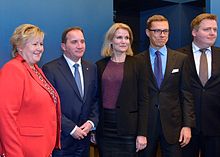
During the two world wars and the Cold War, the five small Nordic states were forced into difficult balancing acts, but retained their independence and developed peaceful democracies. The Nordic states had been neutral during World War I, but during World War II they could no longer stand apart from world politics. The Soviet Union attacked Finland in 1939 and Finland ceded territory following the Winter War. In 1941, Finland launched a retaliatory strike in conjunction with the German attack on the Soviet Union. However, more territory was lost and for many years to come Finnish foreign policy was based on appeasing the Soviet Union, even though Finland was able to retain its democratic form of government. Denmark and Norway were occupied by Germany in 1940. The Allies responded by occupying Iceland, the Faroe Islands and Greenland. Sweden managed to formally maintain its neutrality in the Axis/Allies conflict and avoided direct hostilities, but in practice it adapted to the wishes of the dominant power – first Germany, later the Allies. However, during the Winter War between Finland and Russia in 1939–1940, Sweden did support Finland and declared itself «non combatant» rather than neutral.
Compared with large parts of Europe, the Nordic region got off lightly during the World War II, which partially explains its strong post-war economic development. The labour movement – both trade unions and political parties – was an important political presence throughout the Nordic countries in the 20th century. The big social democratic parties became dominant and after World War II the Nordic countries began to serve as a model for the welfare state. Economically, the five Nordic countries were strongly dependent on foreign trade and so they positioned themselves alongside the big trading blocks. Denmark was the first to join European Economic Community (EEC) in 1972 and after it became European Union (EU) in 1993 Finland and Sweden also joined in 1995. Norway and Iceland are members of the European Free Trade Association (EFTA). All the Nordic countries are however members of the European Economic Area (EEA).
Geography[edit]

Satellite map of the European part of the Nordic countries, except for Jan Mayen and Svalbard

The Nordic countries and self-governing regions in alphabetic order – number of inhabitants (2018), area (km2) and population density (people/km2):
| Country | Inhabitants | Area | Pop. density |
|---|---|---|---|
| Denmark | 5,806,014 | 42,933 | 135 |
| Faroe Islands | 50,322 | 1,393 | 36 |
| Finland | 5,520,535 | 338,424 | 16 |
| Iceland | 355,620 | 102,775 | 3.5 |
| Norway | 5,323,933 | 385,203 | 14 |
| Sweden | 10,313,447 | 450,295 | 23 |
| Åland | 29,884 | 1,580 | 18 |
| Total | 27,301,531 | 1,322,603 | 21 |
| Source:[63] |
Denmark is by far the most densely populated country, whilst Sweden, Norway and Finland are low populated and similar to each other from this perspective. Iceland has both the lowest population and by far the lowest population density. But large areas in Finland, Norway and Sweden, like most of Iceland, are unpopulated. There are no such areas in Denmark. Denmark has a population density around continental average, higher than for instance France and Poland but lower when compared to the United Kingdom, Italy or Germany. Finland, Norway and Sweden has a population density that is a little lower than the United States, but higher than Canada. In round figures, Iceland’s population density resembles Canada’s.
Land and water area[edit]
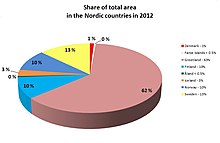
Share of total area in the Nordic countries in 2012
This list includes dependent territories within their sovereign states (including uninhabited territories), but does not include claims on Antarctica. EEZ+TIA is exclusive economic zone (EEZ) plus total internal area (TIA) which includes land and internal waters.
| Rank | Country | Area | EEZ | Shelf | EEZ+TIA |
|---|---|---|---|---|---|
| 1 | Sweden | 447,420 | 160,885 | 154,604 | 602,255 |
| 2 | Norway | 385,203 | 2,385,178 | 434,020 | 2,770,404 |
| 3 | Finland | 338,534 | 87,171 | 85,109 | 425,590 |
| 4 | Iceland | 103,440 | 751,345 | 108,015 | 854,345 |
| 5 | Denmark (including Greenland) | 2,210,579 | 2,551,238 | 495,657 | 4,761,811 |
| Total (excluding Greenland) | 1,318,158 | 3,751,563 | — | 5,064,065 | |
| Total | 3,484,244 | 5,935,817 | 1,277,405 | 9,414,405 |
Denmark[edit]

The Kingdom of Denmark includes the home-rule (hjemmestyre) territory of the Faroe Islands and the self-rule (selvstyre) territory of Greenland.
| Region | EEZ & TW Area (km2)[64] |
Land area | Total |
|---|---|---|---|
| Denmark | 105 989 | 42 394 | 149 083 |
| Faroe Islands | 260 995 | 1 399 | 262 394 |
| Greenland | 2 184 254 | 2 166 086 | 4 350 340 |
| Total | 2 551 238 | 2 210 579 | 4 761 817 |
The Nordic countries have a combined area of around 3.5 million square kilometres and their geography is extremely varied. The area is so vast that it covers five time zones. To the east the region borders Russia, and on the west the Canadian coastline can be seen from Greenland on a clear day. Even excluding Greenland and the Norwegian islands of Svalbard and Jan Mayen, the remaining part of the Nordic countries covers around 1.3 million square kilometres. This is about the same area as France, Germany and Italy together. To the south, the countries neighbor the Baltic states, Poland, Germany and the United Kingdom, while to the north there is the Arctic Ocean.[65]
Notable natural features of the Nordic countries include the Norwegian fjords, the Archipelago Sea between Finland and Sweden, the extensive volcanic and geothermal activity of Iceland, and Greenland, which is the largest island in the world. The southernmost point of the Nordic countries is Gedser, on the island of Falster in Denmark. The northernmost point is Kaffeklubben Island in Greenland, which is also the northernmost point of land on Earth. The largest cities and capitals of the Nordic countries are situated on the southern parts of the region, with the exception of Reykjavík, the capital of Iceland. Helsinki, Oslo and Stockholm are all close to the same latitude as the southernmost point of Greenland, Egger Island (Itilleq): about 60°N.
Topography[edit]
All of Denmark and most of Finland lie below 200 m and the topography of both is relatively flat. In Denmark, moraines and tunnel valleys add some relief to the landscape while in Finland the surroundings of lakes Pielinen and Päijänne display some moderate relief. The Finnish area just east of Bothnian Bay stands out as the largest plain in the Nordic countries.[66] The Scandinavian Mountains dominate the landscape of Norway. The southern part of the Scandinavian Mountains is broader than the northern one and contains higher peaks. The southern part contains also a series of plateaux and gently undulating plains. The western parts of the mountains are cut by fjords, producing a dramatic landscape. The landscape of Sweden can be described as a mixture of that of Norway, Finland and Denmark. Except at the High Coast the coastal areas of Sweden form lowlands. Sweden has three highland areas, the South Swedish Highlands, the Scandinavian Mountains and the Norrland terrain which is the eastern continuation of the Scandinavian Mountains.[66] The South Swedish Highland and the Norrland terrain are separated by the Central Swedish lowland. The topography of Iceland stands out among the Nordic countries for being a bowl-formed highland.[66]
Climate[edit]

Average temperatures in the capitals of the Nordic countries in 2012
Despite their northern location, the Nordic countries generally have a mild climate compared with other countries that share globally the same latitudes. The climate in the Nordic countries is mainly influenced by their northern location, but remedied by the vicinity to the ocean and the Gulf Stream which brings warm ocean currents from the tip of Florida. Even far to the north, the winters can be quite mild, though north of the Polar Circle the climate zone is mostly subarctic with harsh winters and short summers. In Greenland and Svalbard the climate is polar. The sea has a heavy influence on the weather in the western coastal zones of Iceland, Norway, Denmark and Sweden. The precipitation is high and snow cover during winters is rare. Summers are generally cool.
The further away that one gets from the Atlantic Ocean and the Gulf Stream the colder it gets during the winters. Finland, most of Sweden and the south-eastern part of Norway are influenced by the vast continent to the east which results in warm and long summers and clear and cold winters, often with snow. For example, Bergen at the west coast of Norway normally has a temperature above zero in February while Helsinki in Finland normally will have a temperature of 7–8 °C below zero during the same month.[67]
Climatic conditions and quality of land have determined how land is used in the Nordic countries. In densely populated mainland Denmark there is hardly any wild nature left. Most of the scarce forests are plantations and nearly 60 per cent of Denmark’s total area is cultivated or zoned as gardens or parks. On the other hand, in the other Nordic countries there is much wild nature left. Only between 0 and 9 per cent of the land in the other Nordic countries is cultivated. Around 17 per cent of the land area in Iceland is used for permanent meadows and pastures and both Finland, Norway as well as Sweden have large forest areas.[68]
Politics[edit]
Political dimension and divisions[edit]
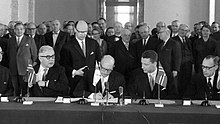
The Nordic region has a political dimension in the joint official bodies called the Nordic Council and the Nordic Council of Ministers. The Helsinki Treaty, signed on 23 March 1962 entered into force on 1 July 1962 and is the political agreement which sets the framework for Nordic cooperation. 23 March is celebrated as the «Nordic Day» as the treaty is sometimes referred to as the constitution of the Nordic cooperation.[69][70][71]
Several aspects of the common market as in the EU have been implemented decades before the EU implemented them. Intra-Nordic trade is not covered by the United Nations Convention on Contracts for the International Sale of Goods (CISG), but by local law. The Nordic countries have cooperated closely in the administrative and consular fields since the Nordic Passport Union was established and the Helsinki Treaty concluded. According to the Helsinki Treaty, public officials in the foreign services of any of the Nordic countries are to assist citizens of another Nordic country if that country is not represented in the territory concerned.[72]
Nordic Council and Nordic Council of Ministers[edit]

Nordic cooperation is based on the Helsinki Treaty.[73] Politically, Nordic countries do not form a separate entity, but they cooperate in the Nordic Council and the Nordic Council of Ministers. The council was established after World War II and its first concrete result was the introduction of a Nordic Passport Union in 1952. This resulted in a common labour market and free movement across borders without passports for the countries’ citizens. In 1971, the Nordic Council of Ministers, an intergovernmental forum, was established to complement the council. The Nordic Council and the Council of Ministers have their headquarters in Copenhagen and various installations in each separate country, as well as many offices in neighbouring countries. The headquarters are located at Ved Stranden No. 18, close to Slotsholmen.
The Nordic Council consists of 87 representatives, elected from its members’ parliaments and reflecting the relative representation of the political parties in those parliaments. It holds its main session in the autumn, while a so-called «theme session» is arranged in the spring. Each of the national delegations has its own secretariat in the national parliament. The autonomous territories – Greenland, the Faroe Islands and Åland – also have Nordic secretariats.[74] The Council does not have any formal power on its own, but each government has to implement any decisions through its country’s legislative assembly. With Denmark, Iceland, and Norway being members of NATO and Finland and Sweden being neutral, the Nordic Council has not been involved in any military cooperation. However, the Nordic foreign and security policy cooperation has become closer and over the past few years expanded its scope.[75][76]
The Nordic Council of Ministers is responsible for inter-governmental cooperation. Prime ministers have ultimate responsibility, but this is usually delegated to the Minister for Nordic Cooperation and the Nordic Committee for Co-operation, which coordinates the day-to-day work. The autonomous territories have the same representation as states.[77]
Nordic model[edit]

Vote percentage over time of the main social democratic parties in Denmark, Finland, Sweden and Norway.
The Nordic countries share an economic and social model, which involves the combination of a market economy with a welfare state financed with heavy taxes. The welfare states were largely developed by strong social democrat parties and in Finland with cooperation with the Agrarian League. Although the specifics differ between countries and there are ongoing political arguments, there is a strong consensus about keeping to the general concept.
A central theme in the Nordic model is the «universalist» welfare state aimed specifically at enhancing individual autonomy, promoting social mobility and ensuring the universal provision of basic human rights, as well as for stabilizing the economy. In this model welfare is not just aid to those who are in need of it, but a central part of the life of everybody: education is free, healthcare has zero or nominal fees in most cases, most children go to municipal day care, etc.
The Nordic model is distinguished from other types of welfare states by its emphasis on maximizing labour force participation, promoting gender equality, egalitarian and extensive benefit levels, the large magnitude of income redistribution and liberal use of expansionary fiscal policy. Trade unions are strong.
The model has been successful: the countries are among the wealthiest worldwide and there is little social unrest. In 2015, Save the Children ranked[78] the Nordic countries as number 1–5 of countries where mothers and children fare the best (among 179 countries studied).
Elections[edit]

Nordic parliaments are all based on a one-chamber system. The Norwegian parliament, the Storting, did actually function as two separate chambers until 2009 when dealing with certain issues. The Icelandic Althing, founded in 930 AD, is reputed to be the oldest working parliament in the world. However, it was dissolved for much of the first half of the 19th century. In Denmark, Iceland and Sweden elections are held at least once every four years. Finland, Åland and Norway have fixed four-year election periods. Elections in the Faroe Islands and Greenland follow the Danish system of elections. The Danish Folketing has 179 seats, including two seats each for the Faroe Islands and Greenland. The Finnish Eduskunta has 200 seats, including one seat for Åland. The Icelandic Althing has 63 seats, the Norwegian Storting 169 seats and the Swedish Riksdag 349 seats. The Faroese Løgting has 32 seats, Greenland’s Inatsisartut 31 seats and Åland’s Lagtinget 30 seats.[79]
Nordic citizens – and in the three member countries of the EU also EU citizens – living in another Nordic country are normally entitled to vote in local government elections after three months of residence, while other foreign citizens have to reside in the Nordic countries for three to four years before they are eligible to vote. In Denmark and the Faroe Islands, the percentage turn-out at elections is close to 90% per cent, but it is only about 67% in Åland and Finland. Men are more often elected to the national assembly compared to women. The biggest bias between the two sexes is seen in the Faroe Islands and Åland, while in Sweden men and women are close to being equally represented in the national assembly.[80]
Nordic Passport Union[edit]

The Nordic Passport Union, created in 1954 and implemented on 1 May 1958, allows citizens of the Nordic countries: Denmark (Faroe Islands included since 1 January 1966, Greenland not included), Sweden, Norway (Svalbard, Bouvet Island and Queen Maud Land not included), Finland and Iceland (since 24 September 1965) to cross approved border districts without carrying and having their passport checked. Other citizens can also travel between the Nordic countries’ borders without having their passport checked, but still have to carry some sort of approved travel identification documents. During the 2015 European migrant crisis, temporary border controls were set up between Denmark and Sweden to control the movement of refugees into Sweden.[81]
Since 1996, these countries have been part of the larger EU directive Schengen Agreement area, comprising 30 countries in Europe. Border checkpoints have been removed within the Schengen Area and only a national ID card is required. Within the Nordic area any means of proving one’s identity, e.g. a driving licence, is valid for Nordic citizens because of the Nordic Passport Union. When traveling to other countries than the Nordics, public officials in the foreign services of any of the Nordic countries are to assist citizens of another Nordic country if that country is not represented in the territory concerned, according to the Helsinki Treaty.[82]
Since 25 March 2001, the Schengen acquis has fully applied to the five countries of the Nordic Passport Union (except for the Faroe Islands). There are some areas in the Nordic Passport Union that give extra rights for Nordic citizens, not covered by Schengen, such as less paperwork if moving to a different Nordic country and fewer requirements for naturalisation.
European integration and international cooperation[edit]
| Organisation | Denmark | Finland | Iceland | Norway | Sweden |
|---|---|---|---|---|---|
| CoE | Yes | Yes | Yes | Yes | Yes |
| Nordic Council | Yes | Yes | Yes | Yes | Yes |
| EEA | Yes | Yes | Yes | Yes | Yes |
| EFTA | No | No | Yes | Yes | No |
| EU | Yes | Yes | No | No | Yes |
| Eurozone | No | Yes | No | No | No |
| Schengen Area | Yes | Yes | Yes | Yes | Yes |
| NATO | Yes | No | Yes | Yes | No |
| OECD | Yes | Yes | Yes | Yes | Yes |
| UN | Yes | Yes | Yes | Yes | Yes |
| WTO | Yes | Yes | Yes | Yes | Yes |
The political cooperation between the Nordic countries has not led to a common policy or an agreement on the countries’ memberships in the EU, Eurozone and NATO. Norway and Iceland are the only Nordic countries not members of the EU – both countries are instead members of EFTA. Finland and Sweden are the only Nordic countries not members of NATO. Denmark alone participates in both organizations. Only Finland is a member of the Eurozone. The Nordics are however all part of the European lex. The tasks and policies of the EU overlap with the Nordic Council significantly, e.g. the Schengen Agreement, Freedom of movement for workers in the European Union and Free Movement Directive partially supersedes the Nordic passport-free zone and the common Nordic labor market. The Schengen Area covers all the Nordic countries, excluding the Faroe Island and Svalbard.
Additionally, certain areas of Nordic countries have special relationships with the EU. For example, Finland’s autonomous island province Åland is not a part of the EU VAT zone.
In the EU, the Northern Dimension refers to external and cross-border policies covering the Nordic countries, the Baltic countries and Russia.
There is no explicit provision in the Treaty on European Union or Treaty on the Functioning of the European Union that takes Nordic cooperation into account. However, the Treaties provide that international agreements concluded by the Member States before they become members of the Union remain valid, even if they are contrary to the provisions of Union law. Each Member State must nonetheless take all necessary measures to eliminate any discrepancies as quickly as possible. Nordic cooperation can therefore in practice only be designed to the extent that it complies with Union law. Sweden and Finland issued a joint declaration when they joined the EU:[83] «The Contracting Parties notes that Sweden […] and Finland, as members of the European Union, intend to continue their Nordic co-operation, both with each other and with other countries and territories, in full compliance with Community law and other provisions of the Maastricht Treaty.»
Article 121 of the EEA-agreement states that «the provisions of the Agreement shall not preclude cooperation: (a) within the framework of the Nordic cooperation to the extent that such cooperation does not impair the good functioning of this Agreement».[84]
Current leaders[edit]
All the Nordic countries are long-established parliamentary democracies. Denmark, Norway and Sweden have a political system of constitutional monarchy, in which a nonpolitical monarch acts as head of state and the de facto executive power is exercised by a cabinet led by a prime minister. Margrethe II has reigned in Denmark as Queen Regnant and head of state since 14 January 1972, Carl XVI Gustaf became King of Sweden on 15 September 1973 and King Harald V of Norway has reigned since 17 January 1991.
Finland and Iceland have been parliamentary republics since their independence. Both countries are led by prime ministers, whilst the directly elected president acts mostly as a ceremonial head of state with some legislative power. Finland had a long tradition of having a strong presidential system, since in the beginning of its independence Prince Frederick Charles of Hesse was elected to the throne of Finland and Finland was to become a monarchy. This failed due to World War I and the fall of the German Empire and so it was a compromise that Finland became a republic with a strong head of state. The President’s powers were once so broad that it was said Finland was the only real monarchy in northern Europe. However, amendments passed in 1999 reduced his powers somewhat and the President now shares executive authority with the Prime Minister.[85]
- Heads of state
-

-

-

-

-


- Prime ministers
-
-

-

-
-




- Speakers of Parliament
-

-
-
-
-


![Finland Matti Vanhanen Speaker of the Eduskunta since 2022[86]](https://upload.wikimedia.org/wikipedia/commons/thumb/0/02/2020-03-02_Matti_Vanhanen_%28cropped%29.jpg/90px-2020-03-02_Matti_Vanhanen_%28cropped%29.jpg)


- Leaders of the largest party in opposition
-
-
-

-

-


Economy[edit]

Copenhagen Central Station with S-Trains

The Nordic economies are among the countries in the Western world with the best macroeconomic performance in the recent ten years. Denmark, Finland, Norway and Sweden have for example experienced constant and large excess exports in recent years. Iceland is the only country which has balance of payments deficits as of 2011. At the same time, unemployment is low in most of the Nordic countries compared with the rest of Europe. As a result of the cyclical down-turn, the public balance is now in deficit, except for Norway. Over the past ten years, the Nordic countries had a noticeably larger increase in their gross domestic product (GDP) than the Eurozone. The only exceptions were Denmark and Åland which had a lower growth. Measured by GDP per capita, the Nordic countries have a higher income than the Eurozone countries. Norway’s GDP per capita is as high as 80 per cent above the EA17 average and Norway is actually one of the countries with the highest standard of living in the world.[87]
However, after the financial crisis of 2007–2008 and the following recession all the Nordic countries have been affected by the global crisis though to varying degrees. Iceland was most affected and had an economic crisis from 2008 to 2011, but GDP growth was also negative in all the other Nordic countries in 2008 and 2009. From 2009 most of the Nordic countries experienced growth again. The Nordic Council has set an objective for Nordic cooperation to achieve stable and sustainable economic growth, development of the Nordic welfare model, economic integration in the Nordic region and the promotion of joint Nordic interests at international level.[88]
Private consumption has fallen during the crisis, but it gained pace again from 2010 onward. The decline was most profound in Denmark, Finland and Iceland. On the other hand, public consumption has experienced positive growth rates – except for Iceland since 2008 and Denmark since 2010. The general rise is due to the many fiscal initiatives made by the Nordic governments to support economic growth and the financial and business sectors. From 2006 Iceland has experienced a fall in gross capital formation. This is after many years with an Icelandic growth particularly driven by investments, which had more than tripled in the recent ten years. Iceland also holds a leading position compared to the other Nordic countries regarding growth in public consumption in the years from 2000 to 2008.[89]
Recent years’ large balance-of-payments surplus in Denmark, Finland, Norway and Sweden has reduced the countries’ foreign debt. In addition to a balance-of-payments surplus or deficit, the size of a country’s foreign debt and foreign assets is affected by the exchange rate and the price of securities. Consequently, Finland’s foreign debt increased noticeably when the price of technology shares increased drastically in the late 1990s due to a large proportion of these shares being owned by households, funds and companies abroad. In this way, these foreign owners held a greater claim on Finland. When share prices decreased drastically in 1999–2001 in the dot-com bubble, it also led to a marked decrease in Finland’s net foreign debt. Iceland’s foreign net debt accounts for close to five times of its GDP. This means that Iceland owes the surrounding world values corresponding to five times the country’s total production. Sweden also had foreign debts by the end of 2010, but at a much smaller scale. In 2012, all Nordic countries had a surplus on the total balance of payments. Norway accounts for a substantial foreign exchange surplus, which is due to revenue from exports of oil and gas.[90]
Industries[edit]

Since the late 1990s, the Nordic manufacturing industry has accounted for a slightly declining proportion of the gross domestic product, with Norway being a distinct exception. In Norway, the manufacturing industry’s proportion of GDP is still at a high level of around 35 per cent due to the large oil and natural gas sector. In the rest of the Nordic countries, the proportion lies between 15 and 20 per cent. Despite growing production, the manufacturing industry accounts for a decreasing proportion of total employment in the Nordic countries. Among the Nordic countries, Finland is today the number one Nordic industrial country, as the manufacturing industry in Finland accounts for the greatest proportion of the country’s jobs, around 16 per cent. By way of comparison, in Denmark, Norway and Iceland it only accounts for less than 13 per cent of total employment.[91]
The service sector has increased drastically in all Nordic countries in the last 15 years and today accounts for about three fourths of all employed persons. Denmark, Norway, Iceland, Sweden and Åland have the largest proportion of employed in the service sector, between 75 and more than 90 per cent of those employed, while the corresponding figure is 72 per cent in Finland and 70 per cent in Iceland. The service sector is a little smaller if its proportion of total gross domestic product is measured compared to the share of employment. In Norway, the service sector accounts for 57 per cent of GDP, in Iceland for 66 per cent, in Finland for 69 per cent, in Sweden for 72 per cent and in Denmark for 78 per cent. The service sector includes retail and wholesale trade, hotels, restaurants, transportation, communication, financial services, real estate sale, renting, business services and other services such as teaching and care of children, sick persons and the elderly – services which are typically rendered by the public sector in the Nordic countries.[92]
Foreign investments[edit]
Iceland and Sweden have the highest rate of foreign direct investment, both with regards to foreign companies investing in Iceland and Sweden and Icelandic and Swedish companies investing abroad. However, in 2011 Denmark superseded Sweden regarding outward investments. Looking at a larger time span of ten years, most of the Nordic countries have experienced growth in both inward and outward investments.
However, Iceland has been in a league of its own in this area. Foreign investment from Iceland increased significantly and sharply especially from 2003 to 2007 from 16 to 123 per cent of GDP. The expansion of Icelandic companies into foreign markets was a rapid process. Strong pension funds provided capital for investments, and the privatization of the banking system made new sources of financing available for companies wishing to expand their operations. Also inward investment to Iceland increased sharply from 2003, but at a more moderate level compared with other Nordic countries. This pattern changed in 2007 with dramatic decreases in both outward and inward foreign direct investment.[93]
Foreign and intra-Nordic trade[edit]

Nordic cooperation is characterized largely by the international community and the global challenges and opportunities. The Nordic countries, which are relatively small, have historically and still are benefiting greatly by obtaining common use in cooperation with other countries and institutions. The Nordic economies are small and open and thus the countries are export-depending. Foreign trade constitutes an important part of the economic activity. Nordic foreign trade in goods, measured as the average of imports and exports, amounts to more than one fourth of GDP in the Nordic countries. All the Nordic countries except Finland had a surplus in their balance of trade in 2012 and every year since 1995 Denmark, Norway and Sweden have all had greater exports than imports.[94]
The trade between the Nordic countries is especially considerable as about one fifth of the countries’ foreign trade is trade with other Nordic countries. The total population of the Nordic countries of around 26 million people makes them to a far greater extent dependent on each other with respect to exports and imports, compared to for example Germany with a population of 82 million people. Swedish exports to the other Nordic countries account for a considerably higher share than combined Swedish exports to Germany and France – despite the fact that the total population of Germany and France is 147 million people, while Denmark, Finland, Iceland and Norway only have a total population of 16 million. In 2012, around 23 per cent of the total exports from both Denmark and Sweden went to other Nordic countries. Other Nordic countries account for 16 per cent of Finnish exports, 13 per cent of Norwegian exports and 10 per cent of the total exports in Iceland.[95]
In addition to the other Nordic countries, The EU is the largest trading partner for the Nordic countries. Especially important is trade with Germany, Belgium and the Netherlands. Outside of Europe, the United States is also a major trading partner. A common characteristic in the exports of the Nordic countries is a concentration on a few products. The exports of Greenland and the Faroe Islands are entirely dominated by fish and fish products, to a lesser extent in Iceland where aluminium exports also contribute significantly. Oil and gas are the predominant products exported by Norway and Finnish exports are dominated by wood, paper and paper products and telecommunication equipment. Danish and Swedish exports are more equally distributed on different products, with processed food, pharmaceuticals and chemical products as the major Danish export products and cars, wood, paper products and telecommunication equipment as predominant in Swedish exports. Germany is completely dominant when it comes to Nordic imports. However, the Nordic countries also have considerable imports from the Netherlands, China and Russia.[96]
Energy[edit]

The Nordic region is one of the richest sources of energy in the world. Apart from the natural occurrence of fossil fuels such as oil and gas, the Nordic countries also have good infrastructure and technology to exploit renewable energy sources such as water, wind, bio-energy and geothermal heat. Especially Iceland and Norway, but also Finland and Sweden, have a significant production of electricity based on hydro power. Geothermal energy production is the most important
source of energy in Iceland, whilst nuclear power is produced in both Finland and in Sweden. The indigenous production of energy in the Nordic countries has risen considerably over the last couple of decades – especially in Denmark and Norway due to oil deposits in the North Sea.[97]
The most important energy sources in the Nordic countries measured in terms of energy supply in million toe (tonnes oil equivalent) are in order of importance: oil, solid fuels (e.g. coal and wood), nuclear power, hydro and geothermal power and solar energy and gas. In the EU, the most important source of energy is also oil, but gas comes in second. Hydro and geothermal power and other renewable sources of energy are major sources in the Nordic countries as compared to the EU countries. Particularly in Iceland and Norway, hydro and geothermal power constitute a major share of the overall energy supply. Denmark depends almost entirely on thermal power generated from coal, oil and gas. Iceland obtains a substantial part of its energy for heating from geothermal energy and depends almost entirely upon hydro-power resources for its production of electricity.[98]
Tourism[edit]
The Nordic countries in order of popularity with tourists are Sweden, Norway, Denmark, Finland then Iceland.[99]
Demographics[edit]
| Country | Capital | Population | Area (km2) |
|---|---|---|---|
| Denmark | Copenhagen | 5,748,769[100] | 42,894 |
| Greenland | Nuuk | 55,877[101] | 2,166,086 |
| Faroe Islands | Tórshavn | 50,778[102] | 1,396 |
| Finland | Helsinki | 5,509,717[103] | 338,534 |
| Åland | Mariehamn | 29,489[104] | 1,580 |
| Iceland | Reykjavík | 350,710[105] | 103,440 |
| Norway | Oslo | 5,295,619[106] | 385,203 |
| Sweden | Stockholm | 10,313,447[107] | 447,420 |

At the beginning of the 20th century, almost 12 million people lived in the Nordic countries. Today, the population has increased to 27 million people. The Nordic countries have one of the lowest population densities in the world. The low density is partly due to the fact that many parts of the Nordic countries are marginal areas, where nature puts limitations on settlement. In four out of five Nordic countries,[which?] around 20 per cent of the population is to be found in the vicinity of the respective capitals. In Iceland, this percentage is even higher, with more than 60 per cent of Icelanders residing at or nearby the capital city of Reykjavík.[65]
During the past 100 years, the population growth has been strongest in Greenland, where the population has multiplied by almost five, from 12,000 to 56,000 people. In Iceland, the increase has gone from 78,000 to 322,000 people. The population on the Faroe Islands has more than tripled, from 15,000 to 48,000 people. The Swedish and Ålandic populations are the only ones that have not at least doubled.[citation needed] Since 1990, the total population in the Nordic countries has increased by more than 2.8 million people (12 per cent) – the most in Iceland (27 per cent) and in Norway and Åland by 19 and close to 18 per cent. Certain regions in Finland, Norway and Sweden have experienced a decline in the population due to urbanization, but at the national level all the Nordic countries have experienced growth. Compared to 2005, both the Faroe Islands and Greenland have experienced a minor decline in the population. Iceland has also experienced shorter periods with a declining population. The Danish population is expected to increase by 8 per cent until 2035, while Finland and Sweden expect an increase in the population of about 10 and almost 16 per cent respectively.[108]
Life expectancy is rising in all the Nordic countries, though the levels vary greatly. Life expectancy for men in Greenland is 68.3 years (2011), compared to 80.8 years for men in Iceland. Women in the Faroe Islands and in Åland are expected to live the longest – more than 84 years. The population in the Nordic countries is getting older and according to the population projection for the Nordic countries as a whole, the share of the population above the age of 80 will reach 8.4 per cent in 2040, as compared to the 2013 level of 4.7 per cent. The share of population 80 years or older has increased from 1990 to 2013. The increase in the share of people above the age of 80 over the last 10 years is partly due to the fact that the death rate has fallen for almost all age groups and partly that the number of births has been low during the same period. In the next 25 years, the demographic dependency ratio is expected to have the strongest growth in Finland and Åland. According to the most recent population forecasts in Finland and Åland, in 2030 it is expected that people over 65 will make up 50 per cent of the adult population. Sweden and Denmark can look forward to a relatively modest increase in the next decades. Iceland and Norway seem to maintain their positions with the lowest proportions of elderly people in the Nordic countries.[109]
Languages[edit]
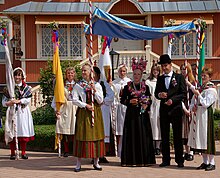
Historical reenactment of a farmer wedding in Jomala, Åland
Most of the Nordic languages belong to one of three linguistic families: North Germanic languages, Finno-Ugric languages and Eskimo–Aleut languages. Although the area is linguistically heterogeneous, with three unrelated language groups, the common linguistic heritage is one of the factors making up the Nordic identity.[110]
Danish, Faroese, Icelandic, Norwegian and Swedish belong to the North Germanic branch of the Indo-European languages. The languages have developed from a common Nordic language, but have moved away from each other during the past 1000 years. However, it is still possible for Danish, Norwegian and Swedish speakers to understand each other. These languages are taught in school throughout the Nordic countries: for example, Swedish is a mandatory subject in Finnish schools, whereas Danish is mandatory in Icelandic and Faroese schools. Approximately 5,3 per cent of population of Finland speak Swedish as their mother tongue.[111]
In the Finnish-Sami group of the Finno-Ugric languages, Finnish is the most widely spoken language in the Nordic countries. However, other languages in this family are also spoken in the region. Various Sami languages are spoken in northern Finland, Norway and Sweden. Karelian is spoken a little in Finland, the Kven language in Norway and Meänkieli or «Torne Valley Finnish» in Sweden. Finns are also the largest immigrant group in Sweden, around 4.46 per cent of the total population; and Finnish is an official minority language of Sweden.[112][113]
Greenlandic or Kalaallisut belongs to the Inuit branch of the Eskimo-Aleut languages and is spoken in Greenland. The language is related to a number of languages spoken in northern Canada and Alaska. As of 2009, the Greenland Home rule does not require Danish to be taught or the use of Danish for official purposes.[114]
A number of other minority languages also exist in the region. German is spoken by a minority in Southern Jutland and their cultural and language rights are protected by the government. Finnish Kale, Norwegian and Swedish Travellers and other Romani peoples of the Nordic countries have the right to maintain and develop their language and culture. Yiddish is also an official minority language in Sweden. Besides the so-called «natural» languages national variants of sign languages are used. The Icelandic Sign Language is derived from the Danish, while the Finnish Sign Language is developed on the basis of the Swedish variant. The right to use sign language is set in the Finnish Language Act and in Sweden the Swedish Sign Language is an official minority language.[115]
-

The Finnic languages in Northern Europe

Migration[edit]
In 2012, net migration had the greatest impact on the population increase in Sweden. That was also the case with Denmark, Finland, Åland and Norway. In the Faroe Islands, Greenland and Iceland, natural population increase had the greatest impact on the population change, but both Greenland and the Faroe Islands still had a slight decrease in the population due to a negative net migration in 2012.
A large proportion of the migration in the Nordic countries occurs between and among the countries themselves, largely as the result of the free labour market and liberal rules for the exchange of students in the Nordic countries. The trend has led to an increasing number of foreign citizens in the Nordic countries during the past few decades. In all the countries, the major part of the foreign citizens is non-Nordic. That is not the case for Greenland and the Faroe Islands, which have a high proportion of other Nordic citizens. Non-nationals range from 47 per cent of the total immigration in Iceland, to 89 per cent in Norway. In 2013 the largest proportions of non-nationals were in Norway and Denmark, where they account for 8.9 and 8.8 per cent of the population. The proportion
of non-nationals in the Finnish population is small compared to the other Nordic countries – 3.6 per cent in 2013 – but the proportion has risen significantly during and after the 1990s.[116]
Sami people[edit]

The Sami people, also spelled Sámi or Saami, are a Finno-Ugric people who have their traditional settlement areas in northern Finland, Norway and Sweden and Western Russia. Most Sami live in Norway, followed by Sweden and Finland, while the fewest Sami live in Russia. Because the countries do not make an official record of who has the Sami identity or background,[clarification needed] no one knows the exact number of the Sami people. The Sami are the only indigenous people of the Nordic countries excluding Greenland that are recognized and protected under the international conventions of indigenous peoples. They are hence the northernmost indigenous people of Europe. There are several Sami languages.
Traditionally, the Sami have plied a variety of livelihoods, including coastal fishing, fur trapping and sheep herding. However, the best known Sami livelihood is semi-nomadic reindeer herding. For traditional, environmental, cultural and political reasons, reindeer herding is legally reserved only for Sami people in certain regions of the Nordic countries. Nowadays, the Sami work in all sectors, in line with the non-Sami population, though the primary industries are still important culture bearers for the Sami people.
-

Share of total population of the Nordic countries by country in January 2013
-

Marriages and divorces in the Nordic countries in 2012
-

Immigrants in the Nordic countries in 2012


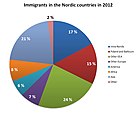
Culture[edit]

Faroese folk dancers in national costumes
Nordic countries have historically been one of the most socially progressive cultures in the world and culture is one of the main components of cooperation between the Nordic countries. The policies of the Nordic countries with respect to cultural life, mass media and religion have many shared values and features in common. However, some differences may be pointed out and for instance cultural institutions arising from historical circumstances. In both Denmark and Sweden, there are cultural institutions with roots in the traditions of the royal courts. In these countries, national institutions formed the foundation of cultural life at an early stage while in Norway cultural institutions began to form later.[117]
Iceland has the highest government expenditure on culture, a total of 3.3 per cent of its GDP in 2011. Denmark comes second with a total of 1.6 per cent of GDP in 2011. Sweden spend the least in 2011 with 1.1 per cent. Looking at per capita expenditure, Iceland again has the highest expenditure with Norway coming second. Greenland spends the third highest amount on culture and leisure per capita. In Iceland and Norway, expenditures have more than doubled since 2000. In the other Nordic countries, expenditures have gone up between 40 and 50 per cent in the same period.[118]
Denmark has the most museums, a total of 274, but museums in Åland and Iceland have the most visitors, an average of 4 and 5 visits per inhabitant. Many theatres in the Nordic countries receive public funding. Theatre funding constitutes a major share of allocations within the cultural area in all the countries. All countries have national theatres, where plays, ballets and operas are performed. In addition to the national theatres, there are professional regional theatres, which are also supported by the state, counties or municipalities. Most countries also have a few private theatres and many amateur ensembles, which may be supported at least partially by municipalities, primarily.[119]
Nordic Culture Fund, established in 1966, aims to support a broad spectrum of cultural cooperations between the Nordic countries. The Fund’s ambition is to enable talented artists, both professionals and amateurs, to enrich each other via the cultural diversity that exists among the 26 million or more people of the Region. Its activities are based on an agreement between the Nordic countries, which came into force in 1967. The Fund receives its money in the form of an annual grant from the Nordic Council of Ministers.[120]
Music[edit]

Nordic countries share certain traditions in music, many of which have diverged significantly. In folk music, Denmark, Iceland, Norway, Sweden and the Faroe Islands share many common aspects. Greenland’s Inuit culture has its own musical traditions, influenced by Scandinavian culture. Finland shares many cultural similarities with both the other Nordic countries as well as Estonia. The Sami have their own unique culture, with ties to the neighboring cultures.
Art music has a strong position in Nordic countries. Apart from state-owned opera houses, there are symphony orchestras in most major cities. The most prominent historical composers from Nordic countries are the Finn Jean Sibelius, the Dane Carl Nielsen and the Norwegian Edvard Grieg. Of contemporary composers, the Finns Magnus Lindberg, Kaija Saariaho and Esa-Pekka Salonen are among the most often performed in the world.
Rock and roll influences that came from the United States and United Kingdom were the start of the Nordic pop scene, but influences from the Nordic folk music can still be found today in popular music. Common characteristic in Nordic pop music is that it can often be either very lighthearted pop music or very dark metal. Some of the most well-known Nordic music groups include ABBA, Ace of Base, a-ha, Aqua, Björk, The Cardigans, Europe, Hanoi Rocks, Roxette, The Rasmus, Kaizers Orchestra and The Spotnicks. Sweden and Finland have possibly the largest music industries in the area, especially Sweden which is the largest exporter of pop music per capita and the third largest overall after the United States and the United Kingdom. Norway, Iceland and Denmark have all had successful domestic record industries for many years.[121][122]
The Nordic metal scene is highly visible compared to other genres from the region. Many big names such as Amon Amarth, Children of Bodom, In Flames, Meshuggah and Opeth originate from the Nordic countries. Nordic metal bands have had a long and lasting influence on the metal subculture alongside their counterparts in the United Kingdom and the United States. The black metal genre was developed in Norway by bands such as Mayhem, Darkthrone, Burzum, Immortal and Emperor and the related genre of Viking metal was developed throughout the Nordic region by bands such as Bathory, Enslaved, Burzum, Emperor, Einherjer, Moonsorrow and Amon Amarth.
Since 2000, the total sale of music has declined by almost 50 per cent in all the Nordic countries and at the same time the digital sale has increased (digital sales cover both downloads and streaming of music). In Denmark, Norway and Finland, the sale of digital music has increased by 400 per cent since 2006 and now amounts to 39, 27 and 25 per cent of the total sale in 2010/2011. In Denmark and Sweden, sales of digital music rose almost eight-fold in the same period and now represent 51 per cent of the total sale. In Iceland, digital sales still only represent three per cent of the total sale.[123]
Literature[edit]


The earliest written records from Scandinavia are runic inscriptions on memorial stones and other objects. Some of those contain allusions to Norse mythology and even short poems in alliterative verse. The best known example is the elaborate Rök runestone (c. 800) which alludes to legends from the migration age. The oldest of the Eddic poems are believed to have been composed in the 9th century, though they are only preserved in 13th-century manuscripts. They tell of the myths and heroic legends of Scandinavia. Skaldic poetry is mostly preserved in late manuscripts but was preserved orally from the 9th century onwards and also appears on runestones, such as the Karlevi Runestone. In Iceland the sagas of Icelanders are the best-known specimens of Icelandic literature. In Finland the most famous collection of folk poetry is by far the Kalevala, which is the national epic of the country.
Nordic countries have produced important and influential literature. Henrik Ibsen, a Norwegian playwright, was largely responsible for the popularity of modern realistic drama in Europe, with plays like The Wild Duck and A Doll’s House. His contemporary, Swedish novelist and playwright August Strindberg, was a forerunner of experimental forms such as expressionism, symbolism and surrealism. Nobel prizes for literature have been awarded to Selma Lagerlöf, Verner von Heidenstam, Karl Adolph Gjellerup, Henrik Pontoppidan, Knut Hamsun, Sigrid Undset, Erik Axel Karlfeldt, Frans Eemil Sillanpää, Johannes Vilhelm Jensen, Pär Lagerkvist, Halldór Laxness, Nelly Sachs, Eyvind Johnson, Harry Martinson and Tomas Tranströmer. World-famous Nordic children’s book writers include Hans Christian Andersen, Tove Jansson and Astrid Lindgren.
Since 1962, the Nordic Council has awarded a literature prize once a year for a work of fiction written in one of the Nordic languages. Since its establishment, the prize has been won by 15 Swedish, 10 Danish, 10 Norwegian, 8 Finnish, 7 Icelandic, 2 Faroe and 1 Sami writers.[124]
Nordic libraries function as information centres with a wide variety of services and access to all kinds of printed and electronic media. In the last twenty years, there has been an overall decline in stock and lending of books in public libraries. Despite the general decline in stock and loans, most of the Nordic countries have had an increase in the lending of other media than books. Since 2000, the stock of other media has increased between 30 and 85 per cent in the Nordic countries. The lending of books has at the same time decreased in all Nordic countries, a decline between 10 and 20 per cent.[125]
Art[edit]
- Examples of nordic art from the 19th century
-

-


![[icon]](https://upload.wikimedia.org/wikipedia/commons/thumb/1/1c/Wiki_letter_w_cropped.svg/20px-Wiki_letter_w_cropped.svg.png) |
This section needs expansion. You can help by adding to it. (July 2016) |
National symbols[edit]

The Nordic countries, including the autonomous territories of the Faroe Islands and Åland, have a similar flag design, all based on the Dannebrog, the Danish flag.[126] They display an off-centre cross with the intersection closer to the hoist – the «Nordic cross» or «Scandinavian cross»[127]– however each has a different aspect ratio. Greenland and Sápmi have adopted flags without the Nordic cross, but they both feature a circle which is placed off-centre, similar to the cross.
See also[edit]
Associated[edit]
- Climate of the Nordic countries
- Comparison of the Nordic countries
- Subdivisions of the Nordic countries
- Universal basic income in the Nordic countries
Others[edit]
- Baltic region
- Baltoscandia
- British Isles
- Nordic-Baltic Eight
- Nordic identity in Estonia
Notes[edit]
- ^ Including Queen Maud Land (2,700,000 km2), which is claimed by Norway and recognized by Australia, France, New Zealand and the United Kingdom.
- ^ Two unincorporated territories in the Arctic Ocean, Svalbard and Jan Mayen, are considered integral parts of the Kingdom of Norway and are sometimes included in definitions of the Nordic countries.[3] Norway’s three dependencies in the Southern Hemisphere (Bouvet Island and two areas subject to the Antarctic Treaty System, Peter I Island and Queen Maud Land), all of which are uninhabited and geographically remote from the Nordic region, are not generally included in the term.
References[edit]
- ^ «Report for Selected Countries and Subjects». www.imf.org.
- ^ Leaders (2 February 2013). «The next supermodel». The Economist. ISSN 0013-0613. Retrieved 22 March 2022.
- ^ «Facts about Norway | Nordic cooperation». 5 January 2022. Archived from the original on 5 January 2022. Retrieved 18 May 2022.
- ^ Kronvall, Alf (n.d.). «Facts about the Nordic countries». Nordic Co-operation. The Nordic Council and the Nordic Council of Ministers. Archived from the original on 20 March 2022. Retrieved 22 March 2022.
- ^ Munch Haagensen, Klaus (2013). Nordic Statistical Yearbook. Nordic Council of Ministers. p. 8. doi:10.6027/Nord2013-001. ISBN 978-92-893-2350-5.
- ^ Lane, Kenworthy (3 December 2013). Social Democratic America. New York City: Oxford University Press. p. 138. ISBN 9780199322527.
- ^ Hicks, Alexander (20 January 2000). Social democracy and Welfare Capitalism: A Century of Income Security Politics. Cornell University Press. p. 130. ISBN 978-0801485565.
By the late 1950s, labor had been incorporated alongside Swedish business in fully elaborated corporatist institutions of collective bargaining and policy making, public as well as private, supply-side (as for labour training) as well as demand side (e.g., Keynesian). During the 1950s and 1960s, similar neocorpratist institutions developed in Denmark and Norway, in Austria and the Netherlands, and somewhat later, in Belgium and Finland.
- ^ Sandbu, Martin (28 August 2018). «What the Nordic mixed economy can teach today’s new left». Financial Times. Retrieved 3 December 2019.
- ^ «Protestantism in the Scandinavian countries». Musée protestant. Retrieved 30 December 2018.
- ^ Markkola, Pirjo (2015). «The Long History of Lutheranism in Scandinavia. From State Religion to the People’s Church» Archived 29 August 2019 at the Wayback Machine. Perichoresis. 13 (2): 3–15. doi:10.1515/perc-2015-0007.
- ^ «Scandinavia». In Merriam-Webster’s Online Dictionary. Retrieved 10 January 2008: «Scandinavia: Denmark, Norway, Sweden – sometimes also considered to include Iceland, the Faeroe Islands, & Finland.» (Merriam-Webster Online Dictionary defines «Nordic» as an adjective dated to 1898 with the meaning «of or relating to the Germanic peoples of northern Europe and especially of Scandinavia.»).
- ^ «Scandinavia» (2005). The New Oxford American Dictionary, Second Edition. Ed. Erin McKean. Oxford University Press, ISBN 0-19-517077-6: «a cultural region consisting of the countries of Norway, Sweden, and Denmark and sometimes also of Iceland, Finland, and the Faroe Islands».
- ^ Scandinavia (2001). The Columbia Encyclopedia, Sixth Edition. Retrieved 31 January 2007: «Scandinavia, region of N Europe. It consists of the kingdoms of Sweden, Norway, and Denmark; Finland and Iceland are usually, but incorrectly, considered part of Scandinavia».
- ^ Scandinavia (2007). Encyclopædia Britannica. Retrieved 31 January 2007, from Encyclopædia Britannica Online: «Scandinavia, historically, part of northern Europe, generally held to consist of the two countries of the Scandinavian Peninsula, Norway and Sweden, with the addition of Denmark».
- ^ Scandinavia Archived 28 October 2009 at the Wayback Machine (2006). Microsoft Encarta Online Encyclopedia. Retrieved 30 January 2007: «Scandinavia (ancient Scandia), name applied collectively to three countries of northern Europe – Norway and Sweden (which together form the Scandinavian Peninsula), and Denmark». Archived 1 November 2009.
- ^ Saetre, Elvind (1 October 2007). «About Nordic co-operation». Nordic Council of Ministers & Nordic Council. Archived from the original on 26 March 2014. Retrieved 9 January 2008.
The Nordic countries consist of Denmark, the Faroe Islands, Greenland, Finland, Åland, Iceland, Norway and Sweden.
- ^ Caplex. Leksikon, atlas, tabellverk. Oslo: Cappelen, 1997.
- ^ a b c d e f g h i j k l m n o p «Europe :: Denmark». The World Factbook. CIA. 26 May 2022.
- ^ a b c d e f g h i j k l m «Europe :: Finland». The World Factbook. CIA. 26 May 2022.
- ^ a b c d e f g h i j k l «Europe :: Iceland». The World Factbook. CIA. 26 May 2022.
- ^ a b c d e f g h i j k l m n o p q r «Europe :: Norway». The World Factbook. CIA. 26 May 2022.
- ^ a b c d e f g h i j k l m n «Europe :: Sweden». The World Factbook. CIA. June 2022.
- ^ «Hvert er formlegt heiti landsins okkar?». Vísindavefurinn (in Icelandic). Retrieved 15 October 2016.
- ^ «Norway, Ethnologue».
- ^ «Population statistics».
- ^ «Regeringen». Valtioneuvosto (in Swedish). Archived from the original on 6 June 2019. Retrieved 10 June 2019.
- ^ «Klart: Ulf Kristersson framröstad som tillträdande statsminister». SVT. Retrieved 18 October 2022.
- ^ a b c d Population structure Statistics Finland
- ^ a b c d «Populations by religious and life stance organisations 1998–2020». Reykjavík, Iceland: Statistics Iceland.
- ^ Church of Norway 17 June 2020 Statistics Norway
- ^ Members of Christian communities outside the Church of Norway. 8 December 2020 Statistics Norway
- ^ Members of religious and life stance communities outside the Church of Norway 8 December 2020 Statistics Norway
- ^ a b c d e f g «World Economic Outlook Database». International Monetary Fund. April 2016.
- ^ a b c d e f g «GDP (current US$)» (PDF). World Development Indicators. World Bank. Retrieved 2 July 2015.
- ^ a b c d e f g «GDP and its breakdown at current prices in US Dollars». United Nations Statistics Division. December 2015.
- ^ a b c d e f g «GDP (Official Exchange Rate)». The World Factbook. Central Intelligence Agency. Archived from the original on 13 June 2007. Retrieved 4 June 2015.
- ^ a b c d e f g h Some data refers to IMF staff estimates but some are actual figures for the year 2015, made in April 2016. World Economic Outlook Database April 2016, International Monetary Fund. Accessed on 12 April 2016.
- ^ a b c d e f g h Data refer mostly to the year 2014. [1] (selecting all countries, GDP per capita (current US$), World Bank. Accessed on 9 July 2015.
- ^ a b c d e f g h National Accounts Main Aggregates Database, December 2014, (Select all countries, «GDP, Per Capita GDP – US Dollars», and 2014 to generate table), United Nations Statistics Division. Accessed on 4 January 2016.
- ^ a b c d e f g h «Report for Selected Country Groups and Subjects (PPP valuation of country GDP)». IMF. Retrieved 13 June 2016.
- ^ a b c d e f g h «Gross domestic product 2014, PPP» (PDF). The World Bank: Data. World Bank. 2 July 2015. Retrieved 2 July 2015. European Union calculated by sum of individual countries.
- ^ a b c d e f g h «The World Factbook». Central Intelligence Agency. Archived from the original on 13 June 2007.
- ^ a b c d e f g World Economic Outlook Database, April 2016, International Monetary Fund. Database updated on 12 April 2016. Accessed on 14 April 2016.
- ^ a b c d e f g «GDP per capita, PPP (current international $)», World Development Indicators database, World Bank. Database updated on 11 April 2016. Accessed on 14 April 2016.
- ^ a b c d e f g GDP – per capita (PPP), The World Factbook, Central Intelligence Agency. Accessed on 7 March 2014.
- ^ a b c d e f g «Real GDP growth rate». Central Intelligence Agency. Retrieved 21 August 2021.
- ^ «Puolustusmenot». Puolustusministeriö (in Finnish). Retrieved 5 February 2021.
- ^ «2014». The Military Balance. 114: 88–90. ISSN 0459-7222.
- ^ «Reservissä – Reserviläinen – Intti.fi». intti.fi (in Finnish). Retrieved 5 February 2021.
- ^ «2014». The Military Balance. 114: 108. ISSN 0459-7222.
- ^ «2014». The Military Balance. 114: 123–26. ISSN 0459-7222.
- ^ «Personalsiffror – Försvarsmakten». 25 March 2015. Archived from the original on 25 March 2015. Retrieved 5 February 2021.
- ^ «Labor force, total». World Bank. World Bank. Retrieved 2 September 2016.
- ^ «2021 World Press Freedom Index». Reporters Without Borders. 2021. Archived from the original on 24 April 2016. Retrieved 21 August 2021.
- ^ «In a Lamentable Year, Finland Again is the Happiest Country in the World». Sustainable Development Solutions Network. 19 March 2021. Retrieved 21 August 2021.
- ^ a b c d e f g h i j k «Europe :: Faroe Islands». CIA The World Factbook. 19 May 2022.
- ^ a b c d e f g h i j k l «Europe :: Greenland». CIA The World Factbook. 19 May 2022.
- ^ Key figures on population by region, 1990–2019 Statistics Finland
- ^ a b «World Economic Outlook – April 2016» (PDF). International Monetary Fund. 2016. Retrieved 15 October 2016.
- ^ «Goth». Encyclopædia Britannica Online. Encyclopædia Britannica, Inc. 2015.
- ^ V.-P. Suhonen and Janne Heinonen (2011). «Helsingin keskiaikaiset ja uuden ajan alun kylänpaikat 2011, Inventointiraportti 2011. Museovirasto» (PDF).
- ^ Tarkiainen, Kari (2010). Ruotsin itämaa. Porvoo: Svenska litteratussällskapet i Finland. pp. 122–125. ISBN 9789515832122.
- ^ Inhabitants and area taken from our articles Denmark, Finland, Iceland, Norway and Sweden, where these numbers have sources. Population density is calculated based on those figures. Faroe Islands and Greenland are not included in Denmark. Svalbard also excluded. Population density rounded to closest integer, with exception of Iceland where the number is rounded to closes «half people per square kilometre» (as that is very low)
- ^ «Danish foreign ministry». Archived from the original on 23 November 2008.
- ^ a b Haagensen, Klaus Munch (2013). Nordic Statistical Yearbook. Nordic Council. p. 24. ISBN 978-92-893-2481-6.
- ^ a b c Rudberg, Sten (1960). «Geology and Morphology». In Somme, Axel (ed.). Geography of Norden. pp. 27–40.
- ^ Haagensen, Klaus Munch (2013). Nordic Statistical Yearbook. Nordic Council. pp. 23–26. ISBN 978-92-893-2481-6.
- ^ Haagensen, Klaus Munch (2013). Nordic Statistical Yearbook. Nordic Council. p. 25. ISBN 978-92-893-2481-6.
- ^ «Nordic Day – sustainability and bridge-building | Nordic cooperation». www.norden.org. Retrieved 15 May 2020.
- ^ «Nordens dag». www.norden.no (in Norwegian). Retrieved 15 May 2020.
- ^ «50 år med «Nordens grunnlov»«. www.nordlys.no (in Norwegian). 22 March 2012. Retrieved 15 May 2020.
- ^ «Meld. St. 12 (2010–2011)». April 2011.
- ^ «Formal Nordic co-operation | Nordic cooperation». www.norden.org. Retrieved 4 March 2020.
- ^ «The Nordic Council – Nordic cooperation». Archived from the original on 24 October 2014. Retrieved 26 March 2014.
- ^ «Nordic Countries strengthen their cooperation in foreign and security policy». valtioneuvosto.fi. Finnish Government. Retrieved 27 March 2014.
- ^ «Joint statement by the Ministers of Foreign Affairs of Denmark, Finland, Iceland, Norway and Sweden on Nordic foreign and security policy cooperation – building security in a comprehensive manner». Nordic council. Retrieved 27 March 2014.
- ^ «About the Nordic Council of Ministers – Nordic cooperation». Archived from the original on 30 September 2017. Retrieved 26 March 2014.
- ^ Save the Children: State of the World’s Mothers 2015. ISBN 1-888393-30-0
- ^ Haagensen, Klaus Munch (2013). Nordic Statistical Yearbook. Nordic Council. p. 91. ISBN 978-92-893-2481-6.
- ^ Haagensen, Klaus Munch (2013). Nordic Statistical Yearbook. Nordic Council. p. 92. ISBN 978-92-893-2481-6.
- ^ «Migrant crisis: Sweden operator cancels trains on bridge link». BBC News. 22 December 2015. Retrieved 28 August 2021.
- ^ «Meld. St. 12 (2010–2011)». April 2011.
- ^ Leino-Sandberg, Päivi; Leppävirta, Liisa; Miettinen, Samuli (4 July 2016). Rapport över ändringar i de nordiska avtalen efter 1 januari 1995, i synnerhet ur ett EU-rättsligt perspektiv (PDF). TemaNord 2016:520 (in Swedish). ISBN 978-92-893-4544-6.
- ^ «Agreement on the European Economic Area». Eur-lex Official Journal L 001. 3 January 1994. pp. 3–36.
- ^ Thompson, Wayne C. (2008). The World Today Series: Nordic, Central and Southeastern Europe 2008. Harpers Ferry, West Virginia: Stryker-Post Publications. ISBN 978-1-887985-95-6.
- ^ «Ex-PM Vanhanen elected speaker of parliament». Yle News. 1 February 2022. Retrieved 11 March 2022.
- ^ Haagensen, Klaus Munch (2013). Nordic Statistical Yearbook. Nordic Council. p. 99. ISBN 978-92-893-2481-6.
- ^ Haagensen, Klaus Munch (2013). Nordic Statistical Yearbook. Nordic Council. p. 100. ISBN 978-92-893-2481-6.
- ^ Haagensen, Klaus Munch (2013). Nordic Statistical Yearbook. Nordic Council. p. 101. ISBN 978-92-893-2481-6.
- ^ Haagensen, Klaus Munch (2013). Nordic Statistical Yearbook. Nordic Council. pp. 103–04. ISBN 978-92-893-2481-6.
- ^ Haagensen, Klaus Munch (2013). Nordic Statistical Yearbook. Nordic Council. p. 106. ISBN 978-92-893-2481-6.
- ^ Haagensen, Klaus Munch (2013). Nordic Statistical Yearbook. Nordic Council. p. 107. ISBN 978-92-893-2481-6.
- ^ Haagensen, Klaus Munch (2013). Nordic Statistical Yearbook. Nordic Council. p. 105. ISBN 978-92-893-2481-6.
- ^ Haagensen, Klaus Munch (2013). Nordic Statistical Yearbook. Nordic Council. p. 108. ISBN 978-92-893-2481-6.
- ^ Haagensen, Klaus Munch (2013). Nordic Statistical Yearbook. Nordic Council. p. 111. ISBN 978-92-893-2481-6.
- ^ Haagensen, Klaus Munch (2013). Nordic Statistical Yearbook. Nordic Council. pp. 114–15. ISBN 978-92-893-2481-6.
- ^ Haagensen, Klaus Munch (2013). Nordic Statistical Yearbook. Nordic Council. p. 35. ISBN 978-92-893-2481-6.
- ^ Haagensen, Klaus Munch (2013). Nordic Statistical Yearbook. Nordic Council. p. 36. ISBN 978-92-893-2481-6.
- ^ «Tourism». Nordic Statistics database (in Swedish).
- ^ «Population at the first day of the quarter by municipality, sex, age, marital status, ancestry, country of origin and citizenship». Statistics Denmark. Retrieved 13 February 2017.
January 2017
- ^ «Grønlands Statistik». stat.gl.
- ^ «Faroe Islands Statistical Office». Hagstova Føroya. Statistics Faroe Islands. Archived from the original on 23 November 2017. Retrieved 5 June 2018.
- ^ «Finland’s preliminary population figure 5,509,717 at the end of August». Tilastokeskus.fi. Statistics Finland. Retrieved 24 October 2017.
- ^ «Ålands officiella statistikmyndighet». asub.ax.
- ^ [2]. Statistics Iceland. Retrieved 5 June 2018.
- ^ «Population, 2018». Statistics Norway. Retrieved 23 February 2018.
- ^ Key figures for Sweden. Statistics Sweden. Retrieved 10 May 2018.
- ^ Haagensen, Klaus Munch (2013). Nordic Statistical Yearbook. Nordic Council. pp. 37–38. ISBN 978-92-893-2481-6.
- ^ Haagensen, Klaus Munch (2013). Nordic Statistical Yearbook. Nordic Council. pp. 39–43. ISBN 978-92-893-2481-6.
- ^ «Nordic Welfare language co-operation». Nordic Council. Retrieved 27 March 2014.
- ^ Tilastokeskus. «Population». www.tilastokeskus.fi. Retrieved 1 February 2018.
- ^ «Finska språket i Sverige» [Finnish language in Sweden]. minoritet.se (in Swedish). Sametinget. Retrieved 27 March 2014.
- ^ «Languages across Europe – Finland». bbb.co.uk/languages. BBC. Retrieved 27 March 2014.
- ^ «Nordic council – Language». norden.org. Nordic council. Archived from the original on 21 July 2014. Retrieved 27 March 2014.
- ^ «The Nordic Region – Language». Norden.org. Nordic Council. Archived from the original on 21 July 2014. Retrieved 25 March 2014.
- ^ Haagensen, Klaus Munch (2013). Nordic Statistical Yearbook. Nordic Council. pp. 48–52. ISBN 978-92-893-2481-6.
- ^ Haagensen, Klaus Munch (2013). Nordic Statistical Yearbook. Nordic Council. p. 94. ISBN 978-92-893-2481-6.
- ^ Haagensen, Klaus Munch (2013). Nordic Statistical Yearbook. Nordic Council. p. 95. ISBN 978-92-893-2481-6.
- ^ Haagensen, Klaus Munch (2013). Nordic Statistical Yearbook. Nordic Council. p. 96. ISBN 978-92-893-2481-6.
- ^ «Nordic Culture Fund – About the fund». nordiskkulturfond.org. Nordic Culture Fund. Retrieved 28 March 2014.
- ^ «Top 10 Best selling Scandinavian artists of all time». allscandinavian.com. Peter Krogholm and Thomas Brundstom. Retrieved 28 March 2014.
- ^ «The Swedish Music Export Phenomenon». sacc-sandiego.org. The Swedish-American Chamber of Commerce. Retrieved 28 March 2014.
- ^ Haagensen, Klaus Munch (2013). Nordic Statistical Yearbook. Nordic Council. p. 97. ISBN 978-92-893-2481-6.
- ^ «Nordic Council Literature Prize». Norden.org. Nordic Council. Archived from the original on 18 September 2016. Retrieved 28 March 2014.
- ^ Haagensen, Klaus Munch (2013). Nordic Statistical Yearbook. Nordic Council. p. 98. ISBN 978-92-893-2481-6.
- ^ Znamierowski, Alfred (2002). The world encyclopedia of flags : The definitive guide to international flags, banners, standards and ensigns. London: Hermes House. pp. 103 and 134. ISBN 1-84309-042-2.
- ^ «THE SCANDINAVIAN CROSS». tmg110.tripod.com. Retrieved 7 June 2022.
Further reading[edit]
- Clerc, Louis; Glover, Nikolas; Jordan, Paul, eds. Histories of Public Diplomacy and Nation Branding in the Nordic and Baltic Countries: Representing the Periphery (Leiden: Brill Nijhoff, 2015). 348 pp. ISBN 978-90-04-30548-9. online review
- Elmgren, Ainur and Norbert Götz (eds.). Theme issue «Power Investigation: The Political Culture of Nordic Self-Understanding». Journal of Contemporary European Studies 21 (2013) 3: 338–412.
- Götz, Norbert and Heidi Haggrén (eds.). Regional Cooperation and International Organizations: The Nordic Model in Transnational Alignment. London: Routledge, 2009.
- Götz, Norbert and Carl Marklund (eds.). The Paradox of Openness: Transparency and Participation in Nordic Cultures of Consensus. Leiden: Brill, 2015.
- Kjellberg, Anders (2022) The Nordic Model of Industrial Relations. Lund: Department of Sociology.
- Strang, Johan (ed.). Nordic Cooperation: A European Region in Transition. London: Routledge, 2016.
External links[edit]
- Norden, website of the Nordic Council and Nordic Council of Ministers
- Nordic Countries, railway map of the Nordic countries
- Nordregio, European centre for research, education and documentation on spatial development, established by the Nordic Council of Ministers. Includes maps and graphs
- Go Scandinavia, official website of the Scandinavian Tourist Boards in North America
- Scandinavia House, the Nordic Center in New York, run by the American-Scandinavian Foundation
- vifanord, a digital library that provides scientific information on the Nordic and Baltic countries as well as the Baltic region as a whole
- Mid Nordic Committee, Nordic organization to promote sustainable development and growth in the region (archived 17 December 2009)
- The Helsinki Treaty of 1962, nicknamed the constitution of the Nordic countries
Coordinates: 64°00′N 10°00′E / 64.000°N 10.000°E
|
Nordic countries
|
|
|---|---|
|
Land controlled by the Nordic countries shown in dark green. Bouvet Island and Antarctic claims not shown. |
|
| Capitals |
|
| Official languages |
|
| Recognised regional languages |
|
| Composition | 5 sovereign states
2 autonomous territories
1 autonomous region
2 unincorporated areas
1 dependency
2 Antarctic claims
|
| Establishment | |
|
• Inauguration of the Nordic Council |
12 February 1953 |
|
• Helsinki Treaty |
23 March 1962 |
|
• Inauguration of the Nordic Council of Ministers |
July 1971 |
| Area | |
|
• Total |
6,125,804 km2 (2,365,186 sq mi)[a] (7th) |
| Population | |
|
• 2021 estimate |
27,562,156 (52nd) |
|
• 2000 census |
24,221,754 |
|
• Density |
7.62/km2 (19.7/sq mi) (225th) |
| GDP (PPP) | 2019 estimate |
|
• Total |
$1.6 trillion[1] (19th) |
|
• Per capita |
$58,000 (13th) |
| GDP (nominal) | 2021 estimate |
|
• Total |
$1.8 trillion (10th) |
|
• Per capita |
$66,900 (15th) |
| Currency |
|
| Driving side | right |
| Calling code |
|
The Nordic countries (also known as the Nordics or Norden; lit. ‘the North’)[2] are a geographical and cultural region in Northern Europe and the North Atlantic. It includes the sovereign states of Denmark, Finland, Iceland, Norway[b] and Sweden; the autonomous territories of the Faroe Islands and Greenland; and the autonomous region of Åland.[4]
The Nordic countries have much in common in their way of life, history, religion and social structure. They have a long history of political unions and other close relations but do not form a singular entity today. The Scandinavist movement sought to unite Denmark, Norway and Sweden into one country in the 19th century. With the dissolution of the union between Norway and Sweden (Norwegian independence), the independence of Finland in the early 20th century and the 1944 Icelandic constitutional referendum, this movement expanded into the modern organised Nordic cooperation. Since 1962, this cooperation has been based on the Helsinki Treaty that sets the framework for the Nordic Council and the Nordic Council of Ministers.
The Nordic countries cluster near the top in numerous metrics of national performance, including education, economic competitiveness, civil liberties, quality of life and human development.[5] Each country has its own economic and social model, sometimes with large differences from its neighbours. Still, they share aspects of the Nordic model of economy and social structure to varying degrees.[6] This includes a mixed market economy combined with strong labour unions and a universalist welfare sector financed by high taxes, enhancing individual autonomy and promoting social mobility. There is a high degree of income redistribution, commitment to private ownership and little social unrest.[7][8]
North Germanic peoples, who comprise over three-quarters of the region’s population, are the largest ethnic group, followed by the Baltic Finnic Peoples, who comprise the majority in Finland; other ethnic groups are the Greenlandic Inuit, the Sami people and recent immigrants and their descendants. Historically, the main religion in the region was Norse paganism. This gave way first to Roman Catholicism after the Christianisation of Scandinavia. Then, following the Protestant Reformation, the main religion became Lutheran Christianity, the state religion of several Nordic countries.[9][10]
Although the area is linguistically heterogeneous, with three unrelated language groups, the common linguistic heritage is one factor that makes up the Nordic identity. Most Nordic languages belong to North Germanic languages, Finno-Ugric languages and Eskimo–Aleut languages. Danish, Norwegian and Swedish are considered mutually intelligible, and they are the working languages of the region’s two political bodies. Swedish is a mandatory subject in Finnish schools and Danish in Faroese and Greenlandic schools. Danish is also taught in schools in Iceland.
The combined area of the Nordic countries is 3,425,804 square kilometres (1,322,710 sq mi). Uninhabitable icecaps and glaciers comprise about half of this area, mainly Greenland. In September 2021, the region had over 27 million people. Especially in English, Scandinavia is sometimes used as a synonym for the Nordic countries. Still, that term more properly refers to the three monarchies of Denmark, Norway and Sweden. Geologically, the Scandinavian Peninsula comprises the mainland of Norway and Sweden and the northernmost part of Finland.[11][12][13][14][15]
Etymology and concept of the Nordic countries[edit]
The term Nordic countries found mainstream use after the advent of Foreningen Norden. The term is derived indirectly from the local term Norden, used in the Scandinavian languages, which means ‘The North(ern lands)’.[16] Unlike the Nordic countries, the term Norden is in the singular. The demonym is nordbo, literally meaning ‘northern dweller’.
Similar or related regional terms include:
- Scandinavia refers typically to the cultural and linguistic group formed by Denmark, Norway and Sweden, or the Scandinavian Peninsula, which is formed by mainland Norway and Sweden as well as the northwesternmost part of Finland. Outside of the Nordic region the term Scandinavia is sometimes used as a synonym for the Nordic countries. First recorded use of the name by Pliny the Elder about a «large, fertile island in the North» (possibly referring to Scania).[17]
- Fennoscandia refers to the area that includes the Scandinavian Peninsula, Finland, Kola Peninsula and Karelia. This term is mostly restricted to geology, when speaking of the Fennoscandian Shield.
- Cap of the North consists of the provinces and counties of Lapland in Finland; Finnmark, Nordland and Troms in Norway; and Lapland and Norrbotten in Sweden. This Arctic area is located around and north of the Arctic Circle in the three Nordic European countries Norway, Sweden and Finland and the Kola Peninsula in Russia.
- Barents Region is formed by the Cap of the North as well as the Northern Ostrobothnia and Kainuu regions of Finland, Swedish provinces of Lapland, Västerbotten and Norrbotten, Russian Oblasts of Arkhangelsk and Murmansk, Nenets Autonomous Okrug, as well as the Republics of Karelia and Komi. This area cooperates through the Barents Euro-Arctic Council and Barents Regional Council.[citation needed]
-
Nordic countries (orange and red) and Scandinavian countries (red)
-
-
A satellite photograph of Northern Europe
List[edit]
Sovereign states[edit]
| Sovereign state | Kingdom of Denmark[18] | Republic of Finland[19] | Iceland[20] | Kingdom of Norway[21] | Kingdom of Sweden[22] |
|---|---|---|---|---|---|
| Flag |
|
|
|
|
|
| Coat of arms |
|
|
|
|
|
| Official local name | Kongeriget Danmark[18] | Suomen tasavalta[19] Republiken Finland[19] |
Ísland[20][23] | Kongeriket Norge[21] Kongeriket Noreg[21] Norgga gonagasriika[24] |
Konungariket Sverige[22] |
| Local common name | Danmark | Suomi Finland |
Ísland | Norge Noreg |
Sverige |
| English common name | Denmark[18] | Finland[19] | Iceland[20] | Norway[21] | Sweden[22] |
| Population (2021 estimate) | 5,894,687[18] | 5,587,442[19] | 354,234[20] | 5,509,591[21] | 10,261,767[22] |
| Area | 43,094 km2[18] | 338,145 km2[19] | 103,000 km2[20] | 385,207 km2[21] | 450,295 km2[25] |
| Population density (2015 estimate) | 129.5/km2[18] | 16.2/km2[19] | 3.2/km2[20] | 13.5/km2[21] | 22.9/km2[22] |
| Capital city | Copenhagen[18] | Helsinki[19] | Reykjavík[20] | Oslo[21] | Stockholm[22] |
| Largest urban areas [citation needed] |
Copenhagen – 2,057,142 Aarhus – 330,639 Odense – 213,558 Aalborg – 205,809 Esbjerg – 116,032 |
Helsinki – 1,488,236 Tampere – 370,084 Turku – 315,751 Oulu – 200,400 Jyväskylä – 140,812 |
Reykjavík – 201,049 Akureyri – 18,103 Reykjanesbær – 14,000 Akranes – 6,699 Selfoss – 6,512 |
Oslo – 1,043,168 Bergen – 265,470 Stavanger/Sandnes – 229,911 Trondheim – 191,771 Fredrikstad/Sarpsborg – 117,510 |
Stockholm – 2,371,774 Gothenburg – 1,015,974 Malmö – 707,120 Helsingborg – 272,873 Uppsala – 253,704 |
| Form of government | Unitary parliamentary constitutional monarchy[18] | Unitary parliamentary republic[19] | Unitary parliamentary republic[20] | Unitary parliamentary constitutional monarchy[21] | Unitary parliamentary constitutional monarchy[22] |
| Current head of state and government | Margrethe II[18] (Queen) Mette Frederiksen[18] (Prime Minister) |
Sauli Niinistö[19] (President) Sanna Marin[26] (Prime Minister) |
Guðni Th. Jóhannesson[20] (President) Katrín Jakobsdóttir[20] (Prime Minister) |
Harald V[21] (King) Jonas Gahr Støre[21] (Prime Minister) |
Carl XVI Gustaf[22] (King) Ulf Kristersson[27] (Prime Minister) |
| European Free Trade Association | No | No | Yes | Yes | No |
| European Union | Yes | Yes | No | No | Yes |
| European Economic Area | Yes | Yes | Yes | Yes | Yes |
| Official languages | Danish[18] | Finnish[19] and Swedish[19] | Icelandic[20] | Norwegian[21] and Sami | Swedish[22] |
| Official or recognized minority languages | German (in South Jutland)[18] | Sami, Romani, Sign Language, Karelian | Sign Language | Kven, Tavringer, Romani | Finnish, Sami, Romani, Yiddish and Meänkieli[22] |
| Main religions | 74.8% Lutheran[18] 5.3% Islam[18] 19.9% other, unspecified or no religion[18] |
67.8% Lutheran[28] 1.1% Orthodox[28] 1.7% other religion[28] 29.4% unspecified or no religion[28] |
63.5% Lutheran[29] 11.7% other Christian[29] 3.3% other religion[29] 21.5% unspecified or no religion[29] |
68.7% Lutheran 7.0% other Christian 3.4% Islam 0.8% other religion 20.2% no religion[30][31][32] |
60.2% Lutheran[22] 8.5% other[22] 31.3% no religion[22] |
| GDP (nominal) (2016) | $306.7 billion[33][34][35][36] | $236.8 billion[33][34][35][36] | $20.0 billion[33][34][35][36] | $370.4 billion[33][34][35][36] | $511.3 billion[33][34][35][36] |
| GDP (nominal) per capita (2016)[37][38][39] | $53,744[37][38][39] | $43,169[37][38][39] | $59,629[37][38][39] | $70,392[37][38][39] | $51,165[37][38][39] |
| GDP (PPP) (2016)[40][41][42] | $273.8 billion[40][41][42] | $231.3 billion[40][41][42] | $16.5 billion[40][41][42] | $364.4 billion[40][41][42] | $498.1 billion[40][41][42] |
| GDP (PPP) per capita (2016) | $47,985[43][44][45] | $42,165[43][44][45] | $49,136[43][44][45] | $69,249[43][44][45] | $49,836[43][44][45] |
| Real GDP growth rate (2019 est.) | 2.85%[46] | 1.15%[46] | 1.94%[46] | 0.86%[46] | 1.29%[46] |
| Currency | Danish krone[18] | Euro[19] | Icelandic króna[20] | Norwegian krone[21] | Swedish krona[22] |
| Military expenditure | 1.41% of GDP | 1.99% of GDP[47] | 0.13% of GDP | 1.4% of GDP | 1.18% of GDP |
| Military personnel | 72,135[48] | 900,000[49] | 130[50] | 69,700[51] | 57,000[52] |
| Labour force[53] | 2,962,340 | 2,677,260 | 197,200 | 2,781,420 | 5,268,520 |
| Human Development Index rank (2019 data, 2020 report) | 10 | 11 | 4 | 1 | 7 |
| Corruption Perceptions Index rank (2020) | 1 | 3 | 17 | 7 | 3 |
| Press Freedom Index rank (2021)[54] | 4 | 2 | 16 | 1 | 3 |
| Fragile States Index rank (2021) | 175 | 179 | 177 | 178 | 172 |
| Economic Freedom rank (2021) | 10 | 17 | 11 | 28 | 21 |
| Global Competitiveness rank (2019) | 10 | 11 | 26 | 17 | 8 |
| Environmental Performance rank (2020) | 1 | 7 | 17 | 9 | 8 |
| Good Country rank (2022) | 2 | 5 | 20 | 11 | 1 |
| Global Gender Gap Report rank (2021) | 28 | 2 | 1 | 3 | 5 |
| World’s Mothers report rank (2014) | 6 | 1 | 4 | 2 | 3 |
| World Happiness Report rank (2021)[55] | 2 | 1 | 4 | 6 | 7 |
| The figures in this table do not include the Faroe Islands, Greenland, Åland, Jan Mayen, Svalbard, Bouvet Island, Peter I Island, and Queen Maud Land. |
Associated territories and other areas[edit]
| Territory / Area | Faroe Islands[56] | Greenland[57] | Åland | Svalbard |
|---|---|---|---|---|
| Flag |
|
|
|
|
| Coat of arms |
|
|
|
|
| Official local name | Føroyar Færøerne[56] |
Kalaallit Nunaat[57] Grønland |
Landskapet Åland | Svalbard |
| Population (2016 estimate) |
49,188[56] | 56,483[57] | 29,013 | 2,667 |
| Area | 1,393 km2[56] | 2,166,086 km2[57] | 1,580 km2 | 61,022 km2 |
| Population density | 35.5/km2 | 0.028/km2 | 18.36/km2 | 0.044/km2 |
| Capital city | Tórshavn[56] | Nuuk[57] | Mariehamn | Longyearbyen |
| Largest urban areas | Tórshavn – 12,648 Klaksvík – 4,681 Hoyvík – 2,951 Argir – 1,907 Fuglafjørður – 1,542 |
Nuuk – 16,464 Sisimiut – 5,598 Ilulissat – 4,541 Qaqortoq – 3,229 Aasiaat – 3,142 |
Mariehamn – 11,521 Jomala – 4,646 Finström – 2,529 Lemland – 1,991 Saltvik – 1,827 |
Longyearbyen – 2,144 Barentsburg – 471 Ny-Ålesund – ~30–130 Isbjørnhamna – ~10–12 |
| Sovereign state | Kingdom of Denmark[56][57]
|
Republic of Finland
|
Kingdom of Norway
|
|
| Status | Autonomous territory | Autonomous region | Unincorporated area | |
| Form of government | Devolved parliamentary within a constitutional monarchy[56] | Devolved parliamentary within a constitutional monarchy[57] | Unitary parliamentary republic | Unitary parliamentary constitutional monarchy[21] |
| Current head of state and government | Margrethe II (Queen) Aksel V. Johannesen (Premier) |
Margrethe II[57] (Queen) Múte Bourup Egede[57] (Premier) |
Sauli Niinistö (President) Veronica Thörnroos (Prime Minister) |
Harald V[21] (King) Jonas Gahr Støre[21] (Prime Minister) |
| European Union | No | No, OCT | Yes | No |
| European Economic Area | No | No | Yes | No |
| Nordic Council | Associate member | Associate member | Associate member | No individual representation |
| Main languages | Faroese,[56] Danish[56] | Greenlandic,[57] Danish[57] | Swedish | Norwegian[21] |
| Main religions | 89.3% Lutheran 6% unspecified 3.8% none[56] |
96.08% Lutheran 0.79% Inuit spiritual beliefs 2.48% atheist+agnostic |
72.0% Lutheran 1.3% Other religion 26.7% No religion[58] |
|
| GDP (nominal) | $2.77 billion[33][34][35][36] | $2.22 billion[33][34][35][36] | ||
| GDP (nominal) per capita | $50,300[37][38][39] | $43,365[37][38][39] | ||
| GDP (PPP) | $1.471 billion[40][41][42] | $2.173 billion[40][41][42] | $1.563 billion | |
| GDP (PPP) per capita | $36,600[43][44][45] | $37,900[43][44][45] | $55,829 | |
| Real GDP growth rate | 5.90% (2017 est.)[46][59] | 7.70% (2016 est.)[46][59] | ||
| Currency | Faroese króna[56] Danish krone |
Danish krone[57] | Euro | Norwegian krone[21] |
History[edit]
Timeline[edit]
| Century | Nordic political entities | ||||||
|---|---|---|---|---|---|---|---|
| Danes | Greenlanders | Faroese | Icelanders | Norwegians | Swedes | Finns | |
| 8th | Prehistoric Danish (East-Norse) |
Prehistoric Greenlandic (Paleo-Eskimo and West-Norse) |
Prehistoric Faroese (West-Norse) |
Prehistoric Icelandic (West-Norse) |
Prehistoric Norwegian (West-Norse) |
Prehistoric Swedish (East-Norse) |
Prehistoric Finnish (Finnic) |
| 9th | Hereditary Kingdom of Norway | ||||||
| 10th | Denmark | Icelandic Commonwealth | |||||
| 11th | |||||||
| 12th | Sweden | ||||||
| 13th | |||||||
| 14th | |||||||
| 15th | Kalmar Union | ||||||
| 16th | Denmark-Norway | Sweden | |||||
| 17th | |||||||
| 18th | |||||||
| 19th | Denmark | United Kingdoms of Sweden and Norway | Grand Duchy of Finland | ||||
| 20th | Denmark | Greenland | Faroe Islands | Iceland | Norway | Sweden | Finland |
| 21st |
Italics indicates a dependent territory.
Early history and Middle Ages[edit]
Little evidence remains in the Nordic countries of the Stone Age, the Bronze Age, or the Iron Age with the exception of a limited numbers of tools created from stone, bronze and iron, some jewelry and ornaments and stone burial cairns. However, one important collection that exists is a widespread and rich collection of stone drawings known as petroglyphs. The Goths, who originated in southern Scandinavia and would later divide into Visigoths and Ostrogoths, are known to have been one of the Germanic people that would later relate to the fall of the Western Roman Empire and the emergence of Medieval Europe. However, these acquired the Latin culture of Rome.[60]
The Nordic countries first came into more permanent contact with the rest of Europe during the Viking Age. Southern Finland and northern parts of Sweden and Norway were areas where the Vikings mostly only traded and had raids, whilst the permanent settlements of Vikings in the Nordic region were in southern Norway and Sweden, Denmark and Faroes as well as parts of Iceland, Greenland and Estonia. Christian Europe responded to the raids and conquest of Vikings with intensive missionary work. The missionaries wanted the new territories to be ruled by Christian kings who would help to strengthen the church. After conversion to Christianity in the 11th century, three northern kingdoms emerged in the region: Denmark, Norway and Sweden. Iceland first became a commonwealth before it came under Norwegian rule in the early 13th century. There were several secular powers who aimed to bring Finland under their rule, but through the Second and Third Swedish Crusade in the latter part of 13th and through the colonisation of some coastal areas of Finland with Christian Swedes, the Swedish rule was gradually established in the region.[61][62]
During the Middle Ages, increased trade meant that the Nordic countries became increasingly integrated into Europe and Nordic society became more Continental. The monarchies strengthened their positions in the 12th and 13th centuries through imposing taxes on peasants and a class of nobles also emerged. By the Late Middle Ages, the whole of the Nordic region was politically united in the loose Kalmar Union. Diverging interests and especially Sweden’s dissatisfaction over the Danish dominance gave rise to a conflict that hampered the union from the 1430s onward until its final dissolution in 1523. After the dissolution Denmark and Norway, including Iceland, formed a personal union of the two kingdoms called Denmark–Norway whilst the successful period of Vasa Kings began in Sweden and Finland. The Lutheran Reformation played a major role in the establishment of the early-modern states in Denmark–Norway and Sweden.
Early modern period and industrialization[edit]
Sweden was very successful during the Thirty Years’ War, while Denmark was a failure. Sweden saw an opportunity of a change of power in the region. Denmark–Norway had a threatening territory surrounding Sweden and the Sound Dues were a continuing irritation for the Swedes. In 1643, the Swedish Privy Council determined Swedish territorial gain in an eventual war against Denmark–Norway to have good chances. Not long after this, Sweden invaded Denmark–Norway.
The war ended as foreseen with Swedish victory and with the Treaty of Brömsebro in 1645 Denmark–Norway had to cede some of their territories, including Norwegian territories Jemtland, Herjedalen and Idre and Serna, as well as the Danish Baltic Sea islands of Gotland and Ösel. The Thirty Years’ War thus began the rise of Sweden as a great power, while it marked the start of decline for the Danish.
To some extent in the 16th century and certainly in the 17th, the Nordic region played a major role in European politics at the highest level. The struggle for dominion over the Baltic Sea and its trading opportunities raged between Denmark–Norway and Sweden, which began to impact upon the neighboring nations. Sweden prevailed in the long term and became a major European power as it extended its reach into coastal tracts in modern-day Russia, Estonia, Latvia, and – following the Thirty Years’ War – also into Pomerania and other North German areas. Sweden also conquered vast areas from Denmark–Norway during the Northern Wars in the middle of the 17th century. Sweden also had several conflicts with Russia over Finland and other eastern areas of the country and after the Great Northern War (1700–1721) Sweden lost most of its territories outside the old Swedish border to Russia which then became the new major power in Northern Europe.
After the Napoleonic Wars (1803–1815), the political map of the Nordic countries altered again. In 1809, Finland was conquered by Russian Empire from Sweden in the Finnish War, after which Finland became the autonomous Grand Duchy of Finland. In turn, Sweden captured Norway from Denmark in 1814 in the Swedish–Norwegian War and started a Union between Sweden and Norway. Iceland, the Faroe Islands and Greenland, which had been re-colonised in the 18th century, became Danish. Population growth and industrialization brought change to the Nordic countries during the 19th century and new social classes steered political systems towards democracy. International politics and nationalism also created the preconditions for the later independence of Norway in 1905, Finland in 1917 and Iceland in 1944.
Late modern period and contemporary era[edit]
During the two world wars and the Cold War, the five small Nordic states were forced into difficult balancing acts, but retained their independence and developed peaceful democracies. The Nordic states had been neutral during World War I, but during World War II they could no longer stand apart from world politics. The Soviet Union attacked Finland in 1939 and Finland ceded territory following the Winter War. In 1941, Finland launched a retaliatory strike in conjunction with the German attack on the Soviet Union. However, more territory was lost and for many years to come Finnish foreign policy was based on appeasing the Soviet Union, even though Finland was able to retain its democratic form of government. Denmark and Norway were occupied by Germany in 1940. The Allies responded by occupying Iceland, the Faroe Islands and Greenland. Sweden managed to formally maintain its neutrality in the Axis/Allies conflict and avoided direct hostilities, but in practice it adapted to the wishes of the dominant power – first Germany, later the Allies. However, during the Winter War between Finland and Russia in 1939–1940, Sweden did support Finland and declared itself «non combatant» rather than neutral.
Compared with large parts of Europe, the Nordic region got off lightly during the World War II, which partially explains its strong post-war economic development. The labour movement – both trade unions and political parties – was an important political presence throughout the Nordic countries in the 20th century. The big social democratic parties became dominant and after World War II the Nordic countries began to serve as a model for the welfare state. Economically, the five Nordic countries were strongly dependent on foreign trade and so they positioned themselves alongside the big trading blocks. Denmark was the first to join European Economic Community (EEC) in 1972 and after it became European Union (EU) in 1993 Finland and Sweden also joined in 1995. Norway and Iceland are members of the European Free Trade Association (EFTA). All the Nordic countries are however members of the European Economic Area (EEA).
Geography[edit]
Satellite map of the European part of the Nordic countries, except for Jan Mayen and Svalbard
The Nordic countries and self-governing regions in alphabetic order – number of inhabitants (2018), area (km2) and population density (people/km2):
| Country | Inhabitants | Area | Pop. density |
|---|---|---|---|
| Denmark | 5,806,014 | 42,933 | 135 |
| Faroe Islands | 50,322 | 1,393 | 36 |
| Finland | 5,520,535 | 338,424 | 16 |
| Iceland | 355,620 | 102,775 | 3.5 |
| Norway | 5,323,933 | 385,203 | 14 |
| Sweden | 10,313,447 | 450,295 | 23 |
| Åland | 29,884 | 1,580 | 18 |
| Total | 27,301,531 | 1,322,603 | 21 |
| Source:[63] |
Denmark is by far the most densely populated country, whilst Sweden, Norway and Finland are low populated and similar to each other from this perspective. Iceland has both the lowest population and by far the lowest population density. But large areas in Finland, Norway and Sweden, like most of Iceland, are unpopulated. There are no such areas in Denmark. Denmark has a population density around continental average, higher than for instance France and Poland but lower when compared to the United Kingdom, Italy or Germany. Finland, Norway and Sweden has a population density that is a little lower than the United States, but higher than Canada. In round figures, Iceland’s population density resembles Canada’s.
Land and water area[edit]
Share of total area in the Nordic countries in 2012
This list includes dependent territories within their sovereign states (including uninhabited territories), but does not include claims on Antarctica. EEZ+TIA is exclusive economic zone (EEZ) plus total internal area (TIA) which includes land and internal waters.
| Rank | Country | Area | EEZ | Shelf | EEZ+TIA |
|---|---|---|---|---|---|
| 1 | Sweden | 447,420 | 160,885 | 154,604 | 602,255 |
| 2 | Norway | 385,203 | 2,385,178 | 434,020 | 2,770,404 |
| 3 | Finland | 338,534 | 87,171 | 85,109 | 425,590 |
| 4 | Iceland | 103,440 | 751,345 | 108,015 | 854,345 |
| 5 | Denmark (including Greenland) | 2,210,579 | 2,551,238 | 495,657 | 4,761,811 |
| Total (excluding Greenland) | 1,318,158 | 3,751,563 | — | 5,064,065 | |
| Total | 3,484,244 | 5,935,817 | 1,277,405 | 9,414,405 |
Denmark[edit]
The Kingdom of Denmark includes the home-rule (hjemmestyre) territory of the Faroe Islands and the self-rule (selvstyre) territory of Greenland.
| Region | EEZ & TW Area (km2)[64] |
Land area | Total |
|---|---|---|---|
| Denmark | 105 989 | 42 394 | 149 083 |
| Faroe Islands | 260 995 | 1 399 | 262 394 |
| Greenland | 2 184 254 | 2 166 086 | 4 350 340 |
| Total | 2 551 238 | 2 210 579 | 4 761 817 |
The Nordic countries have a combined area of around 3.5 million square kilometres and their geography is extremely varied. The area is so vast that it covers five time zones. To the east the region borders Russia, and on the west the Canadian coastline can be seen from Greenland on a clear day. Even excluding Greenland and the Norwegian islands of Svalbard and Jan Mayen, the remaining part of the Nordic countries covers around 1.3 million square kilometres. This is about the same area as France, Germany and Italy together. To the south, the countries neighbor the Baltic states, Poland, Germany and the United Kingdom, while to the north there is the Arctic Ocean.[65]
Notable natural features of the Nordic countries include the Norwegian fjords, the Archipelago Sea between Finland and Sweden, the extensive volcanic and geothermal activity of Iceland, and Greenland, which is the largest island in the world. The southernmost point of the Nordic countries is Gedser, on the island of Falster in Denmark. The northernmost point is Kaffeklubben Island in Greenland, which is also the northernmost point of land on Earth. The largest cities and capitals of the Nordic countries are situated on the southern parts of the region, with the exception of Reykjavík, the capital of Iceland. Helsinki, Oslo and Stockholm are all close to the same latitude as the southernmost point of Greenland, Egger Island (Itilleq): about 60°N.
Topography[edit]
All of Denmark and most of Finland lie below 200 m and the topography of both is relatively flat. In Denmark, moraines and tunnel valleys add some relief to the landscape while in Finland the surroundings of lakes Pielinen and Päijänne display some moderate relief. The Finnish area just east of Bothnian Bay stands out as the largest plain in the Nordic countries.[66] The Scandinavian Mountains dominate the landscape of Norway. The southern part of the Scandinavian Mountains is broader than the northern one and contains higher peaks. The southern part contains also a series of plateaux and gently undulating plains. The western parts of the mountains are cut by fjords, producing a dramatic landscape. The landscape of Sweden can be described as a mixture of that of Norway, Finland and Denmark. Except at the High Coast the coastal areas of Sweden form lowlands. Sweden has three highland areas, the South Swedish Highlands, the Scandinavian Mountains and the Norrland terrain which is the eastern continuation of the Scandinavian Mountains.[66] The South Swedish Highland and the Norrland terrain are separated by the Central Swedish lowland. The topography of Iceland stands out among the Nordic countries for being a bowl-formed highland.[66]
Climate[edit]
Average temperatures in the capitals of the Nordic countries in 2012
Despite their northern location, the Nordic countries generally have a mild climate compared with other countries that share globally the same latitudes. The climate in the Nordic countries is mainly influenced by their northern location, but remedied by the vicinity to the ocean and the Gulf Stream which brings warm ocean currents from the tip of Florida. Even far to the north, the winters can be quite mild, though north of the Polar Circle the climate zone is mostly subarctic with harsh winters and short summers. In Greenland and Svalbard the climate is polar. The sea has a heavy influence on the weather in the western coastal zones of Iceland, Norway, Denmark and Sweden. The precipitation is high and snow cover during winters is rare. Summers are generally cool.
The further away that one gets from the Atlantic Ocean and the Gulf Stream the colder it gets during the winters. Finland, most of Sweden and the south-eastern part of Norway are influenced by the vast continent to the east which results in warm and long summers and clear and cold winters, often with snow. For example, Bergen at the west coast of Norway normally has a temperature above zero in February while Helsinki in Finland normally will have a temperature of 7–8 °C below zero during the same month.[67]
Climatic conditions and quality of land have determined how land is used in the Nordic countries. In densely populated mainland Denmark there is hardly any wild nature left. Most of the scarce forests are plantations and nearly 60 per cent of Denmark’s total area is cultivated or zoned as gardens or parks. On the other hand, in the other Nordic countries there is much wild nature left. Only between 0 and 9 per cent of the land in the other Nordic countries is cultivated. Around 17 per cent of the land area in Iceland is used for permanent meadows and pastures and both Finland, Norway as well as Sweden have large forest areas.[68]
Politics[edit]
Political dimension and divisions[edit]
The Nordic region has a political dimension in the joint official bodies called the Nordic Council and the Nordic Council of Ministers. The Helsinki Treaty, signed on 23 March 1962 entered into force on 1 July 1962 and is the political agreement which sets the framework for Nordic cooperation. 23 March is celebrated as the «Nordic Day» as the treaty is sometimes referred to as the constitution of the Nordic cooperation.[69][70][71]
Several aspects of the common market as in the EU have been implemented decades before the EU implemented them. Intra-Nordic trade is not covered by the United Nations Convention on Contracts for the International Sale of Goods (CISG), but by local law. The Nordic countries have cooperated closely in the administrative and consular fields since the Nordic Passport Union was established and the Helsinki Treaty concluded. According to the Helsinki Treaty, public officials in the foreign services of any of the Nordic countries are to assist citizens of another Nordic country if that country is not represented in the territory concerned.[72]
Nordic Council and Nordic Council of Ministers[edit]
Nordic cooperation is based on the Helsinki Treaty.[73] Politically, Nordic countries do not form a separate entity, but they cooperate in the Nordic Council and the Nordic Council of Ministers. The council was established after World War II and its first concrete result was the introduction of a Nordic Passport Union in 1952. This resulted in a common labour market and free movement across borders without passports for the countries’ citizens. In 1971, the Nordic Council of Ministers, an intergovernmental forum, was established to complement the council. The Nordic Council and the Council of Ministers have their headquarters in Copenhagen and various installations in each separate country, as well as many offices in neighbouring countries. The headquarters are located at Ved Stranden No. 18, close to Slotsholmen.
The Nordic Council consists of 87 representatives, elected from its members’ parliaments and reflecting the relative representation of the political parties in those parliaments. It holds its main session in the autumn, while a so-called «theme session» is arranged in the spring. Each of the national delegations has its own secretariat in the national parliament. The autonomous territories – Greenland, the Faroe Islands and Åland – also have Nordic secretariats.[74] The Council does not have any formal power on its own, but each government has to implement any decisions through its country’s legislative assembly. With Denmark, Iceland, and Norway being members of NATO and Finland and Sweden being neutral, the Nordic Council has not been involved in any military cooperation. However, the Nordic foreign and security policy cooperation has become closer and over the past few years expanded its scope.[75][76]
The Nordic Council of Ministers is responsible for inter-governmental cooperation. Prime ministers have ultimate responsibility, but this is usually delegated to the Minister for Nordic Cooperation and the Nordic Committee for Co-operation, which coordinates the day-to-day work. The autonomous territories have the same representation as states.[77]
Nordic model[edit]
Vote percentage over time of the main social democratic parties in Denmark, Finland, Sweden and Norway.
The Nordic countries share an economic and social model, which involves the combination of a market economy with a welfare state financed with heavy taxes. The welfare states were largely developed by strong social democrat parties and in Finland with cooperation with the Agrarian League. Although the specifics differ between countries and there are ongoing political arguments, there is a strong consensus about keeping to the general concept.
A central theme in the Nordic model is the «universalist» welfare state aimed specifically at enhancing individual autonomy, promoting social mobility and ensuring the universal provision of basic human rights, as well as for stabilizing the economy. In this model welfare is not just aid to those who are in need of it, but a central part of the life of everybody: education is free, healthcare has zero or nominal fees in most cases, most children go to municipal day care, etc.
The Nordic model is distinguished from other types of welfare states by its emphasis on maximizing labour force participation, promoting gender equality, egalitarian and extensive benefit levels, the large magnitude of income redistribution and liberal use of expansionary fiscal policy. Trade unions are strong.
The model has been successful: the countries are among the wealthiest worldwide and there is little social unrest. In 2015, Save the Children ranked[78] the Nordic countries as number 1–5 of countries where mothers and children fare the best (among 179 countries studied).
Elections[edit]
Nordic parliaments are all based on a one-chamber system. The Norwegian parliament, the Storting, did actually function as two separate chambers until 2009 when dealing with certain issues. The Icelandic Althing, founded in 930 AD, is reputed to be the oldest working parliament in the world. However, it was dissolved for much of the first half of the 19th century. In Denmark, Iceland and Sweden elections are held at least once every four years. Finland, Åland and Norway have fixed four-year election periods. Elections in the Faroe Islands and Greenland follow the Danish system of elections. The Danish Folketing has 179 seats, including two seats each for the Faroe Islands and Greenland. The Finnish Eduskunta has 200 seats, including one seat for Åland. The Icelandic Althing has 63 seats, the Norwegian Storting 169 seats and the Swedish Riksdag 349 seats. The Faroese Løgting has 32 seats, Greenland’s Inatsisartut 31 seats and Åland’s Lagtinget 30 seats.[79]
Nordic citizens – and in the three member countries of the EU also EU citizens – living in another Nordic country are normally entitled to vote in local government elections after three months of residence, while other foreign citizens have to reside in the Nordic countries for three to four years before they are eligible to vote. In Denmark and the Faroe Islands, the percentage turn-out at elections is close to 90% per cent, but it is only about 67% in Åland and Finland. Men are more often elected to the national assembly compared to women. The biggest bias between the two sexes is seen in the Faroe Islands and Åland, while in Sweden men and women are close to being equally represented in the national assembly.[80]
Nordic Passport Union[edit]
The Nordic Passport Union, created in 1954 and implemented on 1 May 1958, allows citizens of the Nordic countries: Denmark (Faroe Islands included since 1 January 1966, Greenland not included), Sweden, Norway (Svalbard, Bouvet Island and Queen Maud Land not included), Finland and Iceland (since 24 September 1965) to cross approved border districts without carrying and having their passport checked. Other citizens can also travel between the Nordic countries’ borders without having their passport checked, but still have to carry some sort of approved travel identification documents. During the 2015 European migrant crisis, temporary border controls were set up between Denmark and Sweden to control the movement of refugees into Sweden.[81]
Since 1996, these countries have been part of the larger EU directive Schengen Agreement area, comprising 30 countries in Europe. Border checkpoints have been removed within the Schengen Area and only a national ID card is required. Within the Nordic area any means of proving one’s identity, e.g. a driving licence, is valid for Nordic citizens because of the Nordic Passport Union. When traveling to other countries than the Nordics, public officials in the foreign services of any of the Nordic countries are to assist citizens of another Nordic country if that country is not represented in the territory concerned, according to the Helsinki Treaty.[82]
Since 25 March 2001, the Schengen acquis has fully applied to the five countries of the Nordic Passport Union (except for the Faroe Islands). There are some areas in the Nordic Passport Union that give extra rights for Nordic citizens, not covered by Schengen, such as less paperwork if moving to a different Nordic country and fewer requirements for naturalisation.
European integration and international cooperation[edit]
| Organisation | Denmark | Finland | Iceland | Norway | Sweden |
|---|---|---|---|---|---|
| CoE | Yes | Yes | Yes | Yes | Yes |
| Nordic Council | Yes | Yes | Yes | Yes | Yes |
| EEA | Yes | Yes | Yes | Yes | Yes |
| EFTA | No | No | Yes | Yes | No |
| EU | Yes | Yes | No | No | Yes |
| Eurozone | No | Yes | No | No | No |
| Schengen Area | Yes | Yes | Yes | Yes | Yes |
| NATO | Yes | No | Yes | Yes | No |
| OECD | Yes | Yes | Yes | Yes | Yes |
| UN | Yes | Yes | Yes | Yes | Yes |
| WTO | Yes | Yes | Yes | Yes | Yes |
The political cooperation between the Nordic countries has not led to a common policy or an agreement on the countries’ memberships in the EU, Eurozone and NATO. Norway and Iceland are the only Nordic countries not members of the EU – both countries are instead members of EFTA. Finland and Sweden are the only Nordic countries not members of NATO. Denmark alone participates in both organizations. Only Finland is a member of the Eurozone. The Nordics are however all part of the European lex. The tasks and policies of the EU overlap with the Nordic Council significantly, e.g. the Schengen Agreement, Freedom of movement for workers in the European Union and Free Movement Directive partially supersedes the Nordic passport-free zone and the common Nordic labor market. The Schengen Area covers all the Nordic countries, excluding the Faroe Island and Svalbard.
Additionally, certain areas of Nordic countries have special relationships with the EU. For example, Finland’s autonomous island province Åland is not a part of the EU VAT zone.
In the EU, the Northern Dimension refers to external and cross-border policies covering the Nordic countries, the Baltic countries and Russia.
There is no explicit provision in the Treaty on European Union or Treaty on the Functioning of the European Union that takes Nordic cooperation into account. However, the Treaties provide that international agreements concluded by the Member States before they become members of the Union remain valid, even if they are contrary to the provisions of Union law. Each Member State must nonetheless take all necessary measures to eliminate any discrepancies as quickly as possible. Nordic cooperation can therefore in practice only be designed to the extent that it complies with Union law. Sweden and Finland issued a joint declaration when they joined the EU:[83] «The Contracting Parties notes that Sweden […] and Finland, as members of the European Union, intend to continue their Nordic co-operation, both with each other and with other countries and territories, in full compliance with Community law and other provisions of the Maastricht Treaty.»
Article 121 of the EEA-agreement states that «the provisions of the Agreement shall not preclude cooperation: (a) within the framework of the Nordic cooperation to the extent that such cooperation does not impair the good functioning of this Agreement».[84]
Current leaders[edit]
All the Nordic countries are long-established parliamentary democracies. Denmark, Norway and Sweden have a political system of constitutional monarchy, in which a nonpolitical monarch acts as head of state and the de facto executive power is exercised by a cabinet led by a prime minister. Margrethe II has reigned in Denmark as Queen Regnant and head of state since 14 January 1972, Carl XVI Gustaf became King of Sweden on 15 September 1973 and King Harald V of Norway has reigned since 17 January 1991.
Finland and Iceland have been parliamentary republics since their independence. Both countries are led by prime ministers, whilst the directly elected president acts mostly as a ceremonial head of state with some legislative power. Finland had a long tradition of having a strong presidential system, since in the beginning of its independence Prince Frederick Charles of Hesse was elected to the throne of Finland and Finland was to become a monarchy. This failed due to World War I and the fall of the German Empire and so it was a compromise that Finland became a republic with a strong head of state. The President’s powers were once so broad that it was said Finland was the only real monarchy in northern Europe. However, amendments passed in 1999 reduced his powers somewhat and the President now shares executive authority with the Prime Minister.[85]
- Heads of state
-
-
-
-
-
- Prime ministers
-
-
-
-
-
- Speakers of Parliament
-
-
-
-
-
- Leaders of the largest party in opposition
-
-
-
-
-
Economy[edit]
Copenhagen Central Station with S-Trains
The Nordic economies are among the countries in the Western world with the best macroeconomic performance in the recent ten years. Denmark, Finland, Norway and Sweden have for example experienced constant and large excess exports in recent years. Iceland is the only country which has balance of payments deficits as of 2011. At the same time, unemployment is low in most of the Nordic countries compared with the rest of Europe. As a result of the cyclical down-turn, the public balance is now in deficit, except for Norway. Over the past ten years, the Nordic countries had a noticeably larger increase in their gross domestic product (GDP) than the Eurozone. The only exceptions were Denmark and Åland which had a lower growth. Measured by GDP per capita, the Nordic countries have a higher income than the Eurozone countries. Norway’s GDP per capita is as high as 80 per cent above the EA17 average and Norway is actually one of the countries with the highest standard of living in the world.[87]
However, after the financial crisis of 2007–2008 and the following recession all the Nordic countries have been affected by the global crisis though to varying degrees. Iceland was most affected and had an economic crisis from 2008 to 2011, but GDP growth was also negative in all the other Nordic countries in 2008 and 2009. From 2009 most of the Nordic countries experienced growth again. The Nordic Council has set an objective for Nordic cooperation to achieve stable and sustainable economic growth, development of the Nordic welfare model, economic integration in the Nordic region and the promotion of joint Nordic interests at international level.[88]
Private consumption has fallen during the crisis, but it gained pace again from 2010 onward. The decline was most profound in Denmark, Finland and Iceland. On the other hand, public consumption has experienced positive growth rates – except for Iceland since 2008 and Denmark since 2010. The general rise is due to the many fiscal initiatives made by the Nordic governments to support economic growth and the financial and business sectors. From 2006 Iceland has experienced a fall in gross capital formation. This is after many years with an Icelandic growth particularly driven by investments, which had more than tripled in the recent ten years. Iceland also holds a leading position compared to the other Nordic countries regarding growth in public consumption in the years from 2000 to 2008.[89]
Recent years’ large balance-of-payments surplus in Denmark, Finland, Norway and Sweden has reduced the countries’ foreign debt. In addition to a balance-of-payments surplus or deficit, the size of a country’s foreign debt and foreign assets is affected by the exchange rate and the price of securities. Consequently, Finland’s foreign debt increased noticeably when the price of technology shares increased drastically in the late 1990s due to a large proportion of these shares being owned by households, funds and companies abroad. In this way, these foreign owners held a greater claim on Finland. When share prices decreased drastically in 1999–2001 in the dot-com bubble, it also led to a marked decrease in Finland’s net foreign debt. Iceland’s foreign net debt accounts for close to five times of its GDP. This means that Iceland owes the surrounding world values corresponding to five times the country’s total production. Sweden also had foreign debts by the end of 2010, but at a much smaller scale. In 2012, all Nordic countries had a surplus on the total balance of payments. Norway accounts for a substantial foreign exchange surplus, which is due to revenue from exports of oil and gas.[90]
Industries[edit]
Since the late 1990s, the Nordic manufacturing industry has accounted for a slightly declining proportion of the gross domestic product, with Norway being a distinct exception. In Norway, the manufacturing industry’s proportion of GDP is still at a high level of around 35 per cent due to the large oil and natural gas sector. In the rest of the Nordic countries, the proportion lies between 15 and 20 per cent. Despite growing production, the manufacturing industry accounts for a decreasing proportion of total employment in the Nordic countries. Among the Nordic countries, Finland is today the number one Nordic industrial country, as the manufacturing industry in Finland accounts for the greatest proportion of the country’s jobs, around 16 per cent. By way of comparison, in Denmark, Norway and Iceland it only accounts for less than 13 per cent of total employment.[91]
The service sector has increased drastically in all Nordic countries in the last 15 years and today accounts for about three fourths of all employed persons. Denmark, Norway, Iceland, Sweden and Åland have the largest proportion of employed in the service sector, between 75 and more than 90 per cent of those employed, while the corresponding figure is 72 per cent in Finland and 70 per cent in Iceland. The service sector is a little smaller if its proportion of total gross domestic product is measured compared to the share of employment. In Norway, the service sector accounts for 57 per cent of GDP, in Iceland for 66 per cent, in Finland for 69 per cent, in Sweden for 72 per cent and in Denmark for 78 per cent. The service sector includes retail and wholesale trade, hotels, restaurants, transportation, communication, financial services, real estate sale, renting, business services and other services such as teaching and care of children, sick persons and the elderly – services which are typically rendered by the public sector in the Nordic countries.[92]
Foreign investments[edit]
Iceland and Sweden have the highest rate of foreign direct investment, both with regards to foreign companies investing in Iceland and Sweden and Icelandic and Swedish companies investing abroad. However, in 2011 Denmark superseded Sweden regarding outward investments. Looking at a larger time span of ten years, most of the Nordic countries have experienced growth in both inward and outward investments.
However, Iceland has been in a league of its own in this area. Foreign investment from Iceland increased significantly and sharply especially from 2003 to 2007 from 16 to 123 per cent of GDP. The expansion of Icelandic companies into foreign markets was a rapid process. Strong pension funds provided capital for investments, and the privatization of the banking system made new sources of financing available for companies wishing to expand their operations. Also inward investment to Iceland increased sharply from 2003, but at a more moderate level compared with other Nordic countries. This pattern changed in 2007 with dramatic decreases in both outward and inward foreign direct investment.[93]
Foreign and intra-Nordic trade[edit]
Nordic cooperation is characterized largely by the international community and the global challenges and opportunities. The Nordic countries, which are relatively small, have historically and still are benefiting greatly by obtaining common use in cooperation with other countries and institutions. The Nordic economies are small and open and thus the countries are export-depending. Foreign trade constitutes an important part of the economic activity. Nordic foreign trade in goods, measured as the average of imports and exports, amounts to more than one fourth of GDP in the Nordic countries. All the Nordic countries except Finland had a surplus in their balance of trade in 2012 and every year since 1995 Denmark, Norway and Sweden have all had greater exports than imports.[94]
The trade between the Nordic countries is especially considerable as about one fifth of the countries’ foreign trade is trade with other Nordic countries. The total population of the Nordic countries of around 26 million people makes them to a far greater extent dependent on each other with respect to exports and imports, compared to for example Germany with a population of 82 million people. Swedish exports to the other Nordic countries account for a considerably higher share than combined Swedish exports to Germany and France – despite the fact that the total population of Germany and France is 147 million people, while Denmark, Finland, Iceland and Norway only have a total population of 16 million. In 2012, around 23 per cent of the total exports from both Denmark and Sweden went to other Nordic countries. Other Nordic countries account for 16 per cent of Finnish exports, 13 per cent of Norwegian exports and 10 per cent of the total exports in Iceland.[95]
In addition to the other Nordic countries, The EU is the largest trading partner for the Nordic countries. Especially important is trade with Germany, Belgium and the Netherlands. Outside of Europe, the United States is also a major trading partner. A common characteristic in the exports of the Nordic countries is a concentration on a few products. The exports of Greenland and the Faroe Islands are entirely dominated by fish and fish products, to a lesser extent in Iceland where aluminium exports also contribute significantly. Oil and gas are the predominant products exported by Norway and Finnish exports are dominated by wood, paper and paper products and telecommunication equipment. Danish and Swedish exports are more equally distributed on different products, with processed food, pharmaceuticals and chemical products as the major Danish export products and cars, wood, paper products and telecommunication equipment as predominant in Swedish exports. Germany is completely dominant when it comes to Nordic imports. However, the Nordic countries also have considerable imports from the Netherlands, China and Russia.[96]
Energy[edit]
The Nordic region is one of the richest sources of energy in the world. Apart from the natural occurrence of fossil fuels such as oil and gas, the Nordic countries also have good infrastructure and technology to exploit renewable energy sources such as water, wind, bio-energy and geothermal heat. Especially Iceland and Norway, but also Finland and Sweden, have a significant production of electricity based on hydro power. Geothermal energy production is the most important
source of energy in Iceland, whilst nuclear power is produced in both Finland and in Sweden. The indigenous production of energy in the Nordic countries has risen considerably over the last couple of decades – especially in Denmark and Norway due to oil deposits in the North Sea.[97]
The most important energy sources in the Nordic countries measured in terms of energy supply in million toe (tonnes oil equivalent) are in order of importance: oil, solid fuels (e.g. coal and wood), nuclear power, hydro and geothermal power and solar energy and gas. In the EU, the most important source of energy is also oil, but gas comes in second. Hydro and geothermal power and other renewable sources of energy are major sources in the Nordic countries as compared to the EU countries. Particularly in Iceland and Norway, hydro and geothermal power constitute a major share of the overall energy supply. Denmark depends almost entirely on thermal power generated from coal, oil and gas. Iceland obtains a substantial part of its energy for heating from geothermal energy and depends almost entirely upon hydro-power resources for its production of electricity.[98]
Tourism[edit]
The Nordic countries in order of popularity with tourists are Sweden, Norway, Denmark, Finland then Iceland.[99]
Demographics[edit]
| Country | Capital | Population | Area (km2) |
|---|---|---|---|
| Denmark | Copenhagen | 5,748,769[100] | 42,894 |
| Greenland | Nuuk | 55,877[101] | 2,166,086 |
| Faroe Islands | Tórshavn | 50,778[102] | 1,396 |
| Finland | Helsinki | 5,509,717[103] | 338,534 |
| Åland | Mariehamn | 29,489[104] | 1,580 |
| Iceland | Reykjavík | 350,710[105] | 103,440 |
| Norway | Oslo | 5,295,619[106] | 385,203 |
| Sweden | Stockholm | 10,313,447[107] | 447,420 |
At the beginning of the 20th century, almost 12 million people lived in the Nordic countries. Today, the population has increased to 27 million people. The Nordic countries have one of the lowest population densities in the world. The low density is partly due to the fact that many parts of the Nordic countries are marginal areas, where nature puts limitations on settlement. In four out of five Nordic countries,[which?] around 20 per cent of the population is to be found in the vicinity of the respective capitals. In Iceland, this percentage is even higher, with more than 60 per cent of Icelanders residing at or nearby the capital city of Reykjavík.[65]
During the past 100 years, the population growth has been strongest in Greenland, where the population has multiplied by almost five, from 12,000 to 56,000 people. In Iceland, the increase has gone from 78,000 to 322,000 people. The population on the Faroe Islands has more than tripled, from 15,000 to 48,000 people. The Swedish and Ålandic populations are the only ones that have not at least doubled.[citation needed] Since 1990, the total population in the Nordic countries has increased by more than 2.8 million people (12 per cent) – the most in Iceland (27 per cent) and in Norway and Åland by 19 and close to 18 per cent. Certain regions in Finland, Norway and Sweden have experienced a decline in the population due to urbanization, but at the national level all the Nordic countries have experienced growth. Compared to 2005, both the Faroe Islands and Greenland have experienced a minor decline in the population. Iceland has also experienced shorter periods with a declining population. The Danish population is expected to increase by 8 per cent until 2035, while Finland and Sweden expect an increase in the population of about 10 and almost 16 per cent respectively.[108]
Life expectancy is rising in all the Nordic countries, though the levels vary greatly. Life expectancy for men in Greenland is 68.3 years (2011), compared to 80.8 years for men in Iceland. Women in the Faroe Islands and in Åland are expected to live the longest – more than 84 years. The population in the Nordic countries is getting older and according to the population projection for the Nordic countries as a whole, the share of the population above the age of 80 will reach 8.4 per cent in 2040, as compared to the 2013 level of 4.7 per cent. The share of population 80 years or older has increased from 1990 to 2013. The increase in the share of people above the age of 80 over the last 10 years is partly due to the fact that the death rate has fallen for almost all age groups and partly that the number of births has been low during the same period. In the next 25 years, the demographic dependency ratio is expected to have the strongest growth in Finland and Åland. According to the most recent population forecasts in Finland and Åland, in 2030 it is expected that people over 65 will make up 50 per cent of the adult population. Sweden and Denmark can look forward to a relatively modest increase in the next decades. Iceland and Norway seem to maintain their positions with the lowest proportions of elderly people in the Nordic countries.[109]
Languages[edit]
Historical reenactment of a farmer wedding in Jomala, Åland
Most of the Nordic languages belong to one of three linguistic families: North Germanic languages, Finno-Ugric languages and Eskimo–Aleut languages. Although the area is linguistically heterogeneous, with three unrelated language groups, the common linguistic heritage is one of the factors making up the Nordic identity.[110]
Danish, Faroese, Icelandic, Norwegian and Swedish belong to the North Germanic branch of the Indo-European languages. The languages have developed from a common Nordic language, but have moved away from each other during the past 1000 years. However, it is still possible for Danish, Norwegian and Swedish speakers to understand each other. These languages are taught in school throughout the Nordic countries: for example, Swedish is a mandatory subject in Finnish schools, whereas Danish is mandatory in Icelandic and Faroese schools. Approximately 5,3 per cent of population of Finland speak Swedish as their mother tongue.[111]
In the Finnish-Sami group of the Finno-Ugric languages, Finnish is the most widely spoken language in the Nordic countries. However, other languages in this family are also spoken in the region. Various Sami languages are spoken in northern Finland, Norway and Sweden. Karelian is spoken a little in Finland, the Kven language in Norway and Meänkieli or «Torne Valley Finnish» in Sweden. Finns are also the largest immigrant group in Sweden, around 4.46 per cent of the total population; and Finnish is an official minority language of Sweden.[112][113]
Greenlandic or Kalaallisut belongs to the Inuit branch of the Eskimo-Aleut languages and is spoken in Greenland. The language is related to a number of languages spoken in northern Canada and Alaska. As of 2009, the Greenland Home rule does not require Danish to be taught or the use of Danish for official purposes.[114]
A number of other minority languages also exist in the region. German is spoken by a minority in Southern Jutland and their cultural and language rights are protected by the government. Finnish Kale, Norwegian and Swedish Travellers and other Romani peoples of the Nordic countries have the right to maintain and develop their language and culture. Yiddish is also an official minority language in Sweden. Besides the so-called «natural» languages national variants of sign languages are used. The Icelandic Sign Language is derived from the Danish, while the Finnish Sign Language is developed on the basis of the Swedish variant. The right to use sign language is set in the Finnish Language Act and in Sweden the Swedish Sign Language is an official minority language.[115]
-
The Finnic languages in Northern Europe
Migration[edit]
In 2012, net migration had the greatest impact on the population increase in Sweden. That was also the case with Denmark, Finland, Åland and Norway. In the Faroe Islands, Greenland and Iceland, natural population increase had the greatest impact on the population change, but both Greenland and the Faroe Islands still had a slight decrease in the population due to a negative net migration in 2012.
A large proportion of the migration in the Nordic countries occurs between and among the countries themselves, largely as the result of the free labour market and liberal rules for the exchange of students in the Nordic countries. The trend has led to an increasing number of foreign citizens in the Nordic countries during the past few decades. In all the countries, the major part of the foreign citizens is non-Nordic. That is not the case for Greenland and the Faroe Islands, which have a high proportion of other Nordic citizens. Non-nationals range from 47 per cent of the total immigration in Iceland, to 89 per cent in Norway. In 2013 the largest proportions of non-nationals were in Norway and Denmark, where they account for 8.9 and 8.8 per cent of the population. The proportion
of non-nationals in the Finnish population is small compared to the other Nordic countries – 3.6 per cent in 2013 – but the proportion has risen significantly during and after the 1990s.[116]
Sami people[edit]
The Sami people, also spelled Sámi or Saami, are a Finno-Ugric people who have their traditional settlement areas in northern Finland, Norway and Sweden and Western Russia. Most Sami live in Norway, followed by Sweden and Finland, while the fewest Sami live in Russia. Because the countries do not make an official record of who has the Sami identity or background,[clarification needed] no one knows the exact number of the Sami people. The Sami are the only indigenous people of the Nordic countries excluding Greenland that are recognized and protected under the international conventions of indigenous peoples. They are hence the northernmost indigenous people of Europe. There are several Sami languages.
Traditionally, the Sami have plied a variety of livelihoods, including coastal fishing, fur trapping and sheep herding. However, the best known Sami livelihood is semi-nomadic reindeer herding. For traditional, environmental, cultural and political reasons, reindeer herding is legally reserved only for Sami people in certain regions of the Nordic countries. Nowadays, the Sami work in all sectors, in line with the non-Sami population, though the primary industries are still important culture bearers for the Sami people.
-
Share of total population of the Nordic countries by country in January 2013
-
Marriages and divorces in the Nordic countries in 2012
-
Immigrants in the Nordic countries in 2012
Culture[edit]
Faroese folk dancers in national costumes
Nordic countries have historically been one of the most socially progressive cultures in the world and culture is one of the main components of cooperation between the Nordic countries. The policies of the Nordic countries with respect to cultural life, mass media and religion have many shared values and features in common. However, some differences may be pointed out and for instance cultural institutions arising from historical circumstances. In both Denmark and Sweden, there are cultural institutions with roots in the traditions of the royal courts. In these countries, national institutions formed the foundation of cultural life at an early stage while in Norway cultural institutions began to form later.[117]
Iceland has the highest government expenditure on culture, a total of 3.3 per cent of its GDP in 2011. Denmark comes second with a total of 1.6 per cent of GDP in 2011. Sweden spend the least in 2011 with 1.1 per cent. Looking at per capita expenditure, Iceland again has the highest expenditure with Norway coming second. Greenland spends the third highest amount on culture and leisure per capita. In Iceland and Norway, expenditures have more than doubled since 2000. In the other Nordic countries, expenditures have gone up between 40 and 50 per cent in the same period.[118]
Denmark has the most museums, a total of 274, but museums in Åland and Iceland have the most visitors, an average of 4 and 5 visits per inhabitant. Many theatres in the Nordic countries receive public funding. Theatre funding constitutes a major share of allocations within the cultural area in all the countries. All countries have national theatres, where plays, ballets and operas are performed. In addition to the national theatres, there are professional regional theatres, which are also supported by the state, counties or municipalities. Most countries also have a few private theatres and many amateur ensembles, which may be supported at least partially by municipalities, primarily.[119]
Nordic Culture Fund, established in 1966, aims to support a broad spectrum of cultural cooperations between the Nordic countries. The Fund’s ambition is to enable talented artists, both professionals and amateurs, to enrich each other via the cultural diversity that exists among the 26 million or more people of the Region. Its activities are based on an agreement between the Nordic countries, which came into force in 1967. The Fund receives its money in the form of an annual grant from the Nordic Council of Ministers.[120]
Music[edit]
Nordic countries share certain traditions in music, many of which have diverged significantly. In folk music, Denmark, Iceland, Norway, Sweden and the Faroe Islands share many common aspects. Greenland’s Inuit culture has its own musical traditions, influenced by Scandinavian culture. Finland shares many cultural similarities with both the other Nordic countries as well as Estonia. The Sami have their own unique culture, with ties to the neighboring cultures.
Art music has a strong position in Nordic countries. Apart from state-owned opera houses, there are symphony orchestras in most major cities. The most prominent historical composers from Nordic countries are the Finn Jean Sibelius, the Dane Carl Nielsen and the Norwegian Edvard Grieg. Of contemporary composers, the Finns Magnus Lindberg, Kaija Saariaho and Esa-Pekka Salonen are among the most often performed in the world.
Rock and roll influences that came from the United States and United Kingdom were the start of the Nordic pop scene, but influences from the Nordic folk music can still be found today in popular music. Common characteristic in Nordic pop music is that it can often be either very lighthearted pop music or very dark metal. Some of the most well-known Nordic music groups include ABBA, Ace of Base, a-ha, Aqua, Björk, The Cardigans, Europe, Hanoi Rocks, Roxette, The Rasmus, Kaizers Orchestra and The Spotnicks. Sweden and Finland have possibly the largest music industries in the area, especially Sweden which is the largest exporter of pop music per capita and the third largest overall after the United States and the United Kingdom. Norway, Iceland and Denmark have all had successful domestic record industries for many years.[121][122]
The Nordic metal scene is highly visible compared to other genres from the region. Many big names such as Amon Amarth, Children of Bodom, In Flames, Meshuggah and Opeth originate from the Nordic countries. Nordic metal bands have had a long and lasting influence on the metal subculture alongside their counterparts in the United Kingdom and the United States. The black metal genre was developed in Norway by bands such as Mayhem, Darkthrone, Burzum, Immortal and Emperor and the related genre of Viking metal was developed throughout the Nordic region by bands such as Bathory, Enslaved, Burzum, Emperor, Einherjer, Moonsorrow and Amon Amarth.
Since 2000, the total sale of music has declined by almost 50 per cent in all the Nordic countries and at the same time the digital sale has increased (digital sales cover both downloads and streaming of music). In Denmark, Norway and Finland, the sale of digital music has increased by 400 per cent since 2006 and now amounts to 39, 27 and 25 per cent of the total sale in 2010/2011. In Denmark and Sweden, sales of digital music rose almost eight-fold in the same period and now represent 51 per cent of the total sale. In Iceland, digital sales still only represent three per cent of the total sale.[123]
Literature[edit]
The earliest written records from Scandinavia are runic inscriptions on memorial stones and other objects. Some of those contain allusions to Norse mythology and even short poems in alliterative verse. The best known example is the elaborate Rök runestone (c. 800) which alludes to legends from the migration age. The oldest of the Eddic poems are believed to have been composed in the 9th century, though they are only preserved in 13th-century manuscripts. They tell of the myths and heroic legends of Scandinavia. Skaldic poetry is mostly preserved in late manuscripts but was preserved orally from the 9th century onwards and also appears on runestones, such as the Karlevi Runestone. In Iceland the sagas of Icelanders are the best-known specimens of Icelandic literature. In Finland the most famous collection of folk poetry is by far the Kalevala, which is the national epic of the country.
Nordic countries have produced important and influential literature. Henrik Ibsen, a Norwegian playwright, was largely responsible for the popularity of modern realistic drama in Europe, with plays like The Wild Duck and A Doll’s House. His contemporary, Swedish novelist and playwright August Strindberg, was a forerunner of experimental forms such as expressionism, symbolism and surrealism. Nobel prizes for literature have been awarded to Selma Lagerlöf, Verner von Heidenstam, Karl Adolph Gjellerup, Henrik Pontoppidan, Knut Hamsun, Sigrid Undset, Erik Axel Karlfeldt, Frans Eemil Sillanpää, Johannes Vilhelm Jensen, Pär Lagerkvist, Halldór Laxness, Nelly Sachs, Eyvind Johnson, Harry Martinson and Tomas Tranströmer. World-famous Nordic children’s book writers include Hans Christian Andersen, Tove Jansson and Astrid Lindgren.
Since 1962, the Nordic Council has awarded a literature prize once a year for a work of fiction written in one of the Nordic languages. Since its establishment, the prize has been won by 15 Swedish, 10 Danish, 10 Norwegian, 8 Finnish, 7 Icelandic, 2 Faroe and 1 Sami writers.[124]
Nordic libraries function as information centres with a wide variety of services and access to all kinds of printed and electronic media. In the last twenty years, there has been an overall decline in stock and lending of books in public libraries. Despite the general decline in stock and loans, most of the Nordic countries have had an increase in the lending of other media than books. Since 2000, the stock of other media has increased between 30 and 85 per cent in the Nordic countries. The lending of books has at the same time decreased in all Nordic countries, a decline between 10 and 20 per cent.[125]
Art[edit]
- Examples of nordic art from the 19th century
-
-
|
This section needs expansion. You can help by adding to it. (July 2016) |
National symbols[edit]
The Nordic countries, including the autonomous territories of the Faroe Islands and Åland, have a similar flag design, all based on the Dannebrog, the Danish flag.[126] They display an off-centre cross with the intersection closer to the hoist – the «Nordic cross» or «Scandinavian cross»[127]– however each has a different aspect ratio. Greenland and Sápmi have adopted flags without the Nordic cross, but they both feature a circle which is placed off-centre, similar to the cross.
See also[edit]
Associated[edit]
- Climate of the Nordic countries
- Comparison of the Nordic countries
- Subdivisions of the Nordic countries
- Universal basic income in the Nordic countries
Others[edit]
- Baltic region
- Baltoscandia
- British Isles
- Nordic-Baltic Eight
- Nordic identity in Estonia
Notes[edit]
- ^ Including Queen Maud Land (2,700,000 km2), which is claimed by Norway and recognized by Australia, France, New Zealand and the United Kingdom.
- ^ Two unincorporated territories in the Arctic Ocean, Svalbard and Jan Mayen, are considered integral parts of the Kingdom of Norway and are sometimes included in definitions of the Nordic countries.[3] Norway’s three dependencies in the Southern Hemisphere (Bouvet Island and two areas subject to the Antarctic Treaty System, Peter I Island and Queen Maud Land), all of which are uninhabited and geographically remote from the Nordic region, are not generally included in the term.
References[edit]
- ^ «Report for Selected Countries and Subjects». www.imf.org.
- ^ Leaders (2 February 2013). «The next supermodel». The Economist. ISSN 0013-0613. Retrieved 22 March 2022.
- ^ «Facts about Norway | Nordic cooperation». 5 January 2022. Archived from the original on 5 January 2022. Retrieved 18 May 2022.
- ^ Kronvall, Alf (n.d.). «Facts about the Nordic countries». Nordic Co-operation. The Nordic Council and the Nordic Council of Ministers. Archived from the original on 20 March 2022. Retrieved 22 March 2022.
- ^ Munch Haagensen, Klaus (2013). Nordic Statistical Yearbook. Nordic Council of Ministers. p. 8. doi:10.6027/Nord2013-001. ISBN 978-92-893-2350-5.
- ^ Lane, Kenworthy (3 December 2013). Social Democratic America. New York City: Oxford University Press. p. 138. ISBN 9780199322527.
- ^ Hicks, Alexander (20 January 2000). Social democracy and Welfare Capitalism: A Century of Income Security Politics. Cornell University Press. p. 130. ISBN 978-0801485565.
By the late 1950s, labor had been incorporated alongside Swedish business in fully elaborated corporatist institutions of collective bargaining and policy making, public as well as private, supply-side (as for labour training) as well as demand side (e.g., Keynesian). During the 1950s and 1960s, similar neocorpratist institutions developed in Denmark and Norway, in Austria and the Netherlands, and somewhat later, in Belgium and Finland.
- ^ Sandbu, Martin (28 August 2018). «What the Nordic mixed economy can teach today’s new left». Financial Times. Retrieved 3 December 2019.
- ^ «Protestantism in the Scandinavian countries». Musée protestant. Retrieved 30 December 2018.
- ^ Markkola, Pirjo (2015). «The Long History of Lutheranism in Scandinavia. From State Religion to the People’s Church» Archived 29 August 2019 at the Wayback Machine. Perichoresis. 13 (2): 3–15. doi:10.1515/perc-2015-0007.
- ^ «Scandinavia». In Merriam-Webster’s Online Dictionary. Retrieved 10 January 2008: «Scandinavia: Denmark, Norway, Sweden – sometimes also considered to include Iceland, the Faeroe Islands, & Finland.» (Merriam-Webster Online Dictionary defines «Nordic» as an adjective dated to 1898 with the meaning «of or relating to the Germanic peoples of northern Europe and especially of Scandinavia.»).
- ^ «Scandinavia» (2005). The New Oxford American Dictionary, Second Edition. Ed. Erin McKean. Oxford University Press, ISBN 0-19-517077-6: «a cultural region consisting of the countries of Norway, Sweden, and Denmark and sometimes also of Iceland, Finland, and the Faroe Islands».
- ^ Scandinavia (2001). The Columbia Encyclopedia, Sixth Edition. Retrieved 31 January 2007: «Scandinavia, region of N Europe. It consists of the kingdoms of Sweden, Norway, and Denmark; Finland and Iceland are usually, but incorrectly, considered part of Scandinavia».
- ^ Scandinavia (2007). Encyclopædia Britannica. Retrieved 31 January 2007, from Encyclopædia Britannica Online: «Scandinavia, historically, part of northern Europe, generally held to consist of the two countries of the Scandinavian Peninsula, Norway and Sweden, with the addition of Denmark».
- ^ Scandinavia Archived 28 October 2009 at the Wayback Machine (2006). Microsoft Encarta Online Encyclopedia. Retrieved 30 January 2007: «Scandinavia (ancient Scandia), name applied collectively to three countries of northern Europe – Norway and Sweden (which together form the Scandinavian Peninsula), and Denmark». Archived 1 November 2009.
- ^ Saetre, Elvind (1 October 2007). «About Nordic co-operation». Nordic Council of Ministers & Nordic Council. Archived from the original on 26 March 2014. Retrieved 9 January 2008.
The Nordic countries consist of Denmark, the Faroe Islands, Greenland, Finland, Åland, Iceland, Norway and Sweden.
- ^ Caplex. Leksikon, atlas, tabellverk. Oslo: Cappelen, 1997.
- ^ a b c d e f g h i j k l m n o p «Europe :: Denmark». The World Factbook. CIA. 26 May 2022.
- ^ a b c d e f g h i j k l m «Europe :: Finland». The World Factbook. CIA. 26 May 2022.
- ^ a b c d e f g h i j k l «Europe :: Iceland». The World Factbook. CIA. 26 May 2022.
- ^ a b c d e f g h i j k l m n o p q r «Europe :: Norway». The World Factbook. CIA. 26 May 2022.
- ^ a b c d e f g h i j k l m n «Europe :: Sweden». The World Factbook. CIA. June 2022.
- ^ «Hvert er formlegt heiti landsins okkar?». Vísindavefurinn (in Icelandic). Retrieved 15 October 2016.
- ^ «Norway, Ethnologue».
- ^ «Population statistics».
- ^ «Regeringen». Valtioneuvosto (in Swedish). Archived from the original on 6 June 2019. Retrieved 10 June 2019.
- ^ «Klart: Ulf Kristersson framröstad som tillträdande statsminister». SVT. Retrieved 18 October 2022.
- ^ a b c d Population structure Statistics Finland
- ^ a b c d «Populations by religious and life stance organisations 1998–2020». Reykjavík, Iceland: Statistics Iceland.
- ^ Church of Norway 17 June 2020 Statistics Norway
- ^ Members of Christian communities outside the Church of Norway. 8 December 2020 Statistics Norway
- ^ Members of religious and life stance communities outside the Church of Norway 8 December 2020 Statistics Norway
- ^ a b c d e f g «World Economic Outlook Database». International Monetary Fund. April 2016.
- ^ a b c d e f g «GDP (current US$)» (PDF). World Development Indicators. World Bank. Retrieved 2 July 2015.
- ^ a b c d e f g «GDP and its breakdown at current prices in US Dollars». United Nations Statistics Division. December 2015.
- ^ a b c d e f g «GDP (Official Exchange Rate)». The World Factbook. Central Intelligence Agency. Archived from the original on 13 June 2007. Retrieved 4 June 2015.
- ^ a b c d e f g h Some data refers to IMF staff estimates but some are actual figures for the year 2015, made in April 2016. World Economic Outlook Database April 2016, International Monetary Fund. Accessed on 12 April 2016.
- ^ a b c d e f g h Data refer mostly to the year 2014. [1] (selecting all countries, GDP per capita (current US$), World Bank. Accessed on 9 July 2015.
- ^ a b c d e f g h National Accounts Main Aggregates Database, December 2014, (Select all countries, «GDP, Per Capita GDP – US Dollars», and 2014 to generate table), United Nations Statistics Division. Accessed on 4 January 2016.
- ^ a b c d e f g h «Report for Selected Country Groups and Subjects (PPP valuation of country GDP)». IMF. Retrieved 13 June 2016.
- ^ a b c d e f g h «Gross domestic product 2014, PPP» (PDF). The World Bank: Data. World Bank. 2 July 2015. Retrieved 2 July 2015. European Union calculated by sum of individual countries.
- ^ a b c d e f g h «The World Factbook». Central Intelligence Agency. Archived from the original on 13 June 2007.
- ^ a b c d e f g World Economic Outlook Database, April 2016, International Monetary Fund. Database updated on 12 April 2016. Accessed on 14 April 2016.
- ^ a b c d e f g «GDP per capita, PPP (current international $)», World Development Indicators database, World Bank. Database updated on 11 April 2016. Accessed on 14 April 2016.
- ^ a b c d e f g GDP – per capita (PPP), The World Factbook, Central Intelligence Agency. Accessed on 7 March 2014.
- ^ a b c d e f g «Real GDP growth rate». Central Intelligence Agency. Retrieved 21 August 2021.
- ^ «Puolustusmenot». Puolustusministeriö (in Finnish). Retrieved 5 February 2021.
- ^ «2014». The Military Balance. 114: 88–90. ISSN 0459-7222.
- ^ «Reservissä – Reserviläinen – Intti.fi». intti.fi (in Finnish). Retrieved 5 February 2021.
- ^ «2014». The Military Balance. 114: 108. ISSN 0459-7222.
- ^ «2014». The Military Balance. 114: 123–26. ISSN 0459-7222.
- ^ «Personalsiffror – Försvarsmakten». 25 March 2015. Archived from the original on 25 March 2015. Retrieved 5 February 2021.
- ^ «Labor force, total». World Bank. World Bank. Retrieved 2 September 2016.
- ^ «2021 World Press Freedom Index». Reporters Without Borders. 2021. Archived from the original on 24 April 2016. Retrieved 21 August 2021.
- ^ «In a Lamentable Year, Finland Again is the Happiest Country in the World». Sustainable Development Solutions Network. 19 March 2021. Retrieved 21 August 2021.
- ^ a b c d e f g h i j k «Europe :: Faroe Islands». CIA The World Factbook. 19 May 2022.
- ^ a b c d e f g h i j k l «Europe :: Greenland». CIA The World Factbook. 19 May 2022.
- ^ Key figures on population by region, 1990–2019 Statistics Finland
- ^ a b «World Economic Outlook – April 2016» (PDF). International Monetary Fund. 2016. Retrieved 15 October 2016.
- ^ «Goth». Encyclopædia Britannica Online. Encyclopædia Britannica, Inc. 2015.
- ^ V.-P. Suhonen and Janne Heinonen (2011). «Helsingin keskiaikaiset ja uuden ajan alun kylänpaikat 2011, Inventointiraportti 2011. Museovirasto» (PDF).
- ^ Tarkiainen, Kari (2010). Ruotsin itämaa. Porvoo: Svenska litteratussällskapet i Finland. pp. 122–125. ISBN 9789515832122.
- ^ Inhabitants and area taken from our articles Denmark, Finland, Iceland, Norway and Sweden, where these numbers have sources. Population density is calculated based on those figures. Faroe Islands and Greenland are not included in Denmark. Svalbard also excluded. Population density rounded to closest integer, with exception of Iceland where the number is rounded to closes «half people per square kilometre» (as that is very low)
- ^ «Danish foreign ministry». Archived from the original on 23 November 2008.
- ^ a b Haagensen, Klaus Munch (2013). Nordic Statistical Yearbook. Nordic Council. p. 24. ISBN 978-92-893-2481-6.
- ^ a b c Rudberg, Sten (1960). «Geology and Morphology». In Somme, Axel (ed.). Geography of Norden. pp. 27–40.
- ^ Haagensen, Klaus Munch (2013). Nordic Statistical Yearbook. Nordic Council. pp. 23–26. ISBN 978-92-893-2481-6.
- ^ Haagensen, Klaus Munch (2013). Nordic Statistical Yearbook. Nordic Council. p. 25. ISBN 978-92-893-2481-6.
- ^ «Nordic Day – sustainability and bridge-building | Nordic cooperation». www.norden.org. Retrieved 15 May 2020.
- ^ «Nordens dag». www.norden.no (in Norwegian). Retrieved 15 May 2020.
- ^ «50 år med «Nordens grunnlov»«. www.nordlys.no (in Norwegian). 22 March 2012. Retrieved 15 May 2020.
- ^ «Meld. St. 12 (2010–2011)». April 2011.
- ^ «Formal Nordic co-operation | Nordic cooperation». www.norden.org. Retrieved 4 March 2020.
- ^ «The Nordic Council – Nordic cooperation». Archived from the original on 24 October 2014. Retrieved 26 March 2014.
- ^ «Nordic Countries strengthen their cooperation in foreign and security policy». valtioneuvosto.fi. Finnish Government. Retrieved 27 March 2014.
- ^ «Joint statement by the Ministers of Foreign Affairs of Denmark, Finland, Iceland, Norway and Sweden on Nordic foreign and security policy cooperation – building security in a comprehensive manner». Nordic council. Retrieved 27 March 2014.
- ^ «About the Nordic Council of Ministers – Nordic cooperation». Archived from the original on 30 September 2017. Retrieved 26 March 2014.
- ^ Save the Children: State of the World’s Mothers 2015. ISBN 1-888393-30-0
- ^ Haagensen, Klaus Munch (2013). Nordic Statistical Yearbook. Nordic Council. p. 91. ISBN 978-92-893-2481-6.
- ^ Haagensen, Klaus Munch (2013). Nordic Statistical Yearbook. Nordic Council. p. 92. ISBN 978-92-893-2481-6.
- ^ «Migrant crisis: Sweden operator cancels trains on bridge link». BBC News. 22 December 2015. Retrieved 28 August 2021.
- ^ «Meld. St. 12 (2010–2011)». April 2011.
- ^ Leino-Sandberg, Päivi; Leppävirta, Liisa; Miettinen, Samuli (4 July 2016). Rapport över ändringar i de nordiska avtalen efter 1 januari 1995, i synnerhet ur ett EU-rättsligt perspektiv (PDF). TemaNord 2016:520 (in Swedish). ISBN 978-92-893-4544-6.
- ^ «Agreement on the European Economic Area». Eur-lex Official Journal L 001. 3 January 1994. pp. 3–36.
- ^ Thompson, Wayne C. (2008). The World Today Series: Nordic, Central and Southeastern Europe 2008. Harpers Ferry, West Virginia: Stryker-Post Publications. ISBN 978-1-887985-95-6.
- ^ «Ex-PM Vanhanen elected speaker of parliament». Yle News. 1 February 2022. Retrieved 11 March 2022.
- ^ Haagensen, Klaus Munch (2013). Nordic Statistical Yearbook. Nordic Council. p. 99. ISBN 978-92-893-2481-6.
- ^ Haagensen, Klaus Munch (2013). Nordic Statistical Yearbook. Nordic Council. p. 100. ISBN 978-92-893-2481-6.
- ^ Haagensen, Klaus Munch (2013). Nordic Statistical Yearbook. Nordic Council. p. 101. ISBN 978-92-893-2481-6.
- ^ Haagensen, Klaus Munch (2013). Nordic Statistical Yearbook. Nordic Council. pp. 103–04. ISBN 978-92-893-2481-6.
- ^ Haagensen, Klaus Munch (2013). Nordic Statistical Yearbook. Nordic Council. p. 106. ISBN 978-92-893-2481-6.
- ^ Haagensen, Klaus Munch (2013). Nordic Statistical Yearbook. Nordic Council. p. 107. ISBN 978-92-893-2481-6.
- ^ Haagensen, Klaus Munch (2013). Nordic Statistical Yearbook. Nordic Council. p. 105. ISBN 978-92-893-2481-6.
- ^ Haagensen, Klaus Munch (2013). Nordic Statistical Yearbook. Nordic Council. p. 108. ISBN 978-92-893-2481-6.
- ^ Haagensen, Klaus Munch (2013). Nordic Statistical Yearbook. Nordic Council. p. 111. ISBN 978-92-893-2481-6.
- ^ Haagensen, Klaus Munch (2013). Nordic Statistical Yearbook. Nordic Council. pp. 114–15. ISBN 978-92-893-2481-6.
- ^ Haagensen, Klaus Munch (2013). Nordic Statistical Yearbook. Nordic Council. p. 35. ISBN 978-92-893-2481-6.
- ^ Haagensen, Klaus Munch (2013). Nordic Statistical Yearbook. Nordic Council. p. 36. ISBN 978-92-893-2481-6.
- ^ «Tourism». Nordic Statistics database (in Swedish).
- ^ «Population at the first day of the quarter by municipality, sex, age, marital status, ancestry, country of origin and citizenship». Statistics Denmark. Retrieved 13 February 2017.
January 2017
- ^ «Grønlands Statistik». stat.gl.
- ^ «Faroe Islands Statistical Office». Hagstova Føroya. Statistics Faroe Islands. Archived from the original on 23 November 2017. Retrieved 5 June 2018.
- ^ «Finland’s preliminary population figure 5,509,717 at the end of August». Tilastokeskus.fi. Statistics Finland. Retrieved 24 October 2017.
- ^ «Ålands officiella statistikmyndighet». asub.ax.
- ^ [2]. Statistics Iceland. Retrieved 5 June 2018.
- ^ «Population, 2018». Statistics Norway. Retrieved 23 February 2018.
- ^ Key figures for Sweden. Statistics Sweden. Retrieved 10 May 2018.
- ^ Haagensen, Klaus Munch (2013). Nordic Statistical Yearbook. Nordic Council. pp. 37–38. ISBN 978-92-893-2481-6.
- ^ Haagensen, Klaus Munch (2013). Nordic Statistical Yearbook. Nordic Council. pp. 39–43. ISBN 978-92-893-2481-6.
- ^ «Nordic Welfare language co-operation». Nordic Council. Retrieved 27 March 2014.
- ^ Tilastokeskus. «Population». www.tilastokeskus.fi. Retrieved 1 February 2018.
- ^ «Finska språket i Sverige» [Finnish language in Sweden]. minoritet.se (in Swedish). Sametinget. Retrieved 27 March 2014.
- ^ «Languages across Europe – Finland». bbb.co.uk/languages. BBC. Retrieved 27 March 2014.
- ^ «Nordic council – Language». norden.org. Nordic council. Archived from the original on 21 July 2014. Retrieved 27 March 2014.
- ^ «The Nordic Region – Language». Norden.org. Nordic Council. Archived from the original on 21 July 2014. Retrieved 25 March 2014.
- ^ Haagensen, Klaus Munch (2013). Nordic Statistical Yearbook. Nordic Council. pp. 48–52. ISBN 978-92-893-2481-6.
- ^ Haagensen, Klaus Munch (2013). Nordic Statistical Yearbook. Nordic Council. p. 94. ISBN 978-92-893-2481-6.
- ^ Haagensen, Klaus Munch (2013). Nordic Statistical Yearbook. Nordic Council. p. 95. ISBN 978-92-893-2481-6.
- ^ Haagensen, Klaus Munch (2013). Nordic Statistical Yearbook. Nordic Council. p. 96. ISBN 978-92-893-2481-6.
- ^ «Nordic Culture Fund – About the fund». nordiskkulturfond.org. Nordic Culture Fund. Retrieved 28 March 2014.
- ^ «Top 10 Best selling Scandinavian artists of all time». allscandinavian.com. Peter Krogholm and Thomas Brundstom. Retrieved 28 March 2014.
- ^ «The Swedish Music Export Phenomenon». sacc-sandiego.org. The Swedish-American Chamber of Commerce. Retrieved 28 March 2014.
- ^ Haagensen, Klaus Munch (2013). Nordic Statistical Yearbook. Nordic Council. p. 97. ISBN 978-92-893-2481-6.
- ^ «Nordic Council Literature Prize». Norden.org. Nordic Council. Archived from the original on 18 September 2016. Retrieved 28 March 2014.
- ^ Haagensen, Klaus Munch (2013). Nordic Statistical Yearbook. Nordic Council. p. 98. ISBN 978-92-893-2481-6.
- ^ Znamierowski, Alfred (2002). The world encyclopedia of flags : The definitive guide to international flags, banners, standards and ensigns. London: Hermes House. pp. 103 and 134. ISBN 1-84309-042-2.
- ^ «THE SCANDINAVIAN CROSS». tmg110.tripod.com. Retrieved 7 June 2022.
Further reading[edit]
- Clerc, Louis; Glover, Nikolas; Jordan, Paul, eds. Histories of Public Diplomacy and Nation Branding in the Nordic and Baltic Countries: Representing the Periphery (Leiden: Brill Nijhoff, 2015). 348 pp. ISBN 978-90-04-30548-9. online review
- Elmgren, Ainur and Norbert Götz (eds.). Theme issue «Power Investigation: The Political Culture of Nordic Self-Understanding». Journal of Contemporary European Studies 21 (2013) 3: 338–412.
- Götz, Norbert and Heidi Haggrén (eds.). Regional Cooperation and International Organizations: The Nordic Model in Transnational Alignment. London: Routledge, 2009.
- Götz, Norbert and Carl Marklund (eds.). The Paradox of Openness: Transparency and Participation in Nordic Cultures of Consensus. Leiden: Brill, 2015.
- Kjellberg, Anders (2022) The Nordic Model of Industrial Relations. Lund: Department of Sociology.
- Strang, Johan (ed.). Nordic Cooperation: A European Region in Transition. London: Routledge, 2016.
External links[edit]
- Norden, website of the Nordic Council and Nordic Council of Ministers
- Nordic Countries, railway map of the Nordic countries
- Nordregio, European centre for research, education and documentation on spatial development, established by the Nordic Council of Ministers. Includes maps and graphs
- Go Scandinavia, official website of the Scandinavian Tourist Boards in North America
- Scandinavia House, the Nordic Center in New York, run by the American-Scandinavian Foundation
- vifanord, a digital library that provides scientific information on the Nordic and Baltic countries as well as the Baltic region as a whole
- Mid Nordic Committee, Nordic organization to promote sustainable development and growth in the region (archived 17 December 2009)
- The Helsinki Treaty of 1962, nicknamed the constitution of the Nordic countries