
This article is about the central religious text of Islam. For other uses, see Quran (disambiguation).
| The Quran | |
|---|---|
| القرآن al-Qurʾān | |
 |
|
| Information | |
| Religion | Islam |
| Language | Classical Arabic |
| Period | 610–632 CE |
| Chapters | 114 (list) |
| Full text | |
 The Quran at Arabic Wikisource The Quran at Arabic Wikisource |
|
| Quran at English Wikisource |
The Quran (, kuurr-AHN;[i] vocalized Arabic: اَلْقُرْآنُ, Quranic Arabic: ٱلۡقُرۡءَانُ al-Qurʾān [alqurˈʔaːn],[ii] ‘the recitation’), also romanized Qur’an or Koran,[iii] is the central religious text of Islam, believed by Muslims to be a revelation from God.[11] It is organized in 114 chapters (pl.: سور suwar, sing.: سورة sūrah), which consist of verses (pl.: آيات ʾāyāt, sing.: آية ʾāyah, cons.: ʾāyat). In addition to its religious significance, it is widely regarded as the finest work in Arabic literature,[12][13][14] and has significantly influenced the Arabic language.
Muslims believe that the Quran was orally revealed by God to the final prophet, Muhammad, through the archangel Gabriel[15][16] incrementally over a period of some 23 years, beginning in the month of Ramadan,[17] when Muhammad was 40; and concluding in 632, the year of his death.[11][18][19] Muslims regard the Quran as Muhammad’s most important miracle; a proof of his prophethood;[20] and the culmination of a series of divine messages starting with those revealed to Adam, including the Torah, the Psalms and the Gospel. The word Quran occurs some 70 times in the text itself, and other names and words are also said to refer to the Quran.[21]
The Quran is believed by Muslims to be not simply divinely inspired, but the literal word of God.[22] Muhammad did not write it as he did not know how to write. According to tradition, several of Muhammad’s companions served as scribes, recording the revelations.[23] Shortly after the prophet’s death, the Quran was compiled by the companions, who had written down or memorized parts of it.[24] Caliph Uthman established a standard version, now known as the Uthmanic codex, which is generally considered the archetype of the Quran known today. There are, however, variant readings, with mostly minor differences in meaning.[23]
The Quran assumes familiarity with major narratives recounted in the Biblical and apocryphal scriptures. It summarizes some, dwells at length on others and, in some cases, presents alternative accounts and interpretations of events.[25][26] The Quran describes itself as a book of guidance for humankind ( 2:185). It sometimes offers detailed accounts of specific historical events, and it often emphasizes the moral significance of an event over its narrative sequence.[27] Supplementing the Quran with explanations for some cryptic Quranic narratives, and rulings that also provide the basis for Islamic law in most denominations of Islam,[28][iv] are hadiths—oral and written traditions believed to describe words and actions of Muhammad.[v][28] During prayers, the Quran is recited only in Arabic.[29]
Someone who has memorized the entire Quran is called a hafiz. Ideally, verses are recited with a special kind of elocution reserved for this purpose, called tajwid. During the month of Ramadan, Muslims typically complete the recitation of the whole Quran during tarawih prayers. In order to extrapolate the meaning of a particular Quranic verse, Muslims rely on exegesis, or commentary rather than a direct translation of the text.[30]
Etymology and meaning
The word qurʼān appears about 70 times in the Quran itself, assuming various meanings. It is a verbal noun (maṣdar) of the Arabic verb qaraʼa (قرأ) meaning ‘he read’ or ‘he recited’. The Syriac equivalent is qeryānā (ܩܪܝܢܐ), which refers to ‘scripture reading’ or ‘lesson’.[31] While some Western scholars consider the word to be derived from the Syriac, the majority of Muslim authorities hold the origin of the word is qaraʼa itself.[11] Regardless, it had become an Arabic term by Muhammad’s lifetime.[11] An important meaning of the word is the ‘act of reciting’, as reflected in an early Quranic passage: «It is for Us to collect it and to recite it (qurʼānahu).»[32]
In other verses, the word refers to ‘an individual passage recited [by Muhammad]’. Its liturgical context is seen in a number of passages, for example: «So when al-qurʼān is recited, listen to it and keep silent.»[33] The word may also assume the meaning of a codified scripture when mentioned with other scriptures such as the Torah and Gospel.[34]
The term also has closely related synonyms that are employed throughout the Quran. Each synonym possesses its own distinct meaning, but its use may converge with that of qurʼān in certain contexts. Such terms include kitāb (‘book’), āyah (‘sign’), and sūrah (‘scripture’); the latter two terms also denote units of revelation. In the large majority of contexts, usually with a definite article (al-), the word is referred to as the waḥy (‘revelation’), that which has been «sent down» (tanzīl) at intervals.[35][36] Other related words include: dhikr (‘remembrance’), used to refer to the Quran in the sense of a reminder and warning; and ḥikmah (‘wisdom’), sometimes referring to the revelation or part of it.[11][vi]
The Quran describes itself as ‘the discernment’ (al-furqān), ‘the mother book’ (umm al-kitāb), ‘the guide’ (huda), ‘the wisdom’ (hikmah), ‘the remembrance’ (dhikr), and ‘the revelation’ (tanzīl; ‘something sent down’, signifying the descent of an object from a higher place to lower place).[37] Another term is al-kitāb (‘The Book’), though it is also used in the Arabic language for other scriptures, such as the Torah and the Gospels. The term mus’haf (‘written work’) is often used to refer to particular Quranic manuscripts but is also used in the Quran to identify earlier revealed books.[11]
History
Prophetic era
Islamic tradition relates that Muhammad received his first revelation in the Cave of Hira during one of his isolated retreats to the mountains. Thereafter, he received revelations over a period of 23 years. According to hadith and Muslim history, after Muhammad immigrated to Medina and formed an independent Muslim community, he ordered many of his companions to recite the Quran and to learn and teach the laws, which were revealed daily. It is related that some of the Quraysh who were taken prisoners at the Battle of Badr regained their freedom after they had taught some of the Muslims the simple writing of the time. Thus a group of Muslims gradually became literate. As it was initially spoken, the Quran was recorded on tablets, bones, and the wide, flat ends of date palm fronds. Most suras were in use amongst early Muslims since they are mentioned in numerous sayings by both Sunni and Shia sources, relating Muhammad’s use of the Quran as a call to Islam, the making of prayer and the manner of recitation. However, the Quran did not exist in book form at the time of Muhammad’s death in 632.[38][39][40] There is agreement among scholars that Muhammad himself did not write down the revelation.[41]
Sahih al-Bukhari narrates Muhammad describing the revelations as, «Sometimes it is (revealed) like the ringing of a bell» and Aisha reported, «I saw the Prophet being inspired Divinely on a very cold day and noticed the sweat dropping from his forehead (as the Inspiration was over).»[vii] Muhammad’s first revelation, according to the Quran, was accompanied with a vision. The agent of revelation is mentioned as the «one mighty in power,»[43] the one who «grew clear to view when he was on the uppermost horizon. Then he drew nigh and came down till he was (distant) two bows’ length or even nearer.»[39][44] The Islamic studies scholar Welch states in the Encyclopaedia of Islam that he believes the graphic descriptions of Muhammad’s condition at these moments may be regarded as genuine, because he was severely disturbed after these revelations. According to Welch, these seizures would have been seen by those around him as convincing evidence for the superhuman origin of Muhammad’s inspirations. However, Muhammad’s critics accused him of being a possessed man, a soothsayer or a magician since his experiences were similar to those claimed by such figures well known in ancient Arabia. Welch additionally states that it remains uncertain whether these experiences occurred before or after Muhammad’s initial claim of prophethood.[45]

Muhammad’s first revelation, Surah Al-Alaq, later placed 96th in the Qur’anic regulations, in current writing style
The Quran describes Muhammad as «ummi,»[46] which is traditionally interpreted as ‘illiterate’, but the meaning is rather more complex. Medieval commentators such as Al-Tabari maintained that the term induced two meanings: first, the inability to read or write in general; second, the inexperience or ignorance of the previous books or scriptures (but they gave priority to the first meaning). Muhammad’s illiteracy was taken as a sign of the genuineness of his prophethood. For example, according to Fakhr al-Din al-Razi, if Muhammad had mastered writing and reading he possibly would have been suspected of having studied the books of the ancestors. Some scholars such as Watt prefer the second meaning of ummi—they take it to indicate unfamiliarity with earlier sacred texts.[39][47]
The final verse of the Quran was revealed on the 18th of the Islamic month of Dhu al-Hijjah in the year 10 A.H., a date that roughly corresponds to February or March 632. The verse was revealed after the Prophet finished delivering his sermon at Ghadir Khumm.
Compilation and preservation

Following Muhammad’s death in 632, a number of his companions who knew the Quran by heart were killed in the Battle of Yamama by Musaylimah. The first caliph, Abu Bakr (d. 634), subsequently decided to collect the book in one volume so that it could be preserved. Zayd ibn Thabit (d. 655) was the person to collect the Quran since «he used to write the Divine Inspiration for Allah’s Apostle». Thus, a group of scribes, most importantly Zayd, collected the verses and produced a hand-written manuscript of the complete book. The manuscript according to Zayd remained with Abu Bakr until he died. Zayd’s reaction to the task and the difficulties in collecting the Quranic material from parchments, palm-leaf stalks, thin stones (collectively known as suhuf)[48][ambiguous] and from men who knew it by heart is recorded in earlier narratives. In 644, Muhammad’s widow Hafsa bint Umar was entrusted with the manuscript until the third caliph, Uthman ibn Affan, requested the standard copy from her.[49]
In about 650, Uthman (d. 656) began noticing slight differences in pronunciation of the Quran as Islam expanded beyond the Arabian Peninsula into Persia, the Levant, and North Africa. In order to preserve the sanctity of the text, he ordered a committee headed by Zayd to use Abu Bakr’s copy and prepare a standard text of the Quran.[50][51] Thus, within 20 years of Muhammad’s death, the Quran was committed to written form.[anachronism] That text became the model from which copies were made and promulgated throughout the urban centers of the Muslim world, and other versions are believed to have been destroyed.[50][52][53][54] The present form of the Quran text is accepted by Muslim scholars to be the original version compiled by Abu Bakr.[39][40][viii]
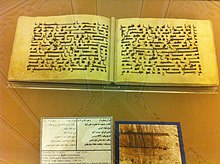
Quran − in Mashhad, Iran − said to be written by Ali
According to Shia, Ali ibn Abi Talib (d. 661) compiled a complete version of the Quran shortly after Muhammad’s death. The order of this text differed from that gathered later during Uthman’s era in that this version had been collected in chronological order. Despite this, he made no objection against the standardized Quran and accepted the Quran in circulation. Other personal copies of the Quran might have existed including Ibn Mas’ud’s and Ubay ibn Ka’b’s codex, none of which exist today.[11][50][56]
The Quran most likely existed in scattered written form during Muhammad’s lifetime. Several sources indicate that during Muhammad’s lifetime a large number of his companions had memorized the revelations. Early commentaries and Islamic historical sources support the above-mentioned understanding of the Quran’s early development.[24] University of Chicago professor Fred Donner states that:[57]
[T]here was a very early attempt to establish a uniform consonantal text of the Qurʾān from what was probably a wider and more varied group of related texts in early transmission.… After the creation of this standardized canonical text, earlier authoritative texts were suppressed, and all extant manuscripts—despite their numerous variants—seem to date to a time after this standard consonantal text was established.
Although most variant readings of the text of the Quran have ceased to be transmitted, some still are.[58][59] There has been no critical text produced on which a scholarly reconstruction of the Quranic text could be based.[ix] Historically, controversy over the Quran’s content has rarely become an issue, although debates continue on the subject.[61][x]

The right page of the Stanford ’07 binary manuscript. The upper layer is verses 265–271 of the surah Bakara. The double-layer reveals the additions made on the first text of the Qur’an and the differences with today’s Qur’an.
In 1972, in a mosque in the city of Sana’a, Yemen, manuscripts were discovered that were later proved to be the most ancient Quranic text known to exist at the time. The Sana’a manuscripts contain palimpsests, a manuscript page from which the text has been washed off to make the parchment reusable again—a practice which was common in ancient times due to the scarcity of writing material. However, the faint washed-off underlying text (scriptio inferior) is still barely visible and believed to be «pre-Uthmanic» Quranic content, while the text written on top (scriptio superior) is believed to belong to Uthmanic times.[62] Studies using radiocarbon dating indicate that the parchments are dated to the period before 671 CE with a 99 percent probability.[63][64] The German scholar Gerd R. Puin has been investigating these Quran fragments for years. His research team made 35,000 microfilm photographs of the manuscripts, which he dated to the early part of the 8th century. Puin has not published the entirety of his work, but noted unconventional verse orderings, minor textual variations, and rare styles of orthography. He also suggested that some of the parchments were palimpsests which had been reused. Puin believed that this implied an evolving text as opposed to a fixed one.[65]
In 2015, fragments of a very early Quran, dating back to 1370 years earlier, were discovered in the library of the University of Birmingham, England. According to the tests carried out by the Oxford University Radiocarbon Accelerator Unit, «with a probability of more than 95%, the parchment was from between 568 and 645». The manuscript is written in Hijazi script, an early form of written Arabic.[66] This is possibly the earliest extant exemplar of the Quran, but as the tests allow a range of possible dates, it cannot be said with certainty which of the existing versions is the oldest.[66] Saudi scholar Saud al-Sarhan has expressed doubt over the age of the fragments as they contain dots and chapter separators that are believed to have originated later.[67] However Joseph E. B. Lumbard of Brandeis University has written in the Huffington Post in support of the dates proposed by the Birmingham scholars. Lumbard notes that the discovery of a Quranic text that may be confirmed by radiocarbon dating as having been written in the first decades of the Islamic era, while presenting a text substantially in conformity with that traditionally accepted, reinforces a growing academic consensus that many Western skeptical and ‘revisionist’ theories of Quranic origins are now untenable in the light of empirical findings—whereas, on the other hand, counterpart accounts of Quranic origins within classical Islamic traditions stand up well in the light of ongoing scientific discoveries.[68]
Significance in Islam
Muslims believe the Quran to be God’s final revelation to humanity, a work of divine guidance revealed to Muhammad through the angel Gabriel.[18][69]
Revered by pious Muslims as «the holy of holies,»[70] whose sound moves some to «tears and ecstasy»,[71] it is the physical symbol of the faith, the text often used as a charm on occasions of birth, death, marriage.[citation needed] Consequently,
It must never rest beneath other books, but always on top of them, one must never drink or smoke when it is being read aloud, and it must be listened to in silence. It is a talisman against disease and disaster.[70][72]
Traditionally great emphasis was put on children memorizing the 6,200+ verses of the Quran, those succeeding being honored with the title Hafiz. «Millions and millions» of Muslims «refer to the Koran daily to explain their actions and to justify their aspirations,»[xi] and in recent years many consider it the source of scientific knowledge.[74][75]
Revelation in Islamic and Quranic contexts means the act of God addressing an individual, conveying a message for a greater number of recipients. The process by which the divine message comes to the heart of a messenger of God is tanzil (‘to send down’) or nuzūl (‘to come down’). As the Quran says, «With the truth we (God) have sent it down and with the truth it has come down.»[76]
The Quran frequently asserts in its text that it is divinely ordained. Some verses in the Quran seem to imply that even those who do not speak Arabic would understand the Quran if it were recited to them.[77] The Quran refers to a written pre-text, «the preserved tablet,» that records God’s speech even before it was sent down.[78][79]
Muslims believe that the present wording of the Quran corresponds to that revealed to Muhammad, and according to their interpretation of Quran 15:9, it is protected from corruption («Indeed, it is We who sent down the Quran and indeed, We will be its guardian.»).[80] Muslims consider the Quran to be a guide, a sign of the prophethood of Muhammad and the truth of the religion.
The Shīa believe that the Quran was gathered and compiled by Muhammad during his lifetime, rather than being compiled by Uthman ibn Affan. There are other differences in the way Shias interpret the text.[81] Muslims do not agree over whether the Quran was created by God or is eternal and «uncreated.» Sunnis (who make up about 85–90% of Muslims) hold that the Quran is uncreated—a doctrine that has been unchallenged among them for many centuries. Shia Twelvers and Zaydi, and the Kharijites—believe the Quran was created.[82] Sufi philosophers view the question as artificial or wrongly framed.[83]: 10 [need quotation to verify]
Inimitability
Inimitability of the Quran (or «I’jaz«) is the belief that no human speech can match the Quran in its content and form. The Quran is considered an inimitable miracle by Muslims, effective until the Day of Resurrection—and, thereby, the central proof granted to Muhammad in authentication of his prophetic status. The concept of inimitability originates in the Quran where in five different verses opponents are challenged to produce something like the Quran: «If men and jinn banded together to produce the like of this Quran they would never produce its like not though they backed one another.»[84] From the ninth century, numerous works appeared which studied the Quran and examined its style and content. Medieval Muslim scholars including al-Jurjani (d. 1078) and al-Baqillani (d. 1013) have written treatises on the subject, discussed its various aspects, and used linguistic approaches to study the Quran. Others argue that the Quran contains noble ideas, has inner meanings, maintained its freshness through the ages and has caused great transformations at the individual level and in history. Some scholars state that the Quran contains scientific information that agrees with modern science. The doctrine of the miraculousness of the Quran is further emphasized by Muhammad’s illiteracy since the unlettered prophet could not have been suspected of composing the Quran.[56][85]
In worship
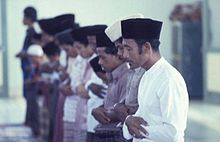
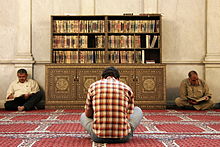
While standing in prayers, worshipers recite the first chapter of the Quran, al-Fatiha, followed by any other section.
The first surah of the Quran is repeated in daily prayers and on other occasions. This surah, which consists of seven verses, is the most often recited surah of the Quran:[11]
|
بِسْمِ ٱللَّهِ ٱلرَّحْمَٰنِ ٱلرَّحِيمِ |
In the Name of Allah the Entirely Merciful, the Especially Merciful. |
| — Quran 1:1-7 | —Sahih International English translation |
Other sections of the Quran of choice are also read in daily prayers.
Respect for the written text of the Quran is an important element of religious faith by many Muslims, and the Quran is treated with reverence. Based on tradition and a literal interpretation of Quran 56:79 («none shall touch but those who are clean»), some Muslims believe that they must perform a ritual cleansing with water (wudu or ghusl) before touching a copy of the Quran, although this view is not universal.[11] Worn-out copies of the Quran are wrapped in a cloth and stored indefinitely in a safe place, buried in a mosque or a Muslim cemetery, or burned and the ashes buried or scattered over water.[86]
In Islam, most intellectual disciplines, including Islamic theology, philosophy, mysticism and jurisprudence, have been concerned with the Quran or have their foundation in its teachings.[11] Muslims believe that the preaching or reading of the Quran is rewarded with divine rewards variously called ajr, thawab, or hasanat.[87]
In Islamic art
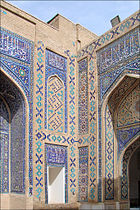
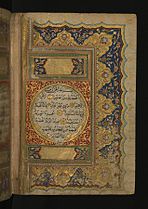
The Quran also inspired Islamic arts and specifically the so-called Quranic arts of calligraphy and illumination.[11] The Quran is never decorated with figurative images, but many Qurans have been highly decorated with decorative patterns in the margins of the page, or between the lines or at the start of suras. Islamic verses appear in many other media, on buildings and on objects of all sizes, such as mosque lamps, metal work, pottery and single pages of calligraphy for muraqqas or albums.
-

-

Quranic verses, Shahizinda mausoleum, Samarkand, Uzbekistan.
-

Quran page decoration art, Ottoman period.

Text and arrangement

First sura of the Quran, Al-Fatiha, consisting of seven verses.
The Quran consists of 114 chapters of varying lengths, each known as a sūrah. Chapters are classified as Meccan or Medinan, depending on whether the verses were revealed before or after the migration of Muhammad to the city of Medina. However, a sūrah classified as Medinan may contain Meccan verses in it and vice versa. Sūrah titles are derived from a name or quality discussed in the text, or from the first letters or words of the sūrah. Chapters are not arranged in chronological order, rather the chapters appear to be arranged roughly in order of decreasing size. Some scholars argue the sūrahs are arranged according to a certain pattern.[88] Each sūrah except the ninth starts with the Bismillah (بِسْمِ ٱللَّٰهِ ٱلرَّحْمَٰنِ ٱلرَّحِيمِ), an Arabic phrase meaning ‘In the name of God.’ There are, however, still 114 occurrences of the Bismillah in the Quran, due to its presence in Quran 27:30 as the opening of Solomon’s letter to the Queen of Sheba.[89]
Each sūrah consists of several verses, known as āyāt, which originally means a ‘sign’ or ‘evidence’ sent by God. The number of verses differs from sūrah to sūrah. An individual verse may be just a few letters or several lines. The total number of verses in the most popular Hafs Quran is 6,236;[xii] however, the number varies if the bismillahs are counted separately.
In addition to and independent of the division into chapters, there are various ways of dividing the Quran into parts of approximately equal length for convenience in reading. The 30 juz’ (plural ajzāʼ) can be used to read through the entire Quran in a month. Some of these parts are known by names—which are the first few words by which the juzʼ begins. A juz’ is sometimes further divided into two ḥizb (plural aḥzāb), and each hizb subdivided into four rubʻ al-ahzab. The Quran is also divided into seven approximately equal parts, manzil (plural manāzil), for it to be recited in a week.[11]
A different structure is provided by semantic units resembling paragraphs and comprising roughly ten āyāt each. Such a section is called a rukū`.
The Muqattaʿat (Arabic: حروف مقطعات ḥurūf muqaṭṭaʿāt, ‘disjoined letters, disconnected letters’;[92] also ‘mysterious letters’)[93] are combinations of between one and five Arabic letters figuring at the beginning of 29 out of the 114 chapters of the Quran just after the basmala.[93] The letters are also known as fawātih (فواتح), or ‘openers’, as they form the opening verse of their respective suras. Four surahs are named for their muqatta’at: Ṭāʾ-Hāʾ, Yāʾ-Sīn, Ṣād, and Qāf. The original significance of the letters is unknown. Tafsir (exegesis) has interpreted them as abbreviations for either names or qualities of God or for the names or content of the respective surahs. According to Rashad Khalifa, those letters are Quranic initials for a hypothetical mathematical code in the Quran, namely the Quran code or known as Code 19.[94]
According to one estimate the Quran consists of 77,430 words, 18,994 unique words, 12,183 stems, 3,382 lemmas and 1,685 roots.[95]
Contents
The Quranic content is concerned with basic Islamic beliefs including the existence of God and the resurrection. Narratives of the early prophets, ethical and legal subjects, historical events of Muhammad’s time, charity and prayer also appear in the Quran. The Quranic verses contain general exhortations regarding right and wrong and historical events are related to outline general moral lessons. Verses pertaining to natural phenomena have been interpreted by Muslims as an indication of the authenticity of the Quranic message.[96] The style of the Quran has been called «allusive,» with commentaries needed to explain what is being referred to—»events are referred to, but not narrated; disagreements are debated without being explained; people and places are mentioned, but rarely named.»[97]
Monotheism
The central theme of the Quran is monotheism. God is depicted as living, eternal, omniscient and omnipotent (see, e.g., Quran 2:20, 2:29, 2:255). God’s omnipotence appears above all in his power to create. He is the creator of everything, of the heavens and the earth and what is between them (see, e.g., Quran 13:16, 2:253, 50:38, etc.). All human beings are equal in their utter dependence upon God, and their well-being depends upon their acknowledging that fact and living accordingly.[39][96]

The Quran uses cosmological and contingency arguments in various verses without referring to the terms to prove the existence of God. Therefore, the universe is originated and needs an originator, and whatever exists must have a sufficient cause for its existence. Besides, the design of the universe is frequently referred to as a point of contemplation: «It is He who has created seven heavens in harmony. You cannot see any fault in God’s creation; then look again: Can you see any flaw?»[98][99]
Eschatology
The doctrine of the last day and eschatology (the final fate of the universe) may be considered the second great doctrine of the Quran.[39] It is estimated that approximately one-third of the Quran is eschatological, dealing with the afterlife in the next world and with the day of judgment at the end of time.[100] There is a reference to the afterlife on most pages of the Quran and belief in the afterlife is often referred to in conjunction with belief in God as in the common expression: «Believe in God and the last day.»[101] A number of suras such as 44, 56, 75, 78, 81 and 101 are directly related to the afterlife and its preparations. Some suras indicate the closeness of the event and warn people to be prepared for the imminent day. For instance, the first verses of Sura 22, which deal with the mighty earthquake and the situations of people on that day, represent this style of divine address: «O People! Be respectful to your Lord. The earthquake of the Hour is a mighty thing.»[102]
The Quran is often vivid in its depiction of what will happen at the end time. Watt describes the Quranic view of End Time:[39]
The climax of history, when the present world comes to an end, is referred to in various ways. It is ‘the Day of Judgment,’ ‘the Last Day,’ ‘the Day of Resurrection,’ or simply ‘the Hour.’ Less frequently it is ‘the Day of Distinction’ (when the good are separated from the evil), ‘the Day of the Gathering’ (of men to the presence of God) or ‘the Day of the Meeting’ (of men with God). The Hour comes suddenly. It is heralded by a shout, by a thunderclap, or by the blast of a trumpet. A cosmic upheaval then takes place. The mountains dissolve into dust, the seas boil up, the sun is darkened, the stars fall and the sky is rolled up. God appears as Judge, but his presence is hinted at rather than described.… The central interest, of course, is in the gathering of all mankind before the Judge. Human beings of all ages, restored to life, join the throng. To the scoffing objection of the unbelievers that former generations had been dead a long time and were now dust and mouldering bones, the reply is that God is nevertheless able to restore them to life.
The Quran does not assert a natural immortality of the human soul, since man’s existence is dependent on the will of God: when he wills, he causes man to die; and when he wills, he raises him to life again in a bodily resurrection.[103]
Prophets
According to the Quran, God communicated with man and made his will known through signs and revelations. Prophets, or ‘Messengers of God’, received revelations and delivered them to humanity. The message has been identical and for all humankind. «Nothing is said to you that was not said to the messengers before you, that your lord has at his Command forgiveness as well as a most Grievous Penalty.»[104] The revelation does not come directly from God to the prophets. Angels acting as God’s messengers deliver the divine revelation to them. This comes out in Quran 42:51, in which it is stated: «It is not for any mortal that God should speak to them, except by revelation, or from behind a veil, or by sending a messenger to reveal by his permission whatsoever He will.»[52][103]
Ethico-religious concepts

Verse about the month of Ramadan, second sura, verse 185. from a Quran manuscript dated to 1510
Belief is a fundamental aspect of morality in the Quran, and scholars have tried to determine the semantic contents of «belief» and «believer» in the Quran.[105] The ethico-legal concepts and exhortations dealing with righteous conduct are linked to a profound awareness of God, thereby emphasizing the importance of faith, accountability, and the belief in each human’s ultimate encounter with God. People are invited to perform acts of charity, especially for the needy. Believers who «spend of their wealth by night and by day, in secret and in public» are promised that they «shall have their reward with their Lord; on them shall be no fear, nor shall they grieve.»[106] It also affirms family life by legislating on matters of marriage, divorce, and inheritance. A number of practices, such as usury and gambling, are prohibited. The Quran is one of the fundamental sources of Islamic law (sharia). Some formal religious practices receive significant attention in the Quran including the formal prayers (salat) and fasting in the month of Ramadan. As for the manner in which the prayer is to be conducted, the Quran refers to prostration.[24][103] The term for charity, zakat, literally means purification. Charity, according to the Quran, is a means of self-purification.[78][107]
Encouragement for the sciences
The astrophysicist Nidhal Guessoum, while being highly critical of pseudo-scientific claims made about the Quran, has highlighted the encouragement for sciences that the Quran provides by developing «the concept of knowledge.» He writes:[108]: 174
The Qur’an draws attention to the danger of conjecturing without evidence (And follow not that of which you have not the (certain) knowledge of… 17:36) and in several different verses asks Muslims to require proofs (Say: Bring your proof if you are truthful 2:111), both in matters of theological belief and in natural science.
Guessoum cites Ghaleb Hasan on the definition of «proof» according to the Quran being «clear and strong… convincing evidence or argument.» Also, such a proof cannot rely on an argument from authority, citing verse 5:104. Lastly, both assertions and rejections require a proof, according to verse 4:174.[108]: 56 Ismail al-Faruqi and Taha Jabir Alalwani are of the view that any reawakening of the Muslim civilization must start with the Quran; however, the biggest obstacle on this route is the «centuries old heritage of tafseer (exegesis) and other classical disciplines» which inhibit a «universal, epidemiological and systematic conception» of the Quran’s message.[108]: 117–8 The philosopher Muhammad Iqbal, considered the Quran’s methodology and epistemology to be empirical and rational.[108]: 58–9
There are around 750 verses[which?] in the Quran dealing with natural phenomena. In many of these verses the study of nature is «encouraged and highly recommended», and historical Islamic scientists like Al-Biruni and Al-Battani derived their inspiration from verses of the Quran.[additional citation(s) needed] Mohammad Hashim Kamali has stated that «scientific observation, experimental knowledge and rationality» are the primary tools with which humanity can achieve the goals laid out for it in the Quran.[108]: 63 Ziauddin Sardar built a case for Muslims having developed the foundations of modern science, by highlighting the repeated calls of the Quran to observe and reflect upon natural phenomenon.[108]: 75
The physicist Abdus Salam, in his Nobel Prize banquet address, quoted a well known verse from the Quran (67:3–4) and then stated: «This in effect is the faith of all physicists: the deeper we seek, the more is our wonder excited, the more is the dazzlement of our gaze.»[108]: 131 One of Salam’s core beliefs was that there is no contradiction between Islam and the discoveries that science allows humanity to make about nature and the universe. Salam also held the opinion that the Quran and the Islamic spirit of study and rational reflection was the source of extraordinary civilizational development.[108]: 132 Salam highlights, in particular, the work of Ibn al-Haytham and Al-Biruni as the pioneers of empiricism who introduced the experimental approach, breaking with Aristotle’s influence and thus giving birth to modern science. Salam was also careful to differentiate between metaphysics and physics, and advised against empirically probing certain matters on which «physics is silent and will remain so,» such as the doctrine of «creation from nothing» which in Salam’s view is outside the limits of science and thus «gives way» to religious considerations.[108]: 134
Literary style

The Quran’s message is conveyed with various literary structures and devices. In the original Arabic, the suras and verses employ phonetic and thematic structures that assist the audience’s efforts to recall the message of the text. Muslims[who?] assert (according to the Quran itself) that the Quranic content and style is inimitable.[109]
The language of the Quran has been described as «rhymed prose» as it partakes of both poetry and prose; however, this description runs the risk of failing to convey the rhythmic quality of Quranic language, which is more poetic in some parts and more prose-like in others. Rhyme, while found throughout the Quran, is conspicuous in many of the earlier Meccan suras, in which relatively short verses throw the rhyming words into prominence. The effectiveness of such a form is evident for instance in Sura 81, and there can be no doubt that these passages impressed the conscience of the hearers. Frequently a change of rhyme from one set of verses to another signals a change in the subject of discussion. Later sections also preserve this form but the style is more expository.[110][111]
The Quranic text seems to have no beginning, middle, or end, its nonlinear structure being akin to a web or net.[11] The textual arrangement is sometimes considered to exhibit lack of continuity, absence of any chronological or thematic order and repetitiousness.[xiii][xiv] Michael Sells, citing the work of the critic Norman O. Brown, acknowledges Brown’s observation that the seeming disorganization of Quranic literary expression—its scattered or fragmented mode of composition in Sells’s phrase—is in fact a literary device capable of delivering profound effects as if the intensity of the prophetic message were shattering the vehicle of human language in which it was being communicated.[114][115] Sells also addresses the much-discussed repetitiveness of the Quran, seeing this, too, as a literary device.
A text is self-referential when it speaks about itself and makes reference to itself. According to Stefan Wild, the Quran demonstrates this metatextuality by explaining, classifying, interpreting and justifying the words to be transmitted. Self-referentiality is evident in those passages where the Quran refers to itself as revelation (tanzil), remembrance (dhikr), news (naba’), criterion (furqan) in a self-designating manner (explicitly asserting its Divinity, «And this is a blessed Remembrance that We have sent down; so are you now denying it?»),[116] or in the frequent appearance of the «Say» tags, when Muhammad is commanded to speak (e.g., «Say: ‘God’s guidance is the true guidance’,» «Say: ‘Would you then dispute with us concerning God?'»). According to Wild the Quran is highly self-referential. The feature is more evident in early Meccan suras.[117]
Interpretation
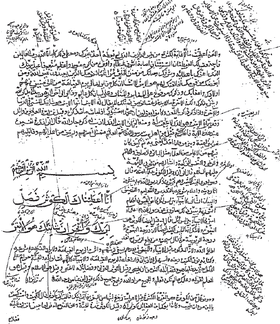
An early interpretation of Sura 108 of the Quran
The Quran has sparked much commentary and explication (tafsir), aimed at explaining the «meanings of the Quranic verses, clarifying their import and finding out their significance.»[118]
Tafsir is one of the earliest academic activities of Muslims. According to the Quran, Muhammad was the first person who described the meanings of verses for early Muslims.[119] Other early exegetes included a few Companions of Muhammad, such as Abu Bakr, ‘Umar ibn al-Khattab, ‘Uthman ibn ‘Affan, ʻAli ibn Abi Talib, ‘Abdullah ibn Mas’ood, ʻAbdullah ibn Abbas, Ubayy ibn Kaʻb, Zayd ibn Thaabit, Abu Moosaa al-Ash’ari, and ‘Abdullah ibn al-Zubayr.[120] Exegesis in those days was confined to the explanation of literary aspects of the verse, the background of its revelation and, occasionally, interpretation of one verse with the help of the other. If the verse was about a historical event, then sometimes a few traditions (hadith) of Muhammad were narrated to make its meaning clear.[118]
Because the Quran is spoken in classical Arabic, many of the later converts to Islam (mostly non-Arabs) did not always understand the Quranic Arabic, they did not catch allusions that were clear to early Muslims fluent in Arabic and they were concerned with reconciling apparent conflict of themes in the Quran. Commentators erudite in Arabic explained the allusions, and perhaps most importantly, explained which Quranic verses had been revealed early in Muhammad’s prophetic career, as being appropriate to the very earliest Muslim community, and which had been revealed later, canceling out or «abrogating» (nāsikh) the earlier text (mansūkh).[121][122] Other scholars, however, maintain that no abrogation has taken place in the Quran.[123]
There have been several commentaries of the Quran by scholars of all denominations, popular ones include Tafsir ibn Kathir, Tafsir al-Jalalayn, Tafsir Al Kabir, Tafsir al-Tabari. More modern works of Tafsir include Ma’ariful Qur’an written by Mufti Muhammad Shafi and Risale-i Nur by Bediüzzaman Said Nursi.
Esoteric interpretation
Esoteric or Sufi interpretation attempts to unveil the inner meanings of the Quran. Sufism moves beyond the apparent (zahir) point of the verses and instead relates Quranic verses to the inner or esoteric (batin) and metaphysical dimensions of consciousness and existence.[124] According to Sands, esoteric interpretations are more suggestive than declarative, they are allusions (isharat) rather than explanations (tafsir). They indicate possibilities as much as they demonstrate the insights of each writer.[125]
Sufi interpretation, according to Annabel Keeler, also exemplifies the use of the theme of love, as for instance can be seen in Qushayri’s interpretation of the Quran:
When Moses came at the appointed time and his Lord spoke to him, he asked, “My Lord! Reveal Yourself to me so I may see You.” Allah answered, “You cannot see Me! But look at the mountain. If it remains firm in its place, only then will you see Me.” When his Lord appeared to the mountain, He levelled it to dust and Moses collapsed unconscious. When he recovered, he cried, “Glory be to You! I turn to You in repentance and I am the first of the believers.”
Moses, in 7:143, comes the way of those who are in love, he asks for a vision but his desire is denied, he is made to suffer by being commanded to look at other than the Beloved while the mountain is able to see God. The mountain crumbles and Moses faints at the sight of God’s manifestation upon the mountain. In Qushayri’s words, Moses came like thousands of men who traveled great distances, and there was nothing left to Moses of Moses. In that state of annihilation from himself, Moses was granted the unveiling of the realities. From the Sufi point of view, God is the always the beloved and the wayfarer’s longing and suffering lead to realization of the truths.[126]
Muhammad Husayn Tabatabaei says that according to the popular explanation among the later exegetes, ta’wil indicates the particular meaning a verse is directed towards. The meaning of revelation (tanzil), as opposed to ta’wil, is clear in its accordance to the obvious meaning of the words as they were revealed. But this explanation has become so widespread that, at present, it has become the primary meaning of ta’wil, which originally meant ‘to return’ or ‘the returning place’. In Tabatabaei’s view, what has been rightly called ta’wil, or hermeneutic interpretation of the Quran, is not concerned simply with the denotation of words. Rather, it is concerned with certain truths and realities that transcend the comprehension of the common run of men; yet it is from these truths and realities that the principles of doctrine and the practical injunctions of the Quran issue forth. Interpretation is not the meaning of the verse—rather it transpires through that meaning, in a special sort of transpiration. There is a spiritual reality—which is the main objective of ordaining a law, or the basic aim in describing a divine attribute—and then there is an actual significance that a Quranic story refers to.[127][128]

According to Shia beliefs, those who are firmly rooted in knowledge like Muhammad and the imams know the secrets of the Quran. According to Tabatabaei, the statement «none knows its interpretation except God» remains valid, without any opposing or qualifying clause.[129] Therefore, so far as this verse is concerned, the knowledge of the Quran’s interpretation is reserved for God. But Tabatabaei uses other verses and concludes that those who are purified by God know the interpretation of the Quran to a certain extent.[128]
According to Tabatabaei, there are acceptable and unacceptable esoteric interpretations. Acceptable ta’wil refers to the meaning of a verse beyond its literal meaning; rather the implicit meaning, which ultimately is known only to God and can’t be comprehended directly through human thought alone. The verses in question here refer to the human qualities of coming, going, sitting, satisfaction, anger and sorrow, which are apparently attributed to God. Unacceptable ta’wil is where one «transfers» the apparent meaning of a verse to a different meaning by means of a proof; this method is not without obvious inconsistencies. Although this unacceptable ta’wil has gained considerable acceptance, it is incorrect and cannot be applied to the Quranic verses. The correct interpretation is that reality a verse refers to. It is found in all verses, the decisive and the ambiguous alike; it is not a sort of a meaning of the word; it is a fact that is too sublime for words. God has dressed them with words to bring them a bit nearer to our minds; in this respect they are like proverbs that are used to create a picture in the mind, and thus help the hearer to clearly grasp the intended idea.[128][130]
One of the notable authors of esoteric interpretation prior to the 12th century is Sulami (d. 1021) without whose work the majority of very early Sufi commentaries would not have been preserved. Sulami’s major commentary is a book named Haqaiq al-Tafsir (‘Truths of Exegesis’) which is a compilation of commentaries of earlier Sufis. From the 11th century onwards several other works appear, including commentaries by Qushayri (d. 1074), Daylami (d. 1193), Shirazi (d. 1209) and Suhrawardi (d. 1234). These works include material from Sulami’s books plus the author’s contributions. Many works are written in Persian such as the works of Maybudi (d. 1135) kashf al-asrar (‘the unveiling of the secrets’).[124] Rumi (d. 1273) wrote a vast amount of mystical poetry in his book Mathnawi. Rumi makes heavy use of the Quran in his poetry, a feature that is sometimes omitted in translations of Rumi’s work. A large number of Quranic passages can be found in Mathnawi, which some consider a kind of Sufi interpretation of the Quran. Rumi’s book is not exceptional for containing citations from and elaboration on the Quran, however, Rumi does mention Quran more frequently.[131] Simnani (d. 1336) wrote two influential works of esoteric exegesis on the Quran. He reconciled notions of God’s manifestation through and in the physical world with the sentiments of Sunni Islam.[132] Comprehensive Sufi commentaries appear in the 18th century such as the work of Ismail Hakki Bursevi (d. 1725). His work ruh al-Bayan (‘the Spirit of Elucidation’) is a voluminous exegesis. Written in Arabic, it combines the author’s own ideas with those of his predecessors (notably Ibn Arabi and Ghazali).[132]
Levels of meaning
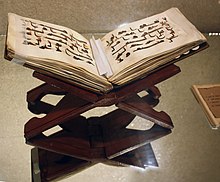
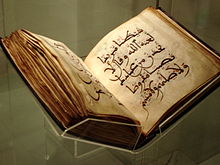
Unlike the Salafis and Zahiri, Shias and Sufis as well as some other Muslim philosophers believe the meaning of the Quran is not restricted to the literal aspect.[83]: 7 For them, it is an essential idea that the Quran also has inward aspects. Henry Corbin narrates a hadith that goes back to Muhammad:
The Quran possesses an external appearance and a hidden depth, an exoteric meaning and an esoteric meaning. This esoteric meaning in turn conceals an esoteric meaning (this depth possesses a depth, after the image of the celestial Spheres, which are enclosed within each other). So it goes on for seven esoteric meanings (seven depths of hidden depth).[83]: 7
According to this view, it has also become evident that the inner meaning of the Quran does not eradicate or invalidate its outward meaning. Rather, it is like the soul, which gives life to the body.[133] Corbin considers the Quran to play a part in Islamic philosophy, because gnosiology itself goes hand in hand with prophetology.[83]: 13
Commentaries dealing with the zahir (‘outward aspects’) of the text are called tafsir, and hermeneutic and esoteric commentaries dealing with the batin are called ta’wil (‘interpretation’ or ‘explanation’), which involves taking the text back to its beginning. Commentators with an esoteric slant believe that the ultimate meaning of the Quran is known only to God.[11] In contrast, Quranic literalism, followed by Salafis and Zahiris, is the belief that the Quran should only be taken at its apparent meaning.[citation needed]
Reappropriation
Reappropriation is the name of the hermeneutical style of some ex-Muslims who have converted to Christianity. Their style or reinterpretation can sometimes be geared towards apologetics, with less reference to the Islamic scholarly tradition that contextualizes and systematizes the reading (e.g., by identifying some verses as abrogated). This tradition of interpretation draws on the following practices: grammatical renegotiation, renegotiation of textual preference, retrieval, and concession.[134]
Translations
Translating the Quran has always been problematic and difficult. Many argue that the Quranic text cannot be reproduced in another language or form.[135] Furthermore, an Arabic word may have a range of meanings depending on the context, making an accurate translation even more difficult.[136]
Nevertheless, the Quran has been translated into most African, Asian, and European languages.[56] The first translator of the Quran was Salman the Persian, who translated surat al-Fatiha into Persian during the seventh century.[137] Another translation of the Quran was completed in 884 in Alwar (Sindh, India, now Pakistan) by the orders of Abdullah bin Umar bin Abdul Aziz on the request of the Hindu Raja Mehruk.[138]
The first fully attested complete translations of the Quran were done between the 10th and 12th centuries in Persian. The Samanid king, Mansur I (961–976), ordered a group of scholars from Khorasan to translate the Tafsir al-Tabari, originally in Arabic, into Persian. Later in the 11th century, one of the students of Abu Mansur Abdullah al-Ansari wrote a complete tafsir of the Quran in Persian. In the 12th century, Najm al-Din Abu Hafs al-Nasafi translated the Quran into Persian.[139] The manuscripts of all three books have survived and have been published several times.[citation needed]
Islamic tradition also holds that translations were made for Emperor Negus of Abyssinia and Byzantine Emperor Heraclius, as both received letters by Muhammad containing verses from the Quran.[136] In early centuries, the permissibility of translations was not an issue, but whether one could use translations in prayer.[citation needed]
In 1936, translations in 102 languages were known.[136] In 2010, the Hürriyet Daily News and Economic Review reported that the Quran was presented in 112 languages at the 18th International Quran Exhibition in Tehran.[140]
Robert of Ketton’s 1143 translation of the Quran for Peter the Venerable, Lex Mahumet pseudoprophete, was the first into a Western language (Latin).[141]
Alexander Ross offered the first English version in 1649, from the French translation of L’Alcoran de Mahomet (1647) by Andre du Ryer. In 1734, George Sale produced the first scholarly translation of the Quran into English; another was produced by Richard Bell in 1937, and yet another by Arthur John Arberry in 1955. All these translators were non-Muslims. There have been numerous translations by Muslims. Popular modern English translations by Muslims include The Oxford World Classic’s translation by Muhammad Abdel Haleem, The Clear Quran by Dr Mustafa Khattab, Sahih International’s translation, among various others.
As with translations of the Bible, the English translators have sometimes favored archaic English words and constructions over their more modern or conventional equivalents; for example, two widely read translators, Abdullah Yusuf Ali and Marmaduke Pickthall, use the plural and singular ye and thou instead of the more common you.[142]
The oldest Gurmukhi translation of the Quran Sharif has been found in village Lande of Moga district of Punjab which was printed in 1911.[143]
-
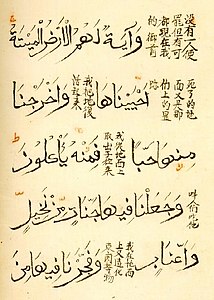
![1091 Quranic text in bold script with Persian translation and commentary in a lighter script.[144]](data:image/svg+xml,%3Csvg%20xmlns='http://www.w3.org/2000/svg'%20viewBox='0%200%20136%20200'%3E%3C/svg%3E)
1091 Quranic text in bold script with Persian translation and commentary in a lighter script.[144]
-

Arabic Quran with interlinear Persian translation from the Ilkhanid Era.
-

Title page of the first German translation (1772) of the Quran.
-

Verses 33 and 34 of surat Yā Sīn in this Chinese translation of the Quran.
![1091 Quranic text in bold script with Persian translation and commentary in a lighter script.[144]](https://upload.wikimedia.org/wikipedia/commons/thumb/a/ac/Page_from_the_Qur%27an_of_Sultan_Ibrahim_%28TKS_EH_209%29.jpg/203px-Page_from_the_Qur%27an_of_Sultan_Ibrahim_%28TKS_EH_209%29.jpg)


Recitation
Rules of recitation
The proper recitation of the Quran is the subject of a separate discipline named tajwid which determines in detail how the Quran should be recited, how each individual syllable is to be pronounced, the need to pay attention to the places where there should be a pause, to elisions, where the pronunciation should be long or short, where letters should be sounded together and where they should be kept separate, etc. It may be said that this discipline studies the laws and methods of the proper recitation of the Quran and covers three main areas: the proper pronunciation of consonants and vowels (the articulation of the Quranic phonemes), the rules of pause in recitation and of resumption of recitation, and the musical and melodious features of recitation.[145]
In order to avoid incorrect pronunciation, reciters follow a program of training with a qualified teacher. The two most popular texts used as references for tajwid rules are Matn al-Jazariyyah by Ibn al-Jazari[146] and Tuhfat al-Atfal by Sulayman al-Jamzuri.
The recitations of a few Egyptian reciters, like El Minshawy, Al-Hussary, Abdul Basit, Mustafa Ismail, were highly influential in the development of current styles of recitation.[147][148][149]: 83 Southeast Asia is well known for world-class recitation, evidenced in the popularity of the woman reciters such as Maria Ulfah of Jakarta.[145] Today, crowds fill auditoriums for public Quran recitation competitions.[150][14]
There are two types of recitation:
- Murattal is at a slower pace, used for study and practice.
- Mujawwad refers to a slow recitation that deploys heightened technical artistry and melodic modulation, as in public performances by trained experts. It is directed to and dependent upon an audience for the mujawwad reciter seeks to involve the listeners.[151]
Variant readings

Page of the Quran with vocalization marks
Vocalization markers indicating specific vowel sounds (tashkeel) were introduced into the text of the Qur’an during the lifetimes of the last Sahabah.[152] The first Quranic manuscripts lacked these marks, enabling multiple possible recitations to be conveyed by the same written text. The 10th-century Muslim scholar from Baghdad, Ibn Mujāhid, is famous for establishing seven acceptable textual readings of the Quran. He studied various readings and their trustworthiness and chose seven 8th-century readers from the cities of Mecca, Medina, Kufa, Basra and Damascus. Ibn Mujahid did not explain why he chose seven readers, rather than six or ten, but this may be related to a prophetic tradition (Muhammad’s saying) reporting that the Quran had been revealed in seven ahruf (meaning seven letters or modes). Today, the most popular readings are those transmitted by Ḥafṣ (d. 796) and Warsh (d. 812) which are according to two of Ibn Mujahid’s reciters, Aasim ibn Abi al-Najud (Kufa, d. 745) and Nafi‘ al-Madani (Medina, d. 785), respectively. The influential standard Quran of Cairo uses an elaborate system of modified vowel-signs and a set of additional symbols for minute details and is based on ʻAsim’s recitation, the 8th-century recitation of Kufa. This edition has become the standard for modern printings of the Quran.[52][58]
The variant readings of the Quran are one type of textual variant.[153][154] According to Melchert (2008), the majority of disagreements have to do with vowels to supply, most of them in turn not conceivably reflecting dialectal differences and about one in eight disagreements has to do with whether to place dots above or below the line.[155]
Nasser categorizes variant readings into various subtypes, including internal vowels, long vowels, gemination (shaddah), assimilation and alternation.[156]
Occasionally, an early Quran shows compatibility with a particular reading. A Syrian manuscript from the 8th century is shown to have been written according to the reading of Ibn Amir ad-Dimashqi.[157] Another study suggests that this manuscript bears the vocalization of himsi region.[158]
Writing and printing
Writing
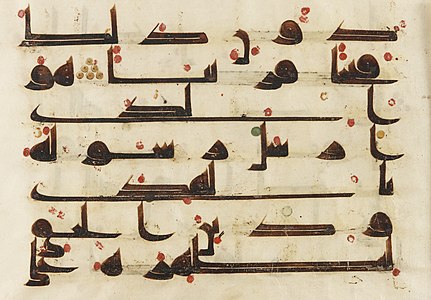
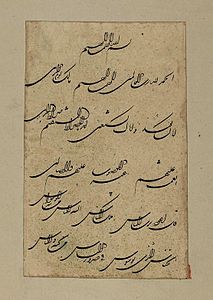
Before printing was widely adopted in the 19th century, the Quran was transmitted in manuscripts made by calligraphers and copyists. The earliest manuscripts were written in Ḥijāzī-typescript. The Hijazi style manuscripts nevertheless confirm that transmission of the Quran in writing began at an early stage. Probably in the ninth century, scripts began to feature thicker strokes, which are traditionally known as Kufic scripts. Toward the end of the ninth century, new scripts began to appear in copies of the Quran and replace earlier scripts. The reason for discontinuation in the use of the earlier style was that it took too long to produce and the demand for copies was increasing. Copyists would therefore choose simpler writing styles. Beginning in the 11th century, the styles of writing employed were primarily the naskh, muhaqqaq, rayḥānī and, on rarer occasions, the thuluth script. Naskh was in very widespread use. In North Africa and Iberia, the Maghribī style was popular. More distinct is the Bihari script which was used solely in the north of India. Nastaʻlīq style was also rarely used in Persian world.[159][160]
In the beginning, the Quran was not written with dots or tashkeel. These features were added to the text during the lifetimes of the last of the Sahabah.[152] Since it would have been too costly for most Muslims to purchase a manuscript, copies of the Quran were held in mosques in order to make them accessible to people. These copies frequently took the form of a series of 30 parts or juzʼ. In terms of productivity, the Ottoman copyists provide the best example. This was in response to widespread demand, unpopularity of printing methods and for aesthetic reasons.[161][162]
Whilst the majority of Islamic scribes were men, some women also worked as scholars and copyists; one such woman who made a copy of this text was the Moroccan jurist, Amina, bint al-Hajj ʿAbd al-Latif. [163]
-

kufic script, Eighth or ninth century.
-
muhaqqaq script, 14th–15th centuries.
-

shikasta nastaliq script, 18th–19th centuries.

Printing
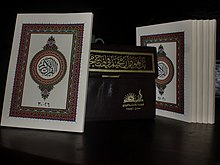
Quran divided into 6 books. Published by Dar Ibn Kathir, Damascus-Beirut
Wood-block printing of extracts from the Quran is on record as early as the 10th century.[164]
Arabic movable type printing was ordered by Pope Julius II (r. 1503–1512) for distribution among Middle Eastern Christians.[165] The first complete Quran printed with movable type was produced in Venice in 1537–1538 for the Ottoman market by Paganino Paganini and Alessandro Paganini.[166][167] But this Quran was not used as it contained a large number of errors.[168] Two more editions include those published by the pastor Abraham Hinckelmann in Hamburg in 1694,[169] and by Italian priest Ludovico Maracci in Padua in 1698 with Latin translation and commentary.[170]
Printed copies of the Quran during this period met with strong opposition from Muslim legal scholars: printing anything in Arabic was prohibited in the Ottoman empire between 1483 and 1726—initially, even on penalty of death.[171][162][172] The Ottoman ban on printing in Arabic script was lifted in 1726 for non-religious texts only upon the request of Ibrahim Muteferrika, who printed his first book in 1729. Except for books in Hebrew and European languages, which were unrestricted, very few books, and no religious texts, were printed in the Ottoman Empire for another century.[xv]
In 1786, Catherine the Great of Russia, sponsored a printing press for «Tatar and Turkish orthography» in Saint Petersburg, with one Mullah Osman Ismail responsible for producing the Arabic types. A Quran was printed with this press in 1787, reprinted in 1790 and 1793 in Saint Petersburg, and in 1803 in Kazan.[xvi] The first edition printed in Iran appeared in Tehran (1828), a translation in Turkish was printed in Cairo in 1842, and the first officially sanctioned Ottoman edition was finally printed in Constantinople between 1875 and 1877 as a two-volume set, during the First Constitutional Era.[175][176]
Gustav Flügel published an edition of the Quran in 1834 in Leipzig, which remained authoritative in Europe for close to a century, until Cairo’s Al-Azhar University published an edition of the Quran in 1924. This edition was the result of a long preparation, as it standardized Quranic orthography, and it remains the basis of later editions.[159]
Criticism
Regarding the claim of divine origin, critics refer to preexisting sources, not only taken from the Bible, supposed to be older revelations of God, but also from heretic, apocryphic and talmudic sources, such as The Syriac Infancy Gospel and Gospel of James. However the Bible was not translated into Arabic until after the completion of the Quran with other Judeo-Christian sources being translated even later.[177] Due to rejection of Crucifixion of Jesus in the Quran, some scholars also suspect Manichaean, a dualistic religion believing in two eternal forces, influences on the Quran.
The Tafsir’ilmi believe the Quran predicts scientific knowledge, relating the author to non-human origin. Critics argue, verses which allegedly explain modern scientific facts, about subjects such as biology, evolution of the earth, and human life, contain fallacies and are unscientific.[178][179][180] Most claims of predictions rely on the ambiguity of the Arabic language, another point of criticism. Despite calling itself a clear book, the Quranic language lacks clarity.[184]
Other criticisms point at the moral attitude asserted by the Quran. Examples include the Sword Verse, which some interpret as promoting violence against «pagans», and An-Nisa, 34, which some view as excusing domestic violence.
Relationship with other literature

Some non-Muslim groups such as the Baháʼí Faith and Druze view the Quran as holy. In the Baháʼí Faith, the Quran is accepted as authentic revelation from God along with the revelations of the other world religions, Islam being a stage within in the divine process of progressive revelation. Bahá’u’lláh, the Prophet-Founder of the Baháʼí Faith, testified to the validity of the Quran, writing, «Say: Perused ye not the Qur’án? Read it, that haply ye may find the Truth, for this Book is verily the Straight Path. This is the Way of God unto all who are in the heavens and all who are on the earth.»[185] Unitarian Universalists may also seek inspiration from the Quran. It has been suggested that the Quran has some narrative similarities to the Diatessaron, Protoevangelium of James, Infancy Gospel of Thomas, Gospel of Pseudo-Matthew and the Arabic Infancy Gospel.[186][187] One scholar has suggested that the Diatessaron, as a gospel harmony, may have led to the conception that the Christian Gospel is one text.[188]
The Bible
He has revealed to you ˹O Prophet˺ the Book in truth, confirming what came before it, as He revealed the Torah and the Gospel previously, as a guide for people, and ˹also˺ revealed the Standard ˹to distinguish between right and wrong˺.[189]
The Quran attributes its relationship with former books (the Torah and the Gospels) to their unique origin, saying all of them have been revealed by the one God.[190]
According to Christoph Luxenberg (in The Syro-Aramaic Reading of the Koran) the Quran’s language was similar to the Syriac language.[191] The Quran recounts stories of many of the people and events recounted in Jewish and Christian sacred books (Tanakh, Bible) and devotional literature (Apocrypha, Midrash), although it differs in many details. Adam, Enoch, Noah, Eber, Shelah, Abraham, Lot, Ishmael, Isaac, Jacob, Joseph, Job, Jethro, David, Solomon, Elijah, Elisha, Jonah, Aaron, Moses, Zechariah, John the Baptist and Jesus are mentioned in the Quran as prophets of God (see Prophets of Islam). In fact, Moses is mentioned more in the Quran than any other individual.[192] Jesus is mentioned more often in the Quran than Muhammad (by name—Muhammad is often alluded to as «The Prophet» or «The Apostle»), while Mary is mentioned in the Quran more than in the New Testament.[193]
Arab writing
After the Quran, and the general rise of Islam, the Arabic alphabet developed rapidly into an art form.[56] The Arabic grammarian Sibawayh wrote one of the earliest books on Arabic grammar, referred to as «Al-Kitab», which relied heavily on the language in the Quran. Wadad Kadi, Professor of Near Eastern Languages and Civilizations at University of Chicago, and Mustansir Mir, Professor of Islamic studies at Youngstown State University, state that the Quran exerted a particular influence on Arabic literature’s diction, themes, metaphors, motifs and symbols and added new expressions and new meanings to old, pre-Islamic words that would become ubiquitous.[194]
See also
- Criticism of the Quran
- Digital Quran
- Hadith of the Quran and Sunnah
- Historical reliability of the Quran
- Islamic schools and branches
- List of chapters in the Quran
- List of translations of the Quran
- Quran and miracles
- Quran code
- Quran translations
- Schools of Islamic theology
- Violence in the Quran
- Women in the Quran
- The True Furqan
References
Notes
- ^ The English pronunciation varies: , , , ;[1] especially with the spelling quran , ;[2] especially in British English .[3][4]
- ^ The Arabic pronunciation can be transcribed phonemically as /al.qurˈʔaːn/. The actual pronunciation in Literary Arabic varies regionally. The first vowel varies from [o] to [ʊ], while the second vowel varies from [æ] to [a] to [ɑ]. For example, the pronunciation in Egypt is [qorˈʔɑːn] and in Central East Arabia [qʊrˈʔæːn].
- ^ (English spelling) The form Alcoran (and its variants) was usual before the 19th century when it became obsolete.[5][6] The form Koran was most predominant from the second half of the 18th century till the 1980s, when it has been superseded by either Qur’an or Quran.[6][7][8][9] Other transliterations include al-Coran, Coran, Kuran and al-Qur’an. The adjectives vary as well and include Koranic, Quranic and Qur’anic (sometimes in lowercase).[10]
- ^ In a small number of denominations, only the Quran is used as a source, an approach called Quranism.
- ^ Hadith are primarily from Muhammad but some are from those closest to him. Muslim scholars have worked carefully to authenticate them.
- ^ According to Welch in the Encyclopedia of Islam, the verses pertaining to the usage of the word hikma should probably be interpreted in the light of IV, 105, where it is said that «Muhammad is to judge (tahkum) mankind on the basis of the Book sent down to him.»
- ^ «God’s Apostle replied, ‘Sometimes it is (revealed) like the ringing of a bell, this form of Inspiration is the hardest of all and then this state passes off after I have grasped what is inspired. Sometimes the Angel comes in the form of a man and talks to me and I grasp whatever he says.’ ʻAisha added: Verily I saw the Prophet being inspired Divinely on a very cold day and noticed the Sweat dropping from his forehead (as the Inspiration was over).»[42]
- ^ «Few have failed to be convinced that … the Quran is … the words of Muhammad, perhaps even dictated by him after their recitation.»[55]
- ^ For both the claim that variant readings are still transmitted and the claim that no such critical edition has been produced, see Gilliot, C., «Creation of a fixed text» [60]
- ^ «Few have failed to be convinced that the Quran is the words of Muhammad, perhaps even dictated by him after their recitation.»[55]
- ^ professor emeritus of Islamic thought at the University of Paris, Algerian Mohammed Arkoun.[73]
- ^ Scholars disagree on the exact number but this is a disagreement over «the placing of the divisions between the verese, not on the text itself.»[90][91]
- ^ «The final process of collection and codification of the Quran text was guided by one over-arching principle: God’s words must not in any way be distorted or sullied by human intervention. For this reason, no serious attempt, apparently, was made to edit the numerous revelations, organize them into thematic units, or present them in chronological order… This has given rise in the past to a great deal of criticism by European and American scholars of Islam, who find the Quran disorganized, repetitive and very difficult to read.»[112]
- ^ Samuel Pepys: «One feels it difficult to see how any mortal ever could consider this Quran as a Book written in Heaven, too good for the Earth; as a well-written book, or indeed as a book at all; and not a bewildered rhapsody; written, so far as writing goes, as badly as almost any book ever was!» [113]
- ^ «the major Ottoman printing houses published a combined total of only 142 books in more than a century of printing between 1727 and 1838. When taken in conjunction with the fact that only a minuscule number of copies of each book were printed, this statistic demonstrates that the introduction of the printing press did not transform Ottoman cultural life until the emergence of vibrant print media in the middle of the nineteenth century» [173]
- ^ «at imperial expense, a ‘Tatar and Turkish Typography’ was established in St. Petersburg; a domestic scholar, Mullah Osman Ismail, was responsible for the manufacture of the types. One of the first products of this printing house was the Qur’ān. Through the doctor and writer, Johann Georg v. Zimmermann (d. 1795), who was befriended by Catherine II, a copy of the publication arrived in the Göttingen University library. Its director, the philologist Christian Gottlob Heyne (d. 1812), presented the work immediately in the Göttingische Anzeigen von gelehrten Sachen (28 July 1788); therein he pointed especially to the beauty of the Arabic types. To the Arabic text marginal glosses have been added that consist predominantly of reading variants. The imprint was reproduced unchanged in 1790 and 1793 in St. Petersburg (cf. Schnurrer, Bibliotheca arabica, no. 384); later, after the transfer of the printing house to Kazan, editions appeared in different formats and with varying presentation [174]
For the 1803 Kazan edition:
Chauvin, V.C. Bib. des ouvrages arabes, vol. X, 95;
Schnurrer, C.F. von. Bibliotheca Arabica, 385.
Original held by Bayerische Staatsbibliothek – Munich, Germany, shelfmark BSB A.or.554. - ^ Gerd Puin is quoted in the Atlantic Monthly, January 1999:«The Koran claims for itself that it is ‘mubeen’ or ‘clear’. But if you look at it, you will notice that every fifth sentence or so simply doesn’t make sense… the fact is that a fifth of the Koranic text is just incomprehensible…«[65]
Citations
- ^ dictionary.reference.com: koran
- ^ dictionary.reference.com: quran
- ^ Cambridge dictionary: koran
- ^ Cambridge dictionary: quran
- ^ «Alcoran». Oxford English Dictionary. Vol. 1 (1st ed.). Oxford University Press. 1888. p. 210.
- ^ a b «Google Books Ngram Viewer». Google Books. Retrieved 16 February 2021.
- ^ «Koran». Oxford English Dictionary. Vol. 5 (1st ed.). Oxford University Press. 1901. p. 753.
- ^ «Koran». Oxford English Dictionary (Online ed.). Oxford University Press. (Subscription or participating institution membership required.)
- ^ «Quran». Oxford English Dictionary (Online ed.). Oxford University Press. (Subscription or participating institution membership required.)
- ^ «Koran». Merriam-Webster Dictionary.
- ^ a b c d e f g h i j k l m n Nasr 2007
- ^ Arberry, Arthur (1956). The Koran Interpreted. London. p. 191. ISBN 0684825074.
It may be affirmed that within the literature of the Arabs, wide and fecund as it is both in poetry and in elevated prose, there is nothing to compare with it.
- ^ Toropov, Brandon; Buckles, Luke (2004). Complete Idiot’s Guide to World Religions. Alpha. p. 126. ISBN 978-1-59257-222-9.
Muslims believe that Muhammad’s many divine encounters during his years in Mecca and Medina inspired the remainder of the Qur’an, which, nearly fourteen centuries later, remains the Arabic language’s preeminent masterpiece.
- ^ a b Esposito, John (2010). Islam: The Straight Path (4th ed.). Oxford University Press. p. 21. ISBN 978-0-19-539600-3.
«Throughout history, many Arab Christians as well have regarded it as the perfection of the Arabic language and literature.
- ^ Lambert, Gray (2013). The Leaders Are Coming!. WestBow Press. p. 287. ISBN 978-1-4497-6013-7.
- ^ Roy H. Williams; Michael R. Drew (2012). Pendulum: How Past Generations Shape Our Present and Predict Our Future. Vanguard Press. p. 143. ISBN 978-1-59315-706-7.
- ^ * Shaikh, Fazlur Rehman (2001). Chronology of Prophetic Events. Ta-Ha Publishers Ltd. p. 50.
- Quran 17:105 (Arberry tr.)
- ^ a b Fisher, Mary Pat (1997). Living Religions: An Encyclopaedia of the World’s Faiths (Rev. ed.). London: I. B. Tauris Publishers. p. 338.
- ^ Quran 17:106
- ^ Peters, F.E. (2003). The Words and Will of God. Princeton University Press. pp. 12–13. ISBN 978-0-691-11461-3.
- ^ Wheeler, Brannon M. (2002). Prophets in the Quran: An Introduction to the Quran and Muslim Exegesis. A&C Black. p. 2. ISBN 978-0-8264-4957-3.
- ^ Carroll, Jill. «The Quran & Hadith». World Religions. Retrieved 10 July 2019.
- ^ a b Donner, Fred (2006). «The historical context». In McAuliffe, Jane Dammen (ed.). The Cambridge Companion to the Qur’ān. Cambridge University Press. pp. 31–33.
- ^ a b c Campo, Juan E. (2009). Encyclopedia of Islam. Facts On File. pp. 570–574. ISBN 978-0-8160-5454-1.
- ^ Nigosian, Solomon A. (2004). Islam: Its History, Teaching and Practices (New ed.). Indiana University Press. pp. 65–80. ISBN 978-0-253-21627-4.
- ^ Wheeler, Brannon M. (2002). Prophets in the Quran: an introduction to the Quran and Muslim exegesis. Continuum. p. 15. ISBN 978-0-8264-4956-6.
- ^ Nasr 2003, p. 42
- ^ a b Sandıkcı, Özlem; Rice, Gillian (2011). Handbook of Islamic Marketing. p. 38. ISBN 9781849800136.
- ^ Street, Brian V. (2001). Literacy and Development: Ethnographic Perspectives. p. 193.
- ^ Brown, Norman O. (1991). Apocalypse And/or Metamorphosis. University of California Press. p. 81. ISBN 0520072987.
- ^ «The Comprehensive Aramaic Lexicon». Hebrew Union College – Jewish Institute of Religion. Archived from the original on 18 October 2017. Retrieved 31 August 2013.
- ^ Quran 75:17
- ^ Quran 7:204
- ^ See «Ķur’an, al-«, Encyclopedia of Islam Online and 9:111
- ^ Quran 20:2 cf.
- ^ Quran 25:32 cf.
- ^ Jaffer, Abbas; Jaffer, Masuma (2009). Quranic Sciences. ICAS press. pp. 11–15. ISBN 978-1-904063-30-8.
- ^ Tabatabae 1988, p. 98
- ^ a b c d e f g Richard Bell (Revised and Enlarged by W. Montgomery Watt) (1970). Bell’s introduction to the Qur’an. Univ. Press. pp. 31–51. ISBN 978-0-85224-171-4.
- ^ a b P.M. Holt, Ann K.S. Lambton and Bernard Lewis (1970). The Cambridge history of Islam (Reprint. ed.). Cambridge Univ. Press. p. 32. ISBN 978-0-521-29135-4.
- ^ Denffer, Ahmad von (1985). Ulum al-Qur’an : an introduction to the sciences of the Qur an (Repr. ed.). Islamic Foundation. p. 37. ISBN 978-0-86037-132-8.
- ^ «Translation of Sahih Bukhari, Book 1». Center for Muslim-Jewish Engagement. University of Southern California. Archived from the original on 10 January 2012.
- ^ Quran 53:5
- ^ Quran 53:6-9
- ^ Buhl, Fr. (2012) [1913–1936]. «Muhammad». In Houtsma, M. Th.; Arnold, T. W.; Basset, R.; Hartmann, R. (eds.). Encyclopedia of Islam (1 ed.). doi:10.1163/2214-871X_ei1_SIM_4746. ISBN 9789004082656.
- ^ Quran 7:157
- ^ Günther, Sebastian (2002). «Muhammad, the Illiterate Prophet: An Islamic Creed in the Quran and Quranic Exegesis». Journal of Quranic Studies. 4 (1): 1–26. doi:10.3366/jqs.2002.4.1.1.
- ^ Roslan Abdul-Rahim (December 2017). «Demythologizing the Qur’an Rethinking Revelation Through Naskh al-Qur’an». Global Journal Al-Thaqafah. 7 (2): 62. doi:10.7187/GJAT122017-2. ISSN 2232-0474.
- ^ «Wat is de Koran?». Koran.nl (in Dutch). 18 February 2016.
- ^ a b c Tabatabae 1988, p. 99:
Since the word of God seemed threatened with alteration, the [third] caliph ordered that five of the qurrā’ from amongst the companions, (one of them being Zayd ibn Thābit who had compiled the first volume), produce other copies from the first volume which had been prepared on the orders of the first caliph and which had been kept with Ḥafṣah, the wife of the Prophet and daughter of the second caliph.
The other copies, already in the hands of Muslims in other areas, were collected and sent to Medina where, on orders of the Caliph, they were burnt (or, according to some histtorians, were destroyed by boiling). Thus several copies were made, one being kept in Medina, one in Mecca, and one each sent to Sham (a territory now divided into Syria, Lebanon, Palestine and Jordan), Kufa and Basra.
It is said that beside these five, one copy was also sent to Yemen and one to Bahrein. These copies were called the Imam copies and served as original for all future copies. The only difference of order between these copies and the first volume was that the chapters «Spirits of War» and «Immunity» were written in one place between «The Heights» and «Jonah.»
- ^ al-Bukhari, Muhammad. «Sahih Bukhari, volume 6, book 61, narrations number 509 and 510». sahih-bukhari.com. Retrieved 16 February 2018.
- ^ a b c Rippin 2006:
- «Poetry and Language,» by Navid Kermani, pp. 107–20.
- For the history of compilation see «Introduction,» by Tamara Sonn, pp. 5–6
- For eschatology, see «Discovering (final destination),» by Christopher Buck, p. 30.
- For literary structure, see «Language,» by Mustansir Mir, p. 93.
- For writing and printing, see «Written Transmission,» by François Déroche, pp. 172–87.
- For recitation, see «Recitation,» by Anna M. Gade pp. 481–93
- ^ Yusuff, Mohamad K. «Zayd ibn Thabit and the Glorious Qur’an».
- ^ Cook 2000, p. 117–24
- ^ a b Peters 1991, p. 3–5
- ^ a b c d Leaman, Oliver, ed. (2006). The Qur’an: an Encyclopedia. New York: Routledge. ISBN 978-0-415-32639-1.
- For God in the Quran (Allah), see «Allah,» by Zeki Saritoprak, pp. 33–40.
- For eschatology, see «Eschatology,» by Zeki Saritoprak, pp. 194–99.
- For searching the Arabic text on the internet and writing, see «Cyberspace and the Qur’an,» by Andrew Rippin, pp. 159–63.
- For calligraphy, see by «Calligraphy and the Qur’an» by Oliver Leaman, pp. 130–35.
- For translation, see «Translation and the Qur’an,» by Afnan Fatani, pp. 657–69.
- For recitation, see «Art and the Qur’an» by Tamara Sonn, pp. 71–81; and «Reading,» by Stefan Wild, pp. 532–35.
- ^ Donner, Fred M. (2014). «Review: Textual Criticism and Qurʾān Manuscripts, by Keith E. Small». Journal of Near Eastern Studies. 73 (1): 166–169. doi:10.1086/674909.
- ^ a b Melchert, Christopher (2000). «Ibn Mujahid and the Establishment of Seven Qur’anic Readings». Studia Islamica (91): 5–22. doi:10.2307/1596266. JSTOR 1596266.
- ^ Ibn Warraq, Which Koran? Variants, Manuscript, Linguistics, p. 45. Prometheus Books, 2011. ISBN 1591024307
- ^ Gilliot, C. (2006). «Creation of a fixed text». In McAuliffe, Jane Dammen (ed.). The Cambridge Companion to the Qur’ān. Cambridge University Press. p. 52.
- ^ Warraq I, et al. Warraq I (ed.). «The Origins of the Koran: Classic Essays on Islam’s Holy Book». The Christian response to the Muslim debate. Summarised by Sharon Morad, Leeds. Archived from the original on 18 May 2011. Retrieved 15 March 2011.
- ^ «‘The Qur’an: Text, Interpretation and Translation’ Third Biannual SOAS Conference, 16–17 October 2003″. Journal of Qur’anic Studies. 6 (1): 143–145. April 2004. doi:10.3366/jqs.2004.6.1.143.
- ^ Bergmann, Uwe; Sadeghi, Behnam (September 2010). «The Codex of a Companion of the Prophet and the Qurān of the Prophet». Arabica. 57 (4): 343–436. doi:10.1163/157005810X504518.
- ^ Sadeghi, Behnam; Goudarzi, Mohsen (March 2012). «Ṣan’ā’ 1 and the Origins of the Qur’ān». Der Islam. 87 (1–2): 1–129. doi:10.1515/islam-2011-0025. S2CID 164120434.
- ^ a b Lester, Toby (January 1999). «What Is the Koran?». Atlantic. Retrieved 24 September 2019.
- ^ a b Coughlan, Sean. «‘Oldest’ Koran fragments found in Birmingham University». BBC. Retrieved 22 July 2015.
- ^ Dan Bilefsky (22 July 2015). «A Find in Britain: Quran Fragments Perhaps as Old as Islam». New York Times. Retrieved 28 July 2015.
- ^ «New Light on the History of the Quranic Text?». The Huffington Post. 24 July 2015. Retrieved 27 July 2015.
- ^ Watton, Victor (1993), A student’s approach to world religions: Islam, Hodder & Stoughton, p. 1. ISBN 978-0-340-58795-9
- ^ a b Guillaume, Islam, 1954: p.74
- ^ Pickthall, M.M. (1981). The Glorious Qur’an. Chicago IL: Iqra’ Book Center. p. vii.
- ^ Ibn Warraq, Why I’m Not a Muslim, 1995: p.105
- ^ LESTER, TOBY (January 1999). «What Is the Koran?». Atlantic. Retrieved 8 April 2019.
- ^ Guessoum, Nidhal (June 2008). «ThE QUR’AN, SCIENCE, AND THE (RELATED)CONTEMPORARY MUSLIM DISCOURSE». Zygon. 43 (2): 411+. doi:10.1111/j.1467-9744.2008.00925.x. ISSN 0591-2385. Retrieved 15 April 2019.
- ^ SARDAR, ZIAUDDIN (21 August 2008). «Weird science». New Statesman. Retrieved 15 April 2019.
- ^ See:
- Corbin 1993, p. 12
- Wild, Stefan (1996). The Quʼran as Text. Leiden: Brill. pp. 137, 138, 141, 147. ISBN 978-90-04-09300-3.
- Quran 2:97, 17:105
- ^ Jenssen, H. (2001). «Arabic Language». In McAuliffe, Jane Dammen (ed.). Encyclopedia of the Qurʾān. Vol. 1. Leiden: Brill. pp. 127–35.
- ^ a b Sonn, Tamara (2010). Islam : a brief history (Second ed.). Wiley-Blackwell. ISBN 978-1-4051-8093-1.
- ^ Quran 85:22
- ^ Mir Sajjad Ali; Zainab Rahman (2010). Islam and Indian Muslims. Kalpaz Publications. p. 21. ISBN 978-8178358055.
- ^ Shirazi, Muhammad (2001). The Qur’an – When was it compiled?. London, UK: Fountain Books.
- ^ Glassé, Cyril; Smith, Huston (2002). The New Encyclopedia of Islam (revised, reprinted ed.). Rowman Altamira. p. 268. ISBN 978-0-7591-0190-6. Retrieved 7 September 2015.
- ^ a b c d Corbin 1993
- ^ Quran 17:88
- ^ Vasalou, Sophia (2002). «The Miraculous Eloquence of the Qur’an: General Trajectories and Individual Approaches». Journal of Qur’anic Studies. 4 (2): 23–53. doi:10.3366/jqs.2002.4.2.23.
- ^ «Afghan Quran-burning protests: What’s the right way to dispose of a Quran?». Slate Magazine. 22 February 2012.
- ^ Sengers, Erik (2005). Dutch and Their Gods. p. 129.
- ^ see Jamal Malik (6 April 2020). Islam in South Asia: Revised, Enlarged and Updated Second Edition. BRILL. p. 580. ISBN 9789004422711.
- ^ See:
- «Kur`an, al-«, Encyclopaedia of Islam Online
- Allen (2000) p. 53
- ^ Cook, The Koran, 2000: pp.119
- ^ The Koran; A Very Short Introduction, Michael Cook. Oxford University Press, pp. 119
- ^ مقطعات is the plural of a participle from قطع, ‘to cut, break’.
- ^ a b Massey, Keith (2002). «Mysterious Letters». In McAuliffe, Jane Dammen (ed.). Encyclopedia of the Qurʾān. Vol. 3. Leiden: Brill. p. 472. doi:10.1163/1875-3922_q3_EQCOM_00128. ISBN 9004123547.
- ^ «Appendix 1, One of the Great Miracles [74:35]». ICS/Masjid Tucson. Retrieved 8 June 2021.
- ^ Dukes, Kais. «RE: Number of Unique Words in the Quran». The Mail Archive. Retrieved 29 October 2012.
- ^ a b Saeed, Abdullah (2008). The Qurʼan : an introduction. London: Routledge. p. 62. ISBN 978-0-415-42124-9.
- ^ Crone, Patricia (10 June 2008). «What do we actually know about Mohammed?». Open Democracy. Retrieved 3 October 2019.
- ^ Quran 67:3
- ^ Saritoprak, Zeki (2006). «Allah». In Leaman, Oliver (ed.). The Qur’an: an Encyclopedia. New York: Routledge. pp. 33–40. ISBN 978-0-415-32639-1.
- ^ Buck C (2006). «Discovering (final destination)». In Rippin A, et al. (eds.). The Blackwell Companion to the Qur’an (2a reimpr. ed.). Blackwell. p. 30. ISBN 978140511752-4.
- ^ Haleem, Muhammad Abdel (2005). Understanding the Qur’an: themes and style. I.B. Tauris. p. 82. ISBN 978-1-86064-650-8.
- ^ Saritoprak, Zeki (2006). «Eschatology». In Leaman, Oliver (ed.). The Qur’an: an Encyclopedia. New York: Routledge. pp. 194–99. ISBN 978-0-415-32639-1.
- ^ a b c Esack, Farid (2003). Martin, Richard C. (ed.). Encyclopedia of Islam and the Muslim world (Online-Ausg. ed.). Macmillan Reference. pp. 568–562. ISBN 978-0-02-865603-8.
- ^ Quran 41:43
- ^ Izutsu, Toshihiko (6 June 2007) [2002]. Ethico-religious concepts in the Qur’an (Repr. ed.). McGill-Queen’s University Press. p. 184. ISBN 978-0-7735-2427-9.
- ^ Quran 2:274
- ^ Quran 9:103
- ^ a b c d e f g h i Nidhal 2011
- ^ Boullata, Issa J (2002), «Literary Structure of Quran», in McAuliffe, Jane Dammen (ed.), Encyclopedia of the Qurʾān, vol. 3, Leiden: Brill, pp. 192, 204, ISBN 9004123547
- ^ Mir M (2006). «Language». In Rippin A, et al. (eds.). The Blackwell Companion to the Qur’an (2a reimpr. ed.). Blackwell. p. 93. ISBN 978140511752-4.
- ^ Rosenthal, Herman; Waldstein, A. S. «Körner, Moses B. Eliezer». Jewish Encyclopedia. Retrieved 15 August 2022.
- ^ Approaches to the Asian Classics, Irene Blomm, William Theodore De Bary, Columbia University Press, 1990, p. 65
- ^ Peterson, Daniel C. (1990). «Editor’s Introduction: By What Measure Shall We Mete?». FARMS Review of Books. The Neal A. Maxwell Institute for Religious Scholarship at BYU. Archived from the original on 4 March 2008. Retrieved 30 September 2013.
- ^ Sells, Michael (1999), Approaching the Qur’ān, White Cloud Press
- ^ Brown, Norman O (Winter 1983–1984). «The Apocalypse of Islam». Social Text. Duke University Press. 3 (8): 155–71. doi:10.2307/466329. JSTOR 466329.
- ^ Quran 21:50
- ^ Wild, Stefan, ed. (2006). Self-referentiality in the Qur’an. Wiesbaden: Harrassowitz. ISBN 978-3-447-05383-9.
- ^ a b «An Exegesis of the Holy Qur’an». Tafsir Al-Mizan. Tawheed Institute Australia.
- ^ Quran 2:151
- ^ بازمول, محمد. التهذيب والترتيب الاتقان في علوم القرآن. p. 525.
- ^ «How can there be abrogation in the Quran?». Archived from the original on 8 June 2008.
- ^ «Are the verses of the Qur’an Abrogated and/or Substituted?». mostmerciful.com. Archived from the original on 1 May 2008.
- ^ Islahi, Amin Ahsan. «Abrogation in the Qur’ān». Renaissance Journal. Retrieved 26 April 2013.
- ^ a b Godlas, Alan (2008). «No tile given». The Blackwell companion to the Qur’an (Paperback ed.). Wiley-Blackwell. pp. 350–362. ISBN 978-1-4051-8820-3.
- ^ Sands, Kristin Zahra (2006). Sufi commentaries on the Qur’an in classical Islam (1. publ., transferred to digital print. ed.). Routledge. ISBN 978-0-415-36685-4.
- ^ Keeler, Annabel (2006). «Sufi tafsir as a Mirror: al-Qushayri the murshid in his Lataif al-isharat». Journal of Qur’anic Studies. 8 (1): 1–21. doi:10.3366/jqs.2006.8.1.1.
- ^ Tabataba’I, Allamah. «The Principles of Interpretation of the Qur’an». Tafseer Al-Mizan. Archived from the original on 1 December 2008. Retrieved 16 February 2021.
- ^ a b c Tabatabai, Allamah. «Al-Mizan Discourses». Tafsir Al-Mizan <!-– Allamah Muhammad Hussein Tabatabai —>. Archived from the original on 8 December 2008. Retrieved 16 February 2021.
- ^ Quran 3:7
- ^ «The Qur’an Possesses Revelation and Exegesis». Allamah Tabatabaee. Islamic Ma’aref Foundation Institute. 1988. pp. 37–45. Archived from the original on 16 February 2012.
- ^ Mojaddedi, Jawid (2008). «No title given». The Blackwell companion to the Qur’an (Paperback ed.). Wiley-Blackwell. pp. 363–373. ISBN 978-1-4051-8820-3.
- ^ a b Elias, Jamal (2010). «Sufi tafsir Reconsidered: Exploring the Development of a Genre». Journal of Qur’anic Studies. 12 (1–2): 41–55. doi:10.3366/jqs.2010.0104.
- ^ Tabataba’I, Allamah. «The Outward and Inward Aspects of the Qur’an». Tafseer Al-Mizan <!-– Allamah Muhammad Hussein Tabatabai —>. Archived from the original on 5 July 2008. Retrieved 16 February 2021.
- ^ Miller, Duane Alexander (June 2009). «Reappropriation: An Accommodationist Hermeneutic of Islamic Christianity». St Francis Magazine. 5 (3): 30–33. Retrieved 17 December 2014.
- ^ Aslan, Reza (20 November 2008). «How To Read the Quran». Slate. Retrieved 21 November 2008.
- ^ a b c Fatani, Afnan (2006), «Translation and the Qur’an», in Leaman, Oliver (ed.), The Qur’an: an Encyclopedia, New York: Routledge, pp. 657–69, ISBN 978-0-415-32639-1
- ^ An-Nawawi, Al-Majmu’, (Cairo: Matba‘at at-Tadamun n.d.), 380.
- ^ «English Translations of the Quran». Monthly Crescent. July 2009. Archived from the original on 29 April 2014.
- ^ C.E. Bosworth. Encyclopedia of Islam 2nd ed, Brill. «Al-Tabari, Abu Djafar Muhammad b. Djarir b. Yazid», Vol. 10, p. 14.
- ^ «More than 300 publishers visit Quran exhibition in Iran». Hürriyet Daily News and Economic Review. 12 August 2010.
- ^ Bloom, Jonathan; Blair, Sheila (2002). Islam: A Thousand Years of Faith and Power. New Haven: Yale University Press. p. 42. ISBN 978-0-300-09422-0.
- ^ «Al-i-Imran (The Family of Imran) Part 1». Read Quran Online. Archived from the original on 18 November 2010. Retrieved 21 November 2010.
- ^ Pal, Amaninder (5 May 2016) [4 April]. «Gurmukhi translation of Quran traced to Moga village». The Tribune. Retrieved 26 August 2016.
- ^ Alya Karame. «Qur’ans from the Eastern Islamic World between the 4th/10th and 6th/12th Centuries» (PDF). The University of Edinburgh. p. 109.
- ^ a b Leaman, Oliver, ed. (2006), The Qur’an: an Encyclopedia, New York: Routledge, ISBN 978-0-415-32639-1:
- «Art and the Qur’an» by Tamara Sonn, pp. 71–81;
- «Reading,» by Stefan Wild, pp. 532–35.
- ^ Thānawi, Qāri Izhār (21 January 2019). «The Great Imām of Qirā’ah: Muhammad Ibn al-Jazari». IlmGate. Retrieved 9 September 2020.
- ^ Taha Shoeb (2 February 2018) [28 September 2017]. «Khalaf from Hamzah – A look at the features of recitation of al-Qur’an by Shahzada Husain Bhaisaheb». The Dawoodi Bohras. Archived from the original on 19 May 2020.
- ^ Ejaz Taj (6 September 2018). «A Meeting with the Egyptian Giants, al-Minshāwī, al-Huṣrī, Muṣṭafā Ismāʿīl and ʿAbdul-Bāsit ʿAbdus-Ṣamad». islam21c.com. Archived from the original on 18 May 2020. Retrieved 18 May 2020.
- ^ Frishkopf, Michael (28 December 2009). «Mediated Qur’anic Recitation and the Contestation of Islam in Contemporary Egypt». In Nooshin, Laundan (ed.). In Music and Play of Power in the Middle East. London: Routledge. ISBN 978-0-7546-3457-7. Archived from the original on 19 May 2020 – via pdfslide.net.
- ^ «Best Quran Recitation Competition for Students Planned in Egypt». iqna.ir. 4 May 2020. Archived from the original on 19 May 2020.
- ^ Nelson, Kristina (2001). The art of reciting the Qur’an (New ed.). Cairo [u.a.]: American Univ. in Cairo Press. ISBN 978-9774245947.
- ^ a b Ibn Taymiyyah, Ahmed. Majmue Alfatawaa مجموع الفتاوى [Total Fatwas]. p. 12/576.
- ^ Rippin 2006:
- «Written Transmission,» by François Déroche, pp. 172–87.
- «Recitation,» by Anna M. Gade, pp. 481–93
- ^ Small, Keith E. (2011). Textual Criticism and Qur’an Manuscripts. Lexington Books. pp. 109–111. ISBN 978-0-7391-4291-2.
- ^ Melchert, Christopher (2008). «The Relation of the Ten Readings to One Another». Journal of Quranic Studies. 10 (2): 73–87. doi:10.3366/e1465359109000424.
- ^ Hekmat Nasser, Shady (2012). The Transmission of the Variant Readings of the Quran: The Problem of Tawatur and the Emergence of Shawdhdh. Brill Academic Pub. ISBN 978-9004240810.
- ^ Dutton, Yasin (2001). «An Early Mushaf According To The Reading Of Ibn ʻAmir». Journal of Qur’anic Studies. 3 (2): 71–89. doi:10.3366/jqs.2001.3.1.71.
- ^ Rabb, Intisar (2006). «Non-Canonical Readings of the Qur’an: Recognition and Authenticity (The Ḥimṣī Reading)». Journal of Qur’anic Studies. 8 (2): 88–127. doi:10.3366/jqs.2006.8.2.84.
- ^ a b Déroche, François (2006). «Written Transmission». In Rippin, Andrew; et al. (eds.). The Blackwell Companion to the Qur’an (2a reimpr. ed.). Blackwell. pp. 172–87. ISBN 978140511752-4.
- ^ Riddell, Peter G.; Street, Tony; Johns, Anthony Hearle (1997). Islam: essays on scripture, thought and society : a festschrift in honour of Anthony H. Johns. Leiden: Brill. pp. 170–74. ISBN 978-90-04-10692-5.
- ^ Faroqhi, Suraiya (2005). Subjects of the Sultan: culture and daily life in the Ottoman Empire. I.B. Tauris. pp. 134–136. ISBN 978-1-85043-760-4.
- ^ a b Bosworth, Clifford Edmund, ed. (1989). «Matba’a». The Encyclopaedia of Islam: Fascicules 111–112 : Masrah Mawlid. Leiden: E. J. Brill. p. 803. ISBN 9004092390.
- ^ James, David (1 January 2011). «Amina bint al-Hajj ʿAbd al-Latif». In Akyeampong, Emmanuel K; Gates, Henry Louis (eds.). Dictionary of African Biography. Oxford University Press. doi:10.1093/acref/9780195382075.001.0001. ISBN 978-0-19-538207-5. Retrieved 1 July 2022.
- ^ «Muslim Printing Before Gutenberg». muslimheritage.com.
- ^ Krek 1979, p. 203
- ^ «Saudi Aramco World : East Meets West in Venice». archive.aramcoworld.com. Archived from the original on 2 November 2013. Retrieved 16 February 2021.
- ^ Nuovo, Angela (1990). «A Lost Arabic Koran Rediscovered». The Library. s6-12 (4): 273–292. doi:10.1093/library/s6-12.4.273.
- ^ «Paganini Quran». Madain Project. Archived from the original on 6 May 2020. Retrieved 6 May 2020.
- ^ «The Quran in East and West: Manuscripts and Printed Books». Columbia University Libraries Online Exhibitions. Retrieved 3 April 2017.
- ^ «Alcorani textus universus ex correctioribus Arabum exemplaribus summa fide, atque pulcherrimis characteribus descriptus, vol. 2, p. i». Columbia University Libraries Online Exhibitions. Retrieved 3 April 2017.
- ^ Faroqhi, Suraiya (2005). Subjects of the Sultan: culture and daily life in the Ottoman Empire. I.B. Tauris. p. 134–36. ISBN 978-1-85043-760-4.
- ^ Watson 1968, p. 435; Clogg 1979, p. 67
- ^ Hanioğlu, Şükrü (2010). A Brief History of the Late Ottoman Empire. Princeton University Press.
- ^ Dorn (2002). «Chronologisches Verzeichnis, 371». In McAuliffe, Jane Dammen (ed.). Encyclopedia of the Qurʾān. Vol. 3. Leiden: Brill. p. 251. ISBN 9004123547.
- ^ Iriye, A.; Saunier, P. (2009). The Palgrave Dictionary of Transnational History: From the mid-19th century to the present day. Springer. p. 627. ISBN 978-1-349-74030-7.
- ^ Kamusella, T. (2012). The Politics of Language and Nationalism in Modern Central Europe. Springer. pp. 265–266. ISBN 978-0-230-58347-4.
- ^ Griffith, Sidney H. (2013). «Christian Translations of the Bible into Arabic». The Bible in Arabic: The Scriptures of the ‘People of the Book’ in the Language of Islam. Princeton University Press. pp. 127–154. ISBN 978-0-691-15082-6. JSTOR j.ctt28550z.9.
- ^ Cook, The Koran, 2000: p.30
- ^ see also: Ruthven, Malise (2002). A Fury For God. London: Granta. p. 126.
- ^ «Secular Web Kiosk: The Koran Predicted the Speed of Light? Not Really». Archived from the original on 9 February 2008.
- ^ Leirvik, Oddbjørn (2010). Images of Jesus Christ in Islam: 2nd Edition (2 ed.). New York: Bloomsbury Academic. pp. 33–66. ISBN 978-1-4411-8160-2.
- ^ Wansbrough, John (1977). Quranic Studies: Sources and Methods of Scriptural Interpretation.
- ^ Geisler, Norman L. (1999). «Qur’an, Alleged Divine Origin of». Baker encyclopedia of Christian apologetics. Grand Rapids, MI: Baker Books.
- ^ [181][xvii][182][183]
- ^ «The Kitáb-i-Íqán». Bahá’í Reference Library. Retrieved 6 August 2021.
- ^ Griffith, Signey (2008). «Christian Lore and the Arabic Qur’an». In Reynolds, Gabriel S. (ed.). The Qurʼān in its Historical Context. Psychology Press. p. 112. ISBN 9780203939604.
- ^ New Catholic Encyclopedia. Vol. 7. Washington, DC: The Catholic University of America. 1967. p. 677.
- ^ Rawandi, Ibn (2002). «On pre-Islamic Christian strophic poetical texts in the Koran». In Warraq, Ibn (ed.). What the Koran Really Says: Language, Text and Commentary. Prometheus Books. ISBN 978-1-57392-945-5.
- ^ 3:3 نزل عليك الكتاب بالحق مصدقا لما بين يديه وانزل التوراة والانجيل
- ^ Quran 2:285
- ^ Luxenberg, Christoph (2007). The Syro-Aramaic reading of the Koran: a contribution to the decoding of the language of the Koran. Berlin: H.Schiler. ISBN 978-3-89930-088-8.
- ^ Keeler, Annabel (2005). «Moses from a Muslim Perspective». In Solomon, Norman; Harries, Richard; Winter, Tim (eds.). Abraham’s children: Jews, Christians and Muslims in conversation. T&T Clark. pp. 55–66. ISBN 9780567081711.
- ^ Esposito, John L (2010). The Future of Islam. USA: Oxford University Press. p. 40. ISBN 978-0-19-516521-0.
Christians are often surprised to discover that Jesus is mentioned by name in the Quran more than Muhammad and that Mary is mentioned more times in the Quran than in the New Testament. Both Jesus and Mary play important roles not only in the Quran but also in Muslim piety and spirituality.
- ^ Kadi, Wadad; Mir, Mustansir (2002). «Literature and the Quran». In McAuliffe, Jane Dammen (ed.). Encyclopedia of the Qurʾān. Vol. 3. Leiden: Brill. pp. 213, 216. ISBN 9004123547.
Sources
- Guessoum, Nidhal (2011). Islam’s Quantum Question: Reconciling Muslim Tradition and Modern Science. I.B. Tauris. p. 174. ISBN 978-1-84885-517-5.
- Cook, Michael (2000). The Koran; A Very Short Introduction. Oxford University Press. ISBN 978-0-19-285344-8. Retrieved 24 September 2019.
- Allen, Roger (2000). An Introduction to Arabic literature. Cambridge University Press. ISBN 978-0-521-77657-8.
- Corbin, Henry (1993) [1964 (in French)]. History of Islamic Philosophy. Translated by Sherrard, Liadain; Sherrard, Philip. London: Kegan Paul International in association with Islamic Publications for The Institute of Ismaili Studies. ISBN 978-0-7103-0416-2.
- Esposito, John; Haddad, Yvonne Yazbeck (2000). Muslims on the Americanization Path?. Oxford University Press. ISBN 978-0-19-513526-8.
- Nasr, Seyyed Hossein (2003). Islam: Religion, History and Civilization. San Francisco: Harper. ISBN 978-0-06-050714-5.
- Kugle, Scott Alan (2006). Rebel Between Spirit And Law: Ahmad Zarruq, Sainthood, And Authority in Islam. Indiana University Press. ISBN 978-0-253-34711-4.
- Peters, Francis E. (August 1991). «The Quest of the Historical Muhammad». International Journal of Middle East Studies. 23 (3): 291–315. doi:10.1017/S0020743800056312. S2CID 162433825.
- —— (2003). The Monotheists: Jews, Christians and Muslims in Conflict and Competition. Princeton University Press. ISBN 978-0-691-12373-8.
Further reading
Introductory texts
- Bell, Richard; Watt, William Montgomery (1970). Bell’s introduction to the Qurʼān. Edinburgh University Press. ISBN 978-0-7486-0597-2.
- Hawting, G.R. (1993). Approaches to the Qur’ān (1 ed.). Routledge. ISBN 978-0-415-05755-4.
- Hixon, Lex (2003). The heart of the Qurʼan: an introduction to Islamic spirituality (2 ed.). Quest. ISBN 978-0-8356-0822-0.
- Nasr, Seyyed Hossein (2007). «Qurʾān». Encyclopædia Britannica Online. Retrieved 4 November 2007.
- Rahman, Fazlur (2009) [1989]. Major Themes of the Qur’an (Second ed.). University Of Chicago Press. ISBN 978-0-226-70286-5.
- Rippin, Andrew; et al., eds. (2006). The Blackwell companion to the Qur’an. Blackwell. ISBN 978-1-4051-1752-4.
- Robinson, Neal (2002). Discovering the Qur’an. Georgetown University Press. ISBN 978-1-58901-024-6.
- Sells, Michael (15 November 1999). Approaching the Qur’ān: The Early Revelations (Book & CD ed.). White Cloud Press. ISBN 978-1-883991-26-5.
- Tabatabae, Mohammad Hosayn (1988). The Qur’an in Islam: Its Impact and Influence on the Life of Muslims. Routledge. ISBN 978-0-7103-0266-3.
- Wild, Stefan (1996). The Quʼran as Text. Leiden: Brill. ISBN 978-90-04-09300-3.
- Al-Tabari (1987) [Cairo 1955–69]. «Jāmiʻ al-bayān ʻan taʼwīl al-qurʼān». The Commentary on the Qurʼān. transl. J. Cooper (ed.). Oxford University Press. ISBN 978-0-19-920142-6.
- Tabatabae, Sayyid Mohammad Hosayn. Tafsir al-Mizan.
Topical studies
- McAuliffe, Jane Dammen (1991). Qurʼānic Christians: an analysis of classical and modern exegesis. New York: Cambridge University Press. ISBN 978-0-521-36470-6.
- Siljander, Mark D.; Mann, John David (2008). A Deadly Misunderstanding: a Congressman’s Quest to Bridge the Muslim-Christian Divide. New York: Harper One. ISBN 978-0-06-143828-8.
- Stowasser, Barbara Freyer (1 June 1996). Women in the Qur’an, Traditions and Interpretation (Reprint ed.). Oxford University Press. ISBN 978-0-19-511148-4.
Literary criticism
- M.M. Al-Azami (2003). The History of The Qur’anic Text: From Revelation to Compilation: A Comparative Study with the Old and New Testaments (First ed.). UK Islamic Academy. ISBN 978-1-872531-65-6.
- Boullata, Issa J, ed. (2000). Literary Structures of Religious Meaning in the Qur’ān. Curzon Press. ISBN 0700712569..
- Luling, Gunter (2003). A challenge to Islam for reformation: the rediscovery and reliable reconstruction of a comprehensive pre-Islamic Christian hymnal hidden in the Koran under earliest Islamic reinterpretations. New Delhi: Motilal Banarsidass. ISBN 978-81-208-1952-8.
- Luxenberg, Christoph (2007) [2004]. The Syro-Aramaic Reading of the Koran: a contribution to the decoding of the language of the Koran. Berlin: Verlag Hans Schiler. ISBN 978-3-89930-088-8.
- Puin, Gerd R. (1996). «Observations on Early Quran Manuscripts in Sana’a». In Wild, Stefan (ed.). The Qurʾan as Text. Leiden: E.J. Brill. pp. 107–11.
- Wansbrough, John (1977). Quranic Studies. Oxford University Press.
Encyclopedias
- McAuliffe JD, et al., eds. (2001). Encyclopaedia of the Qur’an (First ed.). Brill Academic Publishers. ISBN 978-90-04-11465-4.
- Leaman O, et al., eds. (2005). The Qur’an: An Encyclopedia (First ed.). Routledge. ISBN 978-0-415-77529-8.
- Iqbal M, et al., eds. (2013). The Integrated Encyclopedia of the Qur’an (First ed.). Center for Islamic Sciences. ISBN 978-1-926620-00-8.
Academic journals
- Journal of Qur’anic Studies (ISSN 1465-3591), published by the School of Oriental and African Studies
- Journal of Qur’anic Research and Studies, published by King Fahd Qur’an Printing Complex
External links
Reference material
- The British Library: Discovering Sacred Texts – Islam
Manuscripts
- Several digitised Qurans in the Cambridge University Digital Library
- 2017-232-1 al-Qurʼān. / القرآن at OPenn
Quran browsers and translation
- Al-Quran.info
- Quran Archive – Texts and Studies on the Quran
- Quran text and translation at Tufts University
- Tanzil – Online Quran Navigator
- Quran.com
- Multilingual Quran (Arabic, English, French, German, Dutch, Spanish, Italian)
Коран — перевод с русского на английский
Koran, Coran, Alcoran, Quran, Koran itself
Основные варианты перевода слова «коран» на английский
- Koran |kəˈrɑːn| — Коран
- Coran — Коран
- Alcoran |ælkəʊˈrɑːn| — Коран
- Quran — Коран
- Koran itself — Коран
Смотрите также
имена-эпитеты, которыми Коран призывает называть Аллаха — asma’ al-husna
Родственные слова, либо редко используемые варианты перевода
- the |ðiː| — тот, такой, подходящий, тем, чем… тем
- oran — Оран
коран — перевод на английский
Читайте коран вслух столько, сколько возможно.
Recite, then, as much of the Koran as may be easy to you.
Вы забыли взять Коран, месье Хамиль.
Mr. Hamil, you forgot to take your Koran. No, I haven’t.
Учитель Корана поверил в мой рассказ о чайнике.
The Koran teacher believed my story about the teapot.
Не все такие, как учитель Корана.
Not everyone’s like the Koran teacher.
Положи руку на Коран и клянись.
Put your hand on the Koran and swear.
Показать ещё примеры для «koran»…
Для наших ушей Джеффри Чосер абсолютно непонятен… тогда как любое слово Корана понятно каждому, кто читает арабском языке.
To our ears, Chaucer is almost unintelligible, whereas any Qur’an can be understood by anyone who reads Arabic.
Изготовление копий Корана было всегда очень квалифицированной.. и почетной работой с момента основания Ислама.
Making copies of the Qur’an has always been a specialised and highly respected job since the foundation of Islam.
Они предворяют каждую главу Корана.
They’re the opening line to each chapter in the Qur’an.
Он говорит, что сложность арабской каллиграфии… была предписана мусульманам затем, что при распространении Ислама.. они опасались, что значение слов.. Корана может быть утрачено.
He’s saying that the complexity of Arabic calligraphy was enforced onto them because of the spread of Islam, because they were worried that the meaning of the words in the Qur’an would be lost.
Это было применено для того, чтобы люди смогли бы… правильно произносить слова, читая Коран.
It was something they put into place to ensure that people were able to have the right pronunciation when they read the Qur’an.
Показать ещё примеры для «qur»an»…
Так написано в Коране:
It is written in the Quran, «If we stay alive, we will see»
В Коране написано:
It is written in the Quran that,
Слушайте, я могу поклясться на Коране, мы ничего не скрываем, мы вам сказали правду.
I can put my hand on the Quran to swear that we are telling the truth!
В главе 5 стихе 32-ом Корана Аллах сказал:
In chapter five, verse 32 of the Quran, Allah has decreed that..
Коран строго запрещает бейсбол, лакросс, конечно, и настольные игры с голодными гиппопотамами.
The Quran strictly forbids baseball, lacrosse, of course, and board games with hungry hippos.
Показать ещё примеры для «quran»…
Тот человек, Ён Хо Гэ, что обратил землю Корана в ад…
That man, Yon Ho Gae, who turned the land of Khitan into hell…
Народ Корана!
Men of Khitan!
Тот, кто убьёт правителя, будет признан лучшим воином Корана!
The one who kills the king will be the finest warrior of Khitan!
Моим стремлением всегда был союз с Кораном.
My intent was always to be allies with Khitan.
Если мы убьём их, победа будет принадлежать Корану!
If we kill them, victory belongs to Khitan!
Показать ещё примеры для «of khitan»…
Внутри Тавиза, священные стихи из Корана.
It has inside a Taweez, which is a verse from the Holy Koran.
Большинство людей не знает, что кодекс морпехов не отличается от принципов ислама, записанных в Коране.
Most people don’t know that the Marine code… is not unlike the code of Islam, as written in the Holy Koran.
Единственным их преступлением… было следование законам священного Корана и Аллаха.
Their only crime… was to follow the laws of the holy Koran, Allah.
Древней чем Коран.
It’s older than the Holy Koran.
Отправить комментарий
-
1
Women in the Quran and the Sunna
Универсальный русско-английский словарь > Women in the Quran and the Sunna
-
2
Джинны
Универсальный русско-английский словарь > Джинны
-
3
Иа син
Универсальный русско-английский словарь > Иа син
-
4
Могущество
Универсальный русско-английский словарь > Могущество
-
5
Перенёс ночью
Универсальный русско-английский словарь > Перенёс ночью
-
6
Ряды
Универсальный русско-английский словарь > Ряды
-
7
Свет
Универсальный русско-английский словарь > Свет
-
8
Абдаллах ибн Аббас
Универсальный русско-английский словарь > Абдаллах ибн Аббас
-
9
Алкоран
Универсальный русско-английский словарь > Алкоран
-
10
Джибрил
Универсальный русско-английский словарь > Джибрил
-
11
Если гора не идёт к Магомеду, то Магомед ид
Универсальный русско-английский словарь > Если гора не идёт к Магомеду, то Магомед ид
-
12
Коран
Универсальный русско-английский словарь > Коран
-
13
Священный Коран
Универсальный русско-английский словарь > Священный Коран
-
14
ал-Кур’ан
Универсальный русско-английский словарь > ал-Кур’ан
-
15
алараф
Универсальный русско-английский словарь > алараф
-
16
джинны
Универсальный русско-английский словарь > джинны
-
17
коран
Универсальный русско-английский словарь > коран
-
18
могущество
Универсальный русско-английский словарь > могущество
-
19
ряды
Универсальный русско-английский словарь > ряды
-
20
свет
Универсальный русско-английский словарь > свет
См. также в других словарях:
-
Quran — Qu*ran (k[.u]*r[aum]n ), n. See {Koran}. [1913 Webster] … The Collaborative International Dictionary of English
-
Quran — or Qur an [koo rän′, kooran′] n. KORAN * * * … Universalium
-
Quran — 1876, variant spelling (preferred by scholars) of KORAN (Cf. Koran) (q.v.), from Arabic qur an, lit. book, reading, recitation, from qara a to read … Etymology dictionary
-
Quran — or Qur an [koo rän′, kooran′] n. KORAN … English World dictionary
-
Quran — Part of a series on the … Wikipedia
-
quran — 1. f. sif. Qurmaqla, quruculuqla məşğul olan; yaradıcı, qurucu. Hər bir namuslu yazıçı öz əsərləri ilə quran və yaradan həmvətənlərini ruhlandırmalıdır. 2. is. Müsəlmanların müqəddəs dini kitabı. Nə bilir oxumayan müshəfi hüsnün şərhin; Yerə… … Azərbaycan dilinin izahlı lüğəti
-
Quran — Koran Ko ran (k[=o] ran or k[ o]*r[aum]n ; 277), n. [Ar. qor[=a]n; with the Ar. article, Alkoran, Alcoran; = Turk. Pers. qur[^a]n, from Ar. quran, qoran, book, reading, from q[^a]r[^a], read. See {Alcoran}.] The Scriptures of the Muslims,… … The Collaborative International Dictionary of English
-
Quran — Die erste Sure al Fatiha in einer Handschrift von Hattat Aziz Efendi (Transkription und Übersetzung auf der Bildbeschreibungsseite) Der Koran oder Qur an [qurˈʔaːn] (القرآن al qurʾān, „d … Deutsch Wikipedia
-
Quran — [[t]kɔːrɑ͟ːn[/t]] also Koran, Qur an N PROPER: the N The Quran is the holy book on which the religion of Islam is based … English dictionary
-
Quran Goodman — is a 26 year old hip hop/r b/pop music producer/artist/writer from West Philadelphia, Pennsylvania, USA.BiographyQuran Q.G. Goodman started his career in music at the young age of 11 years old in the rap group Da Youngsta s with brother Taji… … Wikipedia
-
Quran and miracles — Part of a series on the Quran … Wikipedia
Индийская секта, конечно.
Но в нашем храме священник обычно читал и мусульманский Коран и индусскую гиту, перескакивая с одного
Когда я был ребёнком я пел в храме одну песню.
Hindu, of course.
But in our temple, the priest used to read from the Muslim Koran and the Hindu Gita, moving from one to the other as if it mattered not which book was read as long as God was worshiped.
When I was a boy I used to sing a song in the temple.
— Кровный долг?
— Это из Корана.
Он забрал жизнь, так что на нем висит долг за пролитую кровь. Таково правосудие по исламу.
blood debt?
It’s in the Koran.
He took a life, so he owes a debt for spilling blood.
Очень красиво.
Ну что, Корал? Ты хотела дом с видом на океан но не ожидала получить весь океан целиком, верно?
Здесь рыбе есть чем дышать.
It’s beautiful.
So, Coral, when you said you wanted an ocean view, you didn’t think you were going to get the whole ocean, did you?
A fish can breathe out here.
Прямо сейчас?
А эти будут Корал-младшие.
— Вот и все.
All right.
We’ll name this half Marlin Jr and this half Coral Jr.
— Okay, we’re done.
А куда все пропали?
Корал, быстрее домой!
Нет.
Where did everybody go?
Coral, get inside the house.
No, don’t.
Всевышний, прости мои грехи!
Чтение Корана: «Сообщи набожным людям, чтобы они … закрывали глаза при виде женщин… и чтобы контролировали
Это — целомудренно и …
Oh God forgive my sins!
Tell pious men to close their eyes on women and control their lust.
That is more chaste.
Послушай, я знаю, что ты не хочешь со мной говорить. Но хоть посмотри на снимки и выбери из них то, что подходит для агитации.
(Чтение Корана): «Во имя Бога милостивого и милосердного.
Не думайте, что те, кто оказываются убиенными на пути к Господу, мертвы»
I know you’re not speaking to me but at least look at the pictures and choose one for the campaign.
In God’s name.
Think not that those who die in the path of God are dead.
– Денег нет.
Читайте коран вслух столько, сколько возможно.
Бог знает, что среди вас могут быть немощные, тогда как другие странствуют по миру в поисках Его милостей.
— I can’t afford it.
Recite, then, as much of the Koran as may be easy to you.
God knoweth that there be some among you sick while others travel through the Earth in quest for the bounties of God.
Сценарий Кадзутоши Акутагава
Диалоги Тоширо Ишидо, Румико Кора и Кидзю Ешида
Оператор Тацуо Судзуки Композитор Тоши Итиянаги
Author: Kazutoshi AKUTAGAWA
Screenplay: Toshirô ISHIDÔ, Rumiko KÔRA and Kijû YOSHIDA
Camera: Tatsuo SUZUKI Music:
Пусть поднимется.
Кора или Рита будут приносить тебе еду.
Здесь все, что тебе нужно.
Send her up.
Cora or Rita will bring your meals.
There’s everything you need.
Мерджан, почему ты не вернулся?
Читал ей Коран. Все напрасно.
Потом ходили к доктору.
Merdzan, why don’t you go back to Germany?
She was very sick… and the Imam read the Coran over her to cure her.
It was no good.
Просила встречи с господином Аханкой, но власти сказали, что они сами справятся.
Каждый раз, когда мне становилось грустно в тюрьме… я вспоминал строчку из Корана, которая гласит,
«Произнесите имя Аллаха, и сердце ваше успокоится,»
I also asked to see Mr. Ahankhah, but the authorities said they’d handle it.
Every time I feel sad in prison… I think of the Qur’an verse that says,
«Speak Allah’s name, and your heart will be consoled,»
Да, это одна из моих ранних работ.
Почитай последнюю книгу — Корал Кумбхи — там нет ни следа подобной чепухи. — И как вам, господин Топеш
— Великолепно.
That’s nothing.
Read my latest book you won’t get a chance to look up.
What?
Познакомьтесь с ним… с его смелостью не сравнится смелость ни одного выдуманного героя.
Это автор Корал Кумбхи, его псевдоним Ятаю.
Ятаю!
Know him. No one’s imagination can match that of his.
He’s the writer of ‘Kamal Kanya’, Jatayu.
Jatayu!
Люди написали всё.
Люди написали Библию, Коран, Тору, все это дерьмо написано людьми.
Тысячи лет назад, до…
Men wrote everything.
Men wrote the Bible, men wrote the Koran, men wrote the Torah, all that shit written by men.
Thousands of years ago, before … you know, like, 5000 years ago, before there were the DOMOPACK ?
Нет, я не забыл, вот он.
Но это же не Коран, месье Хамиль.
Это правда, Виктор?
It’s in my hand.
It’s Mr. Victor Hugo’s book.
My name is Mohammed. Mohammed?
Ничего.
Вы забыли взять Коран, месье Хамиль.
Нет, я не забыл, вот он.
Nothing.
Mr. Hamil, you forgot to take your Koran. No, I haven’t.
It’s in my hand.
Я не был похож на тех детей, которые мечтают стать астронавтами…
Меня всегда больше интересовало, из чего сделана кора на дереве…
Мой настоящий герой, Ричард Гир…
I wasn ‘t like every other kid, who dreams about being an astronaut…
I was always more interested in what bark was made out of on a tree… Richard Gere’s a real hero of mine…
Sting…
Вот очарование Востока!
Короче, альтернативный Коран.
Ваше остроумие очаровывает меня, но надо поговорить о делах.
East, a delicate matter. Here and rahat delight and cruelty.
In general, alternative rock.
You are very witty. Let’s talk about the case.
Учитель Корана поверил в мой рассказ о чайнике.
Не все такие, как учитель Корана.
— Сегодня пятница.
The Koran teacher believed my story about the teapot.
Not everyone’s like the Koran teacher.
— Today’s Friday.
Но вы все пришли к таким же выводам.
Наша Гита, мусульманский Коран, ваша Библия.
Это всегда простые вещи, от которых захватывает дыхание.
But you’ve all come to the same conclusions.
Our Gita, the Muslim’s Koran, your Bible.
It’s always the simple things that catch your breath.
А кто может врать лучше меня?
Учитель Корана поверил в мой рассказ о чайнике.
Не все такие, как учитель Корана.
And who could lie better than me?
The Koran teacher believed my story about the teapot.
Not everyone’s like the Koran teacher.
Дэйв?
Отель Шератон и Корал Бэй Лонг.
Для тех кто никогда не перестаёт удивляться.
Dave?
The Sheraton Hotel and Coral Bay lounge.
For those who never outgrow the wonder.
Её просят дать приметы Корали и мои тоже.
К счастью, не проходит и часа, как Корали уже дома и я тоже.
Винюсь во всех смертных.
«He asks for descriptions of Coralie and myself. «
«Happily. Less than an hour later. Coralie is there and so am I. «
«I plead guilty.
Я не представляю, каким образом остановить эту катастрофу.
В ближайшее время не увижу ни Корали, ни её мамашу.
Так мне и надо. Впредь буду думать, прежде чем менять чтение на посещение ярмарки.
«How can I put an end to this disaster?»
«I won’t see Coralie and her mother for some time. «
«Serves me right for abandoning reading in favour of having fun. «
— Добрый день, Мари.
— Здравствуй, Корали…
— Добрый день, мсье.
— Hello, Marie.
— Hello, Coralie.
— Hello, monsieur.
Вы опять дрались?
Положи руку на Коран и клянись.
Почему ты ушёл с работы?
Were you fighting again?
Put your hand on the Koran and swear.
Why did you leave your job?
Утончённые комплименты, скромный юмор, красивая бумага,.. …прекрасный почерк.
Одним словом — молодая, сильно занятая мамаша,.. …хочет, чтобы я открыла её десятилетней дочери Корали
И вот я пришла… Жду её» .
«Elegance of feeling, discreet humour, pretty paper, nice writing.»
«In short, a very busy mother, aware of her responsibilities, wants me to help Coralie, aged 6, discover poetry.»
«I’m with the lady, I listen…»
Ей трудно говорить — так она дрожит от боли и гнева.
Её просят дать приметы Корали и мои тоже.
К счастью, не проходит и часа, как Корали уже дома и я тоже.
«She can barely talk. Trembling with pain and anger. «
«He asks for descriptions of Coralie and myself. «
«Happily. Less than an hour later. Coralie is there and so am I. «
Вы всё испортили!
Корали, понимая масштаб своей вины, тоже плачет,..
…потом начинает кататься по полу.
You’ve spoilt everything.
«Realising the gravity of her misdeed.
Coralie cries and rolls on the floor. «
Показать еще
Предложения со словом «quran»
|
The Holy Quran provides that the male will have twice as much as the female. |
В священном Коране сказано, что мужчина должен иметь в два раза больше, чем женщина. |
|
The bomb was thrown into a classroom of 5- to 8-year-olds who were studying Arabic and the Quran . |
Бомба попала в класс детей от 5 до 8 лет, которые изучали арабский язык и Коран . |
|
In the Quran , religious opinion — religious orthodoxy — is dismissed as zanna: |
В Коране религиозное философствование — религиозная ортодоксальность — отклоняется как занна. |
|
We want to fight for the ways of Allah… and live happily in the shadow of the Quran . |
Мы хотим бороться на стороне Аллаха и жить в счастье под сенью Корана . |
|
Should I read Gita or the verse from Quran or Bible? |
Мне следовать Гите, Корану или Библии? |
|
The Quran strictly forbids baseball, lacrosse, of course, and board games with hungry hippos. |
Коран строго запрещает бейсбол, лакросс, конечно, и настольные игры с голодными гиппопотамами. |
|
You quote Quran and talk of immoral acts, when, like cowards, you drop bombs from the sky in drones. |
Вы цитируете Коран и говорите об аморальных действиях, когда, как трусы, сбрасываете бомбы с ваших беспилотников. |
|
He was only 4 years old when he completed the recitation of the Quran . |
Ему было всего 4 года, когда он закончил чтение Корана . |
|
Literary Arabic is derived from Classical Arabic, based on the language of the Quran as it was analyzed by Arabic grammarians beginning in the 8th century. |
Литературный арабский язык происходит от классического арабского языка, основанного на языке Корана , как он был проанализирован арабскими грамматиками начиная с VIII века. |
|
Although the Quran mentions the biblical forbidden tree, it never refers to it as the ‘tree of knowledge of good and evil’. |
Хотя Коран упоминает библейское запретное дерево, он никогда не называет его древом познания добра и зла. |
|
Tradesmen of every occupation used music during work and schools taught the Quran by chanting. |
Торговцы всех профессий использовали музыку во время работы, а школы обучали Корану с помощью пения. |
|
One of these texts included the Proof of Prophecies, in which he comments on several Quranic verses and holds the Quran in high esteem. |
Один из этих текстов включал доказательство пророчеств, в котором он комментирует несколько коранических стихов и высоко ценит Коран . |
|
All of these events can be found also in the Quran . |
Все эти события можно найти также в Коране . |
|
Also, the Quran speaks in Surah 79 about many angels of death. |
Кроме того, Коран говорит в Суре 79 о многих ангелах смерти. |
|
Avicenna first began to learn the Quran and literature in such a way that when he was ten years old he had essentially learned all of them. |
Авиценна впервые начал изучать Коран и литературу таким образом, что, когда ему было десять лет, он, по существу, изучил их все. |
|
Avicenna memorized the Quran by the age of ten, and as an adult, he wrote five treatises commenting on suras from the Quran . |
Авиценна выучил Коран наизусть к десяти годам, а став взрослым, написал пять трактатов, комментирующих суры из Корана . |
|
Although the Quran gave these fallen angels Iranian names, mufassirs recognized them as from the Book of Watchers. |
Хотя Коран дал этим падшим ангелам иранские имена, муфассиры узнали их как из книги наблюдателей. |
|
The Quran does not mention FGM or male circumcision. |
В Коране не упоминается ни о КЖПО, ни о мужском обрезании. |
|
There is no mention of the practice in the Quran . |
В Коране нет упоминания об этой практике. |
|
The first five verses of the 96th chapter of the Quran , the Clot, is believed by Muslims to have been the first verses revealed by Gabriel to Muhammad. |
Первые пять стихов 96 — й главы Корана , сгусток, как полагают мусульмане, были первыми стихами, которые Гавриил открыл Мухаммеду. |
|
Though alternate theories exist, thus whether the occurrence of the Holy spirit in the Quran refers to Gabriel or not, remains an issue of scholarly debate. |
Хотя существуют альтернативные теории, таким образом, относится ли появление Святого Духа в Коране к Гавриилу или нет, остается вопросом научных дебатов. |
|
This seems rooted in the motif of the fall of Iblis in the Quran and the fall of Satan in the Cave of Treasures. |
Это, по — видимому, коренится в мотиве падения Иблиса в Коране и падения Сатаны в пещере сокровищ. |
|
In Islam, Quran states that whatever one gives away generously, with the intention of pleasing God, He will replace it. God knows what is in the hearts of men. |
В Исламе Коран гласит, что все, что человек отдает щедро, с намерением угодить Богу, он заменит это. Бог знает, что творится в сердцах людей. |
|
Both the Bible and Quran issue stern restrictions regarding how much interest to charge on a loan. |
И Библия, и Коран вводят строгие ограничения относительно того, сколько процентов взимать по кредиту. |
|
Imam Abdul Hadi Palazzi, leader of Italian Muslim Assembly, quotes the Quran to support Judaism’s special connection to the Temple Mount. |
Имам Абдул Хади Палацци, лидер итальянской мусульманской Ассамблеи, цитирует Коран , чтобы поддержать особую связь иудаизма с Храмовой горой. |
|
This Christian story is recounted by Islam and appears in a famous Sura of the Quran , Sura Al-Kahf. |
Эта христианская история пересказывается Исламом и появляется в известной суре Корана , суре Аль — КАФ. |
|
Several verses of the Quran state that the doctrine of the Trinity is blasphemous. |
В нескольких стихах Корана говорится, что учение о Троице является богохульным. |
|
The Quran states that such a loan is beautiful and admirable because the borrower of such a loan is God; not the person receiving the money. |
В Коране говорится, что такая ссуда прекрасна и достойна восхищения, потому что заемщиком такой ссуды является Бог, а не человек, получающий деньги. |
|
Also the Quran has introduced it as an outstanding element such as sadaqah, zakat and waqf, that is a necessary concept to provide the welfare of society. |
Кроме того, Коран ввел его в качестве выдающегося элемента, такого как садака, закят и Вакф, что является необходимым понятием для обеспечения благосостояния общества. |
|
Only one passage in the Quran prescribes a strictly legal position. |
Только один отрывок в Коране предписывает строго правовую позицию. |
|
Seriously, you didn’t just think of that yourself, you copied it from the Quran . |
Серьезно, вы не просто сами об этом подумали, вы скопировали это из Корана . |
|
The Quran makes several references to the Sabians, who are frequently thought to be Mandaeans. |
В Коране есть несколько ссылок на Сабиян, которых часто считают Мандейцами. |
|
This story is not mentioned in the Quran , but is discussed in Muslim commentaries. |
Эта история не упоминается в Коране , но обсуждается в мусульманских комментариях. |
|
Textual criticism of the Quran is a beginning area of study, as Muslims have historically disapproved of higher criticism being applied to the Quran . |
Текстуальная критика Корана — это начальная область изучения, поскольку мусульмане исторически не одобряли применения высшей критики к Корану . |
|
A’raf is described in the Quran in sura Al-A’raf, 46-47. |
А’РАФ описан в Коране в суре Аль — Араф, 46 — 47. |
|
Recitation of the Quran during Khusuf salah can be done either silently or loudly. |
Чтение Корана во время намаза Хусуф может быть сделано либо тихо, либо громко. |
|
He explored the possibility on conducting a PhD at UNISA, on the subject of Moses in the Quran , but this project never materialised. |
Он исследовал возможность проведения докторской диссертации в UNISA, посвященной теме Моисея в Коране,но этот проект так и не был реализован. |
|
One of the many complaints is the rumour that the Quran , the praying carpet, and the Malay dresses sent by mother Aminah did not reach Maria. |
Одна из многочисленных жалоб — слухи о том, что Коран , молитвенный ковер и малайские платья, присланные матерью Аминой, не дошли до Марии. |
|
Written references date from 2000 BC, with some of the earliest references to swimming including the Iliad, the Odyssey, the Bible, Beowulf, the Quran and others. |
Письменные источники датируются 2000 годом до нашей эры, причем некоторые из самых ранних упоминаний о плавании включают Илиаду, Одиссею, Библию, Беовульфа, Коран и другие. |
|
Moses is mentioned more in the Quran than any other individual and his life is narrated and recounted more than that of any other Islamic prophet. |
Моисей упоминается в Коране больше, чем любой другой человек, и его жизнь рассказывается и пересказывается больше, чем жизнь любого другого исламского пророка. |
|
The Quran’s account has emphasized Moses’ mission to invite the Pharaoh to accept God’s divine message as well as give salvation to the Israelites. |
В Коране подчеркивается миссия Моисея, призвавшего фараона принять божественное послание Бога, а также дать спасение израильтянам. |
|
According to the Quran , Moses encourages the Israelites to enter Canaan, but they are unwilling to fight the Canaanites, fearing certain defeat. |
Согласно Корану , Моисей призывает израильтян войти в Ханаан, но они не желают сражаться с хананеями, опасаясь неминуемого поражения. |
|
The Muslim Jesus ITV The lives of Jesus and Mary as narrated in The Quran . |
Мусульманин Иисус это жизнь Иисуса и Марии, как описано в Коране . |
|
Muslim interpretations of the Quran agree that the Mount is the site of a Temple built by Sulayman, considered a prophet in Islam, that was later destroyed. |
Мусульманские интерпретации Корана сходятся во мнении, что гора является местом храма, построенного Сулейманом, считавшимся пророком в исламе, который впоследствии был разрушен. |
|
The term itself however, is not mentioned in the Quran , but attested throughout Islamic literature such as Miraj literature and Qisas Al-Anbiya. |
Сам термин, однако, не упоминается в Коране , но засвидетельствован во всей исламской литературе, такой как Miraj literature и Qisas Al — Anbiya. |
|
The Quran states that daughters inherit half as much as sons. |
В Коране говорится, что дочери наследуют вдвое меньше, чем сыновья. |
|
On December 4, 2008, the Afghan Health Ministry announced that the body had been identified on the basis of teeth molds and a small golden Quran found near the body. |
4 декабря 2008 года Министерство здравоохранения Афганистана объявило, что тело было идентифицировано на основании слепков зубов и небольшого золотого Корана , найденного рядом с телом. |
|
The Quran was a present he had received from the king of Saudi Arabia. |
Коран был подарком, который он получил от короля Саудовской Аравии. |
|
Aurangzeb felt that verses from the Quran should not be stamped on coins, as done in former times, because they were constantly touched by the hands and feet of people. |
Аурангзеб считал, что стихи из Корана не должны чеканиться на монетах, как это делалось в прежние времена, потому что к ним постоянно прикасались руки и ноги людей. |
|
The Quran contains several allusions to homosexual activity, which has prompted considerable exegetical and legal commentary over the centuries. |
Коран содержит несколько намеков на гомосексуальную активность, что на протяжении веков вызвало значительные экзегетические и юридические комментарии гомосексуалистов. |
|
The Quran is the principal source for the Islamic concept of angels. |
Коран является главным источником для Исламской концепции ангелов. |
|
Some of them, such as Gabriel and Michael, are mentioned by name in the Quran , others are only referred to by their function. |
Некоторые из них, такие как Гавриил и Михаил, упоминаются по имени в Коране , другие упоминаются только по их функции. |
|
Islamic tradition holds that the Beast will precipitate the death of all true believers and the removal of the Quran from the world. |
Исламская традиция утверждает, что зверь ускорил смерть всех истинных верующих и удаление Корана из мира. |
|
The earliest account of Metatron within Islamic scriptures might derive directly from the Quran itself. |
Самое раннее описание Метатрона в исламских священных писаниях может быть получено непосредственно из самого Корана . |
|
Despite the Biblical account, the Quran mentions only one tree in Eden, the tree of immortality, which God specifically claimed it was forbidden to Adam and Eve. |
Несмотря на библейский рассказ, в Коране упоминается только одно дерево в Эдеме — дерево бессмертия, которое Бог специально запретил Адаму и Еве. |
|
Where traditions and history used to be oral, the need to preserve the words of the Quran necessitated a method of preserving the words by some means other than orally. |
Там, где традиции и история были устными, необходимость сохранять слова Корана требовала метода сохранения слов каким — то иным способом, кроме устного. |
|
This view was also held by the Quran scholar and translator Abdullah Yusuf Ali. |
Такого же мнения придерживался и исследователь Корана и переводчик Абдулла Юсуф Али. |
|
The term used for marriage within the Quran is nikah, which literally means sexual intercourse. |
В Коране для обозначения брака используется термин никах, что буквально означает половое сношение. |
|
Aurangzeb was noted for his religious piety; he memorized the entire Quran , studied hadiths and stringently observed the rituals of Islam. |
Аурангзеб был известен своим религиозным благочестием; он выучил наизусть весь Коран , изучал хадисы и строго соблюдал обряды Ислама. |
|
He translated the Quran into Persian, thus becoming the first person to interpret and translate the Quran into a foreign language. |
Он перевел Коран на персидский язык, став таким образом первым человеком, который интерпретировал и перевел Коран на иностранный язык. |
На основании Вашего запроса эти примеры могут содержать грубую лексику.
На основании Вашего запроса эти примеры могут содержать разговорную лексику.
Перевод «коран» на английский
nm
quran
Koran
book
scripture
Qur’an
Qur’aan
Allah
al-Qur’an
Sura
recited
Qur’anic
Al-Quran
Qurans
Предложения
Не случайно историки медицины внимательно изучают коран.
Not accidentally historians of medicine careful study of the Qur’an.
В 10 лет выучил наизусть коран.
Получается, что коран истинен, но он не исчерпывает истину.
It (the Word) is the truth, because it never perishes.
Очень скоро они освободятся, и будут читать людям свой коран».
They are about to emerge and read a Qur’an to the people.
Слово «коран» означает «книга, которую всегда читают».
The word «Qur’an» means «a book that is always read».
Ну он же читал коран и по этому и тявкает!
He read Qur’an and pondered on it.
Получается, что коран истинен, но он не исчерпывает истину.
It sends forth truth, though it cannot understand it.
Это — аяты Писания и ясный коран.
These are Ayat of the Book and a plain Qur’an.
Это — аяты Писания и ясный коран.
These are the Verses of the Book and a manifest Qur’an.
Слово «коран» означает «то, что читают».
The word «Qur’an» means «that which is recited.»
в корзину коран 1900г. может еще старее.
On the 1930 map, it may be older.
Ну он же читал коран и по этому и тявкает!
(He forbade) reading the Qur’an while bowing and prostrating.
Далее мы направились смотреть на самый большой в мире печатный коран.
We also stopped to see the World’s Largest Hockey Stick.
Вместе с тем можно сказать, что цели Пакта в отношении свобод, прав и защиты человеческого достоинства совпадают с целями, которые коран отстаивал в течение четырнадцати веков.
However, it can be said that the objectives of the Covenant in regard to freedoms, rights and the protection of human dignity are the same as those that the Qur’an has been advocating for 14 centuries.
Иса) выступит свидетелем против них (коран, 4159).
In addition, consult them in affairs) Qur’an: Al’Imran, 159.
Иса) выступит свидетелем против них (коран, 4159).
The Qur’an explicitly instructed him to do so (Alu ‘Imran, 159).
Год прошататься в Пакистане, цитируя коран — великолепный способ найти работу.
A year tooling about in Pakistan reciting the Qur’an, that’s a great way to raise your chances of employment.
Когда Наши ясные аяты читают тем, которые не надеются на встречу с Нами, они говорят: «Принеси нам другой коран, или замени его!».
When Our clear messages are recited to them, those who do not hope to meet Us, say: «Bring a different Qur’an, or make amendments to this one.»
В Британском музее (Лондон, Англия) есть египетский коран четырнадцатого столетия с узлом Соломона на обложке.
The British Museum, London, England has a fourteenth-century CE Egyptian Qur’an with a Solomon’s Knot as its frontispiece.
В Британском музее (Лондон, Англия) есть египетский коран четырнадцатого столетия с узлом Соломона на обложке.
The British Museum, London, England has a fourteenth century CE Egyptian Qur’an with a Solomon’s Knot as its frontispiece.
Предложения, которые содержат коран
Результатов: 3517. Точных совпадений: 3517. Затраченное время: 100 мс
Documents
Корпоративные решения
Спряжение
Синонимы
Корректор
Справка и о нас
Индекс слова: 1-300, 301-600, 601-900
Индекс выражения: 1-400, 401-800, 801-1200
Индекс фразы: 1-400, 401-800, 801-1200