
Перевод «мангуст» на английский
Ваш текст переведен частично.
Вы можете переводить не более 999 символов за один раз.
Войдите или зарегистрируйтесь бесплатно на PROMT.One и переводите еще больше!
<>
мангуст
м.р.
существительное
Склонение


мн.
мангусты
mongoose
[ˈmɔŋɡu:s]

О боже, мангуст схватил ее
Oh dear, the mongoose has copped it

Контексты
О боже, мангуст схватил ее
Oh dear, the mongoose has copped it
Когда я спросил, она смотрела на меня как мангуст.
When I asked, she stared me down like a mongoose.
Итак, у меня на кухне сейчас кобра и мангуст.
And so now I share the kitchen with a cobra and a mongoose.
Я должна была быть сосредоточена на Операции Мангуст, но Робин Гуд.
I should have stayed focused on Operation Mongoose, but Robin Hood.
Итак, на первый взгляд это был чертовски хороший план, потому что мангуст является естественным истребителем крыс, но наш доморощенный гений не учел, что что этот конкретный вид крыс ведет ночной образ жизни.
Now, on the surface, that seemed like a hell of a good plan, ’cause the mongoose is a natural predator of the rat, but what our well-intentioned friend didn’t understand was that this particular species of rat is nocturnal.
Бесплатный переводчик онлайн с русского на английский
Вам нужно переводить на английский сообщения в чатах, письма бизнес-партнерам и в службы поддержки онлайн-магазинов или домашнее задание? PROMT.One мгновенно переведет с русского на английский и еще на 20+ языков.
Точный переводчик
С помощью PROMT.One наслаждайтесь точным переводом с русского на английский, а также смотрите английскую транскрипцию, произношение и варианты переводов слов с примерами употребления в предложениях. Бесплатный онлайн-переводчик PROMT.One — достойная альтернатива Google Translate и другим сервисам, предоставляющим перевод с английского на русский и с русского на английский. Переводите в браузере на персональных компьютерах, ноутбуках, на мобильных устройствах или установите мобильное приложение Переводчик PROMT.One для iOS и Android.
Нужно больше языков?
PROMT.One бесплатно переводит онлайн с русского на азербайджанский, арабский, греческий, иврит, испанский, итальянский, казахский, китайский, корейский, немецкий, португальский, татарский, турецкий, туркменский, узбекский, украинский, финский, французский, эстонский и японский.
На основании Вашего запроса эти примеры могут содержать грубую лексику.
На основании Вашего запроса эти примеры могут содержать разговорную лексику.
Перевод «мангуст» на английский
nm
Следовательно, мангуст получает еду, а бородавочник становится чистым.
Hence, the mongoose gets a meal and the warthog gets clean.
Вскоре существо представилось как Геф, мангуст.
Soon, the entity introduced itself as Gef, a mongoose.
Мангуст был завезен на остров для борьбы с крысами.
Mongooses were introduced to the Island to control rats.
Змея и мангуст — самые часто встречающиеся дикие животные в Индии.
The snake and the mongoose are 2 of India’s most often seen wild animals.
А если это правда, то у нас уже есть воображаемый мангуст.
If this is true, then we already have our imaginary mongoose.
Иди… вытри свое грязное лицо, ты отвратительный мангуст…
Go… wipe your filthy face, you rotten mongoose…
Видите ли, мангуст был важным ключом к разгадке личности этого человека.
The mongoose, you see, was quite key in identifying the man.
Огонь и вода, змея и мангуст.
Fire and water, snake and mongoose.
Если твой мангуст съест мою змею, я тебя засужу.
If your mongoose eats my snake, I will sue.
Дикая природа в парке включает в себя красный hartebeest, мангуст, орикс и разнообразие рептилий.
Wildlife in the park includes red hartebeest, mongoose, oryx, and a diversity of reptiles.
Если королевская кобра укусит мангуста не раз, мангуст может проиграть бой и стать ужином для кобры.
If the cobra bites the mongoose more than once, the mongoose may loose the battle and become the cobras dinner.
Индийский серый мунго (обыкновенный мангуст) и другие, хорошо известны своим умением драться и убивать ядовитых змей, особенно кобр.
The Indian grey mongoose and others are well known for their ability to fight and kill venomous snakes, particularly cobras.
Другие экологические проблемы включают интродукцию неместной дикой природы, включая таких животных, как джаванский и индийский серый мангуст, а также сибирскую ласку.
Other environmental problems include the introduction of non-native wildlife including creatures such as the Javan and Indian gray mongoose as well as the Siberian weasel.
И уж если мы пытаемся успешно взаимодействовать с невидимыми существами, которые постоянно ускользают от большинства попыток их измерить или сосчитать, то нам понадобится собственный воображаемый мангуст.
If we’re to interact successfully with invisible beings that consistently elude most attempts to measure or quantify them, we need our own imaginary mongoose.
Самый известный из них — фосса, своего рода гигантский мангуст размером с гончую, но с очень длинным хвостом.
Of these, the most famous is the fossa, a sort of giant mongoose the size of a beagle but with a very long tail.
В отличие от многих видов, египетский мангуст находится под наименьшей угрозой исчезновения.
Unlike many species on this least, the Egyptian mongoose is a species of least concern.
Узкополосный мангуст распространяется исключительно на юго-западном и западном Мадагаскаре.
The narrow-band mongoose extends exclusively to southwestern and western Madagascar.
Они называли его «операция мангуст«,
They called it «Operation Mongoose«.
Международная премия за заслуги и достижения в спорте «Золотой мангуст — это заслуженное признание лучших спортсменов, тренеров, ветеранов спорта, спортивных деятелей и меценатов Украины и мира.
The international award for achievements and achievements in sports «Golden Mongoose» is a well-deserved recognition of the best athletes, coaches, sport veterans, sports figures and patrons of art in Ukraine and the world.
По меньшей мере 18 кораблей и подводных лодок задействовано в операции Dynamic Mongoose («Шустрый мангуст»).
Some 18 warships and submarines took part in the oddly named exercise, «Dynamic Mongoose«.
Результатов: 134. Точных совпадений: 134. Затраченное время: 65 мс
Documents
Корпоративные решения
Спряжение
Синонимы
Корректор
Справка и о нас
Индекс слова: 1-300, 301-600, 601-900
Индекс выражения: 1-400, 401-800, 801-1200
Индекс фразы: 1-400, 401-800, 801-1200
мангуст — перевод на английский
мангуст — mongoose
Туда никогда нельзя входить без мангуста.
You should never go in there without a mongoose.
Это мангуст.
It is a mongoose.
Но, они привели к тому, что кубинскую операцию передали мне. Ее назвали Операция мангуст.
But one of the results was the Cuban operation was turned over to my department as Operation Mongoose.
Мангуст — типичное черное дело.
Mongoose was pure Black Ops.
Показать ещё примеры для «mongoose»…
Отправить комментарий
Текст комментария:
мангуст
-
1
мангуст
Sokrat personal > мангуст
-
2
мангуст
Biology: common mongoose , gray mongoose , mongoose, mongoose , mungoose , typical mongoose
Универсальный русско-английский словарь > мангуст
-
3
мангуст
Русско-английский биологический словарь > мангуст
-
4
мангуст
Новый русско-английский словарь > мангуст
-
5
мангуст
Русско-английский словарь Wiktionary > мангуст
-
6
мангуст
Русско-английский большой базовый словарь > мангуст
-
7
мангуст
Русско-английский научный словарь > мангуст
-
8
мангуст-крабоед
DICTIONARY OF ANIMAL NAMES IN FIVE LANGUAGES > мангуст-крабоед
-
9
мангуст, крабовый
DICTIONARY OF ANIMAL NAMES IN FIVE LANGUAGES > мангуст, крабовый
-
10
мангуст, полосатый
2.
RUS
полосатошейный [полосатый] мангуст m
3.
ENG
banded [zebra] mongoose
DICTIONARY OF ANIMAL NAMES IN FIVE LANGUAGES > мангуст, полосатый
-
11
мангуст Джексона
DICTIONARY OF ANIMAL NAMES IN FIVE LANGUAGES > мангуст Джексона
-
12
мангуст Дыбовского
DICTIONARY OF ANIMAL NAMES IN FIVE LANGUAGES > мангуст Дыбовского
-
13
мангуст Смита
DICTIONARY OF ANIMAL NAMES IN FIVE LANGUAGES > мангуст Смита
-
14
мангуст Хозе
DICTIONARY OF ANIMAL NAMES IN FIVE LANGUAGES > мангуст Хозе
-
15
мангуст, белохвостый
DICTIONARY OF ANIMAL NAMES IN FIVE LANGUAGES > мангуст, белохвостый
-
16
мангуст, бурый
DICTIONARY OF ANIMAL NAMES IN FIVE LANGUAGES > мангуст, бурый
-
17
мангуст, водяной
3.
ENG
marsh [water, West African water] mongoose
DICTIONARY OF ANIMAL NAMES IN FIVE LANGUAGES > мангуст, водяной
-
18
мангуст, воротничковый
DICTIONARY OF ANIMAL NAMES IN FIVE LANGUAGES > мангуст, воротничковый
-
19
мангуст, гамбийский
DICTIONARY OF ANIMAL NAMES IN FIVE LANGUAGES > мангуст, гамбийский
-
20
мангуст, длинноносый
3.
ENG
(greater) long-nosed [long-snouted, Cameroon] mongoose
DICTIONARY OF ANIMAL NAMES IN FIVE LANGUAGES > мангуст, длинноносый
Страницы
- Следующая →
- 1
- 2
- 3
- 4
- 5
См. также в других словарях:
-
мангуст — мангуста, ихневмон, фаланук, мунго Словарь русских синонимов. мангуст сущ., кол во синонимов: 6 • ихневмон (8) • … Словарь синонимов
-
МАНГУСТ — МАНГУСТ, а, муж. и МАНГУСТА, ы, жен. Хищное млекопитающее с пушистым хвостом, похожее на крупную крысу. Толковый словарь Ожегова. С.И. Ожегов, Н.Ю. Шведова. 1949 1992 … Толковый словарь Ожегова
-
мангуст — мангуст, м., род. мангуста и мангуста, ж., род. мангусты … Словарь трудностей произношения и ударения в современном русском языке
-
мангуст — МАНГУСТА ы, ж., МАНГУСТ а, м. mangouste f. < порт. mangust. Небольшое хищное животное тропических стран из сем. вивет, один из видов которого истребляет ядовитых змей. БАС 1. Мангуст. Животное Индейское, много сходствующее на Европейскаго… … Исторический словарь галлицизмов русского языка
-
Мангуст — африканский мангуст, фараонова крыса (Herpestes ichneumon), хищное млекопитающее рода ихневмонов (См. Ихневмоны) семейства виверровых. Длина тела до 65 см, хвоста до 50 см. Шерсть буровато серая; хвост покрыт длинными волосами.… … Большая советская энциклопедия
-
Мангуст — Мангустовые семейство млекопитающих отряда хищных, выделенное из семейства виверровых. Мангусты род семейства мангустовых. «Мангуст» проект российских патрульных катеров. «Agusta A129 Mangusta» итальянский ударный вертолёт … Википедия
-
мангуст — (мангуста) (фр. mangouste исп.) мангусты род хищных млекопитающих сем.. виверровых; распространен в Юго Зап. Европе, Африке, Юж. Азии и на прилежащих о вах; нек рые виды уничтожают ядовитых змей. Новый словарь иностранных слов. by EdwART, , 2009 … Словарь иностранных слов русского языка
-
Мангуст-крабоед — ? Мангуст крабоед … Википедия
-
Мангуст и Мангуста — м. ж. 1. Небольшое хищное животное тропических стран семейства виверровых, один из видов которого истребляет ядовитых змей Толковый словарь Ефремовой. Т. Ф. Ефремова. 2000 … Современный толковый словарь русского языка Ефремовой
-
Мангуст желтый — ? Жёлтый мангуст Жёлтый мангуст Научная классификация Царство: Животные Тип: Хордовые … Википедия
-
Мангуст жёлтый — ? Жёлтый мангуст Жёлтый мангуст Научная классификация Царство: Животные Тип: Хордовые … Википедия

From Wikipedia, the free encyclopedia
(Redirected from Mungoose)
This article is about the mongoose family Herpestidae. For Malagasy mongooses, see Galidiinae. For other uses, see Mongoose (disambiguation).
| Mongoose
Temporal range: Early Miocene to present, 21.8–0 Ma |
|
|---|---|

|
|
| Top left: Meerkat Top right: Slender mongoose Bottom left: Yellow mongoose Bottom right: Indian gray mongoose |
|
Scientific classification 
|
|
| Kingdom: | Animalia |
| Phylum: | Chordata |
| Class: | Mammalia |
| Order: | Carnivora |
| Suborder: | Feliformia |
| Superfamily: | Herpestoidea |
| Family: | Herpestidae Bonaparte, 1845 |
| Type genus | |
| Herpestes
Johann Karl Wilhelm Illiger, 1811 |
|
| Genera[1] | |
|
List
|
|

|
|
| Synonyms[1] | |
|
List
|
A mongoose is a small terrestrial carnivorous mammal belonging to the family Herpestidae. This family is currently split into two subfamilies, the Herpestinae and the Mungotinae. The Herpestinae comprises 23 living species that are native to southern Europe, Africa and Asia, whereas the Mungotinae comprises 11 species native to Africa.[2]
The Herpestidae originated about 21.8 ± 3.6 million years ago in the Early Miocene and genetically diverged into two main genetic lineages between 19.1 and 18.5 ± 3.5 million years ago.[3]
Etymology
The English word «mongoose» used to be spelled «mungoose» in the 18th and 19th centuries. The name is derived from names used in India for Herpestes species:[4][5][6][7]
muṅgūs or maṅgūs in classical Hindi;[8]
muṅgūs in Marathi;[9]
mungisa in Telugu;[10]
mungi, mungisi and munguli in Kannada.[11]
The form of the English name (since 1698) was altered to its «-goose» ending by folk etymology.[12] The plural form is «mongooses».[13]
Characteristics
Mongooses have long faces and bodies, small, rounded ears, short legs, and long, tapering tails. Most are brindled or grizzly; a few have strongly marked coats which bear a striking resemblance to mustelids. Their nonretractile claws are used primarily for digging. Mongooses, much like goats, have narrow, ovular pupils. Most species have a large anal scent gland, used for territorial marking and signaling reproductive status. The dental formula of mongooses is 3.1.3–4.1–23.1.3–4.1–2.
They range from 24 to 58 cm (9.4 to 22.8 in) in head-to-body length, excluding the tail. In weight, they range from 320 g (11 oz) to 5 kg (11 lb).[14]
Mongooses are one of at least four known mammalian taxa with mutations in the nicotinic acetylcholine receptor that protect against snake venom.[15] Their modified receptors prevent the snake venom α-neurotoxin from binding. These represent four separate, independent mutations. In the mongoose, this change is effected, uniquely, by glycosylation.[16]
Taxonomy
Herpestina was a scientific name proposed by Charles Lucien Bonaparte in 1845 who considered the mongooses a subfamily of the Viverridae.[17] In 1864, John Edward Gray classified the mongooses into three subfamilies: Galidiinae, Herpestinae and Mungotinae.[18] This grouping was supported by Reginald Innes Pocock in 1919, who referred to the family as «Mungotidae».[19]
Genetic research based on nuclear and mitochondrial DNA analyses revealed that the Galidiinae are more closely related to Madagascar carnivores, including the fossa and Malagasy civet.[20][21] Galidiinae is presently considered a subfamily of Eupleridae.[22]
| Subfamily | Genus | Species | Image of type species |
|---|---|---|---|
| Herpestinae | |||
| Herpestes Illiger, 1811[23] |
|

|
|
| Atilax Cuvier, 1826[29] | Marsh mongoose (A. paludinosus) (Cuvier, 1829)[30] | 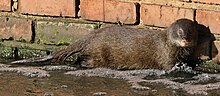
|
|
| Cynictis Ogilby, 1833[31] | Yellow mongoose (C. penicillata) (Cuvier, 1829)[30] | 
|
|
| Urva Hodgson, 1836[32] |
|
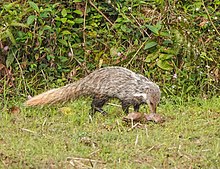
|
|
| Ichneumia Geoffroy Saint-Hilaire, 1837[38] | White-tailed mongoose (I. albicauda) (Cuvier, 1829)[30] | 
|
|
| Bdeogale Peters, 1850[39] |
|

|
|
| Rhynchogale Thomas, 1894[45] | Meller’s mongoose (R. melleri) Gray, 1865[18] | 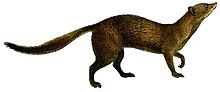
|
|
| Paracynictis Pocock, 1916 | Selous’s mongoose (P. selousi) (de Winton, 1896) | 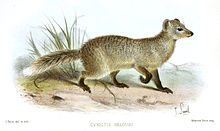
|
|
| Xenogale Allen, 1919[46] | Long-nosed mongoose (X. naso) (de Winton, 1901)[47] | 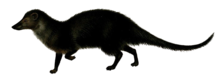
|
|
| Mungotinae | Mungos E. Geoffroy Saint-Hilaire & F. Cuvier, 1795[48] |
|

|
| Suricata Desmarest, 1804[51] | Meerkat (S. suricatta) (Schreber, 1776)[52] | 
|
|
| Crossarchus Cuvier, 1825 |
|

|
|
| Helogale Gray, 1861 |
|
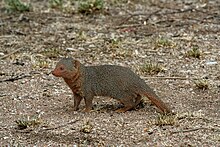
|
|
| Dologale Thomas, 1920 | Pousargues’s mongoose (D. dybowskii) Pousargues, 1894[53] | 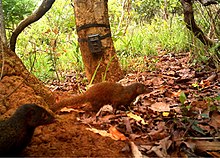
|
|
| Liberiictis Hayman, 1958 | Liberian mongoose (L. kuhni) Hayman, 1958 |
Phylogenetic relationships
Phylogenetic research of 18 mongoose species revealed that the solitary and social mongooses form different clades.[54]
The phylogenetic relationships of Herpestidae are shown in the following cladogram:[55][3]
| Herpestidae |
|
||||||||||||

Extinct species
Atilax Cuvier, 1826
- †A. mesotes Ewer 1956
Herpestes Illiger, 1811
- †H. lemanensis Pomel, 1853
Leptoplesictis Major, 1903[56]
- †L. atavus Beaumont, 1973
- †L. aurelianensis Schlosser, 1888
- †L. filholi Gaillard, 1899
- †L. mbitensis Schmidt-Kittler, 1987
- †L. namibiensis Morales et al., 2008
- †L. peignei, Grohé et al., 2020
- †L. rangwai Schmidt-Kittler, 1987
- †L. senutae Morales et al., 2008
Behaviour and ecology
Mongooses mostly feed on insects, crabs, earthworms, lizards, birds, and rodents. However, they also eat eggs and carrion.[57]
Some species can learn simple tricks. They can be tamed and are kept as pets to control vermin.[58]
Cultural significance
In ancient Mesopotamia, mongooses were sacred to the deity Ninkilim, who was conflated with Ningirama, a deity of magic who was invoked for protection against serpents. According to a Babylonian popular saying, when a mouse fled from a mongoose into a serpent’s hole, it announced, «I bring you greetings from the snake-charmer!» A creature resembling a mongoose also appears in Old Babylonian glyptic art, but its significance is not known.[59]
All mongoose species, except for Suricata suricatta, are classed as a «prohibited new organism» under New Zealand’s Hazardous Substances and New Organisms Act 1996, preventing them from being imported into the country.[60]
A well-known fictional mongoose is Rikki-Tikki-Tavi, who appears in a short story of the same title in The Jungle Book (1894) by Rudyard Kipling. In this tale set in India, a young pet mongoose saves his human family from a krait and from Nag and Nagaina, two cobras. The story was later made into several films and a song by Donovan, among other references. A mongoose is also featured in Bram Stoker’s novel The Lair of the White Worm. The main character, Adam Salton, purchases one to independently hunt snakes. Another mongoose features in the denouement of the Sherlock Holmes story «The Adventure of the Crooked Man», by Sir Arthur Conan Doyle. The Indian Tamil devotional film Padai Veetu Amman shows Tamil actor Vinu Chakravarthy changing himself into a mongoose by using his evil tantric mantra, to fight the goddess Amman. However, the mongoose finally dies at the hands of the goddess.
Mongoose species are prohibited to be kept as pets in the United States.[61]
See also
- List of herpestids
References
- ^ a b Wozencraft, W. C. (2005). «Family Herpestidae». In Wilson, D. E.; Reeder, D. M. (eds.). Mammal Species of the World: A Taxonomic and Geographic Reference (3rd ed.). Johns Hopkins University Press. pp. 562–571. ISBN 978-0-8018-8221-0. OCLC 62265494.
- ^ Gilchrist, J.S.; Jennings, A.P.; Veron, G. & Cavallini, P. (2009). «Family Herpestidae (Mongooses)». In Wilson, D. E. & Mittermeier, R. A. (eds.). Handbook of the Mammals of the World. Vol. 1. Carnivores. Barcelona: Lynx Edicions. pp. 262–328. ISBN 978-84-96553-49-1.
- ^ a b c d Patou, M.; Mclenachan, P.A.; Morley, C.G.; Couloux, A.; Jennings, A.P.; Veron, G. (2009). «Molecular phylogeny of the Herpestidae (Mammalia, Carnivora) with a special emphasis on the Asian Herpestes». Molecular Phylogenetics and Evolution. 53 (1): 69–80. doi:10.1016/j.ympev.2009.05.038. PMID 19520178.
- ^ Valentini, M.B. & Major, J.D. (1714). «Viverra Indica grysea. Mungos». Museum museorum, oder, Vollständige Schau Bühne aller Materialien und Specereyen. Vol. 2 Appendix IX. Franckfurt am Mayn: Johann David Zunners Sel. Erben, und Johann Adam Jungen. p. 24.
- ^ Jerdon, T.C. (1874). «127. Herpestes griseus». The mammals of India; a natural history of all the animals known to inhabit continental India. London: J. Wheldon. pp. 132–134.
- ^ Sterndale, R.A. (1884). «Herpestidae. The Ichneumon or Mungoose Family». Natural history of the Mammalia of India and Ceylon. Calcutta: Thacker & Spink. pp. 222–228.
- ^ Lydekker, R. (1894). «XIII. The Mungooses. Genus Herpestes«. A hand-book to the Carnivora. Part 1: Cats, civets, and mungooses. London: Edward Lloyd Limited. pp. 244–269.
- ^ Platts, J.T. (1884). «منگوس मुंगूस muṅgūs, or मंगूस maṅgūs. The Mongoose, or ichneumon, Viverra ichneumon». A dictionary of Urdu, classical Hindi, and English. London: W. H. Allen & Co. p. 1081.
- ^ Molesworth, J. T. (1857). «मुंगूस muṅgūsa, Bengal Mungoose, Viverra Ichneumon, or Herpesteus Griseus». A dictionary, Marathi and English (Second, revised and enlarged ed.). Bombay: Printed for Government at the Bombay Education Society’s Press. p. 384.
- ^ Brown, C.P. (1903). «ముంగి or ముంగిస mungi. The ichneumon or mongoose, a kind of weasel. Viverra ichneumon». A Telugu-English dictionary (New, thoroughly revised and brought up to date second ed.). Madras: Promoting Christian Knowledge. p. 997.
- ^ Reeve, W. & Sanderson, D. (1858). «ಮುಂಗಿ, ಮುಂಗಿಸಿ, ಮುಂಗುಲಿ». A dictionary, Canarese and English (Revised, corrected and enlarged ed.). Bangalore: Wesleyan Mission Press. p. 787.
- ^ Forsyth, M. (2012). «Folk etymology». The Etymologicon: A Circular Stroll Through the Hidden Connections of the English Language. Penguin Books. p. 77. ISBN 9781101611760.
- ^ Hinton, H. E. & Dunn, A. M. S. (1967). «Preface». Mongooses: Their Natural History and Behaviour. Berkeley: University of California Press. p. v. OCLC 1975837.
- ^ Macdonald, D., ed. (2009). The Encyclopedia of Mammals. Oxford: Oxford University Press. p. 660. ISBN 978-0-19-956799-7.
- ^ Barchan, D.; Kachalsky, S., Neumann, D., Vogel, Z., Ovadia, M., Kochva, E. and Fuchs, S. (1992). «How the mongoose can fight the snake: the binding site of the mongoose acetylcholine receptor» (PDF). Proceedings of the National Academy of Sciences. 89 (16): 7717–7721. Bibcode:1992PNAS…89.7717B. doi:10.1073/pnas.89.16.7717. PMC 49782. PMID 1380164.
{{cite journal}}: CS1 maint: multiple names: authors list (link) - ^ Drabeck, D. H.; Dean, A. M.; Jansa, S. A. (2015). «Why the honey badger don’t care: Convergent evolution of venom-targeted nicotinic acetylcholine receptors in mammals that survive venomous snake bites». Toxicon. 99: 68–72. doi:10.1016/j.toxicon.2015.03.007. PMID 25796346.
- ^ Bonaparte, C. L. (1845). «Fam. VII. Viverridae». Catalogo Methodico dei Mammiferi Europei. Milan, Italy: L. di Giacomo Pirola. p. 8.
- ^ a b Gray, J.E. (1865). «A revision of the genera and species of viverrine animals (Viverridae) founded on the collection in the British Museum». Proceedings of the Zoological Society of London: 502–579.
- ^ Pocock, R. I. (1919). «The classification of mongooses (Mungotidae)». The Annals and Magazine of Natural History. 9 (3): 515–524. doi:10.1080/00222931908673851.
- ^ Yoder, A. D.; Burns, M. M.; Zehr, S.; Delefosse, T.; Veron, G.; Goodman, S. M.; Flynn, J. J. (2003). «Single origin of Malagasy carnivora from an African ancestor». Nature. 421 (6924): 434–437. Bibcode:2003Natur.421..734Y. doi:10.1038/nature01303. PMID 12610623. S2CID 4404379.
- ^ Flynn, J. J.; Finarelli, J.; Zehr, S.; Hsu, J.; Nedbal, M. (2005). «Molecular phylogeny of the Carnivora (Mammalia): Assessing the Impact of Increased sampling on resolving enigmatic relationships». Systematic Biology. 54 (2): 317–337. doi:10.1080/10635150590923326. PMID 16012099.
- ^ Wilson, D. E.; Reeder, D. M., eds. (2005). Mammal Species of the World: A Taxonomic and Geographic Reference (3rd ed.). Johns Hopkins University Press. ISBN 978-0-8018-8221-0. OCLC 62265494.
- ^ Illiger, C. (1815). «Überblick der Säugethiere nach ihrer Verteilung über die Welttheile». Abhandlungen der Königlichen Preußischen Akademie der Wissenschaften zu Berlin. 1804−1811: 39−159.
- ^ Linnaeus, C. (1758). «Viverra ichneumon«. Caroli Linnæi Systema naturæ per regna tria naturæ, secundum classes, ordines, genera, species, cum characteribus, differentiis, synonymis, locis. Vol. Tomus I (Decima, reformata ed.). Holmiae: Laurentius Salvius. p. 41. (in Latin)
- ^ Rüppell, E. (1835). «Herpestes sanguineus. Rüppell». Neue Wirbelthiere zu der Fauna von Abyssinien gehörig. Frankfurt am Main: S. Schmerber. pp. 27–28.
- ^ Wagner, J.A. (1839). «Über die Verwandtschafts-Verhältnisse der Pharaonsratte». Gelehrte Anzeigen der Königlich Bayerischen Akademie der Wissenschaften zu München. 9 (183): 425–429.
- ^ Gray, J.E. (1848). «Description of a new species of Herpestes, from Abyssinia». Proceedings of the Zoological Society of London (November): 138–139.
- ^ Bocage, J.V.B. (1889). «Mammifère d’Angola et du Congo». Jornal de Sciencias mathematicas, physicas e naturaes. 2. 1: 174–185.
- ^ Cuvier, F. G. (1826). «Vansire». In E. Geoffroy Saint-Hilaire; Cuvier, F. G. (eds.). Histoire Naturelle des Mammifères : avec des figures originales, coloriées, dessinées d’aprèsdes animaux vivans. Tome 5. Paris: A. Belin. p. LIV.
- ^ a b c Cuvier, G. (1829). «Les Mangoustes. Cuv. (Herpestes, Illiger)». Le règne animal distribué d’après son organisation, pour servir de base à l’histoire naturelle des animaux et d’introduction à l’anatomie comparée. Paris: Chez Déterville. pp. 157–158.
- ^ Ogilby, W. (1833). «Characters of a new Genus of carnivorous Mammalia from the collection of Mr. Steedman». Proceedings of the Zoological Society of London (Part 1): 48–49.
- ^ a b c Hodgson, B. H. (1836). «Synoptical description of sundry new animals, enumerated in the Catalogue of Nepalese Mammals». Journal of the Asiatic Society of Bengal. 5: 231–238.
- ^ a b Geoffroy Saint-Hilaire, É. (1817). «De l’Ichneumon. Ichneumon pharaon«. In Jomard, E. F. (ed.). Description de l’Égypte, ou, Recueil des observations et des recherches qui ont été faites en Égypte pendant l’éxpédition de l’armée française. Vol. Tome II. Paris: Commission des Sciences et Arts d’Egypte. pp. 137–144.
- ^ Bennett, E. T. (1835). «Remarks on some Mammalia from Travancore, including a New Species of Herpestes». Proceedings of the Zoological Society of London. III: 66–67.
- ^ a b Gray, J. E. (1837). «Description of some or little known Mammalia, principally in the British Mueum Collection». The Magazine of Natural History and Journal of Zoology, Botany, Mineralogy, Geology and Meteorology. I (November): 577–587.
- ^ Waterhouse, G. R. (1838). «On two new species of Mammalia, from the Society’s collection, belonging to the genera Gerbillus and Herpestes«. Proceedings of the Zoological Society of London. VI: 55–56.
- ^ Gray, J.E. (1846). «New species of Mammalia». The Annals and Magazine of Natural History; Zoology, Botany, and Geology. 18 (118): 211–212.
- ^ Geoffroy Saint-Hilaire, I. (1837). «Notices sur deux nouveaux genres de Mammifères carnassiers, les Ichneumies, du continent Africain, et les Galidies de Madagascar». Annales des Sciences Naturelles. 2. 8: 249–252.
- ^ Peters, W. (1850). «Bdeogale». Sitzungsberichte der Gesellschaft Naturforschender Freunde zu Berlin: 94.
- ^ Peters, W. (1852). «Mittheilung über die in Mossambique beobachteten Mangusten». Verhandlungen der Königlich Preussischen Akademie der Wissenschaften zu Berlin: 81–82.
- ^ Pucheran, J.P. (1855). «Les Mammifères de la côte occidental d’Afrique». Revue et magasin de zoologie pure et appliquée. 2. 7: 111.
- ^ Thomas, O. (1894). «On a new African Genus of Mustelidae». The Annals and Magazine of Natural History; Zoology, Botany, and Geology. 6. 13 (78): 522–524.
- ^ Heller, E. (1914). «New antelopes and carnivores from British East Africa». Smithsonian Miscellaneous Collections. 61 (2240): 1–15.
- ^ Foley, C. & Do Linh San, E. (2016). «Bdeogale omnivora«. IUCN Red List of Threatened Species. 2016: e.T136686A45221619.
- ^ Thomas, O. (1894). «On the mammals of Nyasaland: third contribution». Proceedings of the Zoological Society of London (February): 136–146.
- ^ Allen, J. A. (1919). «Preliminary notes on African Carnivora». Journal of Mammalogy. 1 (1): 23–31. doi:10.2307/1373716. JSTOR 1373716.
- ^ de Winton, W. E. (1901). «Description of a New Mongoose from West Africa». Bulletin of the Liverpool Museums Under the City Council. 3 (2): 35–37.
- ^ Geoffroy, E. & Cuvier, F. (1795). «Mémoire sur une nouvelle division des Mammifères, et sur Ies principes qui doivent servir de base dans cette sorte de travail, lu à la société d’Histoire naturelle, le premier floréal de l’an troisième». In Millin; Noel & Warens (eds.). Magasin Encyclopédique : ou journal des sciences, des lettres et des arts. Vol. Tome second. Paris: I’lmprimerie du Magazin Encyclopédique. pp. 164–189.
- ^ Gmelin, J. F. (1788). «Viverra mungo«. Caroli a Linné, Systema naturae per regna tria naturae, secundum classes, ordines, genera, species, cum characteribus, differentiis, synonymis, locis. Vol. I (13th aucta, reformata ed.). Lipsiae: Georg Emanuel Beer. pp. 84–85.
- ^ Ogilby, W. (1835). «Descriptions of Mammalia and Birds from the Gambia». Proceedings of the Zoological Society of London. Part III: 97–105.
- ^ Desmarest, A. G. (1804). «Genre Surikate, Suricata Nob.». In Deterville, J. F. P. (ed.). Nouveau dictionnaire d’histoire naturelle appliquée aux arts : principalement à l’agriculture et à l’économie rurale et domestique. Vol. 24. Paris: Deterville. p. 15.
- ^ Schreber, J. C. D. (1776). «Viverra suricata«. Die Säugethiere in Abbildungen nach der Natur, mit Beschreibungen. Erlangen: Expedition des Schreber’schen Säugthier- und des Esper’schen Schmetterlingswerkes. p. CVII.
- ^ de Pousargues, E. (1894). «Description d’une nouvelle espèce de mammifère du genre Crossarchus et considérations sur la répartition géographique des crossarques rayés». Nouvelles Archives du Muséum d’Histoire Naturelle. 3 (in French). 6: 121–134.
- ^ Veron, G.; Colyn, M.; Dunham, A.E.; Taylor, P.; Gaubert, P. (2004). «Molecular systematics and origin of sociality in mongooses (Herpestidae, Carnivora)». Molecular Phylogenetics and Evolution. 30 (3): 582–598. doi:10.1016/S1055-7903(03)00229-X. PMID 15012940.
- ^ Barycka, E. (2005). «Evolution and systematics of the feliform Carnivora». Mammalian Biology. 72 (5): 257–282. doi:10.1016/j.mambio.2006.10.011.
- ^ Morales, J., Pickford, M. and Salesa, M.J. (2008). «Creodonta and Carnivora from the Early Miocene of the Northern Sperrgebiet, Namibia». Memoir of the Geological Survey of Namibia. 20: 291–310.
{{cite journal}}: CS1 maint: uses authors parameter (link) - ^ Cronk, N. E.; Pillay, N. (2018). «Food choice and feeding on carrion in two African mongoose species in an urban environment». Acta Ethologica. 21 (2): 127–136. doi:10.1007/s10211-018-0291-x. S2CID 21688548.
- ^ Sherman, D. M. (2007). Tending Animals in the Global Village: A Guide to International Veterinary Medicine. John Wiley & Sons. ISBN 9780470292105.
- ^ Black, J.; Green, A. (1992). Gods, Demons and Symbols of Ancient Mesopotamia: An Illustrated Dictionary. The British Museum Press. p. 132. ISBN 0-7141-1705-6.
- ^ «Hazardous Substances and New Organisms Act 2003 — Schedule 2 Prohibited new organisms». New Zealand Government. Retrieved 26 January 2012.
- ^ Krueger, A. (2010). «Remembering Duluth’s famous mongoose, Mr. Magoo». Duluth News Tribune. Archived from the original on 1 February 2014.
Further reading
- Rasa, A. (1986). Mongoose Watch: A Family Observed. Garden City, N.Y.: Anchor Press, Doubleday & Co. ISBN 9780385231756. OCLC 12664019.
- Lodrick, D. O. (1982). «Man and Mongoose in Indian Culture». Anthropos. 77 (1/2): 191–214. JSTOR 40460438.
External links
- «Ichneumon» . Encyclopædia Britannica (11th ed.). 1911.
From Wikipedia, the free encyclopedia
(Redirected from Mungoose)
This article is about the mongoose family Herpestidae. For Malagasy mongooses, see Galidiinae. For other uses, see Mongoose (disambiguation).
| Mongoose
Temporal range: Early Miocene to present, 21.8–0 Ma |
|
|---|---|
|
|
|
| Top left: Meerkat Top right: Slender mongoose Bottom left: Yellow mongoose Bottom right: Indian gray mongoose |
|
| Scientific classification
|
|
| Kingdom: | Animalia |
| Phylum: | Chordata |
| Class: | Mammalia |
| Order: | Carnivora |
| Suborder: | Feliformia |
| Superfamily: | Herpestoidea |
| Family: | Herpestidae Bonaparte, 1845 |
| Type genus | |
| Herpestes
Johann Karl Wilhelm Illiger, 1811 |
|
| Genera[1] | |
|
List
|
|
|
|
|
| Synonyms[1] | |
|
List
|
A mongoose is a small terrestrial carnivorous mammal belonging to the family Herpestidae. This family is currently split into two subfamilies, the Herpestinae and the Mungotinae. The Herpestinae comprises 23 living species that are native to southern Europe, Africa and Asia, whereas the Mungotinae comprises 11 species native to Africa.[2]
The Herpestidae originated about 21.8 ± 3.6 million years ago in the Early Miocene and genetically diverged into two main genetic lineages between 19.1 and 18.5 ± 3.5 million years ago.[3]
Etymology
The English word «mongoose» used to be spelled «mungoose» in the 18th and 19th centuries. The name is derived from names used in India for Herpestes species:[4][5][6][7]
muṅgūs or maṅgūs in classical Hindi;[8]
muṅgūs in Marathi;[9]
mungisa in Telugu;[10]
mungi, mungisi and munguli in Kannada.[11]
The form of the English name (since 1698) was altered to its «-goose» ending by folk etymology.[12] The plural form is «mongooses».[13]
Characteristics
Mongooses have long faces and bodies, small, rounded ears, short legs, and long, tapering tails. Most are brindled or grizzly; a few have strongly marked coats which bear a striking resemblance to mustelids. Their nonretractile claws are used primarily for digging. Mongooses, much like goats, have narrow, ovular pupils. Most species have a large anal scent gland, used for territorial marking and signaling reproductive status. The dental formula of mongooses is 3.1.3–4.1–23.1.3–4.1–2.
They range from 24 to 58 cm (9.4 to 22.8 in) in head-to-body length, excluding the tail. In weight, they range from 320 g (11 oz) to 5 kg (11 lb).[14]
Mongooses are one of at least four known mammalian taxa with mutations in the nicotinic acetylcholine receptor that protect against snake venom.[15] Their modified receptors prevent the snake venom α-neurotoxin from binding. These represent four separate, independent mutations. In the mongoose, this change is effected, uniquely, by glycosylation.[16]
Taxonomy
Herpestina was a scientific name proposed by Charles Lucien Bonaparte in 1845 who considered the mongooses a subfamily of the Viverridae.[17] In 1864, John Edward Gray classified the mongooses into three subfamilies: Galidiinae, Herpestinae and Mungotinae.[18] This grouping was supported by Reginald Innes Pocock in 1919, who referred to the family as «Mungotidae».[19]
Genetic research based on nuclear and mitochondrial DNA analyses revealed that the Galidiinae are more closely related to Madagascar carnivores, including the fossa and Malagasy civet.[20][21] Galidiinae is presently considered a subfamily of Eupleridae.[22]
| Subfamily | Genus | Species | Image of type species |
|---|---|---|---|
| Herpestinae | |||
| Herpestes Illiger, 1811[23] |
|
|
|
| Atilax Cuvier, 1826[29] | Marsh mongoose (A. paludinosus) (Cuvier, 1829)[30] |
|
|
| Cynictis Ogilby, 1833[31] | Yellow mongoose (C. penicillata) (Cuvier, 1829)[30] |
|
|
| Urva Hodgson, 1836[32] |
|
|
|
| Ichneumia Geoffroy Saint-Hilaire, 1837[38] | White-tailed mongoose (I. albicauda) (Cuvier, 1829)[30] |
|
|
| Bdeogale Peters, 1850[39] |
|
|
|
| Rhynchogale Thomas, 1894[45] | Meller’s mongoose (R. melleri) Gray, 1865[18] |
|
|
| Paracynictis Pocock, 1916 | Selous’s mongoose (P. selousi) (de Winton, 1896) |
|
|
| Xenogale Allen, 1919[46] | Long-nosed mongoose (X. naso) (de Winton, 1901)[47] |
|
|
| Mungotinae | Mungos E. Geoffroy Saint-Hilaire & F. Cuvier, 1795[48] |
|
|
| Suricata Desmarest, 1804[51] | Meerkat (S. suricatta) (Schreber, 1776)[52] |
|
|
| Crossarchus Cuvier, 1825 |
|
|
|
| Helogale Gray, 1861 |
|
|
|
| Dologale Thomas, 1920 | Pousargues’s mongoose (D. dybowskii) Pousargues, 1894[53] |
|
|
| Liberiictis Hayman, 1958 | Liberian mongoose (L. kuhni) Hayman, 1958 |
Phylogenetic relationships
Phylogenetic research of 18 mongoose species revealed that the solitary and social mongooses form different clades.[54]
The phylogenetic relationships of Herpestidae are shown in the following cladogram:[55][3]
| Herpestidae |
|
||||||||||||
Extinct species
Atilax Cuvier, 1826
- †A. mesotes Ewer 1956
Herpestes Illiger, 1811
- †H. lemanensis Pomel, 1853
Leptoplesictis Major, 1903[56]
- †L. atavus Beaumont, 1973
- †L. aurelianensis Schlosser, 1888
- †L. filholi Gaillard, 1899
- †L. mbitensis Schmidt-Kittler, 1987
- †L. namibiensis Morales et al., 2008
- †L. peignei, Grohé et al., 2020
- †L. rangwai Schmidt-Kittler, 1987
- †L. senutae Morales et al., 2008
Behaviour and ecology
Mongooses mostly feed on insects, crabs, earthworms, lizards, birds, and rodents. However, they also eat eggs and carrion.[57]
Some species can learn simple tricks. They can be tamed and are kept as pets to control vermin.[58]
Cultural significance
In ancient Mesopotamia, mongooses were sacred to the deity Ninkilim, who was conflated with Ningirama, a deity of magic who was invoked for protection against serpents. According to a Babylonian popular saying, when a mouse fled from a mongoose into a serpent’s hole, it announced, «I bring you greetings from the snake-charmer!» A creature resembling a mongoose also appears in Old Babylonian glyptic art, but its significance is not known.[59]
All mongoose species, except for Suricata suricatta, are classed as a «prohibited new organism» under New Zealand’s Hazardous Substances and New Organisms Act 1996, preventing them from being imported into the country.[60]
A well-known fictional mongoose is Rikki-Tikki-Tavi, who appears in a short story of the same title in The Jungle Book (1894) by Rudyard Kipling. In this tale set in India, a young pet mongoose saves his human family from a krait and from Nag and Nagaina, two cobras. The story was later made into several films and a song by Donovan, among other references. A mongoose is also featured in Bram Stoker’s novel The Lair of the White Worm. The main character, Adam Salton, purchases one to independently hunt snakes. Another mongoose features in the denouement of the Sherlock Holmes story «The Adventure of the Crooked Man», by Sir Arthur Conan Doyle. The Indian Tamil devotional film Padai Veetu Amman shows Tamil actor Vinu Chakravarthy changing himself into a mongoose by using his evil tantric mantra, to fight the goddess Amman. However, the mongoose finally dies at the hands of the goddess.
Mongoose species are prohibited to be kept as pets in the United States.[61]
See also
- List of herpestids
References
- ^ a b Wozencraft, W. C. (2005). «Family Herpestidae». In Wilson, D. E.; Reeder, D. M. (eds.). Mammal Species of the World: A Taxonomic and Geographic Reference (3rd ed.). Johns Hopkins University Press. pp. 562–571. ISBN 978-0-8018-8221-0. OCLC 62265494.
- ^ Gilchrist, J.S.; Jennings, A.P.; Veron, G. & Cavallini, P. (2009). «Family Herpestidae (Mongooses)». In Wilson, D. E. & Mittermeier, R. A. (eds.). Handbook of the Mammals of the World. Vol. 1. Carnivores. Barcelona: Lynx Edicions. pp. 262–328. ISBN 978-84-96553-49-1.
- ^ a b c d Patou, M.; Mclenachan, P.A.; Morley, C.G.; Couloux, A.; Jennings, A.P.; Veron, G. (2009). «Molecular phylogeny of the Herpestidae (Mammalia, Carnivora) with a special emphasis on the Asian Herpestes». Molecular Phylogenetics and Evolution. 53 (1): 69–80. doi:10.1016/j.ympev.2009.05.038. PMID 19520178.
- ^ Valentini, M.B. & Major, J.D. (1714). «Viverra Indica grysea. Mungos». Museum museorum, oder, Vollständige Schau Bühne aller Materialien und Specereyen. Vol. 2 Appendix IX. Franckfurt am Mayn: Johann David Zunners Sel. Erben, und Johann Adam Jungen. p. 24.
- ^ Jerdon, T.C. (1874). «127. Herpestes griseus». The mammals of India; a natural history of all the animals known to inhabit continental India. London: J. Wheldon. pp. 132–134.
- ^ Sterndale, R.A. (1884). «Herpestidae. The Ichneumon or Mungoose Family». Natural history of the Mammalia of India and Ceylon. Calcutta: Thacker & Spink. pp. 222–228.
- ^ Lydekker, R. (1894). «XIII. The Mungooses. Genus Herpestes«. A hand-book to the Carnivora. Part 1: Cats, civets, and mungooses. London: Edward Lloyd Limited. pp. 244–269.
- ^ Platts, J.T. (1884). «منگوس मुंगूस muṅgūs, or मंगूस maṅgūs. The Mongoose, or ichneumon, Viverra ichneumon». A dictionary of Urdu, classical Hindi, and English. London: W. H. Allen & Co. p. 1081.
- ^ Molesworth, J. T. (1857). «मुंगूस muṅgūsa, Bengal Mungoose, Viverra Ichneumon, or Herpesteus Griseus». A dictionary, Marathi and English (Second, revised and enlarged ed.). Bombay: Printed for Government at the Bombay Education Society’s Press. p. 384.
- ^ Brown, C.P. (1903). «ముంగి or ముంగిస mungi. The ichneumon or mongoose, a kind of weasel. Viverra ichneumon». A Telugu-English dictionary (New, thoroughly revised and brought up to date second ed.). Madras: Promoting Christian Knowledge. p. 997.
- ^ Reeve, W. & Sanderson, D. (1858). «ಮುಂಗಿ, ಮುಂಗಿಸಿ, ಮುಂಗುಲಿ». A dictionary, Canarese and English (Revised, corrected and enlarged ed.). Bangalore: Wesleyan Mission Press. p. 787.
- ^ Forsyth, M. (2012). «Folk etymology». The Etymologicon: A Circular Stroll Through the Hidden Connections of the English Language. Penguin Books. p. 77. ISBN 9781101611760.
- ^ Hinton, H. E. & Dunn, A. M. S. (1967). «Preface». Mongooses: Their Natural History and Behaviour. Berkeley: University of California Press. p. v. OCLC 1975837.
- ^ Macdonald, D., ed. (2009). The Encyclopedia of Mammals. Oxford: Oxford University Press. p. 660. ISBN 978-0-19-956799-7.
- ^ Barchan, D.; Kachalsky, S., Neumann, D., Vogel, Z., Ovadia, M., Kochva, E. and Fuchs, S. (1992). «How the mongoose can fight the snake: the binding site of the mongoose acetylcholine receptor» (PDF). Proceedings of the National Academy of Sciences. 89 (16): 7717–7721. Bibcode:1992PNAS…89.7717B. doi:10.1073/pnas.89.16.7717. PMC 49782. PMID 1380164.
{{cite journal}}: CS1 maint: multiple names: authors list (link) - ^ Drabeck, D. H.; Dean, A. M.; Jansa, S. A. (2015). «Why the honey badger don’t care: Convergent evolution of venom-targeted nicotinic acetylcholine receptors in mammals that survive venomous snake bites». Toxicon. 99: 68–72. doi:10.1016/j.toxicon.2015.03.007. PMID 25796346.
- ^ Bonaparte, C. L. (1845). «Fam. VII. Viverridae». Catalogo Methodico dei Mammiferi Europei. Milan, Italy: L. di Giacomo Pirola. p. 8.
- ^ a b Gray, J.E. (1865). «A revision of the genera and species of viverrine animals (Viverridae) founded on the collection in the British Museum». Proceedings of the Zoological Society of London: 502–579.
- ^ Pocock, R. I. (1919). «The classification of mongooses (Mungotidae)». The Annals and Magazine of Natural History. 9 (3): 515–524. doi:10.1080/00222931908673851.
- ^ Yoder, A. D.; Burns, M. M.; Zehr, S.; Delefosse, T.; Veron, G.; Goodman, S. M.; Flynn, J. J. (2003). «Single origin of Malagasy carnivora from an African ancestor». Nature. 421 (6924): 434–437. Bibcode:2003Natur.421..734Y. doi:10.1038/nature01303. PMID 12610623. S2CID 4404379.
- ^ Flynn, J. J.; Finarelli, J.; Zehr, S.; Hsu, J.; Nedbal, M. (2005). «Molecular phylogeny of the Carnivora (Mammalia): Assessing the Impact of Increased sampling on resolving enigmatic relationships». Systematic Biology. 54 (2): 317–337. doi:10.1080/10635150590923326. PMID 16012099.
- ^ Wilson, D. E.; Reeder, D. M., eds. (2005). Mammal Species of the World: A Taxonomic and Geographic Reference (3rd ed.). Johns Hopkins University Press. ISBN 978-0-8018-8221-0. OCLC 62265494.
- ^ Illiger, C. (1815). «Überblick der Säugethiere nach ihrer Verteilung über die Welttheile». Abhandlungen der Königlichen Preußischen Akademie der Wissenschaften zu Berlin. 1804−1811: 39−159.
- ^ Linnaeus, C. (1758). «Viverra ichneumon«. Caroli Linnæi Systema naturæ per regna tria naturæ, secundum classes, ordines, genera, species, cum characteribus, differentiis, synonymis, locis. Vol. Tomus I (Decima, reformata ed.). Holmiae: Laurentius Salvius. p. 41. (in Latin)
- ^ Rüppell, E. (1835). «Herpestes sanguineus. Rüppell». Neue Wirbelthiere zu der Fauna von Abyssinien gehörig. Frankfurt am Main: S. Schmerber. pp. 27–28.
- ^ Wagner, J.A. (1839). «Über die Verwandtschafts-Verhältnisse der Pharaonsratte». Gelehrte Anzeigen der Königlich Bayerischen Akademie der Wissenschaften zu München. 9 (183): 425–429.
- ^ Gray, J.E. (1848). «Description of a new species of Herpestes, from Abyssinia». Proceedings of the Zoological Society of London (November): 138–139.
- ^ Bocage, J.V.B. (1889). «Mammifère d’Angola et du Congo». Jornal de Sciencias mathematicas, physicas e naturaes. 2. 1: 174–185.
- ^ Cuvier, F. G. (1826). «Vansire». In E. Geoffroy Saint-Hilaire; Cuvier, F. G. (eds.). Histoire Naturelle des Mammifères : avec des figures originales, coloriées, dessinées d’aprèsdes animaux vivans. Tome 5. Paris: A. Belin. p. LIV.
- ^ a b c Cuvier, G. (1829). «Les Mangoustes. Cuv. (Herpestes, Illiger)». Le règne animal distribué d’après son organisation, pour servir de base à l’histoire naturelle des animaux et d’introduction à l’anatomie comparée. Paris: Chez Déterville. pp. 157–158.
- ^ Ogilby, W. (1833). «Characters of a new Genus of carnivorous Mammalia from the collection of Mr. Steedman». Proceedings of the Zoological Society of London (Part 1): 48–49.
- ^ a b c Hodgson, B. H. (1836). «Synoptical description of sundry new animals, enumerated in the Catalogue of Nepalese Mammals». Journal of the Asiatic Society of Bengal. 5: 231–238.
- ^ a b Geoffroy Saint-Hilaire, É. (1817). «De l’Ichneumon. Ichneumon pharaon«. In Jomard, E. F. (ed.). Description de l’Égypte, ou, Recueil des observations et des recherches qui ont été faites en Égypte pendant l’éxpédition de l’armée française. Vol. Tome II. Paris: Commission des Sciences et Arts d’Egypte. pp. 137–144.
- ^ Bennett, E. T. (1835). «Remarks on some Mammalia from Travancore, including a New Species of Herpestes». Proceedings of the Zoological Society of London. III: 66–67.
- ^ a b Gray, J. E. (1837). «Description of some or little known Mammalia, principally in the British Mueum Collection». The Magazine of Natural History and Journal of Zoology, Botany, Mineralogy, Geology and Meteorology. I (November): 577–587.
- ^ Waterhouse, G. R. (1838). «On two new species of Mammalia, from the Society’s collection, belonging to the genera Gerbillus and Herpestes«. Proceedings of the Zoological Society of London. VI: 55–56.
- ^ Gray, J.E. (1846). «New species of Mammalia». The Annals and Magazine of Natural History; Zoology, Botany, and Geology. 18 (118): 211–212.
- ^ Geoffroy Saint-Hilaire, I. (1837). «Notices sur deux nouveaux genres de Mammifères carnassiers, les Ichneumies, du continent Africain, et les Galidies de Madagascar». Annales des Sciences Naturelles. 2. 8: 249–252.
- ^ Peters, W. (1850). «Bdeogale». Sitzungsberichte der Gesellschaft Naturforschender Freunde zu Berlin: 94.
- ^ Peters, W. (1852). «Mittheilung über die in Mossambique beobachteten Mangusten». Verhandlungen der Königlich Preussischen Akademie der Wissenschaften zu Berlin: 81–82.
- ^ Pucheran, J.P. (1855). «Les Mammifères de la côte occidental d’Afrique». Revue et magasin de zoologie pure et appliquée. 2. 7: 111.
- ^ Thomas, O. (1894). «On a new African Genus of Mustelidae». The Annals and Magazine of Natural History; Zoology, Botany, and Geology. 6. 13 (78): 522–524.
- ^ Heller, E. (1914). «New antelopes and carnivores from British East Africa». Smithsonian Miscellaneous Collections. 61 (2240): 1–15.
- ^ Foley, C. & Do Linh San, E. (2016). «Bdeogale omnivora«. IUCN Red List of Threatened Species. 2016: e.T136686A45221619.
- ^ Thomas, O. (1894). «On the mammals of Nyasaland: third contribution». Proceedings of the Zoological Society of London (February): 136–146.
- ^ Allen, J. A. (1919). «Preliminary notes on African Carnivora». Journal of Mammalogy. 1 (1): 23–31. doi:10.2307/1373716. JSTOR 1373716.
- ^ de Winton, W. E. (1901). «Description of a New Mongoose from West Africa». Bulletin of the Liverpool Museums Under the City Council. 3 (2): 35–37.
- ^ Geoffroy, E. & Cuvier, F. (1795). «Mémoire sur une nouvelle division des Mammifères, et sur Ies principes qui doivent servir de base dans cette sorte de travail, lu à la société d’Histoire naturelle, le premier floréal de l’an troisième». In Millin; Noel & Warens (eds.). Magasin Encyclopédique : ou journal des sciences, des lettres et des arts. Vol. Tome second. Paris: I’lmprimerie du Magazin Encyclopédique. pp. 164–189.
- ^ Gmelin, J. F. (1788). «Viverra mungo«. Caroli a Linné, Systema naturae per regna tria naturae, secundum classes, ordines, genera, species, cum characteribus, differentiis, synonymis, locis. Vol. I (13th aucta, reformata ed.). Lipsiae: Georg Emanuel Beer. pp. 84–85.
- ^ Ogilby, W. (1835). «Descriptions of Mammalia and Birds from the Gambia». Proceedings of the Zoological Society of London. Part III: 97–105.
- ^ Desmarest, A. G. (1804). «Genre Surikate, Suricata Nob.». In Deterville, J. F. P. (ed.). Nouveau dictionnaire d’histoire naturelle appliquée aux arts : principalement à l’agriculture et à l’économie rurale et domestique. Vol. 24. Paris: Deterville. p. 15.
- ^ Schreber, J. C. D. (1776). «Viverra suricata«. Die Säugethiere in Abbildungen nach der Natur, mit Beschreibungen. Erlangen: Expedition des Schreber’schen Säugthier- und des Esper’schen Schmetterlingswerkes. p. CVII.
- ^ de Pousargues, E. (1894). «Description d’une nouvelle espèce de mammifère du genre Crossarchus et considérations sur la répartition géographique des crossarques rayés». Nouvelles Archives du Muséum d’Histoire Naturelle. 3 (in French). 6: 121–134.
- ^ Veron, G.; Colyn, M.; Dunham, A.E.; Taylor, P.; Gaubert, P. (2004). «Molecular systematics and origin of sociality in mongooses (Herpestidae, Carnivora)». Molecular Phylogenetics and Evolution. 30 (3): 582–598. doi:10.1016/S1055-7903(03)00229-X. PMID 15012940.
- ^ Barycka, E. (2005). «Evolution and systematics of the feliform Carnivora». Mammalian Biology. 72 (5): 257–282. doi:10.1016/j.mambio.2006.10.011.
- ^ Morales, J., Pickford, M. and Salesa, M.J. (2008). «Creodonta and Carnivora from the Early Miocene of the Northern Sperrgebiet, Namibia». Memoir of the Geological Survey of Namibia. 20: 291–310.
{{cite journal}}: CS1 maint: uses authors parameter (link) - ^ Cronk, N. E.; Pillay, N. (2018). «Food choice and feeding on carrion in two African mongoose species in an urban environment». Acta Ethologica. 21 (2): 127–136. doi:10.1007/s10211-018-0291-x. S2CID 21688548.
- ^ Sherman, D. M. (2007). Tending Animals in the Global Village: A Guide to International Veterinary Medicine. John Wiley & Sons. ISBN 9780470292105.
- ^ Black, J.; Green, A. (1992). Gods, Demons and Symbols of Ancient Mesopotamia: An Illustrated Dictionary. The British Museum Press. p. 132. ISBN 0-7141-1705-6.
- ^ «Hazardous Substances and New Organisms Act 2003 — Schedule 2 Prohibited new organisms». New Zealand Government. Retrieved 26 January 2012.
- ^ Krueger, A. (2010). «Remembering Duluth’s famous mongoose, Mr. Magoo». Duluth News Tribune. Archived from the original on 1 February 2014.
Further reading
- Rasa, A. (1986). Mongoose Watch: A Family Observed. Garden City, N.Y.: Anchor Press, Doubleday & Co. ISBN 9780385231756. OCLC 12664019.
- Lodrick, D. O. (1982). «Man and Mongoose in Indian Culture». Anthropos. 77 (1/2): 191–214. JSTOR 40460438.
External links
- «Ichneumon» . Encyclopædia Britannica (11th ed.). 1911.
Примеры из текстов
Стайка быстроногих, глазастых мангуст с любопытными мордочками деловито бегает в своих клетках взад и вперед. Нагуливают аппетит.
A host of quick-footed, bright-eyed, inquisitive-faced mongooses patter busily about their cages, working up an appetite.
Даррелл, Джеральд / Поместье зверинецDurrell, Gerald / Menagerie Manor
Menagerie Manor
Durrell, Gerald
© Gerald M. Durrell, 1964
© renewed Gerald M. Durrell, 1992
Поместье зверинец
Даррелл, Джеральд
© Издательство «Мысль», 1978
— Это же мангуста! — воскликнул я.
“It’s a mongoose,” I cried.
Конан Дойль, Артур / ГорбунConan Doyle, Arthur / The Crooked Man
The Crooked Man
Conan Doyle, Arthur
© copyright by Baskervilles Investments
Горбун
Конан Дойль, Артур
© АО «Скиф Алекс», 1992
© перевод Д. Жукова
Переводы пользователей
Пока нет переводов этого текста.
Будьте первым, кто переведёт его!