
Всего найдено: 6
Пожалуйста подскажите как правильно сказать и какие в этом слуаче применимы правила русского языка: Попробуйте свои силы в покер или блэкджек.
или
Попробуйте свои силы в покерe или блэкджекe.
Ответ справочной службы русского языка
Корректно: играть в покер или блек-джек; попробовать силы в покере или блек-джеке.
Добрый день!
Как правильно по-русски написать название карточной игры BlackJack? И где можно найти соответствующие правила?
Спасибо
Ответ справочной службы русского языка
Правильно: _блек-джек_. Это слово зафиксировано в «Русском орфографическом словаре РАН».
Добрый день!
Как правильно по-русски написать название карточной игры BlackJack? И где можно найти соответствующие правила?
Спасибо
Ответ справочной службы русского языка
В «Русском орфографическом словаре» зафиксировано: _блек-джек_.
Дражайшая справка!
Как правильно написать по-русски такое богомерзкое слово, как «блэк-джек»?
Спасибо!
Ответ справочной службы русского языка
Правильно: _блек-джек_. Такое написание зафиксировано в академическом «Русском орфографическом словаре» под ред. В. В. Лопатина.
Как правильно: блек джек, блек-джек, блэк джэк или блэк-джэк? В каких словарях зафиксировано правописание этого слова?
Ответ справочной службы русского языка
Правильно: _блек-джек_. Это слово зафиксировано в «Русском орфографическом словаре РАН».
Как правильно писать название карточной игры блэкджэк? Спасибо.
Ответ справочной службы русского языка
Правильно: _блек-джек_. Такое написание зафиксировано в академическом «Русском орфографическом словаре» под ред. В. В. Лопатина.
- До 7 класса: Алгоритмика, Кодланд, Реботика.
- 8-11 класс: Умскул, Годограф, Знанио.
- Английский: Инглекс, Puzzle, Novakid.
- Взрослым: Skillbox, Нетология, Geekbrains, Яндекс, Otus, SkillFactory.
Как пишется «блэкджек» или «блэк-джек»?
блэкджек
блэк-джек
блекджек
блек-джек
Правило
Блэкджек – слово английского происхождения. Образовалось от Blackjаck. В русском языке в словаре иностранных слов встречается написание как слитно, так и через дефис.
Значение
Блэкджек обозначает популярную карточную игру, появившуюся в Америке. Победителем становится тот, кто набрал 21 очко или меньше.
Примеры
- Каждый игорный дом устанавливает свои правила для игры в блэкджек.
- Блэк-джек стал популярен в Лас-Вегасе во время расцвета игорного бизнеса.
- До 7 класса: Алгоритмика, Кодланд, Реботика.
- 8-11 класс: Умскул, Годограф, Знанио.
- Английский: Инглекс, Puzzle, Novakid.
- Взрослым: Skillbox, Нетология, Geekbrains, Яндекс, Otus, SkillFactory.
Блэкдже́к, блек-дже́к (англ. Blackjack) — одна из самых популярных карточных игр в казино по всему миру. Большая популярность игры обуславливается простыми правилами, скоростью игры и наиболее простой стратегией в подсчёте карт. Тем не менее популярность игра завоевала не сразу. Игорным домам Соединённых Штатов приходилось стимулировать интерес к игре различными видами бонусов и выработкой нескольких разновидностей правил для блек-джека. Считается, что предшественником этой игры была карточная игра «vingt-et-un» («двадцать один»), которая появилась во французских игорных заведениях приблизительно в XIX веке. В России, например, блек-джек по сей день часто называют двадцать одно или очко. (Но у традиционной игры очко несколько отличаются правила.)
Все значения слова «блэкджек»
-
Покерные и рулеточные столы, игровые автоматы баккары и блэкджека заполняли весь холл, давая возможность испытать судьбу всем желающим ночным посетителям.
-
А дилеры на блэкджеке должны уметь прикрывать карты от наблюдателей, чтобы игроки, состоящие в сговоре, не меняли «картинки» (подбирали карты) и не обыгрывали казино.
-
Иногда даже договаривался с крупье блэкджека сыграть против заведения, за что мог крепко поплатиться.
- (все предложения)
- трефа
- ривер
- фолд
- блек-джек
- канаста
- (ещё синонимы…)
- бендер
- (ещё ассоциации…)
- для игры в блэкджек
- за столами блэкджека
- играть в блэкджек
- (полная таблица сочетаемости…)
Судьба хранит почти всех –тот, кому удалось проиграть сегодня, имеет шанс выиграть завтра.
Мигель Сервантес де Сааведра
Если у вас даже большой опыт игры в блэк-джек, то вам не стоит пропускать эту главу. Правилами игры нужно владеть досконально, ведь некоторые казино имеют незначительные, но тем не менее важные различия в правилах. Перед началом игры нужно уяснить определение следующего.
Количество игроков
За игральным столом сосредоточено от 1 до 7 игроков и сдающего, т.е. банкомета, представляющего казино. В случае когда за столом находится меньше 7 человек (неполный стол), некоторые казино позволяют играть больше, чем на одну руку.
Атрибуты игры
В самом обычном варианте используют стандартную колоду карт на 52 листа. Некоторые казино используют в процессе игры 2 или 4 колоды, перемешанные между собой, а в Монте-Карло встречаются столы, использующие в игре 6 и даже 8 колод. Стоит заметить и это прояснится позже, что чем больше колод используется, тем больше повышаются шансы казино. При игре в 1 или 2 колоды банкомет располагает колоды перед собой на столе. Когда же используется большее количество колод, то они достаются банкометом из специального ящика или как принято его называть на жаргоне игроков «ботинка».
Число очков, значение карт
Масть карт не имеет значение в игре блэк-джек. Учитывается только число очков, которое имеет каждая карта. Число очков у карт с Двойки по Девятку, дает соответственно от двух до девяти очков. Карты со значениями Десять, Валет, Дама и Король дают десять очков. Туз по желанию игрока может засчитаться как за 1 очко так и за 11 очков.
Смысл игры
Главная цель игры – это набор большего количества очков, чем банкомет, но не превышая 21 очко. Иначе вы проиграете и поставленные вами деньги окажутся у казино в кармане. Количество игроков также значение не имеет, потому что всегда вашим единственным соперником является банкомет, а ваша ставка равна сумме денег, которую вы поставили.
Очко (блэк-джек)
В случае, когда вашими первыми двумя картами оказываются Туз с картинкой или десяткой, то вы на руках имеете «Очко»и это самый приятный момент, т.к. вами выигрывается партия, а на руки получаете выигрыш в полтора раза больший, чем ваша ставка (15 долларов вместо 10 поставленных).
Случается, что и у банкомета выпадает «очко», тогда партия считается сыгранной в «ничью» и ваши деньги остаются при вас. Стоит заметить, что в случае выпадение «очко» у банкомета, а у вас нет, то банк не выигрывает в 1,5 раза больше и это является вашим преимуществом.
Ставки
Вашей ставкой является процесс помещения на игральный стол в определенное место специальных фишек, которыми заменяются реальные деньги в казино.
Предел ставок
В каждом казино предусмотрено существование максимальных и минимальных ставок, а также наличие «дорогих» и «дешевых» столов. Обычным диапазоном минимальных-максимальных ставок является предел 5-500 долларов, но также могут быть столы с «однодолларовыми» и «тысячедолларовыми» ставками. Об этом необходимо заранее узнать у банкомета.
Процесс игры
Банкометом тасуется колода карт (эту функцию в больших казино выполняют спецмашины), потом игроком снимаются карты. Далее банкометом «срезается» верхняя карта, которую перемещают вниз колоды. Затем игроками делаются ставки и после этого банкометом осуществляется сдача одной карты рубашкой вверх каждому игроку и рубашкой вниз себе. Потом банкомет опять сдает каждому по карте рубашкой вверх, в том числе и себе. Эти две первые карты банкомета именуются у игроков «открытая» и «закрытая» карты. Те игроки, у которых есть желание осуществить прикуп карты, банкомет сдает еще по одной. Такая сдача осуществляется пока каждый игрок не будет удовлетворен комбинацией своих карт или добьется «перебора» 21 очка. «Перебор» является поражением и соответственно потерей ставки.
Дальше банкометом прикупаются карты для себя. Когда банкомет попадает на «перебор», игроки получают выигрыш, за исключением тех, кто «перебрал». В случает отсутствия «перебора», у игроков с меньшим числом очков, чем у банкомета, ставка сгорает, т.е. игрок проигрывает. А у кого число очков больше, чем у банкомета соответственно выигрывает. Также может быть сыграна партия в «ничью». Это происходит, когда банкомет и один из игроков набрали по одинаковому числу очков. При такой ситуации каждый остается при своих деньгах.
Мягкая рука. Твердая рука. Слабая рука.
Под рукой в игровом процессе подразумеваются ваши карты. Когда у вас среди карт попадается туз, которого посчитали за 11 очков и у вас отсутствует перебор, то это называется «мягкой рукой». Остальные сочетания карт, разумеется кроме «очка» принято называть «твердой рукой». А вот «слабая рука» — это «твердая рука», у которой сумма очков на руках, равна12, 13, 14, 15, 16 очкам. В чем особенность этой комбинации мы узнаем дальше.
Прикуп банкомета и его особенности
У банкомета правила прикупа карт для себя очень строгие и они не могут быть распространены на игроков. У банкомета есть обязанность прикупать карты до тех пор, пока его комбинация не станет 17 очков и больше. Потом у него нет права осуществлять прикуп карт. Когда банкомету попадается туз, то он всегда считается как 11 очков в случае, когда на руках сумма очков будет 17 и больше, исключением является перебор. Некоторые казино придерживаются немного измененного правила и разрешенную сумму очков поднимают до 18. Об этом надо узнать до начала партии.
«Дубль» или удваивание ставки
«Дубль» широко распространен у игроков в блэк-джек. Сущность данной тактики заключается в том, что при получении первых двух карт, можно удвоить ставку, однако представляется возможным прикупить только одну карту. Такая возможность широко распространена, например в казино Лас-Вегаса возможно осуществлять «дубль» при любом числе очков, в игорных домах Рено возможно лишь на 10 и 11 очках, а большинство европейских казино такую практику не осуществляют. Перед началом игры необходимо это выяснить. Важно запомнить, что при сокращении возможности дублирования, у банкомета увеличиваются шансы победить вас.
Разделение пар
В случае, когда первыми картами у вас оказались карты с одинаковым значением, т.е. две Двойки, Тройки, два Вальта или Туза, у вас есть право играть двумя отдельными партиями, т.е. по факту играть на двух руках, одной левой и другой правой рукой. Соответственно появляется необходимость доставление второй ставки в банк.В данном случае большинство казино разрешают осуществить дублирование ставок по правилам, описанным в предыдущей части. Также, если при получении карты к одной из разделенной пары вам снова попадается карта одинакового значения, то еще раз можно осуществить игру отдельными партиями.
Однако есть отличия, когда нужно разделить тузовые пары. Когда происходит разделение пары Тузов, то выигрыш в 1,5 раза получить не сможете, т.к. «очко» будет считаться просто получением 21 очка. А также разделить пару Тузов второй раз нельзя.
Страховка
Большинство казино прибегает к системе защиты, если «верхней» картой оказывается Туз. Здесь подразумевается, что вы сможете получить выигрыш на картах банкомета, при этом дополнительно поставив половину своей ставки. В случае, если банкомету выпадает «очко», выигрыш ваш, да еще и удвоенный от вашей ставки. А когда банкомету «очко» не выпадает, вами теряется только дополнительная ставка и игра будет продолжена в обычном режиме.
Для объяснения данной методики нужно привести 2 примера. Предположим, что при вашем страховании, вами «очко» не получено, а банкометом получено, то вы в данном случае проигрываете основную ставку. Дополнительная же при этом приносит двойной выигрыш, т.е. вы ничего в итоге не теряете. А в случае получения «очко» двумя сторонами, вам положен выигрыш за счет страхования. Стоит заметить, если вами выходящие карты не подсчитывались, то страховкой пользоваться не стоит никогда. Это станет понятным после прочтения следующих частей, сейчас же стоит просто на слово поверить.
Капитуляция
Некоторые казино практикуют применение дополнительного правила, которое предусматривает возможность выхода из игры за полставки в случае, когда вы считаете, что не сможете одержать победу, судя по первым двум розданным картам. Сначала этот поступок кажется неразумным, но иногда случается, что интереснее потерять половину, чем лишиться всего. Благодаря этому правилу, игрок имеет хорошее преимущество в борьбе за выигрыш в игре (дальше мы приведем точные цифры), однако именно поэтому это правило в основном запрещено использовать в большинстве казино.
Правила
В основе наших правил лежит версия блэк-джек, которая распространена в большинстве казино Европы и Америки.
1. Вами может быть удвоена своя ставка при любых первых двух картах, вне зависимости, какое на них число очков.
2. Запрещается удваивание ставки в случае, когда в этой игре вами была разделена пара или пары.
3. Необходимо разделять все пары. Повторно нужно разделять все пары, но только не тузовые (два Туза делить можно, третий же нельзя, т.к. он будет считаться «прицепом» к разделенному раньше).
4. Правило капитуляции не действует, а страховки – действует.
5. Обязанность банкомета –это покупать к любому числу очков до 16, включая 16, и необходимость остановиться на 17 очках и более, 17 включено при «мягкой руке».
6. Используется в игре основная колода, но и игра с несколькими колодами также будет обсуждена.
Блэкджек
Пример начала и конца игры в блэкджек
Если у игрока и дилера число очков на руках равное, то такая ситуация называется «Ровно
», часто в казино это называют «Стей
» — от англ. stay
, в английском языке это звучит как Push
(Пуш
). В такой ситуации все остаются при своих ставках, никто не выигрывает и не проигрывает. Хотя в различных казино могут быть исключения и при «пуше» выигрывает казино.
Игроки делают ставки, кладя фишки на соответствующие поля игрового стола. Ставки делаются до раздачи карт. После того, как первая карта сдана, игрокам запрещается делать ставки и прикасаться к своим фишкам.
Дилер раздаёт карты (обычно из одной или двух колод карт , но чаще из шуза, содержащего четыре и более колод): по две карты каждому игроку, себе раздаёт одну карту (в США принято раздавать дилеру две карты, одна из которых открыта, а другая — закрыта, то есть находится на столе рубашкой вверх). Все карты открываются сразу (видны и дилеру, и игроку).
Если у игрока сразу после раздачи набралось 21 очко (то есть у игрока туз и 10 или туз и картинка), то такая ситуация и называется блек-джек
. В таком случае игроку сразу выплачивается выигрыш 3 к 2 (то есть в 1,5 раза превышающий его ставку). Исключение составляют случаи, когда дилеру первой картой (открытой) попадается 10, картинка или туз. В этом случае существует вероятность, что у дилера также будет блек-джек, поэтому игроку с блек-джеком предлагается либо взять выигрыш 1 к 1 (только если первая карта дилера — туз), либо дождаться окончания кона игры (и в случае, если у дилера не блек-джек, получить выигрыш 3 к 2).
Далее игрокам, у которых не блек-джек, предлагается на выбор либо взять ещё карту (в таком случае игрок должен сказать дилеру «карту» или «ещё», англ. «hit me»
), либо остаться при тех картах (и той сумме очков), которые у него на руке (в этом случае игрок должен сказать дилеру «достаточно» или «хватит»).
Как правило, если у игрока после взятия новой карты в сумме получается 21, дилер не спрашивает его больше и переходит к следующему игроку.
Если у игрока после взятия новой карты сумма очков превысит 21, то такая ситуация называется «перебор». Дилер произносит «много» и снимает ставку игрока в пользу казино.
Если у дилера в первых двух картах набирается 21 очко (блек-джек), то все игроки (кроме тех, у кого тоже блек-джек), проигрывают. Те, у которых блек-джек, остаются при своих ставках, если они ранее не выбрали взять выигрыш 1 к 1 или если не застраховали свою комбинацию от блек-джека.
В некоторых случаях, в зависимости от того, какие карты на руках у игрока, дилер может предложить ему дополнительные варианты (см. ниже).
После того, как все игроки завершили брать карты, дилер говорит «себе» и раздаёт карты себе. Общее правило блек-джека состоит в том, что дилер обязан остановиться, как только наберёт 17 очков или выше, и обязан брать, пока не достигнет (даже если у всех не перебравших меньше очков). В различных казино может варьироваться правило, должен ли дилер останавливаться в ситуации, если у него туз и шестёрка (то есть 7 или 17 очков на руке). Обычно это правило написано на игровом столе.
При окончательном подсчете очков в конце раунда карты остальных игроков для вас значения не имеют, игра ведётся только против дилера, то есть сравниваются карты только игрока и дилера, карты и ставки параллельных игроков не учитываются.
Вариации
- Базовый: с одной открытой картой дилера и одной скрытой (hole card)
- Европейский: дилер берёт вторую карту после того, как все игроки закончат набор. В случае, если у дилера блекджек, то игрокам возвращаются все дополнительные ставки (кроме «страховки»)
- На основе блек-джека созданы многочисленные версии, имеющие собственные названия такие как блек-джек в открытую (Double Exposure), трёхкарточный блек-джек (3 Card Blackjack), блек-джек свитч (Blackjack Switch), испанские 21 (Spanish 21), карибские 21 (Caribbean 21), супер фан 21 (Super Fun 21), понтун (Pontoon) и т. д.
Дополнительные правила
Сплит
Если у игрока на руке две карты одного достоинства (то есть, 2 и 2, 3 и 3 и т. п., а также две картинки, даже неодинаковые, например, дама и король), то дилер предлагает игроку сплит, то есть разбиение одной руки на две. В таком случае игрок вносит на игровой стол ставку, равную предыдущей, дилер разделяет карты на две руки, раздаёт на каждую по одной карте и продолжает играть с игроком так, как будто он изначально внёс две ставки (играл за двоих). Исключение составляет лишь случай, когда сплитуется пара тузов: в этом случае игроку к тузам раздаётся по одной карте, далее он брать карты не может, но может пересплитовать тузы (зачастую сплитовать тузы разрешено только один раз). Если при раздаче вторых карт опять образуется пара, то дилер предлагает игроку сплитовать ещё раз (в правилах или ограничено число сплитований или нет, но при этом количество сплитований тузов оговаривается отдельно).
Дабл
Игрок может удвоить ставку и при этом получить ровно одну карту. В некоторых казино такое разрешается лишь тогда, когда у игрока на руке 10 или 11 очков (или, в некоторых случаях, ещё и 9 очков).
Некоторые казино позволяют игроку сделать дабл после сплита.
Трипл
Игрок может опять доставить ставку, равную первоначальной, уже после того, как сделал дабл. И получить ещё одну карту.
Сарендо
В некоторых правилах блек-джека игроку позволяется снять половину своей ставки после раздачи первых двух карт, если игрок думает, что его набор карт плох (отдельно правилами оговаривается саренда против открытого туза у дилера).
Страхование
Если у дилера первой открытой картой является туз, то дилер может предложить игрокам страхование от блек-джека. Игрок, в случае согласия, ставит дополнительную страховую ставку, равную половине первоначальной. В случае, если у дилера будет блек-джек, то игрок теряет свою игровую ставку, но ему выплачивается страховка в размере 2 к 1.
Особые варианты игры
В некоторых случаях казино может предложить игроку некоторые варианты игры.
Пара тузов
В некоторых казино (весьма редко) пара тузов после раздачи выигрывает у любой другой комбинации, даже у блек-джека.
777
Правило по которому игрок, набравший 21 очко из трёх семерок (), получает бонус.
Одномастный блек-джек
Иногда комбинация блек-джек, состоящая из туза и десятиочковой карты одной масти, оплачивается 2 к 1.
Максимум карт
В некоторых казино позволяется (и игрокам, и дилеру) иметь на руке не более 5 карт. Такая комбинация выигрывает (после блекджека).
17+4
В случае игры с 36-карточной колодой, то есть без двоек, троек, четвёрок, пятёрок, валеты считаются за 2 очка, дамы — за 3, короли — за 4. В таком случае вышеуказанные ситуации не применяются, но применяется другая: комбинация из пяти картинок (и ничего более) на руке считается равной блек-джеку. Такой вариант игры в казино не практикуется. Он является основным для домашней игры в очко .
Побочные ставки
Многие казино разнообразят игру, позволяя делать игроку различные побочные ставки. Побочная ставка делается в дополнение к основной и в большинстве случаев не зависит от исхода игры по основной ставке. Примерами популярных побочных ставок являются:
- Идеальные пары (Perfect Pairs) — ставка на то, что игроку первыми двумя картами придёт пара.
- Ставка на джекпот — играет, если игроку и дилеру на четырёх сданных картах приходит от двух тузов, джекпот выплачивается за четырёх тузов одного цвета.
- Хай-лоу 13 (HiLo 13) — ставка на то, будет ли сумма первых двух карт игрока меньше, больше или равна 13 очкам.
- Ставка на бонус — играет, если игрок первыми двумя картами получит одномастные карты.
Подсчёт карт
Обычно производится несколько раздач из одной колоды (или комплекта колод — шуз). То есть, карты не возвращаются каждый раз в колоду и она не перемешивается. Поэтому, в отличие от большинства других игр в казино, вероятность исхода игры в блек-джек зависит от предыдущих игр. Игрок, ведущий подсчёт вышедших карт, может существенно повысить свои шансы и, даже, при определённых условиях, обеспечить себе перевес в игре. Стратегия заключается в том, чтобы делать маленькие ставки, когда вероятность выигрыша низкая и высокие, когда шансы выиграть высоки.
Службы безопасности казино стараются выявлять игроков, занимающихся подсчётом карт и, если местные законы это позволяют, запрещают им доступ в казино. Предпринимаются и другие меры, например увеличение количества колод в шузе, подрезка колоды, запрещается поднимать (увеличивать) свои ставки. Кроме того, сотрудники казино могут сами вести подсчёт карт и перемешивать колоду, когда вероятность выигрыша игроков становится слишком большой.
Данная методика игры легла в основу сюжета кинофильма «21» (в российском кинопрокате — «Двадцать одно») , созданного по мотивам реально произошедших событий.
В фильме использовалась система подсчета «Плюс-минус»
.
Эту систему в 1963 году предложил Харви Дабнер (англ.
). Как и в системе счёта десяток, каждой карте, выходящей из колоды, присваивается своё числовое значение:
Легко убедиться, что сумма значений в одной 52-карточной колоде равна нулю. Так же обстоит дело и с «большой колодой». Системы с таким свойством иногда называют сбалансированными.
По мере выхода карт из колоды следим за текущим счётом. Семёрки, восьмёрки и девятки игнорируются, выход старших карт (десяток и тузов) приводит к уменьшению счёта, младших (от двойки до шестёрки) — к увеличению счёта. Система «Плюс-минус», как и всякая сбалансированная система, обладает очень простым свойством: при положительном счёте шансы игрока возрастают, при отрицательном — падают. Чем выше счёт, тем больше ваш ожидаемый выигрыш.
Но главный вопрос пока остаётся открытым: в какой степени изменяются ваши шансы в зависимости от счёта? В какой момент начинать поднимать ставки? Оказывается, текущий счёт здесь не помощник, ответа он не даёт. Чтобы получить представление о своих шансах, надо воспользоваться так называемым реальным счётом (иногда его называют истинным счётом).
Реальный счёт получается в результате деления текущего счёта на число остающихся в игре колод. Например, из игры вышла одна колода, текущий счёт равен +12. Делим его на пять (число оставшихся колод) и получаем реальный счёт, равный +2,4.
С подсчётом интересующего нас числа колод могут возникнуть затруднения. Тем более, что это число в общем случае дробное. Простейший способ оценки — бросить взгляд на стопку отыгранных карт, лежащую на столе справа от дилера. Прикинув число колод, вышедших из игры, подсчитать количество остающихся колод совсем нетрудно. А если вы сидите недалеко от сабо, откуда дилер извлекает очередные карты, можно заглянуть прямо в этот ящичек.
Всё это, безусловно, требует серьёзных усердных тренировок. Надо научиться хотя бы грубо оценивать число колод, содержащихся в стопке карт, надо привыкнуть к безошибочному ведению текущего счёта. И то, и другое необходимо опробовать в домашних условиях. И не жалейте на это времени: игра с ошибочным счётом может привести к катастрофическим последствиям. Если вы не уверены в себе, гораздо спокойнее напрочь забыть обо всяких вычислениях и всегда играть «ровным кушам», действуя по обычной базовой стратегии. Но предположим, все трудности позади — устный счёт стал привычным, со стопкой карт вы освоились. Вернёмся к стандартному Блек Джеку и посмотрим, как изменяются ваши шансы в зависимости от реального счёта.
| −10 | −4,79 % | +10 | +7,39 % |
| −9 | −4,49 % | +9 | +6,51 % |
| −8 | −4,15 % | +8 | +5,65 % |
| −7 | −3,75 % | +7 | +4,84 % |
| −6 | −3,30 % | +6 | +4,07 % |
| −5 | −2,80 % | +5 | +3,32 % |
| −4 | −2,26 % | +4 | +2,64 % |
| −3 | −1,71 % | +3 | +1,98 % |
| −2 | −1,12 % | +2 | +1,36 % |
| −1 | −0,53 % | +1 | +0,73 % |
| 0 | +0,09 % |
Очевидно, при отрицательном счёте (-2 или ниже) надо уменьшать ставки или вообще воздерживаться от игры. Наоборот, если счёт положителен (+2 или выше), ставки пора увеличивать. Впрочем, всё зависит от вашего темперамента.
Как мы видели в предыдущей главе, при всяком отклонении счёта от нуля, гипотеза о равномерности рушится, а это приводит к необходимости корректировать базовую стратегию. Чем выше реальный счёт, тем осторожнее мы набираем дополнительные карты, тем чаще даём «отступные» и пользуемся новыми возможностями при удвоении ставки или при разделении карт.
Имеет ли система «Плюс-минус» какие-то недостатки? Конечно, имеет. Ни один из результатов, полученных нами в рамках этой системы, не претендует на высокую достоверность. Мы уже знаем, что с точки зрения игрока туз сильнее десятки, а пятёрка «вреднее», чем двойка. Однако при проведении счёта никаких отличий между этими картами мы не делали. Между тем реальный положительный счёт, полученный вследствие выхода из игры пятёрок, намного более ценный, чем тот же счёт, получившийся из-за отыгранных двоек. Ту же параллель можно провести между десятками и тузами. Моменты, когда шансы игрока действительно достигают максимума, отлавливаются совсем не всегда. И наоборот, иногда случается так, что система посылает игроку ложные сигналы.
Каким бы ни был реальный счёт, в системе «Плюс-минус» мы вынуждены считать, что вероятность появления двойки — такая же, как у пятёрки, а десятка будет приходить в четыре раза чаще, чем туз. Что касается средних карт (семёрка, восьмёрка, девятка), то на них мы вообще не обращали внимания. Поэтому приходится исходить из того, что независимо от реального счёта вероятность появления каждой такой карты остаётся неизменной — 1/13. Всё это немного перекликается с нашей исходной гипотезой о равномерности.
Пытаясь нивелировать все эти недостатки, авторы систем не скупились на новые изобретения и постоянно шли дальше. Суть систем по-прежнему опиралась на реальный счёт и оставалась неизменной. Но картам, выходящим из колоды, стали присваивать другие, более (или менее!) адекватные числовые значения. Эффективность разрабатываемых систем иногда повышалась, с простотой дело обстояло значительно хуже. В качестве примера посмотрим на относительно простую систему, достаточно близкую к системе «Плюс-минус».
Система «Половинки»
Эта система описана в замечательной книге Стэнфорда Уонга (англ.
) «Профессиональный блек-джек». Вот числовые значения, которые присваиваются картам, выходящим из колоды:
Если вам не нравятся половинки, можно умножить все значения на два и перейти к целым числам. Хотя при этом придётся работать с удвоенным реальным счётом. Как и в системе «Плюс-минус», ожидаемый выигрыш игрока зависит от реального счёта:
| −10 | −4,63 % | +10 | +7,24 % |
| −9 | −4,33 % | +9 | +6,39 % |
| −8 | −4,01 % | +8 | +5,56 % |
| −7 | −3,64 % | +7 | +4,78 % |
| −6 | −3,20 % | +6 | +4,01 % |
| −5 | −2,73 % | +5 | +3,28 % |
| −4 | −2,20 % | +4 | +2,61 % |
| −3 | −1,67 % | +3 | +1,96 % |
| −2 | −1,10 % | +2 | +1,34 % |
| −1 | −0,52 % | +1 | +0,72 % |
| 0 | +0,09 % |
Это практически то же, что мы видели в предыдущем разделе. Дело, однако, не в этом. Числовые значения, присваиваемые картам, в данном случае более точные, поэтому система становится эффективнее и, главное, надёжнее. Сигналы, которые она посылает игроку, в подавляющем большинстве случаев правильные, и к ним можно относиться с большей долей доверия. Приведенные проценты более достоверны, чем раньше. И хотя отклонения от этих усреднённых показателей встречаются сплошь и рядом, по сравнению с системой «Плюс-минус» они небольшие.
С другой стороны, устный счёт с половинками заметно усложняется, а ошибки, как правило, обходятся очень дорого. Начинать карьеру счётчика с этой системы мы не советуем.
Обе системы — «Плюс-минус» и «Половинки» — направлены на обнаружение ситуаций, где шансы игрока особенно высоки. Возможно, вам захочется сочетать всё это с грамотным подходом к страхованию. В принципе, можно вести двойной счёт, отслеживая реальный счёт по одной из этих систем и одновременно считая десятки. Но работать с двойным счётом очень и очень трудно. Если даже это получится, вы быстро устанете и в лучшем случае покинете казино с головной болью. А в худшем — вы начнёте делать ошибки, сами того не замечая, и уйти из казино придётся потому, что играть будет не на что. Отважиться на двойной счёт может лишь многоопытный игрок, действующий за столом на уровне профессионала.
Тем не менее, одну рекомендацию мы дадим. Работая с системой «Плюс-минус», можно идти на страхование, если реальный счёт превосходит 3,33. В системе «Половинки» это пороговое значение немного больше — 3,67. Конечно, по своей точности эти критерии уступают тому, что мы имели бы, подсчитывая только десятки.
Для удачной одиночной игры (без сговора), рациональна также система «Случайный подсчёт карт»
.
Случайный подсчёт карт не требует от игрока предельной концентрации или математических расчётов во время игры. Вы уже знаете, что в колоде достаточно много десятизначных карт, которые выигрышны для игрока. Всё что вам теперь надо — это просто иногда следить за тем какие карты уходят в отбой. Например, если вы играете несколькими колодами и после серии раздач ушло очень мало тузов или картинок, значит вы имеете неплохой шанс в следующей раздаче выиграть. Увеличивайте ставку.
Просто при заметном отсутствии старших карт, повышайте свою следующую ставку, и ваши шансы на общий выигрыш немного, но увеличатся.
Отслеживание карт
Среди игроков существует методика отслеживания карт в колоде (shuffle tracking), позволяющая при профессиональном подходе улучшить свои шансы на выигрыш. Методика состоит в том, что игрок зрительно замечает где, в каких участках колоды находятся интересующие его карты. И на основе этих данных принимает игровые и ставочные решения.
Фильмы о блек-джеке
- — Последнее казино
- — Двадцать одно / 21
- В мультсериале Футурама (1 сезон, 2 серия) Бендер в разных ситуациях несколько раз произносит фразу «Я построю свой (лунапарк или Лунный модуль), с блек-джеком и шлюхами».
- 2006 BBC. «Как заработать миллионы» (док.фильм)
См. также
Примечания
Литература
- Грановский Олег Давидович.
Блэкджек: профессиональная схема игры. — М
.: «Вильямс», 2007. — С. 144. — ISBN 978-5-8459-1242-8
- Дмитрий Лесной, Лев Натансон, Жан Батист Гриней.
Блэкджек. — 2001. — С. 192. — ISBN 5-7836-0480-1
- Торп, Эдвард
The Kelly criterion in blackjack sports betting, and the stock market . — The 10th International Conference on Gambling and Risk Taking. — Montreal, 1997.
Ссылки
| Азартные игры |
|
|---|---|
| Казино (Онлайн казино) | |
| Игровые автоматы | Рулетка Однорукий бандит Патинко Кости Видеопокер |
| Карточные игры | Покер (Холдем) Блэкджек (Очко) Баккара Бура Макао Сека (Трына) Фараон Экарте |
| Связанные понятия | Тотализатор |
| История |
Эта статья предназначена для тех, кто еще новичок в игре в блэкджек. Мы рассмотрим основные аспекты игры, от атрибутов, терминологии, которой каждый игрок должен владеть до основных вариаций игры в блэкджек.
Стол для игры в блэкджек
В большинстве казино стол для игры в блэкджек покрыт зеленым сукном и вмещает до 7 игроков (некоторые казино также предлагают 5-местные столы для блэкджека). С одной стороны стола располагается дилер, а вокруг него 7 игроков. Каждые игрок может занять место и сделать одну ставку или сделать три ставки и получить три пары карт.
Дилер
Дилер представляет казино во время игры. Он будет стоять за столом в течении нескольких раундов и нести ответственность за перетасовку и раздачу карт. Они также несут ответственность за сбор ставок проигравших и выплаты победителям.
Карты
В блэкджек можно играть традиционной колодой в 52 карты или количество колод может быть увеличено до 2, 4, 5, 6или 8 колод.
При игре одной или двумя колодами, дилер перетасовывает карты и предлагает одному их игроков разделить колоду, чтобы исключить подсчет карт. Дилер будет держать карты в руках и раздать их игрокам. После каждого раунда карты перетасовываются.
При игре в блэкджек несколькими колодам, дилер располагает перетасованные карты в шузе. Самая верхняя карта, как правило, исключается из игры.
После того, как все ставки были сделаны, дилер приступает к раздаче карт. Каждому игроку достается по две карты лицом вверх. А так как крупье тоже участвует в игре, то ему тоже положены карты. Однако, одна из его карт располагается рубашкой вверх.
После того, как все карты были розданы, дилер подходит к каждому игроку и интересуется его следующим ходом.
В большинстве казино игрокам не разрешается прикасаться к картам. Только дилер имеет право трогать их, чтобы избежать любой фальсификации, замены или любой другой деятельности, которая может повлиять на справедливость игры.
Цель игры
Главная цель игры в блэк джек — победа над дилером. Не имеет значения, какие комбинации карт у других игроков, и есть ли у кого-то рука лучше, чем ваша. Единственное, что важно, что сумма ваших очков больше, чем сумма очков крупье. Лучшей комбинацией при игре в блэкджек считается та, которая оценивается 21. Если же на руках игрока более 21 очка, то он автоматически выбывает из игры.
Значение карт
Карты в блэкджеке оцениваются в соответствии с номиналом. Туз может принести 1 или 11 очков, а валет, дама и король — 10 очков. Остальные карты оцениваются от 2 до 9.
Мягкая и жесткая рука
Рука, в которой отсутствует туз или в которой он приносит 1 очко считается жесткой. А если туз оценивается в 11 очков, то такая комбинация будет называться мягкой рукой.
Правила дилера
В любой игре в блэкджек действия дилера определяются правилами игры. Они не могут самостоятельно принимать решения о том, какой ход необходимо сделать в данный момент. Основные правила для дилеров располагаются так, чтобы каждый игрок за столом мог с ними ознакомиться. Например, правил «Дилер останавливается на 17». Это означает, что общая сумма очком карт дилера равна 17, то он не может взять дополнительную карту, даже если они видят, что у некоторых игроков сумма карт 18 и более.
Взять дополнительную карту или остановиться?
После игрок получает свои две карты, он имеет право взять дополнительную карту и увеличить их общую стоимость руки, или не брать карты и играть только с двумя картами, которые достались после раздачи. Игрок брать дополнительные карты до тех пор, пока не наберет 21 очко и победит или 22 и более и автоматически проиграет.
Удвоение
Эта опция позволяет игроку удвоить свою первоначальную ставку в обмен на возможность получить только одну дополнительную карту. Например, открытая карта дилера 4, у вас есть 3 и 6, что приносит вам в общей сложности 9 очков. Это идеальная ситуация для удвоения. Вы увеличиваете свою ставку и надеетесь на 10-очковую карту, которая даст принесет вам 19 очков. Дилер может очень легко перебрать или остановиться на 17. В любом случае, вы одерживаете победу.
Разделение
Разделение позволяет также увеличить свою ставку после первоначальной раздачи. Если у вас на руках парные карты, то вы можете разделить их на две руки. Вам нужно будет удвоить первоначальную ставку, чтобы покрыть вторую руку. Каждая рука будет играться отдельно. Хорошая пара для расщепления это 8-ки. Две 8-ки дают вам общую сумму в 16 очков, поэтому если вы разделяете их, то у вас есть шанс получить 10, что принесет 18 очков и, скорее всего, победу.
Блэкджек — это, пожалуй, одна из популярнейших игр в мире карт. Ее корни уходят во Францию XIX века, когда практически во всех игорных заведениях Парижа играли в «vingt-et-un», что переводится с французского как «двадцать одно». Правила блэкджека так же широко известны в России. Но в нашей стране игра носит другое название: «двадцать одно», или «очко». Несомненно, в нее играло не одно поколение: и ваши бабушки-дедушки, и ваши родители, и вы.
По популярности блэкджек не уступает всем известному покеру. Все дело в непритязательности игры. Правила блэкджека достаточно просты и очень быстро и легко усваиваются. И вместе с тем эта игра очень увлекательная и динамичная. Поэтому в нее «режутся» не только во всех наземных казино, но и онлайн.
Правила игры в блэкджек
Цель данной игры — победить. А чтобы стать победителем, нужно набрать как можно больше баллов. В итоге у вас должно получиться очков из всех играющих, но не более чем 21. Если перешли этот рубеж — автоматически вылетели.
Перед началом игры игроки делают свои ставки. Затем очередь за дилером. Он должен раздать всем играющим по две карты. Сам дилер — с открытыми картами: одной или двумя. После того как карты окажутся на руках у игроков, они по очереди принимают решения.

Правила блэкджека позволяют игрокам принимать следующие решения:
- если у вас на руках две одинаковые карты, их можно разделить;
- если набрано достаточное количество очков, можно остановиться;
- можно взять дополнительную карту, но в таком случае вы потеряете свою ставку. Если кто-то из игроков берет карту, добавляется еще один новый участник, а предел набранных очков увеличивается на 1 (т. е. = 22);
- можно взять карту, не потеряв свою ставку (для этого ставку нужно увеличить в два раза);
- можно сдать карты, но в таком случае вы потеряете половину вашей ставки.
Правила блэкджека: соотношение карт и баллов
- Мелкие карты от 2 до 10 соответственно равны от 2 до 10 баллам.
- Король, дама и валет оцениваются в 10 баллов каждый.
- С тузом сложнее. Если сумма ваших карт на руках до 21 балла — туз добавит целых 11 очков, если же сумма больше 21, тогда туз — 1 балл.
- в блэкджеке никакого значения не имеют.
Правила блэкджека предусматривают некоторые нюансы, возможные в игре:

Запомните, что блэкджек — игра, которая не прощает ошибок и требует продумывания стратегий. Но зато она точно никогда не выйдет из моды!
Блэкджек
Пример начала и конца игры в блэкджек
Если у игрока и дилера число очков на руках равное, то такая ситуация называется «Ровно
», часто в казино это называют «Стей
» — от англ. stay
, в английском языке это звучит как Push
(Пуш
). В такой ситуации все остаются при своих ставках, никто не выигрывает и не проигрывает. Хотя в различных казино могут быть исключения и при «пуше» выигрывает казино.
Игроки делают ставки, кладя фишки на соответствующие поля игрового стола. Ставки делаются до раздачи карт. После того, как первая карта сдана, игрокам запрещается делать ставки и прикасаться к своим фишкам.
Дилер раздаёт карты (обычно из одной или двух колод карт , но чаще из шуза, содержащего четыре и более колод): по две карты каждому игроку, себе раздаёт одну карту (в США принято раздавать дилеру две карты, одна из которых открыта, а другая — закрыта, то есть находится на столе рубашкой вверх). Все карты открываются сразу (видны и дилеру, и игроку).
Если у игрока сразу после раздачи набралось 21 очко (то есть у игрока туз и 10 или туз и картинка), то такая ситуация и называется блек-джек
. В таком случае игроку сразу выплачивается выигрыш 3 к 2 (то есть в 1,5 раза превышающий его ставку). Исключение составляют случаи, когда дилеру первой картой (открытой) попадается 10, картинка или туз. В этом случае существует вероятность, что у дилера также будет блек-джек, поэтому игроку с блек-джеком предлагается либо взять выигрыш 1 к 1 (только если первая карта дилера — туз), либо дождаться окончания кона игры (и в случае, если у дилера не блек-джек, получить выигрыш 3 к 2).
Далее игрокам, у которых не блек-джек, предлагается на выбор либо взять ещё карту (в таком случае игрок должен сказать дилеру «карту» или «ещё», англ. «hit me»
), либо остаться при тех картах (и той сумме очков), которые у него на руке (в этом случае игрок должен сказать дилеру «достаточно» или «хватит»).
Как правило, если у игрока после взятия новой карты в сумме получается 21, дилер не спрашивает его больше и переходит к следующему игроку.
Если у игрока после взятия новой карты сумма очков превысит 21, то такая ситуация называется «перебор». Дилер произносит «много» и снимает ставку игрока в пользу казино.
Если у дилера в первых двух картах набирается 21 очко (блек-джек), то все игроки (кроме тех, у кого тоже блек-джек), проигрывают. Те, у которых блек-джек, остаются при своих ставках, если они ранее не выбрали взять выигрыш 1 к 1 или если не застраховали свою комбинацию от блек-джека.
В некоторых случаях, в зависимости от того, какие карты на руках у игрока, дилер может предложить ему дополнительные варианты (см. ниже).
После того, как все игроки завершили брать карты, дилер говорит «себе» и раздаёт карты себе. Общее правило блек-джека состоит в том, что дилер обязан остановиться, как только наберёт 17 очков или выше, и обязан брать, пока не достигнет (даже если у всех не перебравших меньше очков). В различных казино может варьироваться правило, должен ли дилер останавливаться в ситуации, если у него туз и шестёрка (то есть 7 или 17 очков на руке). Обычно это правило написано на игровом столе.
При окончательном подсчете очков в конце раунда карты остальных игроков для вас значения не имеют, игра ведётся только против дилера, то есть сравниваются карты только игрока и дилера, карты и ставки параллельных игроков не учитываются.
Вариации
- Базовый: с одной открытой картой дилера и одной скрытой (hole card)
- Европейский: дилер берёт вторую карту после того, как все игроки закончат набор. В случае, если у дилера блекджек, то игрокам возвращаются все дополнительные ставки (кроме «страховки»)
- На основе блек-джека созданы многочисленные версии, имеющие собственные названия такие как блек-джек в открытую (Double Exposure), трёхкарточный блек-джек (3 Card Blackjack), блек-джек свитч (Blackjack Switch), испанские 21 (Spanish 21), карибские 21 (Caribbean 21), супер фан 21 (Super Fun 21), понтун (Pontoon) и т. д.
Дополнительные правила
Сплит
Если у игрока на руке две карты одного достоинства (то есть, 2 и 2, 3 и 3 и т. п., а также две картинки, даже неодинаковые, например, дама и король), то дилер предлагает игроку сплит, то есть разбиение одной руки на две. В таком случае игрок вносит на игровой стол ставку, равную предыдущей, дилер разделяет карты на две руки, раздаёт на каждую по одной карте и продолжает играть с игроком так, как будто он изначально внёс две ставки (играл за двоих). Исключение составляет лишь случай, когда сплитуется пара тузов: в этом случае игроку к тузам раздаётся по одной карте, далее он брать карты не может, но может пересплитовать тузы (зачастую сплитовать тузы разрешено только один раз). Если при раздаче вторых карт опять образуется пара, то дилер предлагает игроку сплитовать ещё раз (в правилах или ограничено число сплитований или нет, но при этом количество сплитований тузов оговаривается отдельно).
Дабл
Игрок может удвоить ставку и при этом получить ровно одну карту. В некоторых казино такое разрешается лишь тогда, когда у игрока на руке 10 или 11 очков (или, в некоторых случаях, ещё и 9 очков).
Некоторые казино позволяют игроку сделать дабл после сплита.
Трипл
Игрок может опять доставить ставку, равную первоначальной, уже после того, как сделал дабл. И получить ещё одну карту.
Сарендо
В некоторых правилах блек-джека игроку позволяется снять половину своей ставки после раздачи первых двух карт, если игрок думает, что его набор карт плох (отдельно правилами оговаривается саренда против открытого туза у дилера).
Страхование
Если у дилера первой открытой картой является туз, то дилер может предложить игрокам страхование от блек-джека. Игрок, в случае согласия, ставит дополнительную страховую ставку, равную половине первоначальной. В случае, если у дилера будет блек-джек, то игрок теряет свою игровую ставку, но ему выплачивается страховка в размере 2 к 1.
Особые варианты игры
В некоторых случаях казино может предложить игроку некоторые варианты игры.
Пара тузов
В некоторых казино (весьма редко) пара тузов после раздачи выигрывает у любой другой комбинации, даже у блек-джека.
777
Правило по которому игрок, набравший 21 очко из трёх семерок (), получает бонус.
Одномастный блек-джек
Иногда комбинация блек-джек, состоящая из туза и десятиочковой карты одной масти, оплачивается 2 к 1.
Максимум карт
В некоторых казино позволяется (и игрокам, и дилеру) иметь на руке не более 5 карт. Такая комбинация выигрывает (после блекджека).
17+4
В случае игры с 36-карточной колодой, то есть без двоек, троек, четвёрок, пятёрок, валеты считаются за 2 очка, дамы — за 3, короли — за 4. В таком случае вышеуказанные ситуации не применяются, но применяется другая: комбинация из пяти картинок (и ничего более) на руке считается равной блек-джеку. Такой вариант игры в казино не практикуется. Он является основным для домашней игры в очко .
Побочные ставки
Многие казино разнообразят игру, позволяя делать игроку различные побочные ставки. Побочная ставка делается в дополнение к основной и в большинстве случаев не зависит от исхода игры по основной ставке. Примерами популярных побочных ставок являются:
- Идеальные пары (Perfect Pairs) — ставка на то, что игроку первыми двумя картами придёт пара.
- Ставка на джекпот — играет, если игроку и дилеру на четырёх сданных картах приходит от двух тузов, джекпот выплачивается за четырёх тузов одного цвета.
- Хай-лоу 13 (HiLo 13) — ставка на то, будет ли сумма первых двух карт игрока меньше, больше или равна 13 очкам.
- Ставка на бонус — играет, если игрок первыми двумя картами получит одномастные карты.
Подсчёт карт
Обычно производится несколько раздач из одной колоды (или комплекта колод — шуз). То есть, карты не возвращаются каждый раз в колоду и она не перемешивается. Поэтому, в отличие от большинства других игр в казино, вероятность исхода игры в блек-джек зависит от предыдущих игр. Игрок, ведущий подсчёт вышедших карт, может существенно повысить свои шансы и, даже, при определённых условиях, обеспечить себе перевес в игре. Стратегия заключается в том, чтобы делать маленькие ставки, когда вероятность выигрыша низкая и высокие, когда шансы выиграть высоки.
Службы безопасности казино стараются выявлять игроков, занимающихся подсчётом карт и, если местные законы это позволяют, запрещают им доступ в казино. Предпринимаются и другие меры, например увеличение количества колод в шузе, подрезка колоды, запрещается поднимать (увеличивать) свои ставки. Кроме того, сотрудники казино могут сами вести подсчёт карт и перемешивать колоду, когда вероятность выигрыша игроков становится слишком большой.
Данная методика игры легла в основу сюжета кинофильма «21» (в российском кинопрокате — «Двадцать одно») , созданного по мотивам реально произошедших событий.
В фильме использовалась система подсчета «Плюс-минус»
.
Эту систему в 1963 году предложил Харви Дабнер (англ.
). Как и в системе счёта десяток, каждой карте, выходящей из колоды, присваивается своё числовое значение:
Легко убедиться, что сумма значений в одной 52-карточной колоде равна нулю. Так же обстоит дело и с «большой колодой». Системы с таким свойством иногда называют сбалансированными.
По мере выхода карт из колоды следим за текущим счётом. Семёрки, восьмёрки и девятки игнорируются, выход старших карт (десяток и тузов) приводит к уменьшению счёта, младших (от двойки до шестёрки) — к увеличению счёта. Система «Плюс-минус», как и всякая сбалансированная система, обладает очень простым свойством: при положительном счёте шансы игрока возрастают, при отрицательном — падают. Чем выше счёт, тем больше ваш ожидаемый выигрыш.
Но главный вопрос пока остаётся открытым: в какой степени изменяются ваши шансы в зависимости от счёта? В какой момент начинать поднимать ставки? Оказывается, текущий счёт здесь не помощник, ответа он не даёт. Чтобы получить представление о своих шансах, надо воспользоваться так называемым реальным счётом (иногда его называют истинным счётом).
Реальный счёт получается в результате деления текущего счёта на число остающихся в игре колод. Например, из игры вышла одна колода, текущий счёт равен +12. Делим его на пять (число оставшихся колод) и получаем реальный счёт, равный +2,4.
С подсчётом интересующего нас числа колод могут возникнуть затруднения. Тем более, что это число в общем случае дробное. Простейший способ оценки — бросить взгляд на стопку отыгранных карт, лежащую на столе справа от дилера. Прикинув число колод, вышедших из игры, подсчитать количество остающихся колод совсем нетрудно. А если вы сидите недалеко от сабо, откуда дилер извлекает очередные карты, можно заглянуть прямо в этот ящичек.
Всё это, безусловно, требует серьёзных усердных тренировок. Надо научиться хотя бы грубо оценивать число колод, содержащихся в стопке карт, надо привыкнуть к безошибочному ведению текущего счёта. И то, и другое необходимо опробовать в домашних условиях. И не жалейте на это времени: игра с ошибочным счётом может привести к катастрофическим последствиям. Если вы не уверены в себе, гораздо спокойнее напрочь забыть обо всяких вычислениях и всегда играть «ровным кушам», действуя по обычной базовой стратегии. Но предположим, все трудности позади — устный счёт стал привычным, со стопкой карт вы освоились. Вернёмся к стандартному Блек Джеку и посмотрим, как изменяются ваши шансы в зависимости от реального счёта.
| −10 | −4,79 % | +10 | +7,39 % |
| −9 | −4,49 % | +9 | +6,51 % |
| −8 | −4,15 % | +8 | +5,65 % |
| −7 | −3,75 % | +7 | +4,84 % |
| −6 | −3,30 % | +6 | +4,07 % |
| −5 | −2,80 % | +5 | +3,32 % |
| −4 | −2,26 % | +4 | +2,64 % |
| −3 | −1,71 % | +3 | +1,98 % |
| −2 | −1,12 % | +2 | +1,36 % |
| −1 | −0,53 % | +1 | +0,73 % |
| 0 | +0,09 % |
Очевидно, при отрицательном счёте (-2 или ниже) надо уменьшать ставки или вообще воздерживаться от игры. Наоборот, если счёт положителен (+2 или выше), ставки пора увеличивать. Впрочем, всё зависит от вашего темперамента.
Как мы видели в предыдущей главе, при всяком отклонении счёта от нуля, гипотеза о равномерности рушится, а это приводит к необходимости корректировать базовую стратегию. Чем выше реальный счёт, тем осторожнее мы набираем дополнительные карты, тем чаще даём «отступные» и пользуемся новыми возможностями при удвоении ставки или при разделении карт.
Имеет ли система «Плюс-минус» какие-то недостатки? Конечно, имеет. Ни один из результатов, полученных нами в рамках этой системы, не претендует на высокую достоверность. Мы уже знаем, что с точки зрения игрока туз сильнее десятки, а пятёрка «вреднее», чем двойка. Однако при проведении счёта никаких отличий между этими картами мы не делали. Между тем реальный положительный счёт, полученный вследствие выхода из игры пятёрок, намного более ценный, чем тот же счёт, получившийся из-за отыгранных двоек. Ту же параллель можно провести между десятками и тузами. Моменты, когда шансы игрока действительно достигают максимума, отлавливаются совсем не всегда. И наоборот, иногда случается так, что система посылает игроку ложные сигналы.
Каким бы ни был реальный счёт, в системе «Плюс-минус» мы вынуждены считать, что вероятность появления двойки — такая же, как у пятёрки, а десятка будет приходить в четыре раза чаще, чем туз. Что касается средних карт (семёрка, восьмёрка, девятка), то на них мы вообще не обращали внимания. Поэтому приходится исходить из того, что независимо от реального счёта вероятность появления каждой такой карты остаётся неизменной — 1/13. Всё это немного перекликается с нашей исходной гипотезой о равномерности.
Пытаясь нивелировать все эти недостатки, авторы систем не скупились на новые изобретения и постоянно шли дальше. Суть систем по-прежнему опиралась на реальный счёт и оставалась неизменной. Но картам, выходящим из колоды, стали присваивать другие, более (или менее!) адекватные числовые значения. Эффективность разрабатываемых систем иногда повышалась, с простотой дело обстояло значительно хуже. В качестве примера посмотрим на относительно простую систему, достаточно близкую к системе «Плюс-минус».
Система «Половинки»
Эта система описана в замечательной книге Стэнфорда Уонга (англ.
) «Профессиональный блек-джек». Вот числовые значения, которые присваиваются картам, выходящим из колоды:
Если вам не нравятся половинки, можно умножить все значения на два и перейти к целым числам. Хотя при этом придётся работать с удвоенным реальным счётом. Как и в системе «Плюс-минус», ожидаемый выигрыш игрока зависит от реального счёта:
| −10 | −4,63 % | +10 | +7,24 % |
| −9 | −4,33 % | +9 | +6,39 % |
| −8 | −4,01 % | +8 | +5,56 % |
| −7 | −3,64 % | +7 | +4,78 % |
| −6 | −3,20 % | +6 | +4,01 % |
| −5 | −2,73 % | +5 | +3,28 % |
| −4 | −2,20 % | +4 | +2,61 % |
| −3 | −1,67 % | +3 | +1,96 % |
| −2 | −1,10 % | +2 | +1,34 % |
| −1 | −0,52 % | +1 | +0,72 % |
| 0 | +0,09 % |
Это практически то же, что мы видели в предыдущем разделе. Дело, однако, не в этом. Числовые значения, присваиваемые картам, в данном случае более точные, поэтому система становится эффективнее и, главное, надёжнее. Сигналы, которые она посылает игроку, в подавляющем большинстве случаев правильные, и к ним можно относиться с большей долей доверия. Приведенные проценты более достоверны, чем раньше. И хотя отклонения от этих усреднённых показателей встречаются сплошь и рядом, по сравнению с системой «Плюс-минус» они небольшие.
С другой стороны, устный счёт с половинками заметно усложняется, а ошибки, как правило, обходятся очень дорого. Начинать карьеру счётчика с этой системы мы не советуем.
Обе системы — «Плюс-минус» и «Половинки» — направлены на обнаружение ситуаций, где шансы игрока особенно высоки. Возможно, вам захочется сочетать всё это с грамотным подходом к страхованию. В принципе, можно вести двойной счёт, отслеживая реальный счёт по одной из этих систем и одновременно считая десятки. Но работать с двойным счётом очень и очень трудно. Если даже это получится, вы быстро устанете и в лучшем случае покинете казино с головной болью. А в худшем — вы начнёте делать ошибки, сами того не замечая, и уйти из казино придётся потому, что играть будет не на что. Отважиться на двойной счёт может лишь многоопытный игрок, действующий за столом на уровне профессионала.
Тем не менее, одну рекомендацию мы дадим. Работая с системой «Плюс-минус», можно идти на страхование, если реальный счёт превосходит 3,33. В системе «Половинки» это пороговое значение немного больше — 3,67. Конечно, по своей точности эти критерии уступают тому, что мы имели бы, подсчитывая только десятки.
Для удачной одиночной игры (без сговора), рациональна также система «Случайный подсчёт карт»
.
Случайный подсчёт карт не требует от игрока предельной концентрации или математических расчётов во время игры. Вы уже знаете, что в колоде достаточно много десятизначных карт, которые выигрышны для игрока. Всё что вам теперь надо — это просто иногда следить за тем какие карты уходят в отбой. Например, если вы играете несколькими колодами и после серии раздач ушло очень мало тузов или картинок, значит вы имеете неплохой шанс в следующей раздаче выиграть. Увеличивайте ставку.
Просто при заметном отсутствии старших карт, повышайте свою следующую ставку, и ваши шансы на общий выигрыш немного, но увеличатся.
Отслеживание карт
Среди игроков существует методика отслеживания карт в колоде (shuffle tracking), позволяющая при профессиональном подходе улучшить свои шансы на выигрыш. Методика состоит в том, что игрок зрительно замечает где, в каких участках колоды находятся интересующие его карты. И на основе этих данных принимает игровые и ставочные решения.
Фильмы о блек-джеке
- — Последнее казино
- — Двадцать одно / 21
- В мультсериале Футурама (1 сезон, 2 серия) Бендер в разных ситуациях несколько раз произносит фразу «Я построю свой (лунапарк или Лунный модуль), с блек-джеком и шлюхами».
- 2006 BBC. «Как заработать миллионы» (док.фильм)
См. также
Примечания
Литература
- Грановский Олег Давидович.
Блэкджек: профессиональная схема игры. — М
.: «Вильямс», 2007. — С. 144. — ISBN 978-5-8459-1242-8
- Дмитрий Лесной, Лев Натансон, Жан Батист Гриней.
Блэкджек. — 2001. — С. 192. — ISBN 5-7836-0480-1
- Торп, Эдвард
The Kelly criterion in blackjack sports betting, and the stock market . — The 10th International Conference on Gambling and Risk Taking. — Montreal, 1997.
Ссылки
| Азартные игры |
|
|---|---|
| Казино (Онлайн казино) | |
| Игровые автоматы | Рулетка Однорукий бандит Патинко Кости Видеопокер |
| Карточные игры | Покер (Холдем) Блэкджек (Очко) Баккара Бура Макао Сека (Трына) Фараон Экарте |
| Связанные понятия | Тотализатор |
| История |

|
Данное написание не соответствует ныне действующей норме. Нормативное написание: блек-джек. |
 |
В Википедии есть статья «блэкджек». |
Содержание
- 1 Русский
- 1.1 Морфологические и синтаксические свойства
- 1.2 Произношение
- 1.3 Семантические свойства
- 1.3.1 Значение
- 1.3.2 Синонимы
- 1.3.3 Антонимы
- 1.3.4 Гиперонимы
- 1.3.5 Гипонимы
- 1.4 Родственные слова
- 1.5 Этимология
- 1.6 Фразеологизмы и устойчивые сочетания
- 1.7 Перевод
- 1.8 Библиография
Русский[править]
 |
В Викиданных есть лексема блэкджек (L92564). |
Морфологические и синтаксические свойства[править]
| падеж | ед. ч. | мн. ч. |
|---|---|---|
| Им. | блэкдже́к | блэкдже́ки |
| Р. | блэкдже́ка | блэкдже́ков |
| Д. | блэкдже́ку | блэкдже́кам |
| В. | блэкдже́к | блэкдже́ки |
| Тв. | блэкдже́ком | блэкдже́ками |
| Пр. | блэкдже́ке | блэкдже́ках |
блэкдже́к
Существительное, неодушевлённое, мужской род, 2-е склонение (тип склонения 3a по классификации А. А. Зализняка).
Корень: -блэкджек-.
Произношение[править]
- МФА: [bɫɛɡd͡ʐˈʐɛk]
Семантические свойства[править]
Значение[править]
- карточная игра, распространённая в казино ◆ Карта сначала действительно ложилась удачно (для разминки сыграли в блэкджек). А. И. Слаповский, «Синдром Феникса», 2006 г. [НКРЯ]
Синонимы[править]
Антонимы[править]
Гиперонимы[править]
- карточная игра
Гипонимы[править]
Родственные слова[править]
| Ближайшее родство | |
Этимология[править]
Происходит от ??
Фразеологизмы и устойчивые сочетания[править]
Перевод[править]
| Список переводов | |
|
Библиография[править]
 |
Для улучшения этой статьи желательно:
|
This article is about the gambling game. For the variant of Hearts called Black Jack, see Black Jack (Hearts). For the shedding-type card game sometimes called Black Jack, see Black Jack (Switch). For other uses, see Black Jack.
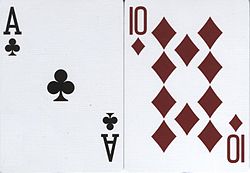
A Blackjack example, consisting of an Ace and a 10-valued card |
|
| Alternative names | Twenty-One |
|---|---|
| Type | Comparing |
| Players | 2+, usually 2–7 |
| Skills | Probability |
| Cards | 52 to 416 (one to eight 52-card decks) |
| Deck | French |
| Play | Clockwise |
| Chance | High |
| Related games | |
| Pontoon, Twenty-One, Siebzehn und Vier, Vingt-et-Un |
Blackjack (formerly Black Jack and Vingt-Un) is a casino banking game.[1]: 342 It is the most widely played casino banking game in the world. It uses decks of 52 cards and descends from a global family of casino banking games known as Twenty-One. This family of card games also includes the European games Vingt-et-Un and Pontoon, and the Russian game Ochko [ru].[2] Blackjack players do not compete against each other. The game is a comparing card game where each player competes against the dealer.
History[edit]
Blackjack’s immediate precursor was the English version of twenty-one called Vingt-Un, a game of unknown (but likely Spanish) provenance. The first written reference is found in a book by the Spanish author Miguel de Cervantes. Cervantes was a gambler, and the protagonists of his «Rinconete y Cortadillo», from Novelas Ejemplares, are card cheats in Seville. They are proficient at cheating at veintiuna (Spanish for «twenty-one») and state that the object of the game is to reach 21 points without going over and that the ace values 1 or 11. The game is played with the Spanish baraja deck.
«Rinconete y Cortadillo» was written between 1601 and 1602, implying that ventiuna was played in Castile since the beginning of the 17th century or earlier. Later references to this game are found in France and Spain.[3]
The first record of the game in France occurs in 1888[4] and in Britain during the 1770s and 1780s, but the first rules appeared in Britain in 1800 under the name of Vingt-Un.[5][6] Twenty-One, still known then as Vingt-Un, appeared in the United States in the early 1800s. The first American rules were an 1825 reprint of the 1800 English rules.[7][8] English Vingt-Un later developed into an American variant in its own right which was renamed blackjack around 1899.[4]
According to popular myth, when Vingt-Un («Twenty-One») was introduced into the United States (in the early 1800s, during the First World War, or in the 1930s, depending on the source), gambling houses offered bonus payouts to stimulate players’ interest. One such bonus was a ten-to-one payout if the player’s hand consisted of the ace of spades and a black jack (either the jack of clubs or the jack of spades). This hand was called a «blackjack», and the name stuck even after the ten-to-one bonus was withdrawn.
French card historian Thierry Depaulis debunks this story, showing that prospectors during the Klondike Gold Rush (1896–99) gave the name blackjack to the game of American Vingt-Un, the bonus being the usual ace and any 10-point card. Since ‘blackjack’ also refers to the mineral zincblende, which was often associated with gold or silver deposits, he suggests that the mineral name was transferred by prospectors to the top bonus hand. He could not find any historical evidence for a special bonus for having the combination of an ace with a black jack.[4]
In September 1956, Roger Baldwin, Wilbert Cantey, Herbert Maisel, and James McDermott published a paper titled The Optimum Strategy in Blackjack in the Journal of the American Statistical Association.,[9] the first mathematically sound optimal blackjack strategy. This paper became the foundation of future efforts to beat blackjack. Ed Thorp used Baldwin’s hand calculations to verify the basic strategy and later published (in 1963) Beat the Dealer.[10]
Rules of play at casinos[edit]

Initial deal

Player action
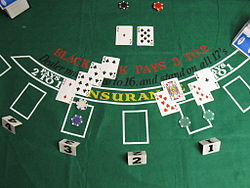
Dealer’s hand revealed

Bets settled
At a blackjack table, the dealer faces five to nine playing positions from behind a semicircular table. Between one and eight standard 52-card decks are shuffled together. To start each round, players place bets in the «betting box» at each position. In jurisdictions allowing back betting, up to three players can be at each position. The player whose bet is at the front of the betting box controls the position, and the dealer consults the controlling player for playing decisions; the other bettors «play behind». A player can usually control or bet in as many boxes as desired at a single table, but an individual cannot play on more than one table at a time or place multiple bets within a single box. In many U.S. casinos, players are limited to playing one to three positions at a table.
The dealer deals from their left («first base») to their far right («third base»). Each box gets an initial hand of two cards visible to the people playing on it. The dealer’s hand gets its first card face-up and, in «hole card» games, immediately gets a second card face-down (the hole card), which the dealer peeks at but only reveals when it makes the dealer’s hand a blackjack. Hole card games are sometimes played on tables with a small mirror or electronic sensor used to peek securely at the hole card. In European casinos, «no hole card» games are prevalent; the dealer’s second card is not drawn until the players have played their hands.
Dealers deal the cards from one or two handheld decks, from a dealer’s shoe or from a shuffling machine. Single cards are dealt to each wagered-on position clockwise from the dealer’s left, followed by a single card to the dealer, followed by an additional card to each of the positions in play. The players’ initial cards may be dealt face-up or face-down (more common in single-deck games).
The object of the game is to win money by creating card totals higher than those of the dealer’s hand but not exceeding 21, or by stopping at a total in the hope that the dealer will bust. On their turn, players choose to «hit» (take a card), «stand» (end their turn and stop without taking a card), «double» (double their wager, take a single card, and finish), «split» (if the two cards have the same value, separate them to make two hands), or «surrender» (give up a half-bet and retire from the game).
Number cards count as their number, the jack, queen, and king («face cards» or «pictures») count as 10, and aces count as either 1 or 11 according to the player’s choice. If the total exceeds 21 points, it busts, and all bets on it immediately lose.
After the boxes have finished playing, the dealer’s hand is resolved by drawing cards until the hand achieves a total of 17 or higher (a dealer total of 17 including an ace valued at 11, also known as a «soft 17», must be drawn to in some games and must stand in others). The dealer never doubles, splits, or surrenders. If the dealer busts, all remaining player hands win. If the dealer does not bust, each remaining bet wins if its hand is higher than the dealer’s and loses if it is lower.
A player total of 21 on the first two cards is a «natural» or «blackjack», and the player wins immediately unless the dealer also has one, in which case the hand ties. In the case of a tie («push» or «standoff»), bets are returned without adjustment. A blackjack beats any hand that is not a blackjack, even one with a value of 21.
Wins are paid out at even money, except for player blackjacks, which are traditionally paid out at 3 to 2 odds. Many casinos today pay blackjacks at less than 3:2. This is common in single-deck blackjack games.[11]
Blackjack games usually offer a side bet called insurance, which may be placed when the dealer’s face-up card is an ace. Additional side bets, such as «Dealer Match» which pays when the player’s cards match the dealer’s up card, are also sometimes available.
Player decisions[edit]
After the initial two cards, the player has up to five options: «hit», «stand», «double down», «split», or «surrender». Each option has a corresponding hand signal.
- Hit: Take another card.
- Signal: Scrape cards against the table (in handheld games); tap the table with a finger or wave a hand toward the body (in games dealt face-up).
- Stand: Take no more cards; also known as «stand pat», «sit», «stick», or «stay».
- Signal: Slide cards under chips (in handheld games); wave hand horizontally (in games dealt face-up).
- Double down: Increase the initial bet by 100% and take exactly one more card. The additional bet is placed next to the original bet. Some games permit the player to increase the bet by amounts smaller than 100%, which is known as «double for less».[12] Non-controlling players may or may not double their wager, but they still only take one card.
- Signal: Place additional chips beside the original bet outside the betting box and point with one finger.
- Split: Create two hands from a starting hand where both cards are the same value. Each new hand gets another card so that the player has two starting hands. This requires an additional bet on the second hand. The two hands are played out independently, and the wager on each hand is won or lost independently. In the case of cards worth 10 points, some casinos only allow splitting when the cards rank the same. For example, 10-10 could be split, but K-10 could not. Doubling and re-splitting after splitting are often restricted. A 10-valued card and an ace resulting from a split usually isn’t considered a blackjack. Hitting split aces is often not allowed. Non-controlling players can opt to put up a second bet or not. If they do not, they only get paid or lose on one of the two post-split hands.
- Signal: Place additional chips next to the original bet outside the betting box and point with two fingers spread into a V formation.
- Surrender: Forfeit half the bet and end the hand immediately. This option is only available at some tables in some casinos, and the option is only available as the first decision.
- Signal: Spoken; there are no standard signals.
Hand signals help the «eye in the sky» make a video recording of the table, which resolves disputes and identifies dealer mistakes. It is also used to protect the casino against dealers who steal chips or players who cheat. Recordings can also identify advantage players. When a player’s hand signal disagrees with their words, the hand signal takes precedence.
A hand can «hit» as often as desired until the total is 21 or more. Players must stand on a total of 21. After a bust or a stand, play proceeds to the next hand clockwise around the table. After the last hand is played, the dealer reveals the hole card and stands or draws according to the game’s rules. When the outcome of the dealer’s hand is established, any hands with bets remaining on the table are resolved (usually in counterclockwise order); bets on losing hands are forfeited, the bet on a push is left on the table, and winners are paid out.
Insurance[edit]
If the dealer shows an ace, an «insurance» bet is allowed. Insurance is a side bet that the dealer has a blackjack. The dealer asks for insurance bets before the first player plays. Insurance bets of up to half the player’s current bet are placed on the «insurance bar» above the player’s cards. If the dealer has a blackjack, insurance pays 2 to 1. In most casinos, the dealer looks at the down card and pays off or takes the insurance bet immediately. In other casinos, the payoff waits until the end of the play.
In face-down games, if a player has more than one hand, they can look at all their hands before deciding. This is the only condition where a player can look at multiple hands.
Players with blackjack can also take insurance.
Insurance bets lose money in the long run. The dealer has a blackjack less than one-third of the time. In some games, players can also take insurance when a 10-valued card shows, but the dealer has an ace in the hole less than one-tenth of the time.
The insurance bet is susceptible to advantage play. It is advantageous to make an insurance bet whenever the hole card has more than a one in three chance of being a ten. Card counting techniques can identify such situations.
Rule variations and effects on house edge[edit]
Note: where changes in the house edge due to changes in the rules are stated in percentage terms, the difference is usually stated here in percentage points, not a percentage. For example, if an edge of 10% is reduced to 9%, it is reduced by one percentage point, not reduced by ten percent.

Doubling down. The third card is placed at right angles to signify that the player cannot receive any more cards.
Blackjack rules are generally set by regulations that establish permissible rule variations at the casino’s discretion.[13] Blackjack comes with a «house edge»; the casino’s statistical advantage is built into the game. Most of the house’s edge comes from the fact that the player loses when both the player and dealer bust. Blackjack players using basic strategy lose on average less than 1% of their action over the long run, giving blackjack one of the lowest edges in the casino. The house edge for games where blackjack pays 6 to 5 instead of 3 to 2 increases by about 1.4%, though. Player deviations from basic strategy also increase the house edge.
- Dealer hits soft 17

A «soft 17» in blackjack (an ace and any combination of 6)
Each game has a rule about whether the dealer must hit or stand on soft 17, which is generally printed on the table surface. The variation where the dealer must hit soft 17 is abbreviated «H17» in blackjack literature, with «S17» used for the stand-on-soft-17 variation. Substituting an «H17» rule with an «S17» rule in a game benefits the player, decreasing the house edge by about 0.2%.
- Number of decks
All things being equal, using fewer decks decreases the house edge. This mainly reflects an increased likelihood of player blackjack, since if the player draws a ten on their first card, the subsequent probability of drawing an ace is higher with fewer decks. It also reflects the decreased likelihood of a blackjack–blackjack push in a game with fewer decks.
Casinos generally compensate by tightening other rules in games with fewer decks, to preserve the house edge or discourage play altogether. When offering single-deck blackjack games, casinos are more likely to disallow doubling on soft hands or after splitting, restrict resplitting, require higher minimum bets, and to pay the player less than 3:2 for a winning blackjack.
The following table illustrates the mathematical effect on the house edge of the number of decks, by considering games with various deck counts under the following ruleset: double after split allowed, resplit to four hands allowed, no hitting split aces, no surrendering, double on any two cards, original bets only lost on dealer blackjack, dealer hits soft 17, and cut-card used. The increase in house edge per unit increase in the number of decks is most dramatic when comparing the single-deck game to the two-deck game, and becomes progressively smaller as more decks are added.
| Number of decks | House advantage |
|---|---|
| Single deck | 0.17% |
| Double deck | 0.46% |
| Four decks | 0.60% |
| Six decks | 0.64% |
| Eight decks | 0.66% |
- Late/early surrender
Surrender, for those games that allow it, is usually not permitted against a dealer blackjack; if the dealer’s first card is an ace or ten, the hole card is checked to make sure there is no blackjack before surrender is offered. This rule protocol is consequently known as «late» surrender. The alternative, «early» surrender, gives the player the option to surrender before the dealer checks for blackjack, or in a no hole card game. Early surrender is much more favorable to the player than late surrender.
For late surrender, however, while it is tempting to opt for surrender on any hand which will probably lose, the correct strategy is to only surrender on the very worst hands, because having even a one-in-four chance of winning the full bet is better than losing half the bet and pushing the other half, as entailed by surrendering.
- Resplitting
If the cards of a post-split hand have the same value, most games allow the player to split again, or «resplit». The player places a further wager, and the dealer separates the new pair dealing a further card to each as before. Some games allow unlimited resplitting, while others may limit it to a certain number of hands, such as four hands (for example, «resplit to 4»).
- Hit/resplit split aces
After splitting aces, the common rule is that only one card will be dealt to each ace; the player cannot split, double, or take another hit on either hand. Rule variants include allowing resplitting aces or allowing the player to hit split aces. Games allowing aces to be resplit are not uncommon, but those allowing the player to hit split aces are extremely rare. Allowing the player to hit hands resulting from split aces reduces the house edge by about 0.13%; allowing resplitting of aces reduces the house edge by about 0.03%. Note that a ten-value card dealt on a split ace (or vice versa) will not be counted as a blackjack but as a soft 21.
- No double after split
After a split, most games allow doubling down on the new two-card hands. Disallowing doubling after a split increases the house edge by about 0.12%.
- Double on 9/10/11 or 10/11 only
Under the «Reno rule», doubling down is only permitted on hard totals of 9, 10, or 11 (under a similar European rule, only 10 or 11). The basic strategy would otherwise call for some doubling down with hard 9 and soft 13–18, and advanced players can identify situations where doubling on soft 19–20 and hard 8, 7, and even 6 is advantageous. The Reno rule prevents the player from taking advantage of double down in these situations and thereby increases the player’s expected loss. The Reno rule increases the house edge by around 1 in 1,000, and its European version by around 1 in 500.
- No hole card and OBO
In most non-U.S. casinos, a «no hole card» game is played, meaning that the dealer does not draw nor consult their second card until after all players have finished making decisions. With no hole card, it is rarely the correct basic strategy to double or split against a dealer ten or ace, since a dealer blackjack will result in the loss of the split and double bets; the only exception is with a pair of aces against a dealer 10, where it is still correct to split. In all other cases, a stand, hit, or surrender is called for. For instance, when holding 11 against a dealer 10, the correct strategy is to double in a hole card game (where the player knows the dealer’s second card is not an ace), but to hit in a no-hole card game. The no-hole-card rule adds approximately 0.11% to the house edge.
The «original bets only» rule variation appearing in certain no hole card games states that if the player’s hand loses to a dealer blackjack, only the mandatory initial bet («original») is forfeited, and all optional bets, meaning doubles and splits, are pushed. «Original bets only» is also known by the acronym OBO; it has the same effect on basic strategy and the house edge as reverting to a hole card game.[14]
- Altered payout for a winning blackjack
In many casinos, a blackjack pays only 6:5 or even 1:1 instead of the usual 3:2. This is most common at tables with lower table minimums. Although this payoff was originally limited to single-deck games, it has spread to double-deck and shoe games. Among common rule variations in the U.S., these altered payouts for blackjack are the most damaging to the player, causing the greatest increase in house edge. Since blackjack occurs in approximately 4.8% of hands, the 1:1 game increases the house edge by 2.3%, while the 6:5 game adds 1.4% to the house edge. Video blackjack machines generally pay a 1:1 payout for a blackjack.[11]
- Dealer wins ties
The rule that bets on tied hands are lost rather than pushed is catastrophic to the player. Though rarely used in standard blackjack, it is sometimes seen in «blackjack-like» games, such as in some charity casinos.
Blackjack strategy[edit]
Basic strategy[edit]
Each blackjack game has a basic strategy, the optimal method of playing any hand. When using basic strategy, the long-term house advantage (the expected loss of the player) is minimized.
An example of a basic strategy is shown in the table below, which applies to a game with the following specifications:[15]
- Four to eight decks
- The dealer hits on a soft 17
- A double is allowed after a split
- Only original bets are lost on dealer blackjack
| Player hand | Dealer’s face-up card | |||||||||
|---|---|---|---|---|---|---|---|---|---|---|
| 2 | 3 | 4 | 5 | 6 | 7 | 8 | 9 | 10 | A | |
| Hard totals (excluding pairs) | ||||||||||
| 18–21 | S | S | S | S | S | S | S | S | S | S |
| 17 | S | S | S | S | S | S | S | S | S | Us |
| 16 | S | S | S | S | S | H | H | Uh | Uh | Uh |
| 15 | S | S | S | S | S | H | H | H | Uh | Uh |
| 13–14 | S | S | S | S | S | H | H | H | H | H |
| 12 | H | H | S | S | S | H | H | H | H | H |
| 11 | Dh | Dh | Dh | Dh | Dh | Dh | Dh | Dh | Dh | Dh |
| 10 | Dh | Dh | Dh | Dh | Dh | Dh | Dh | Dh | H | H |
| 9 | H | Dh | Dh | Dh | Dh | H | H | H | H | H |
| 5–8 | H | H | H | H | H | H | H | H | H | H |
| Soft totals | ||||||||||
| 2 | 3 | 4 | 5 | 6 | 7 | 8 | 9 | 10 | A | |
| A,9 | S | S | S | S | S | S | S | S | S | S |
| A,8 | S | S | S | S | Ds | S | S | S | S | S |
| A,7 | Ds | Ds | Ds | Ds | Ds | S | S | H | H | H |
| A,6 | H | Dh | Dh | Dh | Dh | H | H | H | H | H |
| A,4–A,5 | H | H | Dh | Dh | Dh | H | H | H | H | H |
| A,2–A,3 | H | H | H | Dh | Dh | H | H | H | H | H |
| Pairs | ||||||||||
| 2 | 3 | 4 | 5 | 6 | 7 | 8 | 9 | 10 | A | |
| A, A | SP | SP | SP | SP | SP | SP | SP | SP | SP | SP |
| 10,10 | S | S | S | S | S | S | S | S | S | S |
| 9,9 | SP | SP | SP | SP | SP | S | SP | SP | S | S |
| 8,8 | SP | SP | SP | SP | SP | SP | SP | SP | SP | Usp |
| 7,7 | SP | SP | SP | SP | SP | SP | H | H | H | H |
| 6,6 | SP | SP | SP | SP | SP | H | H | H | H | H |
| 5,5 | Dh | Dh | Dh | Dh | Dh | Dh | Dh | Dh | H | H |
| 4,4 | H | H | H | SP | SP | H | H | H | H | H |
| 2,2–3,3 | SP | SP | SP | SP | SP | SP | H | H | H | H |
Key:
- S = Stand
- H = Hit
- Dh = Double (if not allowed, then hit)
- Ds = Double (if not allowed, then stand)
- SP = Split
- Uh = Surrender (if not allowed, then hit)
- Us = Surrender (if not allowed, then stand)
- Usp = Surrender (if not allowed, then split)
Most basic strategy decisions are the same for all blackjack games. Rule variations call for changes in only a few situations. For example, to use the table above on a game with the stand-on-soft-17 rule (which favors the player, and is typically found only at higher-limit tables today) only 6 cells would need to be changed: hit on 11 vs. A, hit on 15 vs. A, stand on 17 vs. A, stand on A,7 vs. 2, stand on A,8 vs. 6, and split on 8,8 vs. A. Regardless of the specific rule variations, taking insurance or «even money» is never the correct play under a basic strategy.[15]
Estimates of the house edge for blackjack games quoted by casinos and gaming regulators are based on the assumption that the players follow basic strategy.
Most blackjack games have a house edge of between 0.5% and 1%, placing blackjack among the cheapest casino table games for the player. Casino promotions such as complimentary matchplay vouchers or 2:1 blackjack payouts allow players to acquire an advantage without deviating from basic strategy.[16]
Composition-dependent strategy[edit]
The basic strategy is based on a player’s point total and the dealer’s visible card. Players can sometimes improve on this decision by considering the composition of their hand, not just the point total. For example, players should ordinarily stand when holding 12 against a dealer 4. But in a single deck game, players should hit if their 12 consists of a 10 and a 2. The presence of a 10 in the player’s hand has two consequences:[17]
- It makes the player’s 12 a worse hand to stand on (since the only way to avoid losing is for the dealer to go bust, which is less likely if there are fewer 10s left in the shoe).
- It makes hitting safer, since the only way of going bust is to draw a 10, and this is less likely with a 10 already in the hand.
Even when basic and composition-dependent strategies lead to different actions, the difference in expected reward is small, and it becomes smaller with more decks. Using a composition-dependent strategy rather than a basic strategy in a single-deck game reduces the house edge by 4 in 10,000, which falls to 3 in 100,000 for a six-deck game.[18]
Advantage play[edit]
Blackjack has been a high-profile target for advantage players since the 1960s. Advantage play attempts to win more using skills such as memory, computation, and observation. While these techniques are legal, they can give players a mathematical edge in the game, taking advantage of players’ unwanted customers for casinos. Advantage play can lead to ejection or blacklisting. Some advantageous play techniques in blackjack include:
Card counting[edit]
During the course of a blackjack shoe, the dealer exposes the dealt cards. Players can infer from their accounting of the exposed cards which cards remain. These inferences can be used in the following ways:
- Players can make larger bets when they have an advantage. For example, the players can increase the starting bet if many aces and tens are left in the deck, in the hope of hitting a blackjack.
- Players can deviate from basic strategy according to the composition of their undealt cards. For example, with many tens left in the deck, players might double down in more situations since there is a better chance of getting a good hand.
A card counting system assigns a point score to each card rank (e.g., 1 point for 2–6, 0 points for 7–9, and −1 point for 10–A). When a card is exposed, a counter adds the score of that card to a running total, the ‘count’. A card counter uses this count to make betting and playing decisions. The count starts at 0 for a freshly shuffled deck for «balanced» counting systems. Unbalanced counts are often started at a value that depends on the number of decks used in the game.
Blackjack’s house edge is usually around 0.5–1% when players use basic strategy.[19] Card counting can give the player a house edge of up to −2%.[20]: 5
Card counting works best when a few cards remain. This makes single-deck games better for counters. As a result, casinos are more likely to insist that players do not reveal their cards to one another in single-deck games. In games with more decks, casinos limit penetration by ending the shoe and reshuffling when one or more decks remain undealt. Casinos also sometimes use a shuffling machine to reintroduce the cards whenever a deck has been played.
Card counting is legal unless the counter is using an external device,[20]: 6–7 but a casino might inform counters that they are no longer welcome to play blackjack. Sometimes a casino might ban a card counter from the property.[21]
The use of external devices to help count cards is illegal throughout the United States.[22]
Shuffle tracking[edit]
Another advantage play technique, mainly applicable in multi-deck games, involves tracking groups of cards (also known as slugs, clumps, or packs) through the shuffle and then playing and betting according to when those cards come into play from a new shoe. Shuffle tracking requires excellent eyesight and powers of visual estimation but is harder to detect; shuffle trackers’ actions are largely unrelated to the composition of the cards in the shoe.[23]
Arnold Snyder’s articles in Blackjack Forum magazine brought shuffle tracking to the general public. His book, The Shuffle Tracker’s Cookbook, mathematically analyzed the player edge available from shuffle tracking based on the actual size of the tracked slug. Jerry L. Patterson also developed and published a shuffle-tracking method for tracking favorable clumps of cards and cutting them into play and tracking unfavorable clumps of cards and cutting them out of play.[24][25][26]
Identifying concealed cards[edit]
The player can also gain an advantage by identifying cards from distinctive wear markings on their backs, or by hole carding (observing during the dealing process the front of a card dealt face-down). These methods are generally legal although their status in particular jurisdictions may vary.[27]
Side bets[edit]
Many blackjack tables offer side bets on various outcomes including:[28]
- Player hand and dealer’s up card total 19, 20, or 21 («Lucky Lucky»)
- Player initial hand is a pair («Perfect pairs»)
- Player initial hand is suited, suited, and connected, or a suited K-Q («Royal match»)
- Player initial hand plus dealer’s card makes a flush, straight, or three-of-a-kind poker hand («21+3»)
- Player initial hand totals 20 («Lucky Ladies»)
- Dealer upcard is in between the value of the player’s two cards («In Bet»)
- First card drawn to the dealer will result in a dealer bust («Bust It!»)
- One or both of the player’s cards is the same as the dealer’s card («Match the Dealer»)
The side wager is typically placed in a designated area next to the box for the main wager. A player wishing to wager on a side bet usually must place a wager on blackjack. Some games require that the blackjack wager should equal or exceed any side bet wager. A non-controlling player of a blackjack hand is usually permitted to place a side bet regardless of whether the controlling player does so.
The house edge for side bets is generally higher than for the blackjack game itself.[29] Nonetheless, side bets can be susceptible to card counting. A side count designed specifically for a particular side bet can improve the player’s edge. Only a few side bets, like «Insurance» and «Lucky Ladies», offer a sufficient win rate to justify the effort of advantage play.
In team play, it is common for team members to be dedicated to only counting a side bet using a specialized count.
Blackjack tournaments[edit]
Blackjack can be played in tournament form. Players start with an equal number of chips; the goal is to finish among the top chip holders. Depending on the number of competitors, tournaments may be held over several rounds, with one or two players qualifying from each table after a set number of deals to meet the qualifiers from the other tables in the next round. Another tournament format, Elimination Blackjack, drops the lowest-stacked player from the table at pre-determined points in the tournament. A good strategy for blackjack tournaments can differ from a non-tournament strategy because of the added dimension of choosing the amount to be wagered. As in poker tournaments, players pay the casino an initial entry fee to participate in a tournament, and re-buys are sometimes permitted.
Video blackjack[edit]
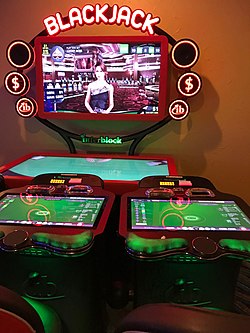
Some casinos, as well as general betting outlets, provide blackjack among a selection of casino-style games at electronic consoles. Video blackjack game rules are generally more favorable to the house; e.g., paying out only even money for winning blackjacks. Video and online blackjack games generally deal each round from a fresh shoe (i.e., use an RNG for each deal), rendering card counting ineffective in most situations.[30]
Variants and related games[edit]
Blackjack is a member of the family of traditional card games played recreationally worldwide. Most of these games have not been adapted for casino play. Furthermore, the casino game development industry actively produces blackjack variants, most of which are ultimately not adopted by casinos. The following are the most prominent and established variants in casinos.
- Spanish 21 provides players with liberal rules, such as doubling down any number of cards (with the option to rescue, or surrender only one wager to the house), payout bonuses for five or more card 21s, 6–7–8 21s, 7–7–7 21s, late surrender, and player blackjacks and player 21s always winning. The trade-off is having no 10s in the deck, although the jacks, queens, and kings are still there. An unlicensed version of Spanish 21 played without a hole card is found in Australian casinos under the name «Pontoon».
- 21st-Century Blackjack (or «Vegas Style» Blackjack) is found in California card rooms. In variations, a player bust does not always result in an automatic loss; depending on the casino, the player can still push if the dealer also busts. The dealer has to bust with a higher total, though.
- Double Exposure Blackjack deals the first two cards of the dealer’s hand face up. Blackjacks pay even money, and players lose on ties. Also, players can neither buy insurance nor surrender.
- Double Attack Blackjack has liberal blackjack rules and the option of increasing one’s wager after seeing the dealer’s up card. This game is dealt from a Spanish shoe, and blackjacks only pay even money.
- Blackjack Switch is played over two hands, and the second card can be switched between hands. For example, if the player is dealt 10–6 and 5–10, then the player can switch two cards to make hands of 10–10 and 6–5. Natural blackjacks are paid 1:1 instead of the standard 3:2, and a dealer 22 is a push.
- Super Fun 21 allows a player to split a hand up to four times. If the player has six cards totaling 20, they automatically win. Wins are paid 1:1.
Examples of local traditional and recreational related games include French Vingt-et-un («Twenty-One») and German Siebzehn und Vier («Seventeen and Four»). Neither game allows splitting. An ace counts only eleven, but two aces count as a blackjack. It is mostly played in private circles and barracks. The popular British member of the Vingt-Un family is called Pontoon, the name being probably a corruption of «Vingt-et-un».
Blackjack Hall of Fame[edit]
In 2002, professional gamblers worldwide were invited to nominate great blackjack players for admission into the Blackjack Hall of Fame. Seven members were inducted in 2002, with new people inducted every year after. The Hall of Fame is at the Barona Casino in San Diego. Members include Edward O. Thorp, author of the 1960s book Beat the Dealer; Ken Uston, who popularized the concept of team play; Arnold Snyder, author and editor of the Blackjack Forum trade journal; and Stanford Wong, author and popularizer of «Wonging».
References[edit]
- ^ Scarne, John (1986). Scarne’s new complete guide to gambling (Fully rev., expanded, updated ed.). Simon & Schuster. ISBN 978-0671630638.
- ^ Parlett, David (1990). The Oxford guide to card games. Oxford [England]. ISBN 0-19-214165-1. OCLC 20852782.
- ^ Fontbona, Marc (2008). Historia del Juego en España. De la Hispania romana a nuestros días. Barcelona: Flor del Viento Ediciones. p. 89. ISBN 978-84-96495-30-2.
- ^ a b c Depaulis 2010, pp. 238–244.
- ^ Jones 1800.
- ^ Andrews 1781, p. 19[full citation needed]
- ^ Jones 1800, pp. 229–231.
- ^ Hoyle’s Games 1825, pp. 106/107.
- ^ Baldwin, Roger R.; Cantey, Wilbert E.; Maisel, Herbert; McDermott, James P. (1956). «The Optimum Strategy in Blackjack». Journal of the American Statistical Association. 51 (275): 429–439. doi:10.2307/2281431. JSTOR 2281431.
- ^ «Blackjack History and Events». blackjackreview.com. Retrieved May 21, 2017.
- ^ a b Haney, Jeff (November 13, 2003). «Taking a hit: New blackjack odds further tilt advantage toward the house». Las Vegas Sun.
- ^ «Gambling Terms — The Complete Guide». GamblingNews. Retrieved November 11, 2022.
- ^ «Blackjack Rule Variations». wizardofodds.com. Retrieved September 4, 2021.
- ^ «Modern Blackjack». qfit.com.
- ^ a b «4-Deck to 8-Deck Blackjack Strategy — Wizard of Odds». Wizard of Odds Consulting, Inc. Retrieved April 30, 2014.
- ^ «How to Win at Blackjack – Strategies 2021». Veritop. 2021. Archived from the original on May 13, 2021.
- ^ «The Wizard of Odds». Fine points of basic strategy in single-deck blackjack. Retrieved December 8, 2006.
- ^ «The Wizard of Odds». Total Dependent and Composition Dependent Basic Strategy in Blackjack. Retrieved December 19, 2006.
- ^ «Blackjack — Beating Bonuses». beatingbonuses.com.
- ^ a b Griffin, Peter (March 1, 1999). The theory of blackjack: the compleat card counter’s guide to the casino game of 21 (6th ed.). Huntington Press. ISBN 978-0929712130.
- ^ Thorp, Edward O. (1966). Beat the dealer: a winning strategy for the game of twenty-one: a scientific analysis of the world-wide game known variously as blackjack, twenty-one, vingt-et-un, pontoon, or van-john (revised ed.). New York: Random House. pp. 132–136. ISBN 0-394-70310-3. OCLC 655875.
- ^ «State Gambling Laws». gambling-law-us.com. Archived from the original on October 7, 2011. Retrieved October 26, 2011.
- ^ «Blackjack in Color». Shuffle Tracking Counts.
- ^ Roberts, Stanley (1984). Thorp, Edward O. (ed.). The Gambling Times guide to blackjack. Hollywood, C]: Gambling Times. ISBN 0-89746-015-4. OCLC 12568192.
- ^ Patterson, Jerry L. (1986). Break the dealer : winning stragegies for today’s blackjack. Eddie Olsen. New York, NY: Putnam. p. 83. ISBN 0-399-51233-0. OCLC 13395266.
- ^ Patterson, Jerry L. (1990). Blackjack, a winner’s handbook (Completely rev. and updated ed.). New York, NY: Perigee Books. p. 51. ISBN 0-399-51598-4. OCLC 21444382.
- ^ Sfetcu, Nicolae (2014). Play Blackjack. Nicolae Sfetcu. p. 20.
- ^ «The Wizard of Odds». Blackjack Side Bets.
- ^ «Live Casino Comparer». Blackjack Side Bets Explained — Which One Pays Best?.
- ^ US8708793B1, Osman, Allan; Osman, Adam & Pfifer, Reagan, «Modified blackjack game method», issued 2014-04-29
Further reading[edit]
General literature[edit]
- Depaulis, Thierry (April–June 2010). «Dawson’s Game: Blackjack and the Klondike». In Endebrock, Peter (ed.). The Playing-Card. Journal of the International Playing-Card Society. Vol. 38 (4). The International Playing-Card Society. ISSN 0305-2133.
- Hoyle’s Games Improved. New York: G. Long. 1825.
- Jones, Charles (1800). Hoyle’s Games Improved (New, considerably enlarged, revised and corrected ed.). London: Ritchie.
- Parlett, David (1990). A History of Card Games, OUP, Oxford. ISBN 0-19-282905-X
Blackjack literature[edit]
- Beat the Dealer: A Winning Strategy for the Game of Twenty-One, Edward O. Thorp, 1966, ISBN 978-0-394-70310-7
- Blackbelt in Blackjack, Arnold Snyder, 1998 (1980), ISBN 978-0-910575-05-8
- Blackjack and the Law, I. Nelson Rose and Robert A. Loeb, 1998, ISBN 0-910575-08-8
- Blackjack: A Winner’s Handbook, Jerry L. Patterson, 2001, (1978), ISBN 978-0-399-52683-1
- Encyclopedia of Casino Twenty-One, Michael Dalton, 2016, (1993), ISBN 1-879712-02-4
- Ken Uston on Blackjack, Ken Uston, 1986, ISBN 978-0-8184-0411-5
- Knock-Out Blackjack, Olaf Vancura and Ken Fuchs, 1998, ISBN 978-0-929712-31-4
- Million Dollar Blackjack, Ken Uston, 1994 (1981), ISBN 978-0-89746-068-2
- Playing Blackjack as a Business, Lawrence Revere, 1998 (1971), ISBN 978-0-8184-0064-3
- Professional Blackjack, Stanford Wong, 1994 (1975), ISBN 978-0-935926-21-7
- The Blackjack Life, Nathaniel Tilton, 2012, ISBN 978-1935396338
- The Theory of Blackjack, Peter Griffin, 1996 (1979), ISBN 978-0-929712-12-3
- The World’s Greatest Blackjack Book, Lance Humble and Carl Cooper, 1980, ISBN 978-0-385-15382-9
Mathematics of blackjack[edit]
- Luck, Logic, and White Lies: The Mathematics of Games, Jörg Bewersdorff, 2004, ISBN 978-1-56881-210-6, doi:10.1201/9780429259005, 121–134, online supplement: Blackjack calculator (JavaScript)
- The Doctrine of Chances. Probabilistic Aspects of Gambling, Stewart Ethier, 2010, ISBN 978-3-540-78782-2, doi:10.1007/978-3-540-78783-9, 643–687
- The Theory of Gambling and Statistical Logic, Richard A. Epstein, 2009 (1967), ISBN 978-0-12-374940-6, doi:10.1016/C2009-0-20160-7, 265–286
External links[edit]
- Search for Blackjack at Curlie
This article is about the gambling game. For the variant of Hearts called Black Jack, see Black Jack (Hearts). For the shedding-type card game sometimes called Black Jack, see Black Jack (Switch). For other uses, see Black Jack.
|
A Blackjack example, consisting of an Ace and a 10-valued card |
|
| Alternative names | Twenty-One |
|---|---|
| Type | Comparing |
| Players | 2+, usually 2–7 |
| Skills | Probability |
| Cards | 52 to 416 (one to eight 52-card decks) |
| Deck | French |
| Play | Clockwise |
| Chance | High |
| Related games | |
| Pontoon, Twenty-One, Siebzehn und Vier, Vingt-et-Un |
Blackjack (formerly Black Jack and Vingt-Un) is a casino banking game.[1]: 342 It is the most widely played casino banking game in the world. It uses decks of 52 cards and descends from a global family of casino banking games known as Twenty-One. This family of card games also includes the European games Vingt-et-Un and Pontoon, and the Russian game Ochko [ru].[2] Blackjack players do not compete against each other. The game is a comparing card game where each player competes against the dealer.
History[edit]
Blackjack’s immediate precursor was the English version of twenty-one called Vingt-Un, a game of unknown (but likely Spanish) provenance. The first written reference is found in a book by the Spanish author Miguel de Cervantes. Cervantes was a gambler, and the protagonists of his «Rinconete y Cortadillo», from Novelas Ejemplares, are card cheats in Seville. They are proficient at cheating at veintiuna (Spanish for «twenty-one») and state that the object of the game is to reach 21 points without going over and that the ace values 1 or 11. The game is played with the Spanish baraja deck.
«Rinconete y Cortadillo» was written between 1601 and 1602, implying that ventiuna was played in Castile since the beginning of the 17th century or earlier. Later references to this game are found in France and Spain.[3]
The first record of the game in France occurs in 1888[4] and in Britain during the 1770s and 1780s, but the first rules appeared in Britain in 1800 under the name of Vingt-Un.[5][6] Twenty-One, still known then as Vingt-Un, appeared in the United States in the early 1800s. The first American rules were an 1825 reprint of the 1800 English rules.[7][8] English Vingt-Un later developed into an American variant in its own right which was renamed blackjack around 1899.[4]
According to popular myth, when Vingt-Un («Twenty-One») was introduced into the United States (in the early 1800s, during the First World War, or in the 1930s, depending on the source), gambling houses offered bonus payouts to stimulate players’ interest. One such bonus was a ten-to-one payout if the player’s hand consisted of the ace of spades and a black jack (either the jack of clubs or the jack of spades). This hand was called a «blackjack», and the name stuck even after the ten-to-one bonus was withdrawn.
French card historian Thierry Depaulis debunks this story, showing that prospectors during the Klondike Gold Rush (1896–99) gave the name blackjack to the game of American Vingt-Un, the bonus being the usual ace and any 10-point card. Since ‘blackjack’ also refers to the mineral zincblende, which was often associated with gold or silver deposits, he suggests that the mineral name was transferred by prospectors to the top bonus hand. He could not find any historical evidence for a special bonus for having the combination of an ace with a black jack.[4]
In September 1956, Roger Baldwin, Wilbert Cantey, Herbert Maisel, and James McDermott published a paper titled The Optimum Strategy in Blackjack in the Journal of the American Statistical Association.,[9] the first mathematically sound optimal blackjack strategy. This paper became the foundation of future efforts to beat blackjack. Ed Thorp used Baldwin’s hand calculations to verify the basic strategy and later published (in 1963) Beat the Dealer.[10]
Rules of play at casinos[edit]
Initial deal
Player action
Dealer’s hand revealed
Bets settled
At a blackjack table, the dealer faces five to nine playing positions from behind a semicircular table. Between one and eight standard 52-card decks are shuffled together. To start each round, players place bets in the «betting box» at each position. In jurisdictions allowing back betting, up to three players can be at each position. The player whose bet is at the front of the betting box controls the position, and the dealer consults the controlling player for playing decisions; the other bettors «play behind». A player can usually control or bet in as many boxes as desired at a single table, but an individual cannot play on more than one table at a time or place multiple bets within a single box. In many U.S. casinos, players are limited to playing one to three positions at a table.
The dealer deals from their left («first base») to their far right («third base»). Each box gets an initial hand of two cards visible to the people playing on it. The dealer’s hand gets its first card face-up and, in «hole card» games, immediately gets a second card face-down (the hole card), which the dealer peeks at but only reveals when it makes the dealer’s hand a blackjack. Hole card games are sometimes played on tables with a small mirror or electronic sensor used to peek securely at the hole card. In European casinos, «no hole card» games are prevalent; the dealer’s second card is not drawn until the players have played their hands.
Dealers deal the cards from one or two handheld decks, from a dealer’s shoe or from a shuffling machine. Single cards are dealt to each wagered-on position clockwise from the dealer’s left, followed by a single card to the dealer, followed by an additional card to each of the positions in play. The players’ initial cards may be dealt face-up or face-down (more common in single-deck games).
The object of the game is to win money by creating card totals higher than those of the dealer’s hand but not exceeding 21, or by stopping at a total in the hope that the dealer will bust. On their turn, players choose to «hit» (take a card), «stand» (end their turn and stop without taking a card), «double» (double their wager, take a single card, and finish), «split» (if the two cards have the same value, separate them to make two hands), or «surrender» (give up a half-bet and retire from the game).
Number cards count as their number, the jack, queen, and king («face cards» or «pictures») count as 10, and aces count as either 1 or 11 according to the player’s choice. If the total exceeds 21 points, it busts, and all bets on it immediately lose.
After the boxes have finished playing, the dealer’s hand is resolved by drawing cards until the hand achieves a total of 17 or higher (a dealer total of 17 including an ace valued at 11, also known as a «soft 17», must be drawn to in some games and must stand in others). The dealer never doubles, splits, or surrenders. If the dealer busts, all remaining player hands win. If the dealer does not bust, each remaining bet wins if its hand is higher than the dealer’s and loses if it is lower.
A player total of 21 on the first two cards is a «natural» or «blackjack», and the player wins immediately unless the dealer also has one, in which case the hand ties. In the case of a tie («push» or «standoff»), bets are returned without adjustment. A blackjack beats any hand that is not a blackjack, even one with a value of 21.
Wins are paid out at even money, except for player blackjacks, which are traditionally paid out at 3 to 2 odds. Many casinos today pay blackjacks at less than 3:2. This is common in single-deck blackjack games.[11]
Blackjack games usually offer a side bet called insurance, which may be placed when the dealer’s face-up card is an ace. Additional side bets, such as «Dealer Match» which pays when the player’s cards match the dealer’s up card, are also sometimes available.
Player decisions[edit]
After the initial two cards, the player has up to five options: «hit», «stand», «double down», «split», or «surrender». Each option has a corresponding hand signal.
- Hit: Take another card.
- Signal: Scrape cards against the table (in handheld games); tap the table with a finger or wave a hand toward the body (in games dealt face-up).
- Stand: Take no more cards; also known as «stand pat», «sit», «stick», or «stay».
- Signal: Slide cards under chips (in handheld games); wave hand horizontally (in games dealt face-up).
- Double down: Increase the initial bet by 100% and take exactly one more card. The additional bet is placed next to the original bet. Some games permit the player to increase the bet by amounts smaller than 100%, which is known as «double for less».[12] Non-controlling players may or may not double their wager, but they still only take one card.
- Signal: Place additional chips beside the original bet outside the betting box and point with one finger.
- Split: Create two hands from a starting hand where both cards are the same value. Each new hand gets another card so that the player has two starting hands. This requires an additional bet on the second hand. The two hands are played out independently, and the wager on each hand is won or lost independently. In the case of cards worth 10 points, some casinos only allow splitting when the cards rank the same. For example, 10-10 could be split, but K-10 could not. Doubling and re-splitting after splitting are often restricted. A 10-valued card and an ace resulting from a split usually isn’t considered a blackjack. Hitting split aces is often not allowed. Non-controlling players can opt to put up a second bet or not. If they do not, they only get paid or lose on one of the two post-split hands.
- Signal: Place additional chips next to the original bet outside the betting box and point with two fingers spread into a V formation.
- Surrender: Forfeit half the bet and end the hand immediately. This option is only available at some tables in some casinos, and the option is only available as the first decision.
- Signal: Spoken; there are no standard signals.
Hand signals help the «eye in the sky» make a video recording of the table, which resolves disputes and identifies dealer mistakes. It is also used to protect the casino against dealers who steal chips or players who cheat. Recordings can also identify advantage players. When a player’s hand signal disagrees with their words, the hand signal takes precedence.
A hand can «hit» as often as desired until the total is 21 or more. Players must stand on a total of 21. After a bust or a stand, play proceeds to the next hand clockwise around the table. After the last hand is played, the dealer reveals the hole card and stands or draws according to the game’s rules. When the outcome of the dealer’s hand is established, any hands with bets remaining on the table are resolved (usually in counterclockwise order); bets on losing hands are forfeited, the bet on a push is left on the table, and winners are paid out.
Insurance[edit]
If the dealer shows an ace, an «insurance» bet is allowed. Insurance is a side bet that the dealer has a blackjack. The dealer asks for insurance bets before the first player plays. Insurance bets of up to half the player’s current bet are placed on the «insurance bar» above the player’s cards. If the dealer has a blackjack, insurance pays 2 to 1. In most casinos, the dealer looks at the down card and pays off or takes the insurance bet immediately. In other casinos, the payoff waits until the end of the play.
In face-down games, if a player has more than one hand, they can look at all their hands before deciding. This is the only condition where a player can look at multiple hands.
Players with blackjack can also take insurance.
Insurance bets lose money in the long run. The dealer has a blackjack less than one-third of the time. In some games, players can also take insurance when a 10-valued card shows, but the dealer has an ace in the hole less than one-tenth of the time.
The insurance bet is susceptible to advantage play. It is advantageous to make an insurance bet whenever the hole card has more than a one in three chance of being a ten. Card counting techniques can identify such situations.
Rule variations and effects on house edge[edit]
Note: where changes in the house edge due to changes in the rules are stated in percentage terms, the difference is usually stated here in percentage points, not a percentage. For example, if an edge of 10% is reduced to 9%, it is reduced by one percentage point, not reduced by ten percent.
Doubling down. The third card is placed at right angles to signify that the player cannot receive any more cards.
Blackjack rules are generally set by regulations that establish permissible rule variations at the casino’s discretion.[13] Blackjack comes with a «house edge»; the casino’s statistical advantage is built into the game. Most of the house’s edge comes from the fact that the player loses when both the player and dealer bust. Blackjack players using basic strategy lose on average less than 1% of their action over the long run, giving blackjack one of the lowest edges in the casino. The house edge for games where blackjack pays 6 to 5 instead of 3 to 2 increases by about 1.4%, though. Player deviations from basic strategy also increase the house edge.
- Dealer hits soft 17
A «soft 17» in blackjack (an ace and any combination of 6)
Each game has a rule about whether the dealer must hit or stand on soft 17, which is generally printed on the table surface. The variation where the dealer must hit soft 17 is abbreviated «H17» in blackjack literature, with «S17» used for the stand-on-soft-17 variation. Substituting an «H17» rule with an «S17» rule in a game benefits the player, decreasing the house edge by about 0.2%.
- Number of decks
All things being equal, using fewer decks decreases the house edge. This mainly reflects an increased likelihood of player blackjack, since if the player draws a ten on their first card, the subsequent probability of drawing an ace is higher with fewer decks. It also reflects the decreased likelihood of a blackjack–blackjack push in a game with fewer decks.
Casinos generally compensate by tightening other rules in games with fewer decks, to preserve the house edge or discourage play altogether. When offering single-deck blackjack games, casinos are more likely to disallow doubling on soft hands or after splitting, restrict resplitting, require higher minimum bets, and to pay the player less than 3:2 for a winning blackjack.
The following table illustrates the mathematical effect on the house edge of the number of decks, by considering games with various deck counts under the following ruleset: double after split allowed, resplit to four hands allowed, no hitting split aces, no surrendering, double on any two cards, original bets only lost on dealer blackjack, dealer hits soft 17, and cut-card used. The increase in house edge per unit increase in the number of decks is most dramatic when comparing the single-deck game to the two-deck game, and becomes progressively smaller as more decks are added.
| Number of decks | House advantage |
|---|---|
| Single deck | 0.17% |
| Double deck | 0.46% |
| Four decks | 0.60% |
| Six decks | 0.64% |
| Eight decks | 0.66% |
- Late/early surrender
Surrender, for those games that allow it, is usually not permitted against a dealer blackjack; if the dealer’s first card is an ace or ten, the hole card is checked to make sure there is no blackjack before surrender is offered. This rule protocol is consequently known as «late» surrender. The alternative, «early» surrender, gives the player the option to surrender before the dealer checks for blackjack, or in a no hole card game. Early surrender is much more favorable to the player than late surrender.
For late surrender, however, while it is tempting to opt for surrender on any hand which will probably lose, the correct strategy is to only surrender on the very worst hands, because having even a one-in-four chance of winning the full bet is better than losing half the bet and pushing the other half, as entailed by surrendering.
- Resplitting
If the cards of a post-split hand have the same value, most games allow the player to split again, or «resplit». The player places a further wager, and the dealer separates the new pair dealing a further card to each as before. Some games allow unlimited resplitting, while others may limit it to a certain number of hands, such as four hands (for example, «resplit to 4»).
- Hit/resplit split aces
After splitting aces, the common rule is that only one card will be dealt to each ace; the player cannot split, double, or take another hit on either hand. Rule variants include allowing resplitting aces or allowing the player to hit split aces. Games allowing aces to be resplit are not uncommon, but those allowing the player to hit split aces are extremely rare. Allowing the player to hit hands resulting from split aces reduces the house edge by about 0.13%; allowing resplitting of aces reduces the house edge by about 0.03%. Note that a ten-value card dealt on a split ace (or vice versa) will not be counted as a blackjack but as a soft 21.
- No double after split
After a split, most games allow doubling down on the new two-card hands. Disallowing doubling after a split increases the house edge by about 0.12%.
- Double on 9/10/11 or 10/11 only
Under the «Reno rule», doubling down is only permitted on hard totals of 9, 10, or 11 (under a similar European rule, only 10 or 11). The basic strategy would otherwise call for some doubling down with hard 9 and soft 13–18, and advanced players can identify situations where doubling on soft 19–20 and hard 8, 7, and even 6 is advantageous. The Reno rule prevents the player from taking advantage of double down in these situations and thereby increases the player’s expected loss. The Reno rule increases the house edge by around 1 in 1,000, and its European version by around 1 in 500.
- No hole card and OBO
In most non-U.S. casinos, a «no hole card» game is played, meaning that the dealer does not draw nor consult their second card until after all players have finished making decisions. With no hole card, it is rarely the correct basic strategy to double or split against a dealer ten or ace, since a dealer blackjack will result in the loss of the split and double bets; the only exception is with a pair of aces against a dealer 10, where it is still correct to split. In all other cases, a stand, hit, or surrender is called for. For instance, when holding 11 against a dealer 10, the correct strategy is to double in a hole card game (where the player knows the dealer’s second card is not an ace), but to hit in a no-hole card game. The no-hole-card rule adds approximately 0.11% to the house edge.
The «original bets only» rule variation appearing in certain no hole card games states that if the player’s hand loses to a dealer blackjack, only the mandatory initial bet («original») is forfeited, and all optional bets, meaning doubles and splits, are pushed. «Original bets only» is also known by the acronym OBO; it has the same effect on basic strategy and the house edge as reverting to a hole card game.[14]
- Altered payout for a winning blackjack
In many casinos, a blackjack pays only 6:5 or even 1:1 instead of the usual 3:2. This is most common at tables with lower table minimums. Although this payoff was originally limited to single-deck games, it has spread to double-deck and shoe games. Among common rule variations in the U.S., these altered payouts for blackjack are the most damaging to the player, causing the greatest increase in house edge. Since blackjack occurs in approximately 4.8% of hands, the 1:1 game increases the house edge by 2.3%, while the 6:5 game adds 1.4% to the house edge. Video blackjack machines generally pay a 1:1 payout for a blackjack.[11]
- Dealer wins ties
The rule that bets on tied hands are lost rather than pushed is catastrophic to the player. Though rarely used in standard blackjack, it is sometimes seen in «blackjack-like» games, such as in some charity casinos.
Blackjack strategy[edit]
Basic strategy[edit]
Each blackjack game has a basic strategy, the optimal method of playing any hand. When using basic strategy, the long-term house advantage (the expected loss of the player) is minimized.
An example of a basic strategy is shown in the table below, which applies to a game with the following specifications:[15]
- Four to eight decks
- The dealer hits on a soft 17
- A double is allowed after a split
- Only original bets are lost on dealer blackjack
| Player hand | Dealer’s face-up card | |||||||||
|---|---|---|---|---|---|---|---|---|---|---|
| 2 | 3 | 4 | 5 | 6 | 7 | 8 | 9 | 10 | A | |
| Hard totals (excluding pairs) | ||||||||||
| 18–21 | S | S | S | S | S | S | S | S | S | S |
| 17 | S | S | S | S | S | S | S | S | S | Us |
| 16 | S | S | S | S | S | H | H | Uh | Uh | Uh |
| 15 | S | S | S | S | S | H | H | H | Uh | Uh |
| 13–14 | S | S | S | S | S | H | H | H | H | H |
| 12 | H | H | S | S | S | H | H | H | H | H |
| 11 | Dh | Dh | Dh | Dh | Dh | Dh | Dh | Dh | Dh | Dh |
| 10 | Dh | Dh | Dh | Dh | Dh | Dh | Dh | Dh | H | H |
| 9 | H | Dh | Dh | Dh | Dh | H | H | H | H | H |
| 5–8 | H | H | H | H | H | H | H | H | H | H |
| Soft totals | ||||||||||
| 2 | 3 | 4 | 5 | 6 | 7 | 8 | 9 | 10 | A | |
| A,9 | S | S | S | S | S | S | S | S | S | S |
| A,8 | S | S | S | S | Ds | S | S | S | S | S |
| A,7 | Ds | Ds | Ds | Ds | Ds | S | S | H | H | H |
| A,6 | H | Dh | Dh | Dh | Dh | H | H | H | H | H |
| A,4–A,5 | H | H | Dh | Dh | Dh | H | H | H | H | H |
| A,2–A,3 | H | H | H | Dh | Dh | H | H | H | H | H |
| Pairs | ||||||||||
| 2 | 3 | 4 | 5 | 6 | 7 | 8 | 9 | 10 | A | |
| A, A | SP | SP | SP | SP | SP | SP | SP | SP | SP | SP |
| 10,10 | S | S | S | S | S | S | S | S | S | S |
| 9,9 | SP | SP | SP | SP | SP | S | SP | SP | S | S |
| 8,8 | SP | SP | SP | SP | SP | SP | SP | SP | SP | Usp |
| 7,7 | SP | SP | SP | SP | SP | SP | H | H | H | H |
| 6,6 | SP | SP | SP | SP | SP | H | H | H | H | H |
| 5,5 | Dh | Dh | Dh | Dh | Dh | Dh | Dh | Dh | H | H |
| 4,4 | H | H | H | SP | SP | H | H | H | H | H |
| 2,2–3,3 | SP | SP | SP | SP | SP | SP | H | H | H | H |
Key:
- S = Stand
- H = Hit
- Dh = Double (if not allowed, then hit)
- Ds = Double (if not allowed, then stand)
- SP = Split
- Uh = Surrender (if not allowed, then hit)
- Us = Surrender (if not allowed, then stand)
- Usp = Surrender (if not allowed, then split)
Most basic strategy decisions are the same for all blackjack games. Rule variations call for changes in only a few situations. For example, to use the table above on a game with the stand-on-soft-17 rule (which favors the player, and is typically found only at higher-limit tables today) only 6 cells would need to be changed: hit on 11 vs. A, hit on 15 vs. A, stand on 17 vs. A, stand on A,7 vs. 2, stand on A,8 vs. 6, and split on 8,8 vs. A. Regardless of the specific rule variations, taking insurance or «even money» is never the correct play under a basic strategy.[15]
Estimates of the house edge for blackjack games quoted by casinos and gaming regulators are based on the assumption that the players follow basic strategy.
Most blackjack games have a house edge of between 0.5% and 1%, placing blackjack among the cheapest casino table games for the player. Casino promotions such as complimentary matchplay vouchers or 2:1 blackjack payouts allow players to acquire an advantage without deviating from basic strategy.[16]
Composition-dependent strategy[edit]
The basic strategy is based on a player’s point total and the dealer’s visible card. Players can sometimes improve on this decision by considering the composition of their hand, not just the point total. For example, players should ordinarily stand when holding 12 against a dealer 4. But in a single deck game, players should hit if their 12 consists of a 10 and a 2. The presence of a 10 in the player’s hand has two consequences:[17]
- It makes the player’s 12 a worse hand to stand on (since the only way to avoid losing is for the dealer to go bust, which is less likely if there are fewer 10s left in the shoe).
- It makes hitting safer, since the only way of going bust is to draw a 10, and this is less likely with a 10 already in the hand.
Even when basic and composition-dependent strategies lead to different actions, the difference in expected reward is small, and it becomes smaller with more decks. Using a composition-dependent strategy rather than a basic strategy in a single-deck game reduces the house edge by 4 in 10,000, which falls to 3 in 100,000 for a six-deck game.[18]
Advantage play[edit]
Blackjack has been a high-profile target for advantage players since the 1960s. Advantage play attempts to win more using skills such as memory, computation, and observation. While these techniques are legal, they can give players a mathematical edge in the game, taking advantage of players’ unwanted customers for casinos. Advantage play can lead to ejection or blacklisting. Some advantageous play techniques in blackjack include:
Card counting[edit]
During the course of a blackjack shoe, the dealer exposes the dealt cards. Players can infer from their accounting of the exposed cards which cards remain. These inferences can be used in the following ways:
- Players can make larger bets when they have an advantage. For example, the players can increase the starting bet if many aces and tens are left in the deck, in the hope of hitting a blackjack.
- Players can deviate from basic strategy according to the composition of their undealt cards. For example, with many tens left in the deck, players might double down in more situations since there is a better chance of getting a good hand.
A card counting system assigns a point score to each card rank (e.g., 1 point for 2–6, 0 points for 7–9, and −1 point for 10–A). When a card is exposed, a counter adds the score of that card to a running total, the ‘count’. A card counter uses this count to make betting and playing decisions. The count starts at 0 for a freshly shuffled deck for «balanced» counting systems. Unbalanced counts are often started at a value that depends on the number of decks used in the game.
Blackjack’s house edge is usually around 0.5–1% when players use basic strategy.[19] Card counting can give the player a house edge of up to −2%.[20]: 5
Card counting works best when a few cards remain. This makes single-deck games better for counters. As a result, casinos are more likely to insist that players do not reveal their cards to one another in single-deck games. In games with more decks, casinos limit penetration by ending the shoe and reshuffling when one or more decks remain undealt. Casinos also sometimes use a shuffling machine to reintroduce the cards whenever a deck has been played.
Card counting is legal unless the counter is using an external device,[20]: 6–7 but a casino might inform counters that they are no longer welcome to play blackjack. Sometimes a casino might ban a card counter from the property.[21]
The use of external devices to help count cards is illegal throughout the United States.[22]
Shuffle tracking[edit]
Another advantage play technique, mainly applicable in multi-deck games, involves tracking groups of cards (also known as slugs, clumps, or packs) through the shuffle and then playing and betting according to when those cards come into play from a new shoe. Shuffle tracking requires excellent eyesight and powers of visual estimation but is harder to detect; shuffle trackers’ actions are largely unrelated to the composition of the cards in the shoe.[23]
Arnold Snyder’s articles in Blackjack Forum magazine brought shuffle tracking to the general public. His book, The Shuffle Tracker’s Cookbook, mathematically analyzed the player edge available from shuffle tracking based on the actual size of the tracked slug. Jerry L. Patterson also developed and published a shuffle-tracking method for tracking favorable clumps of cards and cutting them into play and tracking unfavorable clumps of cards and cutting them out of play.[24][25][26]
Identifying concealed cards[edit]
The player can also gain an advantage by identifying cards from distinctive wear markings on their backs, or by hole carding (observing during the dealing process the front of a card dealt face-down). These methods are generally legal although their status in particular jurisdictions may vary.[27]
Side bets[edit]
Many blackjack tables offer side bets on various outcomes including:[28]
- Player hand and dealer’s up card total 19, 20, or 21 («Lucky Lucky»)
- Player initial hand is a pair («Perfect pairs»)
- Player initial hand is suited, suited, and connected, or a suited K-Q («Royal match»)
- Player initial hand plus dealer’s card makes a flush, straight, or three-of-a-kind poker hand («21+3»)
- Player initial hand totals 20 («Lucky Ladies»)
- Dealer upcard is in between the value of the player’s two cards («In Bet»)
- First card drawn to the dealer will result in a dealer bust («Bust It!»)
- One or both of the player’s cards is the same as the dealer’s card («Match the Dealer»)
The side wager is typically placed in a designated area next to the box for the main wager. A player wishing to wager on a side bet usually must place a wager on blackjack. Some games require that the blackjack wager should equal or exceed any side bet wager. A non-controlling player of a blackjack hand is usually permitted to place a side bet regardless of whether the controlling player does so.
The house edge for side bets is generally higher than for the blackjack game itself.[29] Nonetheless, side bets can be susceptible to card counting. A side count designed specifically for a particular side bet can improve the player’s edge. Only a few side bets, like «Insurance» and «Lucky Ladies», offer a sufficient win rate to justify the effort of advantage play.
In team play, it is common for team members to be dedicated to only counting a side bet using a specialized count.
Blackjack tournaments[edit]
Blackjack can be played in tournament form. Players start with an equal number of chips; the goal is to finish among the top chip holders. Depending on the number of competitors, tournaments may be held over several rounds, with one or two players qualifying from each table after a set number of deals to meet the qualifiers from the other tables in the next round. Another tournament format, Elimination Blackjack, drops the lowest-stacked player from the table at pre-determined points in the tournament. A good strategy for blackjack tournaments can differ from a non-tournament strategy because of the added dimension of choosing the amount to be wagered. As in poker tournaments, players pay the casino an initial entry fee to participate in a tournament, and re-buys are sometimes permitted.
Video blackjack[edit]
Some casinos, as well as general betting outlets, provide blackjack among a selection of casino-style games at electronic consoles. Video blackjack game rules are generally more favorable to the house; e.g., paying out only even money for winning blackjacks. Video and online blackjack games generally deal each round from a fresh shoe (i.e., use an RNG for each deal), rendering card counting ineffective in most situations.[30]
Variants and related games[edit]
Blackjack is a member of the family of traditional card games played recreationally worldwide. Most of these games have not been adapted for casino play. Furthermore, the casino game development industry actively produces blackjack variants, most of which are ultimately not adopted by casinos. The following are the most prominent and established variants in casinos.
- Spanish 21 provides players with liberal rules, such as doubling down any number of cards (with the option to rescue, or surrender only one wager to the house), payout bonuses for five or more card 21s, 6–7–8 21s, 7–7–7 21s, late surrender, and player blackjacks and player 21s always winning. The trade-off is having no 10s in the deck, although the jacks, queens, and kings are still there. An unlicensed version of Spanish 21 played without a hole card is found in Australian casinos under the name «Pontoon».
- 21st-Century Blackjack (or «Vegas Style» Blackjack) is found in California card rooms. In variations, a player bust does not always result in an automatic loss; depending on the casino, the player can still push if the dealer also busts. The dealer has to bust with a higher total, though.
- Double Exposure Blackjack deals the first two cards of the dealer’s hand face up. Blackjacks pay even money, and players lose on ties. Also, players can neither buy insurance nor surrender.
- Double Attack Blackjack has liberal blackjack rules and the option of increasing one’s wager after seeing the dealer’s up card. This game is dealt from a Spanish shoe, and blackjacks only pay even money.
- Blackjack Switch is played over two hands, and the second card can be switched between hands. For example, if the player is dealt 10–6 and 5–10, then the player can switch two cards to make hands of 10–10 and 6–5. Natural blackjacks are paid 1:1 instead of the standard 3:2, and a dealer 22 is a push.
- Super Fun 21 allows a player to split a hand up to four times. If the player has six cards totaling 20, they automatically win. Wins are paid 1:1.
Examples of local traditional and recreational related games include French Vingt-et-un («Twenty-One») and German Siebzehn und Vier («Seventeen and Four»). Neither game allows splitting. An ace counts only eleven, but two aces count as a blackjack. It is mostly played in private circles and barracks. The popular British member of the Vingt-Un family is called Pontoon, the name being probably a corruption of «Vingt-et-un».
Blackjack Hall of Fame[edit]
In 2002, professional gamblers worldwide were invited to nominate great blackjack players for admission into the Blackjack Hall of Fame. Seven members were inducted in 2002, with new people inducted every year after. The Hall of Fame is at the Barona Casino in San Diego. Members include Edward O. Thorp, author of the 1960s book Beat the Dealer; Ken Uston, who popularized the concept of team play; Arnold Snyder, author and editor of the Blackjack Forum trade journal; and Stanford Wong, author and popularizer of «Wonging».
References[edit]
- ^ Scarne, John (1986). Scarne’s new complete guide to gambling (Fully rev., expanded, updated ed.). Simon & Schuster. ISBN 978-0671630638.
- ^ Parlett, David (1990). The Oxford guide to card games. Oxford [England]. ISBN 0-19-214165-1. OCLC 20852782.
- ^ Fontbona, Marc (2008). Historia del Juego en España. De la Hispania romana a nuestros días. Barcelona: Flor del Viento Ediciones. p. 89. ISBN 978-84-96495-30-2.
- ^ a b c Depaulis 2010, pp. 238–244.
- ^ Jones 1800.
- ^ Andrews 1781, p. 19[full citation needed]
- ^ Jones 1800, pp. 229–231.
- ^ Hoyle’s Games 1825, pp. 106/107.
- ^ Baldwin, Roger R.; Cantey, Wilbert E.; Maisel, Herbert; McDermott, James P. (1956). «The Optimum Strategy in Blackjack». Journal of the American Statistical Association. 51 (275): 429–439. doi:10.2307/2281431. JSTOR 2281431.
- ^ «Blackjack History and Events». blackjackreview.com. Retrieved May 21, 2017.
- ^ a b Haney, Jeff (November 13, 2003). «Taking a hit: New blackjack odds further tilt advantage toward the house». Las Vegas Sun.
- ^ «Gambling Terms — The Complete Guide». GamblingNews. Retrieved November 11, 2022.
- ^ «Blackjack Rule Variations». wizardofodds.com. Retrieved September 4, 2021.
- ^ «Modern Blackjack». qfit.com.
- ^ a b «4-Deck to 8-Deck Blackjack Strategy — Wizard of Odds». Wizard of Odds Consulting, Inc. Retrieved April 30, 2014.
- ^ «How to Win at Blackjack – Strategies 2021». Veritop. 2021. Archived from the original on May 13, 2021.
- ^ «The Wizard of Odds». Fine points of basic strategy in single-deck blackjack. Retrieved December 8, 2006.
- ^ «The Wizard of Odds». Total Dependent and Composition Dependent Basic Strategy in Blackjack. Retrieved December 19, 2006.
- ^ «Blackjack — Beating Bonuses». beatingbonuses.com.
- ^ a b Griffin, Peter (March 1, 1999). The theory of blackjack: the compleat card counter’s guide to the casino game of 21 (6th ed.). Huntington Press. ISBN 978-0929712130.
- ^ Thorp, Edward O. (1966). Beat the dealer: a winning strategy for the game of twenty-one: a scientific analysis of the world-wide game known variously as blackjack, twenty-one, vingt-et-un, pontoon, or van-john (revised ed.). New York: Random House. pp. 132–136. ISBN 0-394-70310-3. OCLC 655875.
- ^ «State Gambling Laws». gambling-law-us.com. Archived from the original on October 7, 2011. Retrieved October 26, 2011.
- ^ «Blackjack in Color». Shuffle Tracking Counts.
- ^ Roberts, Stanley (1984). Thorp, Edward O. (ed.). The Gambling Times guide to blackjack. Hollywood, C]: Gambling Times. ISBN 0-89746-015-4. OCLC 12568192.
- ^ Patterson, Jerry L. (1986). Break the dealer : winning stragegies for today’s blackjack. Eddie Olsen. New York, NY: Putnam. p. 83. ISBN 0-399-51233-0. OCLC 13395266.
- ^ Patterson, Jerry L. (1990). Blackjack, a winner’s handbook (Completely rev. and updated ed.). New York, NY: Perigee Books. p. 51. ISBN 0-399-51598-4. OCLC 21444382.
- ^ Sfetcu, Nicolae (2014). Play Blackjack. Nicolae Sfetcu. p. 20.
- ^ «The Wizard of Odds». Blackjack Side Bets.
- ^ «Live Casino Comparer». Blackjack Side Bets Explained — Which One Pays Best?.
- ^ US8708793B1, Osman, Allan; Osman, Adam & Pfifer, Reagan, «Modified blackjack game method», issued 2014-04-29
Further reading[edit]
General literature[edit]
- Depaulis, Thierry (April–June 2010). «Dawson’s Game: Blackjack and the Klondike». In Endebrock, Peter (ed.). The Playing-Card. Journal of the International Playing-Card Society. Vol. 38 (4). The International Playing-Card Society. ISSN 0305-2133.
- Hoyle’s Games Improved. New York: G. Long. 1825.
- Jones, Charles (1800). Hoyle’s Games Improved (New, considerably enlarged, revised and corrected ed.). London: Ritchie.
- Parlett, David (1990). A History of Card Games, OUP, Oxford. ISBN 0-19-282905-X
Blackjack literature[edit]
- Beat the Dealer: A Winning Strategy for the Game of Twenty-One, Edward O. Thorp, 1966, ISBN 978-0-394-70310-7
- Blackbelt in Blackjack, Arnold Snyder, 1998 (1980), ISBN 978-0-910575-05-8
- Blackjack and the Law, I. Nelson Rose and Robert A. Loeb, 1998, ISBN 0-910575-08-8
- Blackjack: A Winner’s Handbook, Jerry L. Patterson, 2001, (1978), ISBN 978-0-399-52683-1
- Encyclopedia of Casino Twenty-One, Michael Dalton, 2016, (1993), ISBN 1-879712-02-4
- Ken Uston on Blackjack, Ken Uston, 1986, ISBN 978-0-8184-0411-5
- Knock-Out Blackjack, Olaf Vancura and Ken Fuchs, 1998, ISBN 978-0-929712-31-4
- Million Dollar Blackjack, Ken Uston, 1994 (1981), ISBN 978-0-89746-068-2
- Playing Blackjack as a Business, Lawrence Revere, 1998 (1971), ISBN 978-0-8184-0064-3
- Professional Blackjack, Stanford Wong, 1994 (1975), ISBN 978-0-935926-21-7
- The Blackjack Life, Nathaniel Tilton, 2012, ISBN 978-1935396338
- The Theory of Blackjack, Peter Griffin, 1996 (1979), ISBN 978-0-929712-12-3
- The World’s Greatest Blackjack Book, Lance Humble and Carl Cooper, 1980, ISBN 978-0-385-15382-9
Mathematics of blackjack[edit]
- Luck, Logic, and White Lies: The Mathematics of Games, Jörg Bewersdorff, 2004, ISBN 978-1-56881-210-6, doi:10.1201/9780429259005, 121–134, online supplement: Blackjack calculator (JavaScript)
- The Doctrine of Chances. Probabilistic Aspects of Gambling, Stewart Ethier, 2010, ISBN 978-3-540-78782-2, doi:10.1007/978-3-540-78783-9, 643–687
- The Theory of Gambling and Statistical Logic, Richard A. Epstein, 2009 (1967), ISBN 978-0-12-374940-6, doi:10.1016/C2009-0-20160-7, 265–286
External links[edit]
- Search for Blackjack at Curlie