
Греческая строчная буква альфа α
Значение символа
Греческая строчная буква альфа. Греческое и коптское письмо.
Символ «Греческая строчная буква альфа» был утвержден как часть Юникода версии 1.1 в 1993 г.
| Название в Юникоде | Greek Small Letter Alpha |
| Номер в Юникоде | |
| HTML-код | |
| CSS-код | |
| Мнемоника | α |
| Разделы Юникода | Греческое и коптское письмо |
| Прописная | Α |
| Версия Юникода | 1.1 (1993) |
| Версия | 1.1 |
| Блок | Греческое и коптское письмо |
| Тип парной зеркальной скобки (bidi) | Нет |
| Композиционное исключение | Нет |
| Изменение регистра | 03B1 |
| Простое изменение регистра | 03B1 |
| Кодировка | hex | dec (bytes) | dec | binary |
|---|---|---|---|---|
| UTF-8 | CE B1 | 206 177 | 52913 | 11001110 10110001 |
| UTF-16BE | 03 B1 | 3 177 | 945 | 00000011 10110001 |
| UTF-16LE | B1 03 | 177 3 | 45315 | 10110001 00000011 |
| UTF-32BE | 00 00 03 B1 | 0 0 3 177 | 945 | 00000000 00000000 00000011 10110001 |
| UTF-32LE | B1 03 00 00 | 177 3 0 0 | 2969763840 | 10110001 00000011 00000000 00000000 |
Похожие символы
Наборы с этим символом
Математические знаки и символы

Часто используемые знаки и символы математики
Часто используемые знаки и символы математики
Δ Σ Ψ Ω α β γ δ ε η θ λ μ ν ξ π ρ σ τ υ φ χ ψ ω
A B C D E F G H I J K L M N O P Q R S T U V W X Y Z
a b c d e f g h i j k l m n o p q r s t u v w x y z
× знак умножения
⋅ умножение ‘точка’
⊗ векторное произведение
⊕ векторная сумма
÷ знак деления
⊥ ортогонально, перпендикулярно
≤ меньше или равно
≥ больше или равно
≈ приблизительно равно (асимптотически равно)
≠ не равно
± плюс-минус
∞ знак бесконечность
∑ знак суммирования
∂ частичный дифференциал
∫ интеграл
≅ approximately equal to
ƒ знак функции
Лекции, примеры решения задач и помощь по математике


Α альфа
Β бета
Γ гамма
Δ дельта
Ε эпсилон
Ζ дзета
Η эта
Θ тета
Ι иота
Κ каппа
Λ лямбда
Μ мю
Ν ню
Ξ кси
Ο омикрон
Π пи
Ρ ро
Σ сигма
Τ тау
Υ ипсилон
Φ фи
Χ хи
Ψ пси
Ω омега
α альфа
β бета
γ гамма
δ дельта
ε эпсилон
ζ дзета
η эта
θ тета
ι иота
κ каппа
λ лямбда
μ мю
ν ню
ξ кси
ο омикрон
π пи
ρ ро
ς сигма (final)
σ сигма
τ тау
υ ипсилон
φ фи
χ хи
ψ пси
ω омега
× знак умножения
÷ знак деления
≤ меньше или равно
≥ больше или равно
≈ приблизительно равно (асимптотически равно)
≠ не равно
≡ тождественно, совпадает с
± плюс-минус
¼ одна четвёртая
½ одна вторая
¾ три четверти
√ квадратный корень (радикал)
∞ знак бесконечность
∑ знак суммирования
∏ произведение последовательности — знак произведения
∂ частичный дифференциал
∫ интеграл
∀ для всех
∃ существует
∅ пустое множество; диаметр **
∇ набла
∈ принадлежит
∉ не принадлежит **
∋ содержит
∗ оператор ‘звездочка’ **
∝ пропорционально
∠ угол
∧ логическое И — wedge
∨ логическое ИЛИ — vee
∩ пересечение — cap
∪ объединение — cup
∴ следовательно
∼ знак тильда — ‘изменяется с’ — знак подобия
≅ approximately equal to **
⊂ является подмножеством
⊃ является надмножеством
⊄ не является подмножеством **
⊆ является подмножеством либо равно
⊇ является надмножеством либо равно
⊕ плюс в кружке
⊗ знак умножения в кружке
⊥ ортогонально, перпендикулярно
⋅ оператор ‘точка’ **
ƒ знак функции


From Wikipedia, the free encyclopedia
Alpha [1] (uppercase Α, lowercase α; Ancient Greek: ἄλφα, álpha, or Greek: άλφα, romanized: álfa) is the first letter of the Greek alphabet. In the system of Greek numerals, it has a value of one. Alpha is derived from the Phoenician letter aleph  , which is the West Semitic word for «ox».[2] Letters that arose from alpha include the Latin letter A and the Cyrillic letter А.
Uses
Greek
In Ancient Greek, alpha was pronounced [a] and could be either phonemically long ([aː]) or short ([a]). Where there is ambiguity, long and short alpha are sometimes written with a macron and breve today: Ᾱᾱ, Ᾰᾰ.
- ὥρα = ὥρᾱ hōrā Greek pronunciation: [hɔ́ːraː] «a time»
- γλῶσσα = γλῶσσᾰ glôssa Greek pronunciation: [ɡlɔ̂ːssa] «tongue»
In Modern Greek, vowel length has been lost, and all instances of alpha simply represent the open front unrounded vowel IPA: [a].
In the polytonic orthography of Greek, alpha, like other vowel letters, can occur with several diacritic marks: any of three accent symbols (ά, ὰ, ᾶ), and either of two breathing marks (ἁ, ἀ), as well as combinations of these. It can also combine with the iota subscript (ᾳ).
Greek grammar
In the Attic–Ionic dialect of Ancient Greek, long alpha [aː] fronted to [ɛː] (eta). In Ionic, the shift took place in all positions. In Attic, the shift did not take place after epsilon, iota, and rho (ε, ι, ρ; e, i, r). In Doric and Aeolic, long alpha is preserved in all positions.[3]
- Doric, Aeolic, Attic χώρᾱ chṓrā – Ionic χώρη chṓrē, «country»
- Doric, Aeolic φᾱ́μᾱ phā́mā – Attic, Ionic φήμη phḗmē, «report»
Privative a is the Ancient Greek prefix ἀ- or ἀν- a-, an-, added to words to negate them. It originates from the Proto-Indo-European *n̥- (syllabic nasal) and is cognate with English un-.
Copulative a is the Greek prefix ἁ- or ἀ- ha-, a-. It comes from Proto-Indo-European *sm̥.
Mathematics and science
The letter alpha represents various concepts in physics and chemistry, including alpha radiation, angular acceleration, alpha particles, alpha carbon and strength of electromagnetic interaction (as fine-structure constant). Alpha also stands for thermal expansion coefficient of a compound in physical chemistry. It is also commonly used in mathematics in algebraic solutions representing quantities such as angles. Furthermore, in mathematics, the letter alpha is used to denote the area underneath a normal curve in statistics to denote significance level[4] when proving null and alternative hypotheses. In ethology, it is used to name the dominant individual in a group of animals. In aerodynamics, the letter is used as a symbol for the angle of attack of an aircraft and the word «alpha» is used as a synonym for this property. In mathematical logic, α is sometimes used as a placeholder for ordinal numbers.
The proportionality operator «∝» (in Unicode: U+221D) is sometimes mistaken for alpha.
The uppercase letter alpha is not generally used as a symbol because it tends to be rendered identically to the uppercase Latin A.
International Phonetic Alphabet
In the International Phonetic Alphabet, the letter ɑ, which looks similar to the lower-case alpha, represents the open back unrounded vowel.
History and symbolism
Origin
The Phoenician alphabet was adopted for Greek in the early 8th century BC, perhaps in Euboea.[5]
The majority of the letters of the Phoenician alphabet were adopted into Greek with much the same sounds as they had had in Phoenician, but ʼāleph, the Phoenician letter representing the glottal stop [ʔ],
was adopted as representing the vowel [a]; similarly, hē [h] and ʽayin [ʕ] are Phoenician consonants that became Greek vowels, epsilon [e] and omicron [o], respectively.
Plutarch
Plutarch, in Moralia,[6] presents a discussion on why the letter alpha stands first in the alphabet. Ammonius asks Plutarch what he, being a Boeotian, has to say for Cadmus, the Phoenician who reputedly settled in Thebes and introduced the alphabet to Greece, placing alpha first because it is the Phoenician name for ox—which, unlike Hesiod,[7] the Phoenicians considered not the second or third, but the first of all necessities. «Nothing at all,» Plutarch replied. He then added that he would rather be assisted by Lamprias, his own grandfather, than by Dionysus’ grandfather, i.e. Cadmus. For Lamprias had said that the first articulate sound made is «alpha», because it is very plain and simple—the air coming off the mouth does not require any motion of the tongue—and therefore this is the first sound that children make.
According to Plutarch’s natural order of attribution of the vowels to the planets, alpha was connected with the Moon.
Alpha and Omega
As the first letter of the alphabet, Alpha as a Greek numeral came to represent the number 1.
Therefore, Alpha, both as a symbol and term, is used to refer to the «first», or «primary», or «principal» (most significant) occurrence or status of a thing.
The New Testament has God declaring himself to be the «Alpha and Omega, the beginning and the end, the first and the last.» (Revelation 22:13, KJV, and see also 1:8).[non-primary source needed]
Consequently, the term «alpha» has also come to be used to denote «primary» position in social hierarchy, examples being «alpha males» or pack leaders.
Computer encodings
- Greek alpha / Coptic alfa[8]
| Preview | Α | α | Ⲁ | ⲁ | ||||
|---|---|---|---|---|---|---|---|---|
| Unicode name | GREEK CAPITAL LETTER ALPHA | GREEK SMALL LETTER ALPHA | COPTIC CAPITAL LETTER ALFA | COPTIC SMALL LETTER ALFA | ||||
| Encodings | decimal | hex | dec | hex | dec | hex | dec | hex |
| Unicode | 913 | U+0391 | 945 | U+03B1 | 11392 | U+2C80 | 11393 | U+2C81 |
| UTF-8 | 206 145 | CE 91 | 206 177 | CE B1 | 226 178 128 | E2 B2 80 | 226 178 129 | E2 B2 81 |
| Numeric character reference | Α | Α | α | α | Ⲁ | Ⲁ | ⲁ | ⲁ |
| Named character reference | Α | α | ||||||
| CP 437 | 224 | E0 | ||||||
| DOS Greek | 128 | 80 | 152 | 98 | ||||
| DOS Greek-2 | 164 | A4 | 214 | D6 | ||||
| Windows 1253 | 193 | C1 | 225 | E1 | ||||
| TeX | alpha |
For accented Greek characters, see Greek diacritics: Computer encoding.
- Latin / IPA alpha
| Preview | Ɑ | ɑ | ɒ | ᶐ | ᵅ | ᶛ | ||||||
|---|---|---|---|---|---|---|---|---|---|---|---|---|
| Unicode name | LATIN CAPITAL LETTER ALPHA | LATIN SMALL LETTER ALPHA | LATIN SMALL LETTER TURNED ALPHA | LATIN SMALL LETTER ALPHA WITH RETROFLEX HOOK |
MODIFIER LETTER SMALL ALPHA |
MODIFIER LETTER SMALL TURNED ALPHA |
||||||
| Encodings | decimal | hex | dec | hex | dec | hex | dec | hex | dec | hex | dec | hex |
| Unicode | 11373 | U+2C6D | 593 | U+0251 | 594 | U+0252 | 7568 | U+1D90 | 7493 | U+1D45 | 7579 | U+1D9B |
| UTF-8 | 226 177 173 | E2 B1 AD | 201 145 | C9 91 | 201 146 | C9 92 | 225 182 144 | E1 B6 90 | 225 181 133 | E1 B5 85 | 225 182 155 | E1 B6 9B |
| Numeric character reference | Ɑ | Ɑ | ɑ | ɑ | ɒ | ɒ | ᶐ | ᶐ | ᵅ | ᵅ | ᶛ | ᶛ |
- Mathematical / Technical alpha
| Preview | ⍺ | ⍶ | 𝚨 | 𝛂 | 𝛢 | 𝛼 | ||||||
|---|---|---|---|---|---|---|---|---|---|---|---|---|
| Unicode name | APL FUNCTIONAL SYMBOL ALPHA | APL FUNCTIONAL SYMBOL ALPHA UNDERBAR |
MATHEMATICAL BOLD CAPITAL ALPHA |
MATHEMATICAL BOLD SMALL ALPHA |
MATHEMATICAL ITALIC CAPITAL ALPHA |
MATHEMATICAL ITALIC SMALL ALPHA |
||||||
| Encodings | decimal | hex | dec | hex | dec | hex | dec | hex | dec | hex | dec | hex |
| Unicode | 9082 | U+237A | 9078 | U+2376 | 120488 | U+1D6A8 | 120514 | U+1D6C2 | 120546 | U+1D6E2 | 120572 | U+1D6FC |
| UTF-8 | 226 141 186 | E2 8D BA | 226 141 182 | E2 8D B6 | 240 157 154 168 | F0 9D 9A A8 | 240 157 155 130 | F0 9D 9B 82 | 240 157 155 162 | F0 9D 9B A2 | 240 157 155 188 | F0 9D 9B BC |
| UTF-16 | 9082 | 237A | 9078 | 2376 | 55349 57000 | D835 DEA8 | 55349 57026 | D835 DEC2 | 55349 57058 | D835 DEE2 | 55349 57084 | D835 DEFC |
| Numeric character reference | ⍺ | ⍺ | ⍶ | ⍶ | 𝚨 | 𝚨 | 𝛂 | 𝛂 | 𝛢 | 𝛢 | 𝛼 | 𝛼 |
| Preview | 𝜜 | 𝜶 | 𝝖 | 𝝰 | 𝞐 | 𝞪 | ||||||
|---|---|---|---|---|---|---|---|---|---|---|---|---|
| Unicode name | MATHEMATICAL BOLD ITALIC CAPITAL ALPHA |
MATHEMATICAL BOLD ITALIC SMALL ALPHA |
MATHEMATICAL SANS-SERIF BOLD CAPITAL ALPHA |
MATHEMATICAL SANS-SERIF BOLD SMALL ALPHA |
MATHEMATICAL SANS-SERIF BOLD ITALIC CAPITAL ALPHA |
MATHEMATICAL SANS-SERIF BOLD ITALIC SMALL ALPHA |
||||||
| Encodings | decimal | hex | dec | hex | dec | hex | dec | hex | dec | hex | dec | hex |
| Unicode | 120604 | U+1D71C | 120630 | U+1D736 | 120662 | U+1D756 | 120688 | U+1D770 | 120720 | U+1D790 | 120746 | U+1D7AA |
| UTF-8 | 240 157 156 156 | F0 9D 9C 9C | 240 157 156 182 | F0 9D 9C B6 | 240 157 157 150 | F0 9D 9D 96 | 240 157 157 176 | F0 9D 9D B0 | 240 157 158 144 | F0 9D 9E 90 | 240 157 158 170 | F0 9D 9E AA |
| UTF-16 | 55349 57116 | D835 DF1C | 55349 57142 | D835 DF36 | 55349 57174 | D835 DF56 | 55349 57200 | D835 DF70 | 55349 57232 | D835 DF90 | 55349 57258 | D835 DFAA |
| Numeric character reference | 𝜜 | 𝜜 | 𝜶 | 𝜶 | 𝝖 | 𝝖 | 𝝰 | 𝝰 | 𝞐 | 𝞐 | 𝞪 | 𝞪 |
References

Look up Α or α in Wiktionary, the free dictionary.

- ^ «alpha». Oxford English Dictionary (Online ed.). Oxford University Press. (Subscription or participating institution membership required.)
- ^ Brookes, I. (2004). Chamber Concise Dictionary. Allied Pub (p) Limited. p. 30. ISBN 978-81-86062-36-4. Archived from the original on 11 June 2022. Retrieved 15 November 2021.
- ^ Herbert Weir Smyth. Greek grammar for colleges. paragraph 30 Archived 20 February 2011 at the Wayback Machine and note Archived 13 March 2009 at the Wayback Machine.
- ^ «Chapter 5: Analysing the Data Part II : Inferential Statistics». Research Methods and Statistics PESS202 Lecture and Commentary Notes. Archived from the original on 22 August 2011.
- ^ The date of the earliest inscribed objects; A.W. Johnston, «The alphabet», in N. Stampolidis and V. Karageorghis, eds, Sea Routes from Sidon to Huelva: Interconnections in the Mediterranean 2003:263-76, summarizes the present scholarship on the dating.
- ^ Symposiacs, Book IX, questions II & III On-line text Archived 13 October 2008 at the Wayback Machine at Adelaide library
- ^ Hesiod, in Works and Days (see on Perseus Project Archived 17 January 2021 at the Wayback Machine), advises the early Greek farmers, «First of all, get a house, then a woman and third, an ox for the plough.»
- ^ «Character Encodings». Archived from the original on 1 August 2019. Retrieved 14 January 2013.
From Wikipedia, the free encyclopedia
Alpha [1] (uppercase Α, lowercase α; Ancient Greek: ἄλφα, álpha, or Greek: άλφα, romanized: álfa) is the first letter of the Greek alphabet. In the system of Greek numerals, it has a value of one. Alpha is derived from the Phoenician letter aleph , which is the West Semitic word for «ox».[2] Letters that arose from alpha include the Latin letter A and the Cyrillic letter А.
Uses
Greek
In Ancient Greek, alpha was pronounced [a] and could be either phonemically long ([aː]) or short ([a]). Where there is ambiguity, long and short alpha are sometimes written with a macron and breve today: Ᾱᾱ, Ᾰᾰ.
- ὥρα = ὥρᾱ hōrā Greek pronunciation: [hɔ́ːraː] «a time»
- γλῶσσα = γλῶσσᾰ glôssa Greek pronunciation: [ɡlɔ̂ːssa] «tongue»
In Modern Greek, vowel length has been lost, and all instances of alpha simply represent the open front unrounded vowel IPA: [a].
In the polytonic orthography of Greek, alpha, like other vowel letters, can occur with several diacritic marks: any of three accent symbols (ά, ὰ, ᾶ), and either of two breathing marks (ἁ, ἀ), as well as combinations of these. It can also combine with the iota subscript (ᾳ).
Greek grammar
In the Attic–Ionic dialect of Ancient Greek, long alpha [aː] fronted to [ɛː] (eta). In Ionic, the shift took place in all positions. In Attic, the shift did not take place after epsilon, iota, and rho (ε, ι, ρ; e, i, r). In Doric and Aeolic, long alpha is preserved in all positions.[3]
- Doric, Aeolic, Attic χώρᾱ chṓrā – Ionic χώρη chṓrē, «country»
- Doric, Aeolic φᾱ́μᾱ phā́mā – Attic, Ionic φήμη phḗmē, «report»
Privative a is the Ancient Greek prefix ἀ- or ἀν- a-, an-, added to words to negate them. It originates from the Proto-Indo-European *n̥- (syllabic nasal) and is cognate with English un-.
Copulative a is the Greek prefix ἁ- or ἀ- ha-, a-. It comes from Proto-Indo-European *sm̥.
Mathematics and science
The letter alpha represents various concepts in physics and chemistry, including alpha radiation, angular acceleration, alpha particles, alpha carbon and strength of electromagnetic interaction (as fine-structure constant). Alpha also stands for thermal expansion coefficient of a compound in physical chemistry. It is also commonly used in mathematics in algebraic solutions representing quantities such as angles. Furthermore, in mathematics, the letter alpha is used to denote the area underneath a normal curve in statistics to denote significance level[4] when proving null and alternative hypotheses. In ethology, it is used to name the dominant individual in a group of animals. In aerodynamics, the letter is used as a symbol for the angle of attack of an aircraft and the word «alpha» is used as a synonym for this property. In mathematical logic, α is sometimes used as a placeholder for ordinal numbers.
The proportionality operator «∝» (in Unicode: U+221D) is sometimes mistaken for alpha.
The uppercase letter alpha is not generally used as a symbol because it tends to be rendered identically to the uppercase Latin A.
International Phonetic Alphabet
In the International Phonetic Alphabet, the letter ɑ, which looks similar to the lower-case alpha, represents the open back unrounded vowel.
History and symbolism
Origin
The Phoenician alphabet was adopted for Greek in the early 8th century BC, perhaps in Euboea.[5]
The majority of the letters of the Phoenician alphabet were adopted into Greek with much the same sounds as they had had in Phoenician, but ʼāleph, the Phoenician letter representing the glottal stop [ʔ],
was adopted as representing the vowel [a]; similarly, hē [h] and ʽayin [ʕ] are Phoenician consonants that became Greek vowels, epsilon [e] and omicron [o], respectively.
Plutarch
Plutarch, in Moralia,[6] presents a discussion on why the letter alpha stands first in the alphabet. Ammonius asks Plutarch what he, being a Boeotian, has to say for Cadmus, the Phoenician who reputedly settled in Thebes and introduced the alphabet to Greece, placing alpha first because it is the Phoenician name for ox—which, unlike Hesiod,[7] the Phoenicians considered not the second or third, but the first of all necessities. «Nothing at all,» Plutarch replied. He then added that he would rather be assisted by Lamprias, his own grandfather, than by Dionysus’ grandfather, i.e. Cadmus. For Lamprias had said that the first articulate sound made is «alpha», because it is very plain and simple—the air coming off the mouth does not require any motion of the tongue—and therefore this is the first sound that children make.
According to Plutarch’s natural order of attribution of the vowels to the planets, alpha was connected with the Moon.
Alpha and Omega
As the first letter of the alphabet, Alpha as a Greek numeral came to represent the number 1.
Therefore, Alpha, both as a symbol and term, is used to refer to the «first», or «primary», or «principal» (most significant) occurrence or status of a thing.
The New Testament has God declaring himself to be the «Alpha and Omega, the beginning and the end, the first and the last.» (Revelation 22:13, KJV, and see also 1:8).[non-primary source needed]
Consequently, the term «alpha» has also come to be used to denote «primary» position in social hierarchy, examples being «alpha males» or pack leaders.
Computer encodings
- Greek alpha / Coptic alfa[8]
| Preview | Α | α | Ⲁ | ⲁ | ||||
|---|---|---|---|---|---|---|---|---|
| Unicode name | GREEK CAPITAL LETTER ALPHA | GREEK SMALL LETTER ALPHA | COPTIC CAPITAL LETTER ALFA | COPTIC SMALL LETTER ALFA | ||||
| Encodings | decimal | hex | dec | hex | dec | hex | dec | hex |
| Unicode | 913 | U+0391 | 945 | U+03B1 | 11392 | U+2C80 | 11393 | U+2C81 |
| UTF-8 | 206 145 | CE 91 | 206 177 | CE B1 | 226 178 128 | E2 B2 80 | 226 178 129 | E2 B2 81 |
| Numeric character reference | Α | Α | α | α | Ⲁ | Ⲁ | ⲁ | ⲁ |
| Named character reference | Α | α | ||||||
| CP 437 | 224 | E0 | ||||||
| DOS Greek | 128 | 80 | 152 | 98 | ||||
| DOS Greek-2 | 164 | A4 | 214 | D6 | ||||
| Windows 1253 | 193 | C1 | 225 | E1 | ||||
| TeX | alpha |
For accented Greek characters, see Greek diacritics: Computer encoding.
- Latin / IPA alpha
| Preview | Ɑ | ɑ | ɒ | ᶐ | ᵅ | ᶛ | ||||||
|---|---|---|---|---|---|---|---|---|---|---|---|---|
| Unicode name | LATIN CAPITAL LETTER ALPHA | LATIN SMALL LETTER ALPHA | LATIN SMALL LETTER TURNED ALPHA | LATIN SMALL LETTER ALPHA WITH RETROFLEX HOOK |
MODIFIER LETTER SMALL ALPHA |
MODIFIER LETTER SMALL TURNED ALPHA |
||||||
| Encodings | decimal | hex | dec | hex | dec | hex | dec | hex | dec | hex | dec | hex |
| Unicode | 11373 | U+2C6D | 593 | U+0251 | 594 | U+0252 | 7568 | U+1D90 | 7493 | U+1D45 | 7579 | U+1D9B |
| UTF-8 | 226 177 173 | E2 B1 AD | 201 145 | C9 91 | 201 146 | C9 92 | 225 182 144 | E1 B6 90 | 225 181 133 | E1 B5 85 | 225 182 155 | E1 B6 9B |
| Numeric character reference | Ɑ | Ɑ | ɑ | ɑ | ɒ | ɒ | ᶐ | ᶐ | ᵅ | ᵅ | ᶛ | ᶛ |
- Mathematical / Technical alpha
| Preview | ⍺ | ⍶ | 𝚨 | 𝛂 | 𝛢 | 𝛼 | ||||||
|---|---|---|---|---|---|---|---|---|---|---|---|---|
| Unicode name | APL FUNCTIONAL SYMBOL ALPHA | APL FUNCTIONAL SYMBOL ALPHA UNDERBAR |
MATHEMATICAL BOLD CAPITAL ALPHA |
MATHEMATICAL BOLD SMALL ALPHA |
MATHEMATICAL ITALIC CAPITAL ALPHA |
MATHEMATICAL ITALIC SMALL ALPHA |
||||||
| Encodings | decimal | hex | dec | hex | dec | hex | dec | hex | dec | hex | dec | hex |
| Unicode | 9082 | U+237A | 9078 | U+2376 | 120488 | U+1D6A8 | 120514 | U+1D6C2 | 120546 | U+1D6E2 | 120572 | U+1D6FC |
| UTF-8 | 226 141 186 | E2 8D BA | 226 141 182 | E2 8D B6 | 240 157 154 168 | F0 9D 9A A8 | 240 157 155 130 | F0 9D 9B 82 | 240 157 155 162 | F0 9D 9B A2 | 240 157 155 188 | F0 9D 9B BC |
| UTF-16 | 9082 | 237A | 9078 | 2376 | 55349 57000 | D835 DEA8 | 55349 57026 | D835 DEC2 | 55349 57058 | D835 DEE2 | 55349 57084 | D835 DEFC |
| Numeric character reference | ⍺ | ⍺ | ⍶ | ⍶ | 𝚨 | 𝚨 | 𝛂 | 𝛂 | 𝛢 | 𝛢 | 𝛼 | 𝛼 |
| Preview | 𝜜 | 𝜶 | 𝝖 | 𝝰 | 𝞐 | 𝞪 | ||||||
|---|---|---|---|---|---|---|---|---|---|---|---|---|
| Unicode name | MATHEMATICAL BOLD ITALIC CAPITAL ALPHA |
MATHEMATICAL BOLD ITALIC SMALL ALPHA |
MATHEMATICAL SANS-SERIF BOLD CAPITAL ALPHA |
MATHEMATICAL SANS-SERIF BOLD SMALL ALPHA |
MATHEMATICAL SANS-SERIF BOLD ITALIC CAPITAL ALPHA |
MATHEMATICAL SANS-SERIF BOLD ITALIC SMALL ALPHA |
||||||
| Encodings | decimal | hex | dec | hex | dec | hex | dec | hex | dec | hex | dec | hex |
| Unicode | 120604 | U+1D71C | 120630 | U+1D736 | 120662 | U+1D756 | 120688 | U+1D770 | 120720 | U+1D790 | 120746 | U+1D7AA |
| UTF-8 | 240 157 156 156 | F0 9D 9C 9C | 240 157 156 182 | F0 9D 9C B6 | 240 157 157 150 | F0 9D 9D 96 | 240 157 157 176 | F0 9D 9D B0 | 240 157 158 144 | F0 9D 9E 90 | 240 157 158 170 | F0 9D 9E AA |
| UTF-16 | 55349 57116 | D835 DF1C | 55349 57142 | D835 DF36 | 55349 57174 | D835 DF56 | 55349 57200 | D835 DF70 | 55349 57232 | D835 DF90 | 55349 57258 | D835 DFAA |
| Numeric character reference | 𝜜 | 𝜜 | 𝜶 | 𝜶 | 𝝖 | 𝝖 | 𝝰 | 𝝰 | 𝞐 | 𝞐 | 𝞪 | 𝞪 |
References
Look up Α or α in Wiktionary, the free dictionary.
- ^ «alpha». Oxford English Dictionary (Online ed.). Oxford University Press. (Subscription or participating institution membership required.)
- ^ Brookes, I. (2004). Chamber Concise Dictionary. Allied Pub (p) Limited. p. 30. ISBN 978-81-86062-36-4. Archived from the original on 11 June 2022. Retrieved 15 November 2021.
- ^ Herbert Weir Smyth. Greek grammar for colleges. paragraph 30 Archived 20 February 2011 at the Wayback Machine and note Archived 13 March 2009 at the Wayback Machine.
- ^ «Chapter 5: Analysing the Data Part II : Inferential Statistics». Research Methods and Statistics PESS202 Lecture and Commentary Notes. Archived from the original on 22 August 2011.
- ^ The date of the earliest inscribed objects; A.W. Johnston, «The alphabet», in N. Stampolidis and V. Karageorghis, eds, Sea Routes from Sidon to Huelva: Interconnections in the Mediterranean 2003:263-76, summarizes the present scholarship on the dating.
- ^ Symposiacs, Book IX, questions II & III On-line text Archived 13 October 2008 at the Wayback Machine at Adelaide library
- ^ Hesiod, in Works and Days (see on Perseus Project Archived 17 January 2021 at the Wayback Machine), advises the early Greek farmers, «First of all, get a house, then a woman and third, an ox for the plough.»
- ^ «Character Encodings». Archived from the original on 1 August 2019. Retrieved 14 January 2013.
Буквы и символы греческого алфавита
Буквы греческого алфавита используются в качестве математических и научных символов.
Список греческого алфавита
| Прописная буква | Строчная буква | Имя греческой буквы | Английский эквивалент | Письмо Имя Произносить |
|---|---|---|---|---|
| Α | α | Альфа | а | volume_up |
| Β | β | Бета | б | volume_up |
| Γ | γ | Гамма | г | volume_up |
| Δ | δ | Дельта | d | volume_up |
| Ε | ε | Эпсилон | е | volume_up |
| Ζ | ζ | Зета | z | volume_up |
| Η | η | Eta | h | volume_up |
| Θ | θ | Тета | th | volume_up |
| Ι | ι | Йота | я | volume_up |
| Κ | κ | Каппа | k | volume_up |
| Λ | λ | Лямбда | л | volume_up |
| Μ | μ | Му | м | volume_up |
| Ν | ν | Ню | п | volume_up |
| Ξ | ξ | Си | х | volume_up |
| Ο | ο | Омикрон | о | volume_up |
| Π | π | Пи | p | volume_up |
| Ρ | ρ | Ро | г | volume_up |
| Σ | σ, ς * | Сигма | с | volume_up |
| Τ | τ | Тау | т | volume_up |
| Υ | υ | Ипсилон | u | volume_up |
| Φ | φ | Пхи | ph | volume_up |
| Χ | χ | Чи | ch | volume_up |
| Ψ | ψ | Пси | пс | volume_up |
| Ω | ω | Омега | о | volume_up |
* вторая строчная сигма-буква используется в последней позиции слова
Происхождение греческого алфавита
| Египетские иероглифы (3500 г. до н.э.) |
 |
| Протосинайский алфавит (1800 г. до н.э.) |
|
| Финикийский алфавит (1200 г. до н.э.) |
|
| Греческий алфавит (800 г. до н.э.) |
Смотрите также
- Математические символы
- римские цифры
- HTML коды греческого алфавита
- Коды греческого алфавита в кодировке Unicode
- Электрические символы
α Греческая строчная буква альфа
Нажмите, чтобы скопировать и вставить символ
Значение символа
Греческая строчная буква альфа. Греческое и коптское письмо.
Символ «Греческая строчная буква альфа» был утвержден как часть Юникода версии 1.1 в 1993 г.
Свойства
| Версия | 1.1 |
| Блок | Греческое и коптское письмо |
| Тип парной зеркальной скобки (bidi) | Нет |
| Композиционное исключение | Нет |
| Изменение регистра | 03B1 |
| Простое изменение регистра | 03B1 |
Похожие символы
-
Α
Греческая заглавная буква альфа
-
ξ
Греческая строчная буква кси
-
ε
Греческая строчная буква эпсилон
-
ζ
Греческая строчная буква дзета
-
η
Греческая строчная буква эта
-
θ
Греческая строчная буква тета
-
ι
Греческая строчная буква йота
-
κ
Греческая строчная буква каппа
-
λ
Греческая строчная буква лямбда
-
μ
Греческая строчная буква мю
-
ν
Греческая строчная буква ню
-
ο
Греческая строчная буква омикрон
-
γ
Греческая строчная буква гамма
-
π
Греческая строчная буква пи
-
ρ
Греческая строчная буква ро
Кодировка
| Кодировка | hex | dec (bytes) | dec | binary |
|---|---|---|---|---|
| UTF-8 | CE B1 | 206 177 | 52913 | 11001110 10110001 |
| UTF-16BE | 03 B1 | 3 177 | 945 | 00000011 10110001 |
| UTF-16LE | B1 03 | 177 3 | 45315 | 10110001 00000011 |
| UTF-32BE | 00 00 03 B1 | 0 0 3 177 | 945 | 00000000 00000000 00000011 10110001 |
| UTF-32LE | B1 03 00 00 | 177 3 0 0 | 2969763840 | 10110001 00000011 00000000 00000000 |
Знак альфа и бета в Ворде

Альфа и бета — первые буквы греческого алфавита. Их строчные знаки (α и β) широко применяются в матерматике и физике. Рассмотрим как быстро их написать в документе Word, не прибегая к копированию из других мест.
В математике α и β используют для обозначения геометрической фигуры — угол.
В физике — положительно и отрицательно заряженных частиц.
Рассмотрим несколько вариантов:
-
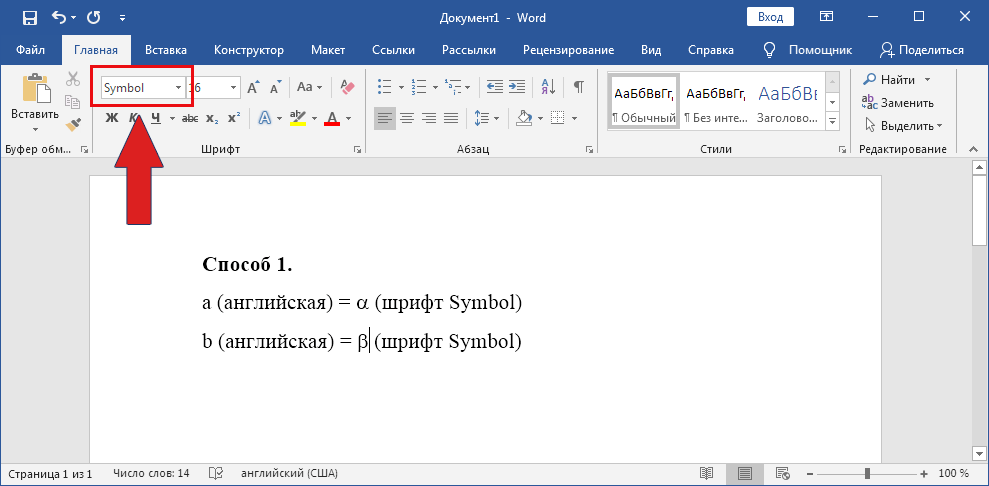
Переведите раскладку клавиатуры на английский язык. Напечатайте букву «a» или «b». Выделите её и установите шрифт «Symbol». Буква «a» автоматически преобразуется в альфа, а «b» — в бета.

-
Другой вариант — использовать коды знаков. Напишите последовательность цифр «03B1» или «03B2». Нажмите одновременно Alt и X на английской раскладке клавиатуры.
0 3 B 1 ➟ Alt + X = α
0 3 B 2 ➟ Alt + X = β -
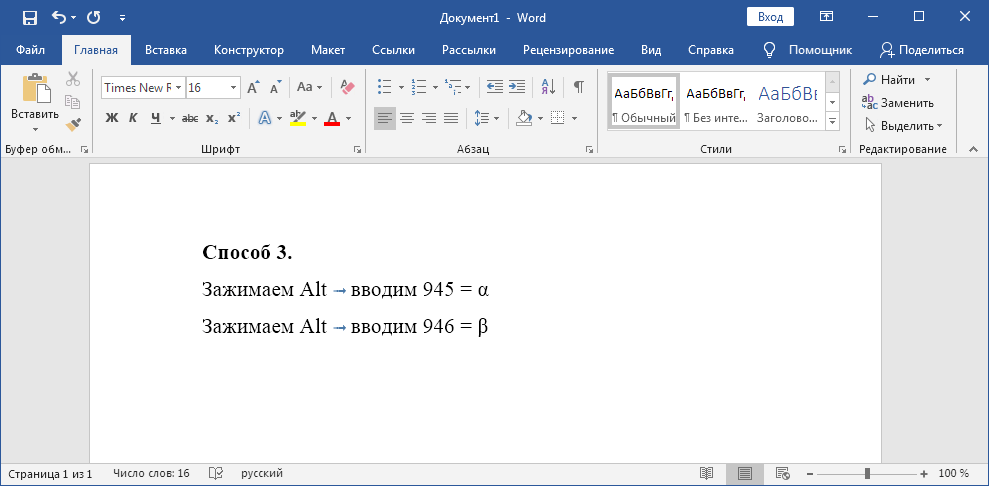
Для обладателей полноценных клавиатур с цифровым блоком клавиш справа, могу порекомендовать запомнить более короткие коды — «945» или «946». Зажимаем Alt и вводим цифрами справа нужный код. Отпускаем Alt и цифры автоматически преобразуются в нужный символ.
Alt + 9 4 5 = α
Alt + 9 4 6 = β

Заглавные буквы выглядят как «A» и «B», поэтому их написание не рассматривается.
В Word есть возможность вставить любую букву только мышью через пункт «Вставка». Но такой подход отнимает больше времени. При частом использовании специальных символов, рекомендую держать под рукой таблицу с их кодами.
Alpha [1] (uppercase Α, lowercase α; Ancient Greek: ἄλφα, álpha, or Greek: άλφα, romanized: álfa) is the first letter of the Greek alphabet. In the system of Greek numerals, it has a value of one. Alpha is derived from the Phoenician letter aleph , which is the West Semitic word for «ox».[2] Letters that arose from alpha include the Latin letter A and the Cyrillic letter А.
Uses
Greek
In Ancient Greek, alpha was pronounced [a] and could be either phonemically long ([aː]) or short ([a]). Where there is ambiguity, long and short alpha are sometimes written with a macron and breve today: Ᾱᾱ, Ᾰᾰ.
- ὥρα = ὥρᾱ hōrā Greek pronunciation: [hɔ́ːraː] «a time»
- γλῶσσα = γλῶσσᾰ glôssa Greek pronunciation: [ɡlɔ̂ːssa] «tongue»
In Modern Greek, vowel length has been lost, and all instances of alpha simply represent the open front unrounded vowel IPA: [a].
In the polytonic orthography of Greek, alpha, like other vowel letters, can occur with several diacritic marks: any of three accent symbols (ά, ὰ, ᾶ), and either of two breathing marks (ἁ, ἀ), as well as combinations of these. It can also combine with the iota subscript (ᾳ).
Greek grammar
In the Attic–Ionic dialect of Ancient Greek, long alpha [aː] fronted to [ɛː] (eta). In Ionic, the shift took place in all positions. In Attic, the shift did not take place after epsilon, iota, and rho (ε, ι, ρ; e, i, r). In Doric and Aeolic, long alpha is preserved in all positions.[3]
- Doric, Aeolic, Attic χώρᾱ chṓrā – Ionic χώρη chṓrē, «country»
- Doric, Aeolic φᾱ́μᾱ phā́mā – Attic, Ionic φήμη phḗmē, «report»
Privative a is the Ancient Greek prefix ἀ- or ἀν- a-, an-, added to words to negate them. It originates from the Proto-Indo-European *n̥- (syllabic nasal) and is cognate with English un-.
Copulative a is the Greek prefix ἁ- or ἀ- ha-, a-. It comes from Proto-Indo-European *sm̥.
Mathematics and science
The letter alpha represents various concepts in physics and chemistry, including alpha radiation, angular acceleration, alpha particles, alpha carbon and strength of electromagnetic interaction (as fine-structure constant). Alpha also stands for thermal expansion coefficient of a compound in physical chemistry. It is also commonly used in mathematics in algebraic solutions representing quantities such as angles. Furthermore, in mathematics, the letter alpha is used to denote the area underneath a normal curve in statistics to denote significance level[4] when proving null and alternative hypotheses. In ethology, it is used to name the dominant individual in a group of animals. In aerodynamics, the letter is used as a symbol for the angle of attack of an aircraft and the word «alpha» is used as a synonym for this property. In mathematical logic, α is sometimes used as a placeholder for ordinal numbers.
The proportionality operator «∝» (in Unicode: U+221D) is sometimes mistaken for alpha.
The uppercase letter alpha is not generally used as a symbol because it tends to be rendered identically to the uppercase Latin A.
International Phonetic Alphabet
In the International Phonetic Alphabet, the letter ɑ, which looks similar to the lower-case alpha, represents the open back unrounded vowel.
History and symbolism
Origin
The Phoenician alphabet was adopted for Greek in the early 8th century BC, perhaps in Euboea.[5]
The majority of the letters of the Phoenician alphabet were adopted into Greek with much the same sounds as they had had in Phoenician, but ʼāleph, the Phoenician letter representing the glottal stop [ʔ],
was adopted as representing the vowel [a]; similarly, hē [h] and ʽayin [ʕ] are Phoenician consonants that became Greek vowels, epsilon [e] and omicron [o], respectively.
Plutarch
Plutarch, in Moralia,[6] presents a discussion on why the letter alpha stands first in the alphabet. Ammonius asks Plutarch what he, being a Boeotian, has to say for Cadmus, the Phoenician who reputedly settled in Thebes and introduced the alphabet to Greece, placing alpha first because it is the Phoenician name for ox—which, unlike Hesiod,[7] the Phoenicians considered not the second or third, but the first of all necessities. «Nothing at all,» Plutarch replied. He then added that he would rather be assisted by Lamprias, his own grandfather, than by Dionysus’ grandfather, i.e. Cadmus. For Lamprias had said that the first articulate sound made is «alpha», because it is very plain and simple—the air coming off the mouth does not require any motion of the tongue—and therefore this is the first sound that children make.
According to Plutarch’s natural order of attribution of the vowels to the planets, alpha was connected with the Moon.
Alpha and Omega
As the first letter of the alphabet, Alpha as a Greek numeral came to represent the number 1.
Therefore, Alpha, both as a symbol and term, is used to refer to the «first», or «primary», or «principal» (most significant) occurrence or status of a thing.
The New Testament has God declaring himself to be the «Alpha and Omega, the beginning and the end, the first and the last.» (Revelation 22:13, KJV, and see also 1:8).[non-primary source needed]
Consequently, the term «alpha» has also come to be used to denote «primary» position in social hierarchy, examples being «alpha males» or pack leaders.
Computer encodings
- Greek alpha / Coptic alfa[8]
Character information
| Preview | Α | α | Ⲁ | ⲁ | ||||
|---|---|---|---|---|---|---|---|---|
| Unicode name | GREEK CAPITAL LETTER ALPHA | GREEK SMALL LETTER ALPHA | COPTIC CAPITAL LETTER ALFA | COPTIC SMALL LETTER ALFA | ||||
| Encodings | decimal | hex | dec | hex | dec | hex | dec | hex |
| Unicode | 913 | U+0391 | 945 | U+03B1 | 11392 | U+2C80 | 11393 | U+2C81 |
| UTF-8 | 206 145 | CE 91 | 206 177 | CE B1 | 226 178 128 | E2 B2 80 | 226 178 129 | E2 B2 81 |
| Numeric character reference | Α | Α | α | α | Ⲁ | Ⲁ | ⲁ | ⲁ |
| Named character reference | Α | α | ||||||
| CP 437 | 224 | E0 | ||||||
| DOS Greek | 128 | 80 | 152 | 98 | ||||
| DOS Greek-2 | 164 | A4 | 214 | D6 | ||||
| Windows 1253 | 193 | C1 | 225 | E1 | ||||
| TeX | alpha |
For accented Greek characters, see Greek diacritics: Computer encoding.
- Latin / IPA alpha
Character information
| Preview | Ɑ | ɑ | ɒ | ᶐ | ᵅ | ᶛ | ||||||
|---|---|---|---|---|---|---|---|---|---|---|---|---|
| Unicode name | LATIN CAPITAL LETTER ALPHA | LATIN SMALL LETTER ALPHA | LATIN SMALL LETTER TURNED ALPHA | LATIN SMALL LETTER ALPHA WITH RETROFLEX HOOK |
MODIFIER LETTER SMALL ALPHA |
MODIFIER LETTER SMALL TURNED ALPHA |
||||||
| Encodings | decimal | hex | dec | hex | dec | hex | dec | hex | dec | hex | dec | hex |
| Unicode | 11373 | U+2C6D | 593 | U+0251 | 594 | U+0252 | 7568 | U+1D90 | 7493 | U+1D45 | 7579 | U+1D9B |
| UTF-8 | 226 177 173 | E2 B1 AD | 201 145 | C9 91 | 201 146 | C9 92 | 225 182 144 | E1 B6 90 | 225 181 133 | E1 B5 85 | 225 182 155 | E1 B6 9B |
| Numeric character reference | Ɑ | Ɑ | ɑ | ɑ | ɒ | ɒ | ᶐ | ᶐ | ᵅ | ᵅ | ᶛ | ᶛ |
- Mathematical / Technical alpha
Character information
| Preview | ⍺ | ⍶ | 𝚨 | 𝛂 | 𝛢 | 𝛼 | ||||||
|---|---|---|---|---|---|---|---|---|---|---|---|---|
| Unicode name | APL FUNCTIONAL SYMBOL ALPHA | APL FUNCTIONAL SYMBOL ALPHA UNDERBAR |
MATHEMATICAL BOLD CAPITAL ALPHA |
MATHEMATICAL BOLD SMALL ALPHA |
MATHEMATICAL ITALIC CAPITAL ALPHA |
MATHEMATICAL ITALIC SMALL ALPHA |
||||||
| Encodings | decimal | hex | dec | hex | dec | hex | dec | hex | dec | hex | dec | hex |
| Unicode | 9082 | U+237A | 9078 | U+2376 | 120488 | U+1D6A8 | 120514 | U+1D6C2 | 120546 | U+1D6E2 | 120572 | U+1D6FC |
| UTF-8 | 226 141 186 | E2 8D BA | 226 141 182 | E2 8D B6 | 240 157 154 168 | F0 9D 9A A8 | 240 157 155 130 | F0 9D 9B 82 | 240 157 155 162 | F0 9D 9B A2 | 240 157 155 188 | F0 9D 9B BC |
| UTF-16 | 9082 | 237A | 9078 | 2376 | 55349 57000 | D835 DEA8 | 55349 57026 | D835 DEC2 | 55349 57058 | D835 DEE2 | 55349 57084 | D835 DEFC |
| Numeric character reference | ⍺ | ⍺ | ⍶ | ⍶ | 𝚨 | 𝚨 | 𝛂 | 𝛂 | 𝛢 | 𝛢 | 𝛼 | 𝛼 |
Character information
| Preview | 𝜜 | 𝜶 | 𝝖 | 𝝰 | 𝞐 | 𝞪 | ||||||
|---|---|---|---|---|---|---|---|---|---|---|---|---|
| Unicode name | MATHEMATICAL BOLD ITALIC CAPITAL ALPHA |
MATHEMATICAL BOLD ITALIC SMALL ALPHA |
MATHEMATICAL SANS-SERIF BOLD CAPITAL ALPHA |
MATHEMATICAL SANS-SERIF BOLD SMALL ALPHA |
MATHEMATICAL SANS-SERIF BOLD ITALIC CAPITAL ALPHA |
MATHEMATICAL SANS-SERIF BOLD ITALIC SMALL ALPHA |
||||||
| Encodings | decimal | hex | dec | hex | dec | hex | dec | hex | dec | hex | dec | hex |
| Unicode | 120604 | U+1D71C | 120630 | U+1D736 | 120662 | U+1D756 | 120688 | U+1D770 | 120720 | U+1D790 | 120746 | U+1D7AA |
| UTF-8 | 240 157 156 156 | F0 9D 9C 9C | 240 157 156 182 | F0 9D 9C B6 | 240 157 157 150 | F0 9D 9D 96 | 240 157 157 176 | F0 9D 9D B0 | 240 157 158 144 | F0 9D 9E 90 | 240 157 158 170 | F0 9D 9E AA |
| UTF-16 | 55349 57116 | D835 DF1C | 55349 57142 | D835 DF36 | 55349 57174 | D835 DF56 | 55349 57200 | D835 DF70 | 55349 57232 | D835 DF90 | 55349 57258 | D835 DFAA |
| Numeric character reference | 𝜜 | 𝜜 | 𝜶 | 𝜶 | 𝝖 | 𝝖 | 𝝰 | 𝝰 | 𝞐 | 𝞐 | 𝞪 | 𝞪 |
References
Look up Α or α in Wiktionary, the free dictionary.
- ^ «alpha». Oxford English Dictionary (Online ed.). Oxford University Press. (Subscription or participating institution membership required.)
- ^ Brookes, I. (2004). Chamber Concise Dictionary. Allied Pub (p) Limited. p. 30. ISBN 978-81-86062-36-4. Archived from the original on 11 June 2022. Retrieved 15 November 2021.
- ^ Herbert Weir Smyth. Greek grammar for colleges. paragraph 30 Archived 20 February 2011 at the Wayback Machine and note Archived 13 March 2009 at the Wayback Machine.
- ^ «Chapter 5: Analysing the Data Part II : Inferential Statistics». Research Methods and Statistics PESS202 Lecture and Commentary Notes. Archived from the original on 22 August 2011.
- ^ The date of the earliest inscribed objects; A.W. Johnston, «The alphabet», in N. Stampolidis and V. Karageorghis, eds, Sea Routes from Sidon to Huelva: Interconnections in the Mediterranean 2003:263-76, summarizes the present scholarship on the dating.
- ^ Symposiacs, Book IX, questions II & III On-line text Archived 13 October 2008 at the Wayback Machine at Adelaide library
- ^ Hesiod, in Works and Days (see on Perseus Project Archived 17 January 2021 at the Wayback Machine), advises the early Greek farmers, «First of all, get a house, then a woman and third, an ox for the plough.»
- ^ «Character Encodings». Archived from the original on 1 August 2019. Retrieved 14 January 2013.
Alpha [1] (uppercase Α, lowercase α; Ancient Greek: ἄλφα, álpha, or Greek: άλφα, romanized: álfa) is the first letter of the Greek alphabet. In the system of Greek numerals, it has a value of one. Alpha is derived from the Phoenician letter aleph , which is the West Semitic word for «ox».[2] Letters that arose from alpha include the Latin letter A and the Cyrillic letter А.
Uses
Greek
In Ancient Greek, alpha was pronounced [a] and could be either phonemically long ([aː]) or short ([a]). Where there is ambiguity, long and short alpha are sometimes written with a macron and breve today: Ᾱᾱ, Ᾰᾰ.
- ὥρα = ὥρᾱ hōrā Greek pronunciation: [hɔ́ːraː] «a time»
- γλῶσσα = γλῶσσᾰ glôssa Greek pronunciation: [ɡlɔ̂ːssa] «tongue»
In Modern Greek, vowel length has been lost, and all instances of alpha simply represent the open front unrounded vowel IPA: [a].
In the polytonic orthography of Greek, alpha, like other vowel letters, can occur with several diacritic marks: any of three accent symbols (ά, ὰ, ᾶ), and either of two breathing marks (ἁ, ἀ), as well as combinations of these. It can also combine with the iota subscript (ᾳ).
Greek grammar
In the Attic–Ionic dialect of Ancient Greek, long alpha [aː] fronted to [ɛː] (eta). In Ionic, the shift took place in all positions. In Attic, the shift did not take place after epsilon, iota, and rho (ε, ι, ρ; e, i, r). In Doric and Aeolic, long alpha is preserved in all positions.[3]
- Doric, Aeolic, Attic χώρᾱ chṓrā – Ionic χώρη chṓrē, «country»
- Doric, Aeolic φᾱ́μᾱ phā́mā – Attic, Ionic φήμη phḗmē, «report»
Privative a is the Ancient Greek prefix ἀ- or ἀν- a-, an-, added to words to negate them. It originates from the Proto-Indo-European *n̥- (syllabic nasal) and is cognate with English un-.
Copulative a is the Greek prefix ἁ- or ἀ- ha-, a-. It comes from Proto-Indo-European *sm̥.
Mathematics and science
The letter alpha represents various concepts in physics and chemistry, including alpha radiation, angular acceleration, alpha particles, alpha carbon and strength of electromagnetic interaction (as fine-structure constant). Alpha also stands for thermal expansion coefficient of a compound in physical chemistry. It is also commonly used in mathematics in algebraic solutions representing quantities such as angles. Furthermore, in mathematics, the letter alpha is used to denote the area underneath a normal curve in statistics to denote significance level[4] when proving null and alternative hypotheses. In ethology, it is used to name the dominant individual in a group of animals. In aerodynamics, the letter is used as a symbol for the angle of attack of an aircraft and the word «alpha» is used as a synonym for this property. In mathematical logic, α is sometimes used as a placeholder for ordinal numbers.
The proportionality operator «∝» (in Unicode: U+221D) is sometimes mistaken for alpha.
The uppercase letter alpha is not generally used as a symbol because it tends to be rendered identically to the uppercase Latin A.
International Phonetic Alphabet
In the International Phonetic Alphabet, the letter ɑ, which looks similar to the lower-case alpha, represents the open back unrounded vowel.
History and symbolism
Origin
The Phoenician alphabet was adopted for Greek in the early 8th century BC, perhaps in Euboea.[5]
The majority of the letters of the Phoenician alphabet were adopted into Greek with much the same sounds as they had had in Phoenician, but ʼāleph, the Phoenician letter representing the glottal stop [ʔ],
was adopted as representing the vowel [a]; similarly, hē [h] and ʽayin [ʕ] are Phoenician consonants that became Greek vowels, epsilon [e] and omicron [o], respectively.
Plutarch
Plutarch, in Moralia,[6] presents a discussion on why the letter alpha stands first in the alphabet. Ammonius asks Plutarch what he, being a Boeotian, has to say for Cadmus, the Phoenician who reputedly settled in Thebes and introduced the alphabet to Greece, placing alpha first because it is the Phoenician name for ox—which, unlike Hesiod,[7] the Phoenicians considered not the second or third, but the first of all necessities. «Nothing at all,» Plutarch replied. He then added that he would rather be assisted by Lamprias, his own grandfather, than by Dionysus’ grandfather, i.e. Cadmus. For Lamprias had said that the first articulate sound made is «alpha», because it is very plain and simple—the air coming off the mouth does not require any motion of the tongue—and therefore this is the first sound that children make.
According to Plutarch’s natural order of attribution of the vowels to the planets, alpha was connected with the Moon.
Alpha and Omega
As the first letter of the alphabet, Alpha as a Greek numeral came to represent the number 1.
Therefore, Alpha, both as a symbol and term, is used to refer to the «first», or «primary», or «principal» (most significant) occurrence or status of a thing.
The New Testament has God declaring himself to be the «Alpha and Omega, the beginning and the end, the first and the last.» (Revelation 22:13, KJV, and see also 1:8).[non-primary source needed]
Consequently, the term «alpha» has also come to be used to denote «primary» position in social hierarchy, examples being «alpha males» or pack leaders.
Computer encodings
- Greek alpha / Coptic alfa[8]
Character information
| Preview | Α | α | Ⲁ | ⲁ | ||||
|---|---|---|---|---|---|---|---|---|
| Unicode name | GREEK CAPITAL LETTER ALPHA | GREEK SMALL LETTER ALPHA | COPTIC CAPITAL LETTER ALFA | COPTIC SMALL LETTER ALFA | ||||
| Encodings | decimal | hex | dec | hex | dec | hex | dec | hex |
| Unicode | 913 | U+0391 | 945 | U+03B1 | 11392 | U+2C80 | 11393 | U+2C81 |
| UTF-8 | 206 145 | CE 91 | 206 177 | CE B1 | 226 178 128 | E2 B2 80 | 226 178 129 | E2 B2 81 |
| Numeric character reference | Α | Α | α | α | Ⲁ | Ⲁ | ⲁ | ⲁ |
| Named character reference | Α | α | ||||||
| CP 437 | 224 | E0 | ||||||
| DOS Greek | 128 | 80 | 152 | 98 | ||||
| DOS Greek-2 | 164 | A4 | 214 | D6 | ||||
| Windows 1253 | 193 | C1 | 225 | E1 | ||||
| TeX | alpha |
For accented Greek characters, see Greek diacritics: Computer encoding.
- Latin / IPA alpha
Character information
| Preview | Ɑ | ɑ | ɒ | ᶐ | ᵅ | ᶛ | ||||||
|---|---|---|---|---|---|---|---|---|---|---|---|---|
| Unicode name | LATIN CAPITAL LETTER ALPHA | LATIN SMALL LETTER ALPHA | LATIN SMALL LETTER TURNED ALPHA | LATIN SMALL LETTER ALPHA WITH RETROFLEX HOOK |
MODIFIER LETTER SMALL ALPHA |
MODIFIER LETTER SMALL TURNED ALPHA |
||||||
| Encodings | decimal | hex | dec | hex | dec | hex | dec | hex | dec | hex | dec | hex |
| Unicode | 11373 | U+2C6D | 593 | U+0251 | 594 | U+0252 | 7568 | U+1D90 | 7493 | U+1D45 | 7579 | U+1D9B |
| UTF-8 | 226 177 173 | E2 B1 AD | 201 145 | C9 91 | 201 146 | C9 92 | 225 182 144 | E1 B6 90 | 225 181 133 | E1 B5 85 | 225 182 155 | E1 B6 9B |
| Numeric character reference | Ɑ | Ɑ | ɑ | ɑ | ɒ | ɒ | ᶐ | ᶐ | ᵅ | ᵅ | ᶛ | ᶛ |
- Mathematical / Technical alpha
Character information
| Preview | ⍺ | ⍶ | 𝚨 | 𝛂 | 𝛢 | 𝛼 | ||||||
|---|---|---|---|---|---|---|---|---|---|---|---|---|
| Unicode name | APL FUNCTIONAL SYMBOL ALPHA | APL FUNCTIONAL SYMBOL ALPHA UNDERBAR |
MATHEMATICAL BOLD CAPITAL ALPHA |
MATHEMATICAL BOLD SMALL ALPHA |
MATHEMATICAL ITALIC CAPITAL ALPHA |
MATHEMATICAL ITALIC SMALL ALPHA |
||||||
| Encodings | decimal | hex | dec | hex | dec | hex | dec | hex | dec | hex | dec | hex |
| Unicode | 9082 | U+237A | 9078 | U+2376 | 120488 | U+1D6A8 | 120514 | U+1D6C2 | 120546 | U+1D6E2 | 120572 | U+1D6FC |
| UTF-8 | 226 141 186 | E2 8D BA | 226 141 182 | E2 8D B6 | 240 157 154 168 | F0 9D 9A A8 | 240 157 155 130 | F0 9D 9B 82 | 240 157 155 162 | F0 9D 9B A2 | 240 157 155 188 | F0 9D 9B BC |
| UTF-16 | 9082 | 237A | 9078 | 2376 | 55349 57000 | D835 DEA8 | 55349 57026 | D835 DEC2 | 55349 57058 | D835 DEE2 | 55349 57084 | D835 DEFC |
| Numeric character reference | ⍺ | ⍺ | ⍶ | ⍶ | 𝚨 | 𝚨 | 𝛂 | 𝛂 | 𝛢 | 𝛢 | 𝛼 | 𝛼 |
Character information
| Preview | 𝜜 | 𝜶 | 𝝖 | 𝝰 | 𝞐 | 𝞪 | ||||||
|---|---|---|---|---|---|---|---|---|---|---|---|---|
| Unicode name | MATHEMATICAL BOLD ITALIC CAPITAL ALPHA |
MATHEMATICAL BOLD ITALIC SMALL ALPHA |
MATHEMATICAL SANS-SERIF BOLD CAPITAL ALPHA |
MATHEMATICAL SANS-SERIF BOLD SMALL ALPHA |
MATHEMATICAL SANS-SERIF BOLD ITALIC CAPITAL ALPHA |
MATHEMATICAL SANS-SERIF BOLD ITALIC SMALL ALPHA |
||||||
| Encodings | decimal | hex | dec | hex | dec | hex | dec | hex | dec | hex | dec | hex |
| Unicode | 120604 | U+1D71C | 120630 | U+1D736 | 120662 | U+1D756 | 120688 | U+1D770 | 120720 | U+1D790 | 120746 | U+1D7AA |
| UTF-8 | 240 157 156 156 | F0 9D 9C 9C | 240 157 156 182 | F0 9D 9C B6 | 240 157 157 150 | F0 9D 9D 96 | 240 157 157 176 | F0 9D 9D B0 | 240 157 158 144 | F0 9D 9E 90 | 240 157 158 170 | F0 9D 9E AA |
| UTF-16 | 55349 57116 | D835 DF1C | 55349 57142 | D835 DF36 | 55349 57174 | D835 DF56 | 55349 57200 | D835 DF70 | 55349 57232 | D835 DF90 | 55349 57258 | D835 DFAA |
| Numeric character reference | 𝜜 | 𝜜 | 𝜶 | 𝜶 | 𝝖 | 𝝖 | 𝝰 | 𝝰 | 𝞐 | 𝞐 | 𝞪 | 𝞪 |
References
Look up Α or α in Wiktionary, the free dictionary.
- ^ «alpha». Oxford English Dictionary (Online ed.). Oxford University Press. (Subscription or participating institution membership required.)
- ^ Brookes, I. (2004). Chamber Concise Dictionary. Allied Pub (p) Limited. p. 30. ISBN 978-81-86062-36-4. Archived from the original on 11 June 2022. Retrieved 15 November 2021.
- ^ Herbert Weir Smyth. Greek grammar for colleges. paragraph 30 Archived 20 February 2011 at the Wayback Machine and note Archived 13 March 2009 at the Wayback Machine.
- ^ «Chapter 5: Analysing the Data Part II : Inferential Statistics». Research Methods and Statistics PESS202 Lecture and Commentary Notes. Archived from the original on 22 August 2011.
- ^ The date of the earliest inscribed objects; A.W. Johnston, «The alphabet», in N. Stampolidis and V. Karageorghis, eds, Sea Routes from Sidon to Huelva: Interconnections in the Mediterranean 2003:263-76, summarizes the present scholarship on the dating.
- ^ Symposiacs, Book IX, questions II & III On-line text Archived 13 October 2008 at the Wayback Machine at Adelaide library
- ^ Hesiod, in Works and Days (see on Perseus Project Archived 17 January 2021 at the Wayback Machine), advises the early Greek farmers, «First of all, get a house, then a woman and third, an ox for the plough.»
- ^ «Character Encodings». Archived from the original on 1 August 2019. Retrieved 14 January 2013.
1. найди что-нибудь интересное >>> 2. нажми/кликни на какую-нибудь картинку >>> 3. сыграй в пазл ………………..1. найди что-нибудь интересное >>> 2. нажми/кликни на какую-нибудь картинку >>> 3. сыграй в пазл
………………..
буква греческого алфавита … ной записи чисел имеет числовое значение 1. Происходит от финикийской буквы 𐤀 — алеф, которая в переводе оз…
Буквы со сходным начертанием: A (b) · А (b)
| Буква греческого алфавита альфа | ||||||||||||||||||||||
|---|---|---|---|---|---|---|---|---|---|---|---|---|---|---|---|---|---|---|---|---|---|---|
| Αα | ||||||||||||||||||||||
|
Изображение
|
||||||||||||||||||||||
|
||||||||||||||||||||||
| Характеристики | ||||||||||||||||||||||
| Название | Α: greek capital letter alpha α: greek small letter alpha |
|||||||||||||||||||||
| Юникод | Α: U+0391 α: U+03B1 |
|||||||||||||||||||||
| HTML-код | Α: Α или Αα: α или α |
|||||||||||||||||||||
| UTF-16 | Α: 0x391 α: 0x3B1 |
|||||||||||||||||||||
| URL-код | Α: %CE%91 α: %CE%B1 |
|||||||||||||||||||||
| Мнемоника | Α: Αα: α |

Α, α (название: альфа, греч. (b) άλφα, др.-греч. (b) ἄλφα) — первая буква греческого алфавита (b) . В системе греческой алфавитной записи чисел (b) имеет числовое значение 1. Происходит от финикийской (b) буквы 𐤀 — алеф (b) , которая в переводе означает «бык» и своим начертанием изображает голову быка. От буквы альфа произошли латинская буква A (b) и кириллическая А (b) .
Использование
В греческом языке альфа передаёт звук [a (b) ].
Прописная буква альфа не используется как символ, потому что она пишется так же, как и заглавная латинская буква A (b) .
Строчная буква α используется как символ для обозначения:
- Плоских углов (b) (вместе с другими греческими буквами);
- Углового ускорения (b) и коэффициента теплоотдачи в физике;
- Альфа-частицы (b) , альфа-излучения (b) и альфа-распада (b) в физике, а также для обозначения постоянной тонкой структуры (b) ;
- Коэффициента поглощения (b) в физике;
- Альфа-ритма (b) , одного из ритмов, регистрируемых с помощью электроэнцефалограммы (b) .
- В астрономии:
- Ярчайшей звезды (b) созвездия (b) (например, Альфа Центавра (b) );
- Прямого восхождения (b) , RA — одной из небесных координат (b) ;
- В лямбда-исчислении (b) — α-конверсия;
- Коволюм (b) пороховых газов во внутренней баллистике (b) ;
- Бесконечно малая функция/последовательность в математическом анализе.
Омоглифы
Геометрически строчная буква «α» является взаимно перпендикулярным омоглифом (b) буквы «Ра», сороковой буквы алфавита каннада (b)  →
→  .
.
Литература
- Альфа, буква // Энциклопедический словарь Брокгауза и Ефрона (b) : в 86 т. (82 т. и 4 доп.). — СПб., 1890. — Т. Ia. — С. 586.
Ссылки
- Α на сайте Scriptsource.org (англ.)
- α на сайте Scriptsource.org (англ.)
|
|---|
Эта статья опубликована с веб-сайта Wikipedia. Исходная статья может быть немного сокращена или изменена. Некоторые ссылки могли быть изменены. Текст находится под лицензией «Creative Commons — Attribution — Sharealike» [1], а часть текста также может быть лицензирована в соответствии с условиями «Лицензии свободной документации GNU» [2]. К медиафайлам могут применяться дополнительные условия. Используя этот сайт, вы соглашаетесь с нашими юридическими страницами[3] [4] [5] [6] [7]. Веб-ссылки: [1] [2]